Introduction
TL;DR Every business hits a growth ceiling at some point. Revenue flatlines. Customer acquisition slows. The market you built your brand around starts feeling small. That is the exact moment when a solid market expansion strategy becomes your most valuable asset.
A market expansion strategy is a plan that helps businesses grow beyond their current boundaries. It could mean entering a new geography, targeting a new customer segment, or launching a product in an adjacent category. The idea is simple. The execution requires data, precision, and the right tools.
Most companies fail at expansion because they rely on gut feeling. They assume a market will respond the way their home market did. That assumption costs money, time, and sometimes the entire business. Data-driven growth flips this approach. It replaces assumptions with evidence. It replaces guessing with clarity.
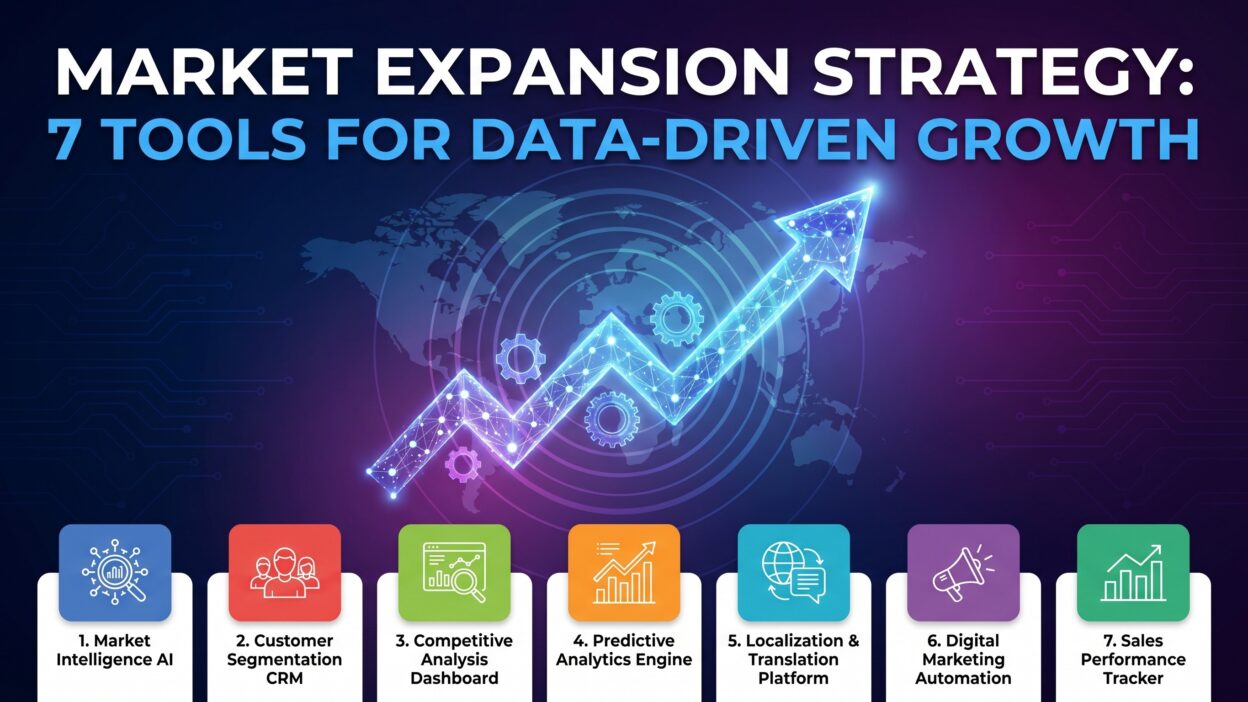
This blog covers seven powerful tools that bring structure and intelligence to your market expansion strategy. Each tool addresses a different gap in the expansion process. Use them together and you build a foundation that turns market entry from a gamble into a calculated move.
Table of Contents
What Is a Market Expansion Strategy and Why Does It Matter?
Defining Market Expansion Strategy
A market expansion strategy is a deliberate plan to grow your business into new markets. These markets can be geographic, demographic, or product-based. The strategy defines where you want to go, who you want to reach, and how you plan to get there.
Businesses pursue expansion for many reasons. Some want to reduce dependence on one market. Others see untapped demand elsewhere. Some face saturation at home and need fresh revenue streams. Regardless of the reason, the strategy must align with your resources, capabilities, and long-term vision.
There are four core types of market expansion strategies. The first is market penetration, which means selling more to your existing customer base. The second is market development, which involves entering new geographies or customer segments with existing products. The third is product development, which means creating new offerings for your current market. The fourth is diversification, which combines new products with new markets.
Each type carries different levels of risk and reward. A well-planned market expansion strategy accounts for these variables before committing resources.
Why Data Makes the Difference
The gap between successful and failed expansions often comes down to how much data informed the decision. Companies that enter new markets with strong data outperform those that do not. They understand demand before they invest. They know competitor positioning before they price. They measure customer behavior before they scale.
Data does not eliminate risk. It reduces it. A market expansion strategy built on clean, current, and relevant data gives decision-makers real confidence. It allows you to test before you invest heavily. It allows you to course-correct without losing everything.
Secondary keywords that matter here include international market expansion, business growth strategy, new market entry, market development strategy, and market penetration tools. These terms reflect the actual search intent of business leaders looking to grow beyond their current walls.
The 7 Best Tools for a Data-Driven Market Expansion Strategy
Tool 1: Google Market Finder — Identify Where Demand Exists
Google Market Finder is a free tool that helps businesses explore new geographic markets. It pulls data from Google Search trends to show where people actively look for your products or services.
You enter your website URL and the tool analyzes your content. It then recommends markets based on monthly search volume, competition levels, and market potential. You get a ranked list of countries or regions sorted by opportunity.
This is a strong starting point for any market expansion strategy. You get a clear picture of where demand already exists before spending a cent. The tool also shows estimated cost-per-click for paid advertising in each market. This helps with initial budget planning.
The limitation of Google Market Finder is depth. It gives you directional data, not definitive research. Use it to build your initial shortlist of target markets. Then validate those markets with deeper tools.
Best for: Geographic market prioritization, international market expansion, initial demand mapping.
Tool 2: Statista — Validate Market Size and Industry Trends
Statista is one of the most comprehensive data platforms for market research. It aggregates statistics from thousands of sources across industries and geographies. For a market expansion strategy, it provides the quantitative foundation you need.
You can access data on market size, consumer behavior, industry revenue, and competitive landscape. Statista covers over 170 industries and 150 countries. This breadth makes it particularly useful when evaluating multiple markets at the same time.
When building your market expansion strategy, use Statista to answer three questions. First, how large is the target market in terms of revenue? Second, what is the projected growth rate over the next three to five years? Third, what consumer behaviors or trends are shaping that market?
These answers tell you whether a market is worth entering and when the right time to enter might be. Entering a market at the start of growth is very different from entering one that is already declining.
Statista offers both free and premium data. The premium tier gives access to full reports, downloadable datasets, and forecasts. For serious expansion planning, the premium version is worth the investment.
Best for: Market size validation, trend analysis, cross-industry benchmarking.
Tool 3: SEMrush Market Explorer — Understand Competitive Positioning
Competitive intelligence is a critical part of any market expansion strategy. Before you enter a market, you need to know who already owns it and how they got there. SEMrush Market Explorer gives you that visibility.
The tool maps the competitive landscape in any market you choose. It shows who the dominant players are, what share of traffic they control, and how audiences overlap. You can analyze competitors’ content strategies, keyword rankings, and backlink profiles.
For expansion purposes, this data is gold. It tells you whether you are entering a crowded market or a fragmented one. Crowded markets require a differentiated positioning. Fragmented markets offer the chance to become a category leader faster.
SEMrush also shows traffic trends over time. This helps you spot markets where competitors are losing ground. Those gaps represent opportunities. A market where existing players are declining is often more attractive than one where they are growing stronger.
The tool also compares audience demographics and interests across markets. If your target audience in Market A and Market B look very different, your messaging needs to change. SEMrush helps you see this before you commit to a strategy that misses the mark.
Best for: Competitive analysis, market positioning, audience comparison.
Tool 4: Tableau — Visualize Complex Market Data
Data without visualization is just noise. Tableau turns raw data into clear, interactive dashboards that support faster and smarter decision-making. For companies running a complex market expansion strategy across multiple regions, Tableau is essential.
You can connect Tableau to dozens of data sources including CRM systems, spreadsheets, databases, and third-party APIs. Once connected, you build dashboards that give a real-time view of market performance. You track KPIs, spot anomalies, and identify trends at a glance.
The power of Tableau in expansion planning is its ability to handle large datasets cleanly. You might be comparing ten potential markets across twenty variables. In a spreadsheet, this becomes unmanageable. In Tableau, it becomes a single visual that your entire leadership team can interpret in minutes.
Tableau also supports collaboration. Teams across marketing, sales, and finance can access the same dashboards. This breaks down silos and ensures every function bases its decisions on the same data. That alignment is critical during a market expansion where each team has different responsibilities.
Best for: Multi-market data visualization, executive reporting, cross-functional alignment.
Tool 5: SurveyMonkey — Test Demand Before You Enter
Research tools show you what the data says. SurveyMonkey lets you hear directly from real people. For a market expansion strategy, this distinction matters. Quantitative data tells you a market exists. Qualitative data tells you whether your specific product will succeed in it.
SurveyMonkey allows you to design targeted surveys and distribute them to specific audiences. You can reach people in your target market and ask them directly about their needs, preferences, and purchasing behavior. The platform has a global panel of respondents, which makes it especially useful for international market expansion.
Ask the right questions in your surveys. Find out whether the problem your product solves is actually a problem in this new market. Find out how much people are willing to pay. Find out which competitors they currently use and what they wish was different. These insights shape your go-to-market strategy before you invest in it.
SurveyMonkey also allows A/B testing of messaging. You can present two different value propositions to two different audience groups and measure which resonates more. This removes guesswork from your positioning decisions.
Best for: Primary market research, demand validation, messaging testing.
Tool 6: HubSpot CRM — Track and Optimize Your Expansion Pipeline
Executing a market expansion strategy requires organizing hundreds of moving parts. Leads need nurturing. Sales teams need visibility. Marketing campaigns need tracking. HubSpot CRM gives you a central command center for all of this.
HubSpot lets you segment contacts by geography, industry, or any custom property. This means your team can run different outreach sequences for different markets simultaneously. Each market gets the right message at the right time without manual management.
The reporting features in HubSpot show you exactly where deals are in the pipeline and how conversion rates differ by market. If one market converts at twice the rate of another, that is a signal to shift resources. If a market generates lots of leads but few closes, something in the messaging or offer needs adjusting.
For companies scaling into multiple markets, HubSpot also integrates with marketing tools, customer support platforms, and data analytics systems. This integration means your expansion data lives in one place. You do not have to chase information across five different platforms.
Best for: Sales pipeline management, market-specific outreach, expansion performance tracking.
Tool 7: Similarweb — Benchmark Digital Performance Across Markets
Similarweb provides digital intelligence on websites, apps, and entire industries. For market expansion planning, it shows you the digital landscape of any market you want to enter. You can benchmark your digital performance against local competitors before you arrive.
The tool shows website traffic by country, traffic sources, audience interests, and engagement metrics. If you are entering a new country and you want to know how people in that country discover businesses like yours, Similarweb gives you the answer.
You can also analyze your competitors’ digital strategies in the target market. See which channels drive the most traffic for them. See how long visitors stay on their site. See which keywords bring in their organic traffic. This competitive intelligence helps you build a smarter digital marketing plan for your expansion.
Similarweb also tracks industry trends over time. You can see whether digital interest in your category is growing or shrinking in a given market. This macro-level view complements the micro-level data from tools like SEMrush and Google Market Finder.
Best for: Digital benchmarking, channel strategy, competitor traffic analysis.
How to Build a Market Expansion Strategy Using These Tools
Define Your Expansion Goals
Start with clarity. What does success look like in this expansion? Define it in specific numbers. Revenue targets, customer acquisition goals, and market share percentages all work. Vague goals lead to vague plans.
Your market expansion strategy must align with your overall business goals. If your company targets $10M in new revenue this year, the expansion plan must contribute a defined portion of that. This alignment keeps expansion efforts focused and accountable.
Research and Shortlist Target Markets
Use Google Market Finder and Statista at this stage. Google Market Finder shows where demand exists. Statista validates whether that demand is large enough to justify the investment. Shortlist three to five markets for deeper evaluation.
Do not try to enter too many markets at once. A scattered approach dilutes resources and attention. Focus your market expansion strategy on one or two primary markets first. Prove the model. Then scale.
Analyze the Competition
Use SEMrush and Similarweb to map the competitive landscape in your shortlisted markets. Identify the dominant players and their weaknesses. Find gaps in the market where your offering can stand out. This analysis shapes your positioning and go-to-market approach.
Validate Demand Directly
Run surveys through SurveyMonkey before committing to full-scale entry. Talk to real people in the target market. Validate that your product solves a real problem there. Confirm your pricing assumptions. Test your messaging. This step can save you from entering a market that looks good on paper but does not match reality.
Build and Track Your Expansion Pipeline
Once you are ready to execute, deploy HubSpot CRM to manage your outreach and sales process. Set up dashboards in Tableau to monitor performance across every market simultaneously. Your market expansion strategy is only as good as your ability to measure and adjust it in real time.
Frequently Asked Questions About Market Expansion Strategy
What is the difference between market expansion and market penetration?
Market penetration focuses on growing your share within an existing market. You sell more to the customers you already have. Market expansion involves entering new markets entirely. These new markets can be geographic, demographic, or product-based. Both are growth strategies, but they target different opportunities.
How do I know if my business is ready for a market expansion strategy?
Your business is ready when it has stable revenue in its current market, a repeatable sales process, and a product or service that solves a clear problem. You should also have the financial reserves to fund an expansion without jeopardizing your core business. If your current market is saturated or slowing down, that urgency may also signal readiness.
What are the biggest risks in market expansion?
The most common risks include underestimating cultural differences, misjudging the competitive landscape, overestimating demand, and spreading resources too thin. A data-driven market expansion strategy reduces these risks by replacing assumptions with evidence. Conducting thorough research before entry and testing before scaling are both critical risk mitigation steps.
How long does it take to see results from a market expansion strategy?
Timelines vary by industry and market. Most businesses see initial traction within three to six months after entry. Meaningful revenue contribution often takes twelve to eighteen months. Patience is necessary. Markets take time to warm up to new entrants. Build your plan for the long term, not just the first quarter.
Can small businesses use a market expansion strategy?
Absolutely. Small businesses often execute market expansion strategies more nimbly than large corporations. They face fewer internal approval layers and can pivot faster. The key for small businesses is to start small, test thoroughly, and scale only what works. The seven tools covered in this blog include free and affordable options that fit small business budgets.
Read More:-7 Top Demand-Side Platforms (DSPs) and Programmatic Ad Tools
Conclusion

A market expansion strategy is not a luxury reserved for large enterprises. It is a necessary growth move for any business that wants to build lasting revenue and reduce market dependency. The difference between companies that expand successfully and those that stumble is not luck. It is preparation, data, and the right tools.
The seven tools covered in this blog each address a specific challenge in the expansion process. Google Market Finder helps you find where demand lives. Statista validates market size. SEMrush maps the competition. Tableau turns data into clarity. SurveyMonkey connects you with real customers. HubSpot CRM manages your growth pipeline. Similarweb benchmarks your digital presence against market leaders.
Used together, these tools give your market expansion strategy the intelligence it needs to work. They replace guesswork with guidance. They turn overwhelming complexity into manageable steps.
Start small. Pick one market. Research it deeply. Validate demand before you scale. Track every metric. Adjust based on what the data tells you.
The businesses that win at market expansion are the ones that respect both the opportunity and the risk. They prepare thoroughly, move decisively, and learn continuously. Your next market is waiting. Go after it with the right strategy and the right tools in hand.