Introduction
TL;DR B2B growth in 2026 does not reward the loudest brand. It rewards the most relevant one. Buyers have more options, less patience, and higher expectations than ever before. Generic outreach gets ignored. Broad campaigns waste budget. Cold approaches rarely open doors.
The brands that win are those who build an audience before they need one. They invest in audience development strategies that create a community of informed, engaged, and loyal professionals who already trust them when a buying decision arrives.
Audience development strategies go beyond follower counts and email list sizes. They focus on the quality of the relationship between a brand and its audience. A smaller, deeply engaged audience consistently outperforms a large, passive one in every B2B metric that matters — pipeline contribution, deal velocity, conversion rate, and customer lifetime value.
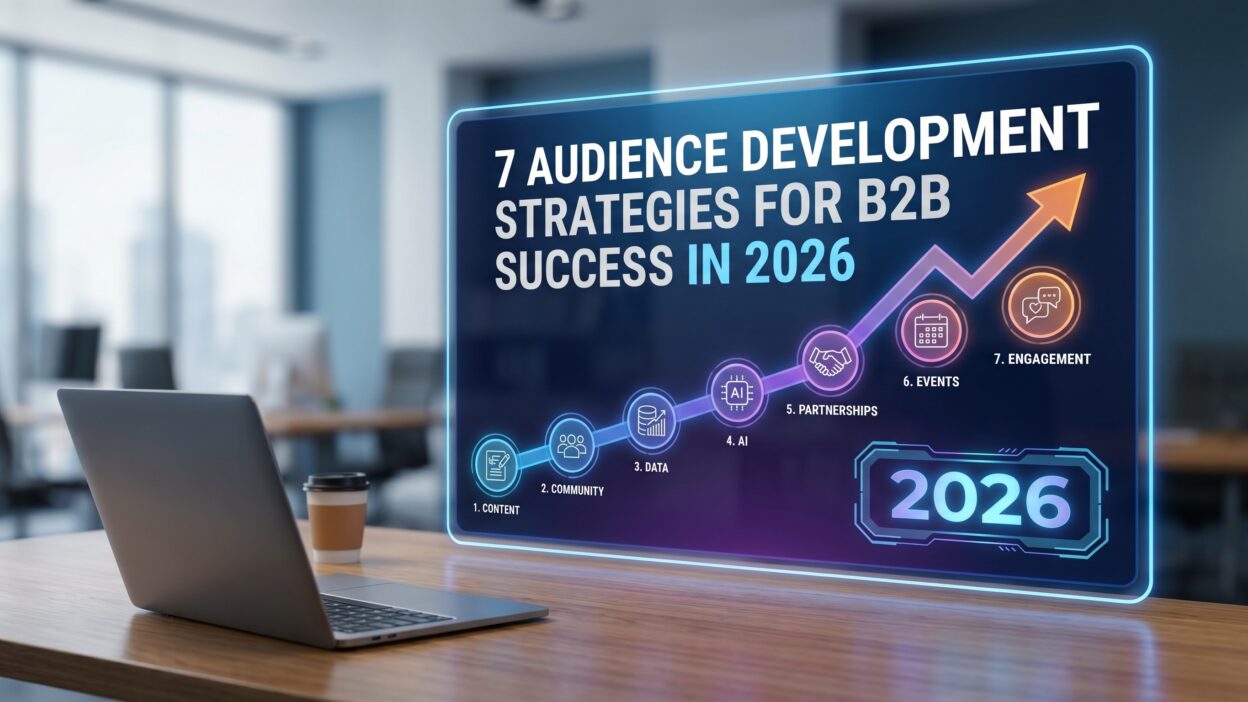
This blog covers seven proven audience development strategies built specifically for B2B success in 2026. Each strategy addresses a different dimension of audience growth. Together they form a complete system for building the kind of engaged professional audience that drives sustained revenue growth. Read carefully, apply deliberately, and build something your competitors cannot easily copy.
Table of Contents
Why Audience Development Strategies Matter More Than Ever in B2B
The Shift in B2B Buying Behavior
B2B buyers changed fundamentally over the past five years. The average B2B buying group now includes six to ten decision-makers. Each one conducts independent research before any vendor contact occurs. By the time a buyer speaks with a sales representative, they have already formed strong opinions based on content they found on their own.
This shift means brand awareness and trust building happen long before the sales conversation starts. Brands that invest in audience development strategies build that awareness and trust continuously. When a decision-maker finally enters a buying cycle, the familiar brand wins the first conversation almost automatically.
Brands without a clear audience development approach start every sales process from zero. They spend enormous resources generating awareness at the exact moment a buyer needs a fast answer. That is the most expensive time to build trust and the least effective.
What Makes B2B Audience Development Different
B2B audiences differ from consumer audiences in important ways. They are smaller and more specialized. They make decisions based on professional outcomes, not personal impulses. They require more education and evidence before committing to a purchase. They respond to peer influence and industry credibility above brand polish.
These differences shape how audience development strategies must work in a B2B context. Content needs depth, not just reach. Community needs professional relevance, not just social engagement. Trust signals need third-party validation, not just brand claims.
Effective audience development strategies for B2B recognize these differences and build accordingly. They treat buyers as intelligent professionals who deserve substantive value at every interaction. They prioritize relationship quality over audience quantity. They measure engagement depth, not just surface metrics.
Secondary keywords running throughout this blog include B2B audience growth, content marketing strategy, thought leadership, email marketing for B2B, LinkedIn audience building, community building strategy, demand generation, B2B lead nurturing, audience segmentation, and buyer persona development.
Strategy 1: Build a Thought Leadership Content Engine
Why Thought Leadership Anchors All Audience Development Strategies
Thought leadership sits at the foundation of every effective set of audience development strategies. B2B buyers trust brands that demonstrate genuine expertise. They subscribe to, share, and return to content that makes them better at their jobs. Thought leadership content delivers exactly that.
A content engine produces original research, expert analysis, practitioner guides, and perspective pieces that address the real challenges your target audience faces daily. This content does not describe your product. It demonstrates your team’s depth of understanding of the problems your audience navigates. The product connection is implicit. The expertise is explicit and immediately valuable.
Original research is particularly powerful in the B2B context. When your brand publishes a study with real data and genuine industry insights, it attracts backlinks, media coverage, social shares, and speaking invitations. Each of these outcomes expands your audience reach into new networks without additional direct investment.
Building the Content Engine Infrastructure
A content engine requires more than good writing. It needs an editorial calendar that maps content to the buyer journey. Awareness-stage content addresses industry challenges and trends. Consideration-stage content compares approaches and builds evaluation frameworks. Decision-stage content addresses specific objections and validates the choice.
Consistency matters enormously in thought leadership. A brand that publishes deeply valuable content weekly builds compounding audience trust over time. A brand that publishes sporadically never accumulates that trust regardless of the individual quality of each piece.
Distribution is as important as creation. The best content reaches nobody without deliberate distribution. Publish on your own channels first. Repurpose for LinkedIn articles, industry newsletters, and partner platforms. Pitch original research to industry publications. Share insights in relevant professional communities. Every distribution step extends your audience reach.
Building a thought leadership content engine is a foundational audience development strategy because it creates an asset that appreciates. Each article, research report, and guide adds to a library of expertise that attracts your ideal audience continuously long after publication.
Strategy 2: Develop a High-Value Email Newsletter
Email Remains the Highest-ROI B2B Channel
Social media platforms change their algorithms constantly. Organic reach fluctuates unpredictably. Paid media requires continuous budget. Email is the one channel where you own direct access to your audience. A well-built email newsletter is the most durable asset in any collection of audience development strategies.
The key distinction is between a marketing email and a genuine newsletter. Marketing emails promote products and announce company news. A high-value newsletter delivers curated insights, expert analysis, and useful frameworks that subscribers look forward to receiving. Subscribers open it because it makes them smarter, not because they expect a promotion.
B2B professionals receive dozens of emails daily. The newsletters that earn consistent opens deliver a predictable experience of value. Every issue addresses something relevant to the subscriber’s professional life. The brand behind the newsletter becomes associated with expertise and usefulness rather than sales messaging.
Building Your Newsletter Audience Deliberately
Growing a B2B newsletter audience requires a clear value proposition. A vague “sign up for updates” prompt attracts almost nobody. A specific promise — “every Tuesday, one data-backed insight for B2B revenue leaders” — attracts exactly the right professionals.
Promote your newsletter at every relevant touchpoint. Feature it prominently on your website. Reference it in your LinkedIn content. Offer exclusive newsletter content as a content upgrade on high-traffic blog posts. Ask podcast guests if they would share it with their audience.
Audience development strategies built around email newsletters succeed because they create a direct, uninterrupted relationship with your audience. No algorithm stands between your message and your subscriber’s inbox. That directness is increasingly rare and increasingly valuable in 2026.
Segmentation improves newsletter performance significantly. Segment subscribers by industry, role, company size, or content interest. Send content that reflects each segment’s specific context. A CFO at a manufacturing company has different priorities than a marketing director at a SaaS startup. Treating them the same way produces average results. Treating them differently produces exceptional ones.
Strategy 3: Build a Branded LinkedIn Presence That Attracts Buyers
LinkedIn Remains the Premier B2B Audience Platform
LinkedIn is where B2B professionals spend professional attention. Decision-makers scroll LinkedIn while evaluating vendors, researching trends, and building their own professional knowledge. A brand with a strong LinkedIn presence participates in that attention economy at no media cost.
Effective LinkedIn audience development strategies operate at two levels simultaneously. The company page builds brand credibility and distributes content to followers. Individual thought leaders within the company build personal audiences that far exceed what the company page can achieve organically.
Personal brand development on LinkedIn is one of the most effective audience development strategies available to B2B companies today. A single executive posting consistently valuable content on LinkedIn builds a professional audience of tens of thousands within eighteen months. That audience trusts the individual, and by extension, trusts the brand they represent.
What Works on LinkedIn for B2B Audience Building
Content that performs on LinkedIn shares specific characteristics. It starts with a strong opening line that earns a click to expand. It takes a clear, often contrarian position on a topic the audience cares about. It shares a genuine insight drawn from experience or original data. It invites conversation through a direct question.
Long-form posts that share frameworks, lessons learned, or analysis of industry trends consistently outperform promotional content. The LinkedIn algorithm rewards content that generates comments and saves, not just likes. Content that sparks conversation receives disproportionate distribution.
Consistency is the most important variable in LinkedIn audience growth. Daily or four-to-five times per week posting builds momentum that sporadic posting never achieves. Audience development strategies on LinkedIn require a six-to-twelve month commitment before compounding audience effects become visible. The brands that stay consistent long enough to see those effects dominate their category’s share of professional attention.
Engage with your audience’s content as well. Thoughtful comments on relevant posts from your target audience attract profile visits, follows, and newsletter subscriptions. Engagement is a two-way investment, not a broadcast activity.
Strategy 4: Launch a B2B Podcast That Your Audience Chooses to Follow
Podcasts Create Unmatched Audience Intimacy
Among all audience development strategies available to B2B brands, podcasting creates the deepest audience intimacy. A listener spends twenty to forty minutes per episode in focused attention with the host. That sustained attention builds familiarity and trust at a rate no other content format matches.
B2B podcasts that attract and retain audiences share a specific character. They feature genuine conversations with practitioners who share real experience. They address specific professional challenges with analytical depth. They maintain consistent positioning that makes the show recognizable within a professional niche.
Generic business advice shows compete with thousands of similar programs. A podcast built for a specific professional audience — say, revenue operations leaders in mid-market SaaS companies — serves that audience with unique relevance. Niche specificity builds loyal audiences faster than broad appeal ever does.
Building an Audience Around Your B2B Podcast
Distribution defines the difference between a podcast with ten listeners and one with ten thousand. Publish on every major podcast platform. Create short video clips from each episode for LinkedIn and YouTube. Write a newsletter summary of each episode’s key insights. Publish a blog post with the full transcript and SEO-optimized headings.
Guest selection drives audience development in podcasting. Choose guests who already have audiences of their own within your target market. Every guest promotes their episode to their network. Each promotion introduces your show to a new segment of your ideal audience.
A B2B podcast is one of the most powerful audience development strategies for building category authority. The show becomes a platform. Guests become network nodes. Listeners become a community. Over time, the podcast attracts the most respected voices in your industry because appearing on it signals credibility. That credibility compounds into brand authority that no advertising campaign can replicate.
Strategy 5: Create a Community That Your Audience Owns
Communities Outperform Campaigns for Long-Term Audience Retention
A community is the most defensible asset in any collection of audience development strategies. When your brand builds a space where your ideal customers gather to learn from each other, solve problems together, and share professional experiences, you create a network effect that competitors cannot buy or copy.
B2B communities work best when they focus on the audience’s professional development rather than the brand’s commercial interests. A community for e-commerce operations leaders, a forum for revenue operations practitioners, or a Slack group for B2B content marketers — these communities attract members because of the peer value they offer. The brand hosts the community but does not dominate it.
Community members develop strong affinity with the brand that created the space for their professional relationships to form. That affinity produces organic advocacy, unprompted referrals, and significantly higher retention rates compared to non-community customers.
Activating and Sustaining Your Community
Community building is demanding. A community without active curation, consistent programming, and thoughtful moderation atrophies quickly. Members disengage when the community becomes noisy without substance.
Sustain your community with regular programming. Host monthly virtual roundtables featuring members who share specific expertise. Publish a curated weekly digest of the best discussions from the week. Feature community members in your external content — newsletter spotlights, podcast interviews, co-authored research. These activities give members reasons to stay active and give prospective members compelling reasons to join.
This community-first approach to audience development strategies creates a virtuous cycle. Active communities attract new members organically through word of mouth. New members bring fresh perspectives. Fresh perspectives generate new discussions. New discussions attract more members. The cycle self-reinforces as long as the brand continues investing in community quality.
Strategy 6: Use Data-Driven Audience Segmentation to Deepen Engagement
Segmentation Transforms Audience Development Into Precision Marketing
The most common mistake in audience development strategies is treating the entire audience as a single entity. A CTO at a 5,000-person enterprise and a marketing manager at a 50-person startup may both follow your LinkedIn page and subscribe to your newsletter. They have almost nothing else in common professionally.
Sending both the same content, the same offers, and the same nurture sequences produces mediocre engagement from both. Segmenting them intelligently and speaking to each segment with content calibrated to their specific context produces dramatically better results.
Data-driven segmentation requires building detailed audience profiles based on job function, industry, company size, stage in the buyer journey, content consumption history, and engagement depth. This data comes from CRM records, marketing automation platforms, website behavior analytics, and content engagement tracking.
Segment your audience into meaningful clusters. Develop messaging frameworks specific to each cluster. Map content types and topics to each segment’s professional priorities. Measure engagement rates by segment and continuously refine the content strategy based on what each group responds to most strongly.
Precision segmentation is one of the audience development strategies that directly accelerates pipeline generation. When every communication feels relevant and timely to the recipient, engagement rates rise, unsubscribe rates fall, and the audience develops deeper trust in the brand. That trust shortens sales cycles when the audience enters a buying moment.
Strategy 7: Partner With Industry Voices to Expand Your Audience Reach
Strategic Partnerships Multiply Audience Development Results
Organic audience development strategies build compounding results over time. Strategic partnerships accelerate those results by borrowing credibility and reach from established voices your target audience already trusts.
Co-marketing partnerships with complementary B2B brands expose your content to audiences that mirror your ideal customer profile. A cybersecurity software company and a compliance consulting firm serve similar audiences without direct competition. A joint research report, co-hosted webinar, or shared newsletter feature benefits both brands by delivering their respective audiences a genuinely useful collaborative resource.
Analyst and influencer partnerships operate differently in B2B than in consumer marketing. B2B influencers are industry analysts, respected practitioners, and category-specific thought leaders. They do not have celebrity social followings. They have deep credibility with specific professional communities. When an analyst who influences thousands of enterprise technology decisions endorses your brand’s research or speaks at your event, the credibility transfer is immediate and significant.
How to Build Partnerships That Deliver Audience Growth
Approach partnership opportunities with a value-first mindset. Ask what you can contribute to a partner’s audience before asking what you will receive in return. Offer to feature their work in your newsletter. Invite them to speak at your virtual event. Co-author a research piece that benefits both audiences. Partnerships built on mutual value creation sustain themselves. Partnerships built on transactional thinking rarely develop beyond the first collaboration.
Industry events and conferences offer partnership opportunities that extend well beyond speaking slots. A shared booth, a co-sponsored dinner, a co-produced event summary distributed to both brands’ lists — each of these creates audience overlap that grows both communities simultaneously.
Strategic partnerships make audience development strategies significantly more efficient. Instead of building every audience relationship from scratch, you leverage networks that took other brands years to develop. The key is choosing partners whose audiences align closely with yours and whose brand values complement rather than contradict your own positioning.
How to Measure the Success of Your Audience Development Strategies
The Metrics That Reveal Audience Development Health
Vanity metrics — follower counts, page views, and social impressions — tell you very little about the health of your audience development strategies. The metrics that matter reflect engagement quality, relationship depth, and commercial impact.
Email newsletter open rate and click-to-open rate measure how compelling your content is to your subscriber base. A declining open rate signals content relevance problems before they become audience attrition problems. Community activity rates — posts per week, member participation percentage, retention over twelve months — reflect whether your community delivers enough value to sustain engagement.
LinkedIn engagement rate per post, measured as comments and saves divided by impressions, reflects content resonance more accurately than reach alone. A post that reaches 10,000 people and generates 200 comments outperforms one that reaches 50,000 and generates 50 likes.
Pipeline influenced by audience engagement is the ultimate metric. Track how many deals in your pipeline involve contacts who engage with your newsletter, community, podcast, or thought leadership content before the sales conversation began. This metric proves the commercial value of your audience development strategies to leadership and justifies continued investment.
Frequently Asked Questions About Audience Development Strategies
What are audience development strategies in B2B marketing?
Audience development strategies are deliberate plans to attract, engage, and retain a defined group of professionals who represent your ideal customers or influencers. In B2B marketing, these strategies typically involve content marketing, email newsletters, LinkedIn presence building, community creation, podcasting, and strategic partnerships. The goal is to build a trusted relationship with your audience before they enter a buying cycle so that your brand receives preference when a purchase decision begins.
How long does it take to see results from audience development strategies?
Meaningful audience development results typically appear within six to twelve months of consistent execution. Individual tactics produce early signals faster — a newsletter launched with a clear value proposition can reach 1,000 engaged subscribers within three months through deliberate promotion. A LinkedIn thought leadership presence begins generating meaningful inbound attention within six months of consistent posting. Community and podcast audiences take longer — twelve to eighteen months of sustained investment usually precede significant traction.
Which audience development strategy delivers the fastest B2B results?
LinkedIn thought leadership combined with a targeted email newsletter typically delivers the fastest visible results for B2B brands. LinkedIn provides immediate organic distribution to professional audiences. A newsletter builds a direct, owned relationship with the most engaged segment of that audience. Together they create a short feedback loop — LinkedIn attracts new audience members, the newsletter converts them into a more committed relationship, and that relationship eventually produces pipeline impact.
How do you build a B2B audience without a large content team?
Focus on one or two audience development strategies executed consistently rather than attempting all seven simultaneously with limited resources. A single executive posting valuable LinkedIn content five times per week plus a biweekly email newsletter can build significant audience momentum with minimal team investment. Repurpose content aggressively — one long-form article becomes three LinkedIn posts, one newsletter section, and one short video. Consistency over volume is the governing principle for resource-constrained audience development.
How do audience development strategies differ from demand generation?
Demand generation focuses on creating immediate buying intent through targeted campaigns directed at identifiable prospects. Audience development strategies build a broader base of trust and awareness that makes demand generation more effective over time. Audience development fills the top of the funnel with informed, pre-warmed professionals. Demand generation converts that awareness into pipeline. Both functions are essential and each improves the performance of the other when aligned correctly.
Read More:-Market Expansion Strategy: 7 Tools for Data-Driven Growth
Conclusion

B2B growth in 2026 belongs to brands that invest in relationships before they need them. The buying journey is longer, more complex, and more self-directed than it has ever been. Buyers form opinions, build preferences, and make shortlists long before a sales conversation begins. Brands that show up consistently, deliver genuine value, and build authentic community connections win those shortlists before the RFP ever gets sent.
The seven audience development strategies in this blog each address a different dimension of the audience relationship. Thought leadership builds credibility. Email newsletters build direct access. LinkedIn builds professional visibility. Podcasting builds intimacy. Community building creates belonging. Segmentation creates relevance. Partnerships accelerate reach.
No single strategy works in isolation. The compounding effect comes from combining them deliberately. A professional who reads your research, follows your LinkedIn thought leader, listens to your podcast, and participates in your community develops a depth of brand familiarity that no amount of paid advertising can replicate.
Start with the one or two audience development strategies that fit your current resources and audience context. Execute them consistently for six months before adding the next. Measure engagement depth, not just size. Invest in quality over quantity at every step.
The audience you build today is the pipeline you close next year. Every piece of content you publish, every newsletter you send, every community discussion you facilitate builds an asset that appreciates continuously. That is the power of genuine audience development strategies executed with patience, consistency, and strategic intent.