Introduction
TL;DR A deep-dive into intent data, behavioural signals, and the AI tools that turn raw noise into closed deals.
Table of Contents
Why Signals & AI for Marketers Is No Longer Optional
Buyers today do not wait for a sales call. They research products silently. They read reviews at midnight. They compare pricing pages on their lunch break. By the time a prospect reaches out, they have already made up 70 percent of their mind.
This shift has created a massive problem for marketing teams. Traditional outreach is slow. Cold lists are stale. Generic email blasts land in spam folders.
The marketers winning right now are not working harder. They are using signals & AI for marketers to find the right buyer at the exact right moment.
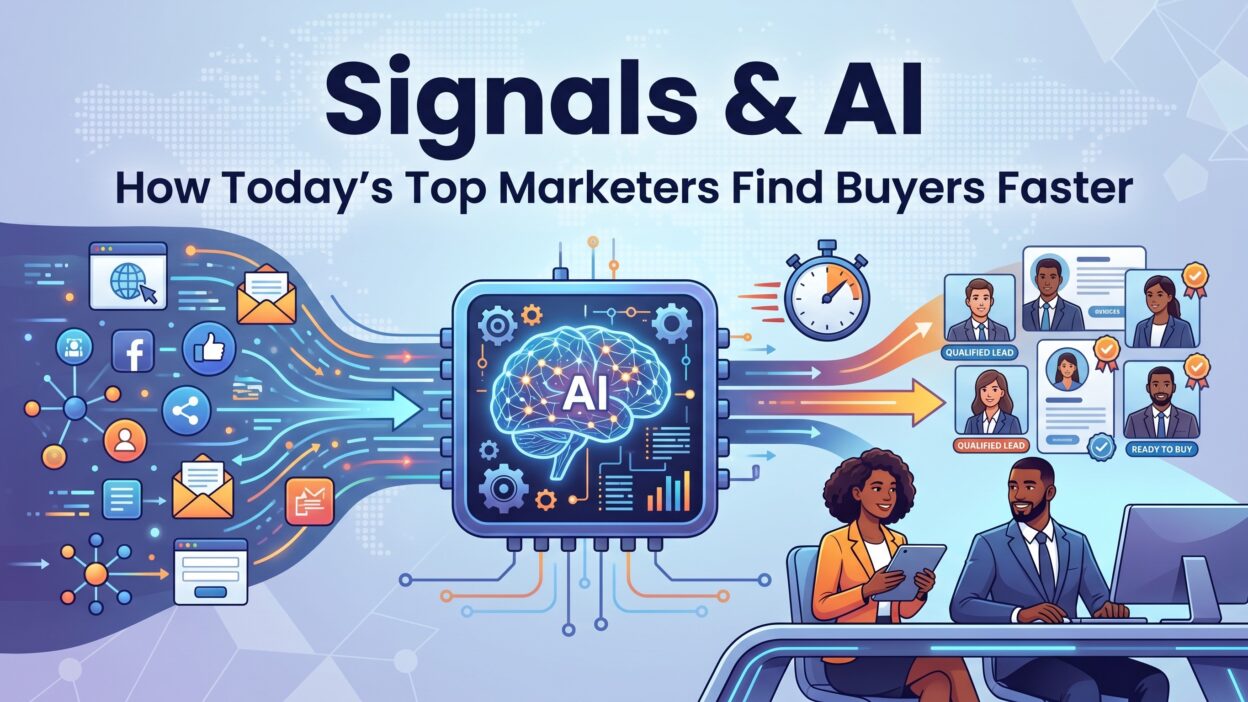
A signal is any digital action a prospect takes that hints at purchase intent. An AI system reads those actions, scores them, and tells your team who to contact today. The result is faster pipelines, shorter sales cycles, and higher conversion rates.
3×Higher conversion rate with intent-based outreach vs. cold lists
67%Of B2B buyers complete research before contacting a vendor
58%Of marketing teams plan to increase AI signal spend in 2025
These numbers tell a clear story. Marketers who ignore signal data fall behind. Marketers who embrace signals & AI gain a structural advantage their competitors cannot easily copy.
What Are Buyer Signals? A Practical Definition
A buyer signal is a measurable digital behaviour that suggests someone is moving toward a purchase decision. It is not a guess. It is a data point tied to a real action.
Some signals are first-party. These come from your own platforms — website visits, email opens, demo requests, and pricing page views. Your CRM and marketing automation tool capture them directly.
Other signals are third-party. These come from external sources — review sites, industry forums, job boards, and content syndication networks. A company suddenly posting five job ads for salespeople is a third-party signal. It suggests they are growing and likely buying new tools.
Signals exist on a spectrum from weak to strong. A single blog visit is a weak signal. A repeated visit to your pricing page within 48 hours, combined with a LinkedIn ad click and a competitor review, is a strong signal cluster.
“The best marketers don’t chase contacts. They read signals, and they show up when the buyer is already leaning in.”
AI makes sense of that spectrum. It weighs each action, combines them into a score, and flags the accounts most likely to convert. That is the core engine behind signals & AI for marketers — turning scattered data into ranked opportunities.
The Four Signal Types That Drive Revenue
1. Intent Signals
Intent signals capture research behaviour. A prospect reads three articles about data warehouse pricing. They visit G2 to compare your product against two competitors. They download an analyst report on your category.
These actions show that a buying conversation has started internally at that company. Intent signal platforms like Bombora and G2 Buyer Intent track this behaviour across millions of web properties. They report which accounts are surging on topics relevant to your product.
For signals & AI for marketers, intent data is the highest-quality input available. It tells you who is in-market right now.
2. Engagement Signals
Engagement signals come from your own content and channels. A contact opens four emails in a row. They watch 80 percent of a webinar. They click every link in a nurture sequence.
These signals show that a prospect is actively engaged with your brand. High engagement scores often predict demo requests before the prospect even fills out a form. AI models trained on historical data learn to recognise these patterns early.
3. Technographic Signals
Technographic signals reveal the technology stack a company currently uses. A prospect runs Salesforce, Marketo, and Slack. They just added a new data integration tool. This tells you what ecosystem they live in and whether your product fits naturally.
Platforms like Clearbit and BuiltWith expose this data. AI systems use it to filter accounts by compatibility and predict adoption likelihood. A marketer selling a Salesforce-native tool can instantly disqualify companies not running Salesforce.
4. Firmographic and Event Signals
Firmographic signals are the structured facts about a company — size, industry, revenue, and geography. Event signals are the live triggers that change a company’s buying context.
A company just raised a Series B round. They hired a new VP of Marketing. They expanded into a new region. Each event shifts their budget, priorities, and purchase readiness.
AI monitors thousands of these events in real time. It surfaces the accounts where something has changed and buying intent is most likely to follow. This is where signals & AI for marketers delivers its most dramatic speed advantage.
How AI Processes Signals to Surface Buyers
Raw signal data is messy. Thousands of accounts generate thousands of actions every day. No human team can sort through all of it quickly enough to act before the buying window closes.
AI solves this with three core capabilities.
Signal Aggregation
AI pulls data from multiple sources simultaneously. First-party CRM data, third-party intent feeds, social media activity, technographic databases, and news feeds all flow into a single processing layer. The AI normalises and de-duplicates the data before scoring begins.
This aggregation alone saves marketing operations teams dozens of hours per week. Manual data merging across sources is one of the biggest time sinks in B2B marketing. AI eliminates it.
Predictive Scoring
The AI model compares current account behaviour against historical patterns from closed-won deals. It identifies which signal combinations have historically led to a purchase. It then assigns each account a score that reflects its likelihood to convert.
Scores update in real time. An account sitting at a medium score in the morning can spike to a high score by the afternoon if they visit your pricing page and check your case studies.
Why Predictive Scoring Matters
Without scoring, sales and marketing teams prioritise by gut feel. Gut feel is inconsistent. Predictive scoring creates a ranked list every rep can trust.
Teams using AI scoring report spending 40% more time on conversations that actually convert — and significantly less time on cold outreach that goes nowhere.
Automated Orchestration
Once a score crosses a threshold, AI can trigger automated actions. A high-intent account gets added to a targeted ad audience. A personalised email sequence fires. A sales rep receives a task in their CRM with the context needed to personalise their outreach.
This orchestration layer is where signals & AI for marketers pays off most visibly. Speed matters enormously in B2B sales. The first vendor to engage a buyer in active research mode wins the conversation more often than not.
Real-World Use Cases for Signals & AI for Marketers
Account-Based Marketing (ABM) Prioritisation
ABM works best when marketing and sales focus on the same accounts at the same time. Without signals, teams guess which accounts to pursue. With AI-powered signals, they know.
A SaaS company selling to mid-market HR teams can use intent data to identify which companies are researching HR software right now. The AI scores them against ICP fit. The top twenty accounts go into a coordinated ABM play immediately.
Outreach is personalised to the exact topics each account is researching. Conversion rates for ABM plays powered by signals & AI for marketers regularly outperform generic ABM by two to four times.
Pipeline Acceleration
Deals stall. A prospect goes quiet after a strong discovery call. A proposal sits unanswered for two weeks. Traditional CRM data offers no clue about what changed.
Signal data fills the gap. If a stalled prospect suddenly starts visiting your competitor’s pricing page, that is an urgent signal. The AI flags it. The rep reaches out the same day with a targeted message addressing the comparison.
This kind of real-time intelligence has helped teams re-engage stalled deals that otherwise would have been lost.
Content Personalisation at Scale
Signals tell you what a prospect cares about right now. AI uses that knowledge to serve the right content without manual segmentation work.
A marketing automation platform can detect that a specific account is surging on “data integration” topics. The AI automatically serves that account case studies about integration use cases. The nurture emails reference integration challenges instead of generic product benefits.
This level of personalisation used to require a team of people. With signals & AI for marketers, it runs automatically at scale.
Churn Prevention in Customer Marketing
Signals are not only useful for acquiring new customers. They protect existing ones too. A customer who stops logging in, reduces their usage, and starts reading competitor content is showing churn signals.
AI detects this pattern early — often weeks before a customer cancels or raises a concern. Customer success teams can intervene with targeted training, a check-in call, or a new feature demonstration before the decision to leave is made.
Top Tools Powering Signals & AI for Marketers
Intent Data Platforms
Bombora is the market leader in B2B intent data. It tracks content consumption across a co-op of thousands of B2B publishers and surfaces company-level intent scores by topic. Marketers use it to identify in-market accounts weeks before those accounts ever contact a vendor.
G2 Buyer Intent is powerful for software companies specifically. When a prospect views your G2 profile, compares you with competitors, or reads your reviews, G2 captures that activity and sends it to your CRM. It is one of the most direct purchase-intent signals available.
AI-Powered CRM Enrichment
Apollo.io and Clay enrich contact and account data automatically. They pull firmographic data, technographic data, and recent hiring signals. They surface relevant triggers in real time directly inside your CRM workflow.
Clay in particular has become popular among growth-focused teams because it connects hundreds of data sources and lets marketers build custom signal logic without engineering support.
Conversational AI and Chat Intelligence
Drift and Qualified use AI to analyse website visitor behaviour in real time. When a high-intent account lands on your site, the AI notifies a sales rep instantly and can open a personalised chat experience. The conversation data feeds back into the signal model, improving scoring accuracy over time.
Revenue Intelligence Platforms
Gong and Chorus analyse recorded sales calls. They use AI to identify deal risks, buyer sentiment, and competitive mentions. Marketers use this data to refine messaging and understand which content themes resonate most during the evaluation stage.
These platforms close the loop between signals & AI for marketers and actual revenue outcomes. They make it possible to see which signal-driven campaigns led to pipeline and which conversations closed deals.
Building Your Signal-Led Marketing Stack
A signal-led stack does not need to be complex on day one. Start with the data you already have. Your CRM holds first-party signals. Your email platform tracks opens and clicks. Your website analytics shows page-level engagement.
Connect these sources into a single view of account activity. Most modern CRMs and marketing automation platforms support native integrations with intent data providers. Set up intent topic alerts for the keywords most relevant to your product category.
Define Your Ideal Customer Profile
Signal data is only valuable when filtered through a clear ICP. Without it, you score every account equally. Define the firmographic and technographic characteristics of your best customers. Use that profile as the filter for all signal prioritisation.
Choose Your Signal Sources
Start with two or three sources. First-party website data is always the foundation. Add one intent data provider for third-party coverage. Add a data enrichment tool to keep firmographic data fresh. That combination gives most B2B teams enough signal volume to act on.
Build Your Scoring Model
Work with your sales team to define what a high-intent account looks like. Which actions matter most? Which combinations of signals have historically preceded a purchase? Use those inputs to configure your AI scoring model.
Revisit the model quarterly. As your product and market evolve, the signals that predict conversion will shift too.
Create Signal-Triggered Workflows
Map every score tier to a specific response. A medium-score account enters a nurture sequence. A high-score account triggers a sales alert and a personalised direct mail or ad campaign. A very high-score account gets a phone call within the hour.
This is the operational backbone of signals & AI for marketers. Speed and relevance at each threshold separate high-performing teams from average ones.
Common Mistakes Marketers Make with Signal Data
Relying on a Single Signal Source
One signal source gives an incomplete picture. An account with high intent data but no engagement with your brand may still be years from buying. Combining first-party and third-party signals creates a much more accurate view of true purchase readiness.
Ignoring Signal Decay
Signals have a shelf life. A prospect who researched your category six months ago may have already bought a competitor’s product. Intent signals that are more than 90 days old lose most of their predictive value. Build decay logic into your scoring model so stale signals do not inflate scores.
Treating All Signals as Equal
Not every action carries the same weight. A pricing page visit means far more than a blog post view. A demo request means far more than an email open. Weight your signals accordingly. Unweighted models surface too many false positives and waste sales team time.
Failing to Align Sales and Marketing on Signal Logic
Signal scoring creates value only when both teams trust the output. Marketing cannot build a model in isolation and hand it to sales. Sales needs to validate the logic, provide feedback from the front lines, and update scoring rules when patterns change. Joint ownership is essential.
Key Principle
The best implementations of signals & AI for marketers treat signal scoring as a living system, not a one-time setup. Monthly reviews of model performance separate teams that scale from teams that stagnate.
The Future of Signals & AI for Marketers
The signal landscape is expanding rapidly. Generative AI now makes it possible to synthesise qualitative signals — news articles, social posts, earnings calls, and job descriptions — into structured insights at scale. This was not practical two years ago.
Multimodal Signal Intelligence
Future AI systems will process video signals, podcast mentions, and community forum conversations alongside traditional data sources. A company’s CEO discusses a pain point in a podcast interview. An AI system flags that company as a high-intent prospect for your product within hours of the episode going live.
This kind of multimodal signal processing will give early adopters a significant first-mover advantage in identifying buyers before competitors even know the conversation happened.
Hyper-Personalised AI Agents
AI agents will soon handle early-stage outreach autonomously. They will read a prospect’s signal history, draft a personalised message, send it at the optimal time, and route qualified responses to a human rep. The marketer’s role shifts from execution to strategy and oversight.
This does not replace marketing teams. It amplifies them. A team of five can execute outreach at the volume and personalisation level that previously required fifty people.
Privacy-First Signal Architecture
As third-party cookies continue to disappear, the value of first-party signal collection grows. Marketers who build strong first-party data assets today — through gated content, community platforms, interactive tools, and loyalty programmes — will be better positioned as the data landscape tightens.
AI will play a central role in making first-party data more predictive by building richer behavioural models from consented interactions. The future of signals & AI for marketers is privacy-conscious by design, not by compliance obligation.
FAQs: Signals & AI for Marketers
What is the difference between intent data and buyer signals?
Intent data is a specific type of buyer signal. It captures third-party research behaviour — content consumption across external publisher networks. Buyer signals is a broader term that includes intent data plus first-party engagement signals, technographic data, and event-based triggers. A complete signal strategy uses all of them together.
How much does it cost to build a signal-led marketing programme?
Costs vary widely by company size and the tools chosen. A small team can start with their existing CRM and a mid-tier intent data subscription for under $2,000 per month. Enterprise programmes with multiple intent providers, AI scoring platforms, and revenue intelligence tools can run $15,000 to $50,000 per month. The ROI typically justifies the investment when pipeline impact is measured correctly.
Do small marketing teams benefit from signals & AI for marketers?
Absolutely. Small teams benefit most because they have the fewest resources to waste on low-probability outreach. A three-person marketing team with good signal data outperforms a ten-person team running cold lists. Focus and timing beat volume every time.
How long does it take to see results from a signal-led marketing approach?
Most teams see measurable improvements in response rates and pipeline quality within sixty to ninety days of implementing a signal-led approach. Full model refinement and sales alignment typically take four to six months. The learning curve is real, but the compounding returns justify it.
Is signal data GDPR and privacy compliant?
Leading signal and intent data providers operate within GDPR, CCPA, and other privacy frameworks. They collect data at the company level rather than the individual level in most cases. Always review the data handling practices of any vendor you work with and confirm their compliance certifications before integrating their data into your workflows.
What secondary keywords relate to signals & AI for marketers?
Key secondary keywords include: buyer intent data, predictive lead scoring, account-based marketing signals, B2B intent data platforms, revenue intelligence, AI sales enablement, first-party signal strategy, real-time marketing automation, and signal-based ABM.
Read More:-Freshsales vs.Monday.com: A Comprehensive Comparison
Conclusion

The buying journey has changed permanently. Prospects are more informed, more independent, and more impatient than ever before. Waiting for them to raise their hand is no longer a viable strategy.
Signals & AI for marketers gives your team the ability to find buyers in motion — before they contact a competitor, before they finalise a shortlist, and before the window closes.
The teams winning the most revenue right now are not the ones with the biggest lists. They are the ones who know which accounts to call today, what those accounts care about, and how to show up with exactly the right message at exactly the right time.
That capability comes from signals & AI for marketers. It comes from building a stack that aggregates intent, scores behaviour, and triggers action in real time. It comes from treating signal data as a living system and refining it continuously with sales feedback.
Start with the data you already have. Add one intent signal source. Build a scoring model with your sales team. Set up automated workflows for your top score tiers. Measure the pipeline impact every quarter.
The marketers who commit to this approach today will have a compounding advantage that grows more powerful every year as AI models improve and signal sources multiply.
The signal is clear. The only question is whether you act on it.