Introduction
TL;DR Every company sells something. Not every company sells it the same way. That difference has a name. It’s called a GTM Motion.
A GTM Motion shapes how your product reaches buyers. It shapes who talks to the buyer first. It shapes how much a sale costs and how fast it closes. Pick the wrong GTM Motion and growth stalls. Pick the right one and revenue compounds.
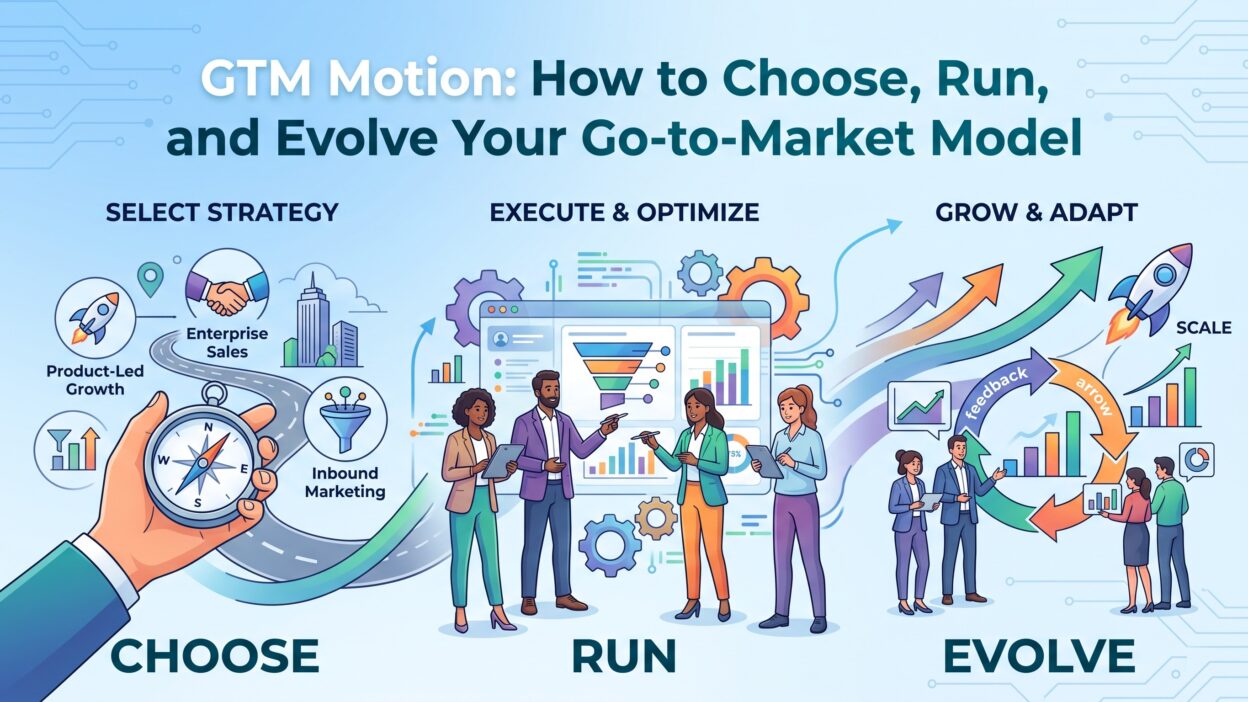
This guide walks through GTM Motion from every angle. You’ll learn what it means. You’ll learn the main types. You’ll learn how to pick one, run it well, and change it when growth slows. Let’s dig in.
Table of Contents
What Is a GTM Motion?
A GTM Motion is the path your company uses to acquire and grow customers. It covers who leads the sale. It covers which channel drives the first touch. It covers how a buyer moves from stranger to customer.
Some companies rely on reps to drive every deal. Some companies let the product sell itself through a free trial. Both approaches count as a GTM Motion. Neither one is right or wrong on its own. The right choice depends on the product and the buyer.
A GTM Motion isn’t a single tactic. It’s the full system behind growth. It includes your pricing model, your sales process, and your marketing channels. All three work together inside one GTM Motion. Change one piece and the whole system shifts.
Think about two companies selling similar software. One company sells through a five-person sales team calling enterprise buyers. The other company sells through a self-serve signup page. Both companies use a GTM Motion. The motions look completely different because the buyers behave differently.
Founders often skip this decision early on. They just start selling in whatever way feels natural. That instinct works for the first few deals. It stops working once the team grows past a handful of people. Without a clear GTM Motion, every new hire builds their own process. That patchwork slows the whole company down.
A defined GTM Motion also shapes how a company measures success. A sales-led company watches pipeline and quota attainment closely. A product-led company watches signups and activation instead. The metrics that matter shift completely based on which GTM Motion drives the business forward.
GTM Motion vs GTM Strategy
Strategy sets the destination. A GTM Motion sets the route. Your strategy might say you want to reach mid-market companies this year. Your GTM Motion decides how you actually get there.
Two companies can share the same strategy and use different motions. One might chase mid-market buyers through outbound sales calls. Another might chase the same buyers through content and free tools. Strategy answers what you want. GTM Motion answers how you get it done.
Confusing these two terms causes real problems. Teams write a strategy document, skip the motion decision, and end up with a scattered plan. A strong GTM Motion turns strategy into daily action.
Leadership teams often spend weeks debating strategy in offsite meetings. They leave the room with a bold vision and no clear execution plan. The GTM Motion is that missing execution plan. It turns a vague goal like “grow enterprise revenue” into a specific process reps and marketers can follow every single day.
Why Your GTM Motion Matters
Your GTM Motion touches every part of the business. It shapes your hiring plan. It shapes your budget. It shapes how fast you can grow without breaking.
A mismatched GTM Motion burns cash fast. A company selling a simple, cheap product through an expensive outbound sales team pays too much to acquire each customer. The math never works. Growth stalls even when the product is good.
The right GTM Motion does the opposite. It matches your cost of acquisition to your deal size. It matches your sales cycle to your buyer’s decision process. Teams that get this right grow with less waste and less stress.
Investors pay close attention to this fit too. A pitch deck full of growth charts means little if the underlying GTM Motion burns more cash than it brings in. Founders who can explain their GTM Motion clearly, and show the math behind it, build far more investor confidence than founders who only show revenue growth without context.
Impact on Sales Efficiency
A clear GTM Motion tells reps exactly what to do each day. Reps without a defined motion waste time guessing which accounts to chase and which channel to use. A defined GTM Motion removes that guesswork. Reps spend their time selling instead of figuring out where to start.
Sales managers also coach better with a clear GTM Motion in place. They know exactly which behaviors to reinforce during call reviews. Coaching becomes specific instead of generic. Reps improve faster with that kind of focus.
Impact on Marketing Spend
Marketing budgets shrink fast without a clear GTM Motion guiding spend. A motion built around content needs a different budget than a motion built around paid ads. Marketing teams that understand the company’s GTM Motion spend money on channels that actually match how buyers decide.
Without this clarity, marketing chases whatever trend looks hot that quarter. Budget flows toward flashy campaigns instead of the channels the actual GTM Motion depends on. Tying spend directly to the motion keeps budget decisions grounded in what drives real pipeline.
Impact on Customer Experience
Buyers notice when a company’s GTM Motion feels disjointed. A slick ad that leads to a clunky sales process breaks trust fast. A strong GTM Motion keeps every touchpoint consistent, from the first click to the signed contract.
Types of GTM Motion
Most companies use one of five common types of GTM Motion. Some blend two together as they grow.
Sales-Led GTM Motion
This motion puts a rep at the center of every deal. Reps prospect, qualify, demo, and close. This GTM Motion works well for complex products with high price tags. Enterprise software often runs on this model because buyers need guidance through a long decision.
Deals inside this GTM Motion often involve multiple stakeholders. A rep has to navigate procurement, legal, and several department heads before a contract gets signed. This slows the cycle down, but it also protects larger deal sizes that a self-serve motion could never capture alone.
Product-Led GTM Motion
This motion lets the product do the selling. Buyers try the product through a free trial or freemium plan before talking to anyone. A product-led GTM Motion works best when the product is easy to use and shows value fast. Sales steps in later to help larger accounts expand.
Onboarding carries huge weight inside this GTM Motion. A confusing first session kills conversion before a rep ever gets involved. Companies running this motion invest heavily in product design and in-app guidance instead of a large outbound team.
Marketing-Led GTM Motion
This motion drives growth through content, ads, and organic search. A marketing-led GTM Motion builds a strong top of funnel first. Sales then works the leads marketing hands off. This model works well when the buyer does heavy research before ever speaking to a rep.
Content quality makes or breaks this GTM Motion. A weak blog or a thin resource library won’t earn trust from a buyer doing careful research. Companies that win with this motion publish real expertise, not shallow filler content built only for search rankings.
Partner-Led GTM Motion
This motion grows through resellers, integrators, and referral partners. A partner-led GTM Motion works well in industries where buyers already trust a specific type of vendor relationship. The company builds a network instead of a direct sales team.
Managing this GTM Motion takes a different skill set than direct sales. Partner managers spend their time training and supporting outside teams instead of closing deals themselves. Success depends on how well those partners represent the product to their own customers.
Community-Led GTM Motion
This motion grows through a loyal user base that shares the product with others. A community-led GTM Motion depends on strong word of mouth and active user groups. Companies with passionate early users often see this model grow on its own.
This GTM Motion takes patience to build. A community doesn’t form overnight just because a company opens a forum or a Slack channel. It grows through genuine engagement over months, and it rewards companies willing to invest in relationships before expecting a return.
How to Choose the Right GTM Motion
Picking a GTM Motion isn’t a guess. It comes down to three clear factors.
Evaluate Your Product Complexity
Simple products fit self-serve motions. Complex products need a guided sales process. A tool a buyer can learn in five minutes doesn’t need a forty-five minute demo call. A product that touches multiple departments usually needs a rep to walk buyers through setup and value.
Ask a simple question here. Can a new user understand the core value inside ten minutes without help? If yes, a lighter GTM Motion probably fits. If the product needs training or integration work, a guided motion protects the buyer from a frustrating first experience.
Evaluate Your Buyer
Some buyers want to research alone before talking to anyone. Others want a human to answer questions early. Look at how your best customers actually bought in the past. Their buying pattern points toward the right GTM Motion for future growth.
Talk to your recent closed-won customers directly. Ask them how they found the product and what almost stopped them from buying. Their answers reveal far more about the right GTM Motion than any internal debate ever could.
Evaluate Your Team Strengths
A small team without a sales background often starts with a product-led GTM Motion. A team with strong enterprise sales experience often leans sales-led instead. Build your motion around the strengths already sitting inside your company.
Fighting your team’s natural strengths rarely pays off. A founder with deep content skills but no sales background often struggles forcing an outbound-heavy GTM Motion. Lean into what the team already does well, then build the surrounding process around that strength.
How to Run a GTM Motion Effectively
Choosing a GTM Motion is only step one. Running it well takes daily discipline.
Align Sales and Marketing
Sales and marketing must agree on the same GTM Motion. A marketing team generating leads for a sales-led motion needs to hand off differently than a team supporting a product-led motion. Misalignment here creates dropped leads and wasted spend. Weekly syncs between both teams keep the motion running smoothly.
A shared definition of a qualified lead matters here too. Sales and marketing often argue about lead quality simply because they never agreed on what “ready” actually means inside the current GTM Motion. Fixing that definition early prevents months of finger-pointing later.
Build the Right Playbook
Every GTM Motion needs a clear playbook behind it. A sales-led motion needs call scripts and objection handling guides. A product-led motion needs onboarding flows and in-app messaging. Write the playbook down. Don’t leave it in someone’s head. A documented playbook helps new hires ramp faster and keeps the motion consistent across the team.
Track the Right Metrics
Each GTM Motion has its own key metrics. A sales-led motion tracks pipeline coverage and win rate. A product-led motion tracks activation rate and trial-to-paid conversion. Track the metrics that match your specific motion, not generic vanity numbers that don’t reflect real growth.
Signs Your GTM Motion Needs to Change
No GTM Motion works forever. Markets shift. Buyers change. Watch for these warning signs.
Slowing Growth
A GTM Motion that worked last year might stall this year. If growth flattens despite steady effort, the motion itself might need a rework, not just more budget thrown at the same approach.
Rising Customer Acquisition Cost
Costs creep up over time inside any GTM Motion. A channel that once brought cheap leads can get crowded and expensive. Rising acquisition cost often signals it’s time to test a new channel or a blended motion.
Sales Cycle Length Increases
A GTM Motion built for a simple buyer breaks down when the buyer pool shifts toward larger, slower-moving companies. A longer sales cycle without a matching process update means your current GTM Motion no longer fits your buyer.
How to Evolve Your GTM Motion
Growing companies rarely stick with one GTM Motion forever. Evolution keeps revenue healthy.
Blend Multiple Motions
Many mature companies run more than one GTM Motion at once. A product-led motion can bring in small accounts while a sales-led motion handles enterprise deals. Blending motions lets a company serve different buyer segments without forcing one process onto everyone.
Test Before You Commit
Don’t overhaul your entire GTM Motion overnight. Test a new channel or process with a small segment first. A pilot program shows real results before the whole team shifts direction. This lowers risk and builds internal buy-in.
Re-align Teams Around the New Motion
A new GTM Motion needs new goals, new comp plans, and new training. Skipping this step causes teams to keep working the old way out of habit. Full alignment across sales, marketing, and success turns a planned shift into a real one.
Common Mistakes Teams Make with GTM Motion
Many teams copy a GTM Motion from a competitor without checking if it fits their own buyer. A motion that works for one company can fail completely for another with a different product or price point.
Other teams run multiple motions without any coordination. Marketing chases one type of buyer while sales chases another. This creates internal conflict and confuses the customer along the way.
Some teams also never revisit their GTM Motion once it’s set. They keep running the same playbook for years while the market moves on. A GTM Motion needs regular review, not a one-time decision locked in forever.
A final mistake shows up in hiring. Teams hire reps built for a sales-led GTM Motion, then try to force those reps into a product-led support role. The skill sets don’t transfer well. Hiring against the actual motion in place saves both time and payroll.
Tools That Support a Strong GTM Motion
CRM platforms track the pipeline behind any sales-led GTM Motion. Product analytics tools track activation and usage behind a product-led GTM Motion. Marketing automation platforms manage the lead flow behind a marketing-led GTM Motion.
The right tool stack depends entirely on the motion in place. A company running a product-led GTM Motion needs strong in-app tracking more than it needs a large outbound dialer. A company running a sales-led GTM Motion needs strong CRM hygiene more than it needs a freemium signup flow. Match your tools to your motion instead of buying every popular tool on the market.
Too many teams buy tools first and figure out the process later. That order causes wasted budget and low adoption. Pick your GTM Motion, map the steps inside it, then choose tools that support each specific step along the way.
Frequently Asked Questions
What does GTM Motion mean?
GTM Motion refers to the specific path a company uses to acquire and grow customers. It covers who leads the sale and which channel drives the first touch.
How many types of GTM Motion exist?
Most companies choose from five common types. These include sales-led, product-led, marketing-led, partner-led, and community-led GTM Motion models. Many companies blend two together as they scale.
Can a company use more than one GTM Motion?
Yes. Many growing companies run a blended approach. A product-led GTM Motion can serve small accounts while a sales-led GTM Motion handles larger enterprise deals within the same company.
How often should a company review its GTM Motion?
A yearly review works well for most companies. Faster-growing markets might need a review every six months to keep the GTM Motion aligned with buyer behavior.
What’s the biggest mistake with GTM Motion?
Copying a competitor’s GTM Motion without checking product fit causes the most damage. A motion built for one product rarely transfers cleanly to a different price point or buyer type.
Does company size affect the right GTM Motion?
Yes. Smaller teams often start with a lean, product-led GTM Motion. Larger teams with bigger budgets often support a full sales-led GTM Motion alongside other channels.
Read More:-Brand Activation: A Beginner’s Guide
Conclusion

A GTM Motion isn’t a slide in a deck. It’s the daily engine behind every deal your company closes. Pick the wrong one and every team fights an uphill battle. Pick the right one and growth starts to feel easier.
Start by looking honestly at your product and your buyer. Match your GTM Motion to what they actually need, not what looks impressive on paper. Run that motion with a clear playbook. Watch the metrics that matter for your specific model.
Markets shift and buyers change. Your GTM Motion should shift with them. Review it often. Test new approaches in small pockets before a full rollout. Companies that treat their GTM Motion as a living system, not a fixed plan, build revenue that lasts.