Introduction
TL;DR AI agents fail for one reason more than any other. They lack the right context. A smart model with the wrong information still gives a wrong answer. That’s why Context Engineering for B2B AI matters so much right now.
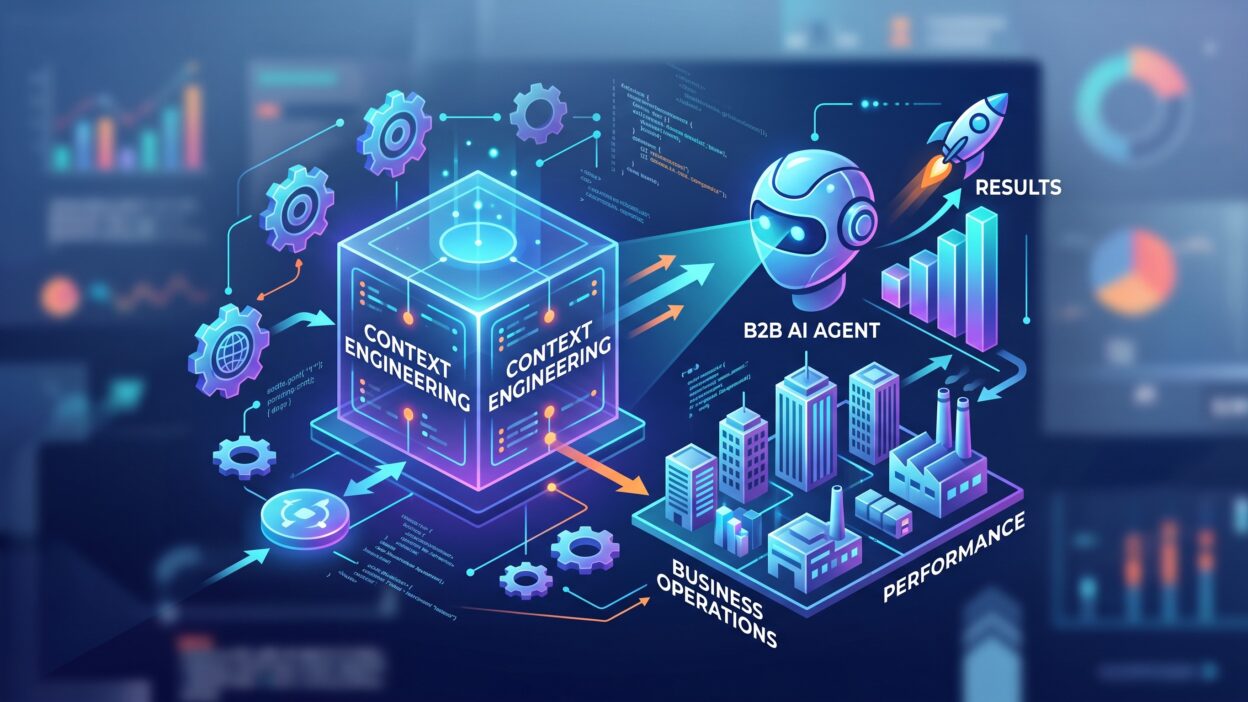
Context Engineering for B2B AI isn’t about writing a clever prompt. It’s about building the full system around an agent. That system decides what the agent knows, what it can do, and how it behaves inside a real business. Get this right and an agent feels like a sharp new hire. Get it wrong and the agent feels like a confused intern.
This guide breaks down Context Engineering for B2B AI step by step. You’ll learn what it means, why it matters, and how to build agents that actually perform inside a B2B environment. Let’s get into it.
Table of Contents
What Is Context Engineering for B2B AI?
Context Engineering for B2B AI is the practice of designing everything an AI agent sees before it acts. This includes instructions, data, tools, and memory. It shapes how an agent understands a task and how it responds to a real business situation.
A model alone doesn’t know your product. It doesn’t know your pricing tiers or your support policies. Context Engineering for B2B AI fills that gap. It hands the model exactly what it needs, right when it needs it, nothing more and nothing less.
Picture a support agent built for a software company. Without proper context, the agent guesses at answers and sounds generic. With strong Context Engineering for B2B AI behind it, the same agent pulls the right documentation, checks the customer’s plan tier, and answers with real accuracy. The model didn’t change. The context around it did.
This discipline sits at the center of every reliable B2B AI product today. Teams that treat it seriously build agents customers trust. Teams that skip it build flashy demos that fall apart in production.
Most failed AI projects trace back to this exact gap. A team builds an impressive demo using clean, curated examples. The demo works great in a conference room. Then real customers show up with messy questions, half-finished sentences, and account details the demo never covered. Context Engineering for B2B AI closes that gap between demo and reality.
The word “engineering” matters here too. This isn’t a one-time creative exercise. It’s a repeatable process with clear inputs and outputs. Teams that treat it like engineering build systems that improve steadily over time. Teams that treat it like guesswork end up rebuilding the same agent every few months.
Context Engineering for B2B AI vs Prompt Engineering
Prompt engineering focuses on one message. It’s the art of phrasing a single instruction well. Context Engineering for B2B AI covers something much bigger. It covers every piece of information an agent touches across an entire session.
A good prompt can’t fix bad context. You can write the cleverest instruction in the world, but if the agent lacks the right account data or the right tool access, the output still falls short. Context Engineering for B2B AI treats the prompt as just one small piece of a much larger system.
Think of prompt engineering as writing a good line of dialogue. Context Engineering for B2B AI is directing the entire scene. Both matter, but only one determines whether the whole system holds up under real business conditions.
Teams that only focus on prompts often hit a wall fast. They tweak wording for hours trying to fix an answer that’s actually wrong because of missing data, not bad phrasing. No amount of clever wording fixes an agent that never received the right document in the first place. Context Engineering for B2B AI catches that root cause instead of masking it with better phrasing.
Why Context Engineering for B2B AI Matters Now
AI agents moved fast from novelty to necessity inside B2B companies. Sales teams use them to draft outreach. Support teams use them to answer tickets. Ops teams use them to pull reports. Every one of these use cases depends on strong Context Engineering for B2B AI behind the scenes.
Buyers notice quickly when an agent feels shallow. A chatbot that repeats generic answers loses trust fast. A chatbot built on solid Context Engineering for B2B AI feels like it actually understands the account. That difference decides whether customers keep using the tool or abandon it after one bad experience.
Budget pressure adds to the urgency too. Leadership teams approve AI projects expecting real efficiency gains. An agent that sends customers back to a human support rep for basic questions doesn’t deliver that gain. It just adds another step to the process. Context Engineering for B2B AI is what actually lets an agent resolve real work instead of just deflecting it elsewhere.
The Rise of AI Agents in B2B
Agents now handle real workflows, not just simple chat replies. They qualify leads, draft contracts, and update CRM records. This shift raises the stakes for Context Engineering for B2B AI. An agent making decisions inside a live sales pipeline needs far more careful context than a simple FAQ bot ever did.
A mistake in a chat reply annoys a customer. A mistake inside a live workflow can update the wrong record or send a contract with the wrong terms. That higher stakes environment is exactly why Context Engineering for B2B AI has become a real discipline rather than a side task handled by whoever built the demo.
Why Generic Prompts Fail in B2B Settings
B2B situations carry nuance. Pricing depends on contract terms. Support depends on plan tier. A generic prompt can’t capture that nuance on its own. Context Engineering for B2B AI closes this gap by feeding the agent the specific business logic each situation actually needs.
A consumer app might serve millions of nearly identical users. A B2B product serves fewer accounts, but each one carries unique contract terms, custom integrations, and specific history. A single generic prompt can’t hold all of that variation. Only strong Context Engineering for B2B AI can adapt the agent’s behavior account by account.
Core Components of Context Engineering for B2B AI
Strong agents rest on five core pieces. Each piece plays a different role inside Context Engineering for B2B AI.
System Instructions
These instructions set the agent’s boundaries. They define tone, scope, and rules the agent must follow. Clear system instructions stop an agent from wandering outside its intended job. A support agent told clearly to avoid discussing pricing changes won’t accidentally promise a discount it can’t offer.
Retrieved Knowledge
This piece pulls real documents into the conversation. Product manuals, policy pages, and past tickets all feed into this layer. Retrieved knowledge keeps answers grounded in facts instead of guesses. An agent without this layer relies purely on general training, which often means outdated or generic answers about your specific product.
Tool Definitions
Agents often need to take action, not just talk. Tool definitions tell the agent what actions exist and how to use them. A support agent might need a tool to check order status. A sales agent might need a tool to pull CRM records. Without clear tool definitions, an agent either refuses to act or guesses at an action it can’t actually perform.
Memory and State
Long conversations need continuity. Memory tracks what already happened earlier in a session. Without it, an agent forgets a customer’s name three messages later and starts sounding careless. Good memory design also decides what to forget, since holding onto every detail forever slows the agent down over time.
User and Account Data
B2B interactions rarely stand alone. They connect to a specific company, contract, and history. Feeding this account data into the agent turns a generic answer into a tailored one. An agent that knows a customer sits on an enterprise plan can skip basic questions and jump straight to a useful answer.
How to Build Agents Using Context Engineering for B2B AI
Suggested word count: 400
Building a strong agent takes more than plugging in a model. It takes a clear process.
Map the Buyer Journey First
Suggested word count: 100
Before writing a single prompt, map out where the agent sits inside the buyer journey. A pre-sales agent needs different context than a renewal agent. This mapping step shapes every later decision inside Context Engineering for B2B AI. Skip this step and you end up building context for the wrong moment entirely.
Define the Agent’s Job Narrowly
Broad agents perform worse than focused ones. An agent trying to handle sales, support, and billing all at once loses accuracy across the board. Narrow the job first, then build the context around that single job well. A focused agent that handles one task perfectly beats a broad one that handles five tasks poorly.
Feed Clean, Structured Data
Messy data breaks even the best-designed agent. Clean up product data, account records, and documentation before connecting them to the agent. Strong Context Engineering for B2B AI starts with strong data hygiene underneath it. Skipping this step means building a smart system on top of a shaky foundation.
Test Against Real Scenarios
Don’t test with easy questions alone. Pull real conversations from support logs or sales calls. Test the agent against messy, real-world scenarios before it ever reaches a customer. A test set built only from perfect examples hides the exact weaknesses customers will find within days.
Common Challenges in Context Engineering for B2B AI
Even well-planned agents run into real obstacles. Knowing these challenges early saves time later.
Context Window Limits
Every model has a limit on how much information it can hold at once. Stuffing too much into that window slows the agent down and confuses its focus. Good Context Engineering for B2B AI picks the most relevant pieces instead of dumping everything available into the prompt.
Teams often assume a bigger window solves this problem automatically. It doesn’t. Even with a large window, an agent buried in irrelevant text struggles to find the one detail that actually matters. Careful selection still beats brute-force volume every time.
Data Quality Problems
Outdated documentation or duplicate records poison an agent’s answers fast. An agent pulling from a stale pricing page gives a customer the wrong number. Context Engineering for B2B AI depends entirely on the quality of the data feeding it.
Fixing this problem takes ongoing ownership, not a one-time cleanup. Someone on the team needs clear responsibility for keeping source documents current. Without that ownership, an agent slowly drifts further from accurate answers every month it runs.
Security and Compliance Risks
B2B data often includes sensitive contract terms and private account details. Poor context handling can expose one customer’s data to another. Strong Context Engineering for B2B AI includes clear guardrails around what data an agent can access and share.
Legal and security teams should review context pipelines early, not after launch. A single misconfigured retrieval step can leak one company’s contract terms into another company’s conversation. That kind of mistake damages trust far more than a wrong answer ever would.
Best Practices for Context Engineering for B2B AI
A few habits separate agents that work well from agents that fall apart under pressure.
Keep Context Relevant, Not Just Available
More context isn’t always better. An agent flooded with unrelated documents often gives a worse answer than one given a tight, relevant set. Context Engineering for B2B AI works best when every piece included earns its place.
Build a simple filter before information reaches the agent. Ask whether each document actually helps answer the current question. Cut anything that doesn’t pass that test, even if it feels useful in general.
Version Your Prompts and Context
Treat prompts and context templates like code. Track changes over time. Roll back quickly when a new version performs worse. This discipline turns Context Engineering for B2B AI into a repeatable process instead of a one-time setup.
Teams without version control often can’t explain why an agent suddenly started giving worse answers. A simple change log saves hours of confused debugging later.
Monitor Agent Output Continuously
Launching an agent isn’t the finish line. Review real conversations weekly. Watch for patterns where the agent struggles or gives a wrong answer. Ongoing review keeps Context Engineering for B2B AI sharp as products and policies change over time.
Set up a simple weekly review with someone close to the customer, not just an engineer. A support lead often spots a wrong answer faster than a dashboard metric ever will.
Context Engineering for B2B AI vs Traditional AI Implementation
Traditional AI implementation often focuses on the model itself. Teams pick a model, write a few prompts, and ship a feature. This approach works for simple, low-stakes tasks. It breaks down fast inside complex B2B workflows.
Context Engineering for B2B AI flips the focus. The model matters less than the system feeding it. Two companies can use the exact same model and get completely different results, based purely on how well each one handles context.
This gap shows up clearly during vendor evaluations. Two competing products might run on the same underlying model under the hood. One feels sharp and specific. The other feels vague and generic. The difference almost always comes down to the depth of Context Engineering for B2B AI behind each product, not the raw model powering it.
This shift changes team structure too. Traditional AI projects often sit with a single engineer. Context Engineering for B2B AI usually needs a cross-functional effort. Product teams define the data. Engineers build the pipelines. Support and sales teams validate real accuracy against daily use.
Timeline expectations shift with this broader approach. A traditional AI feature might ship in a sprint. A well-built agent using proper Context Engineering for B2B AI often takes longer up front, since the surrounding data and tooling needs real investment. That investment pays off through fewer embarrassing mistakes once the agent reaches real customers.
Tools and Platforms for Context Engineering for B2B AI
Several categories of tools support strong Context Engineering for B2B AI. Vector databases store and retrieve relevant documents quickly. Orchestration frameworks manage how different context pieces combine before reaching the model. Evaluation platforms track agent accuracy over time and flag weak responses.
Picking tools depends on team size and use case. A small team might start with a simple retrieval setup connected directly to a support knowledge base. A larger team building multiple agents across sales, support, and success often needs a full orchestration layer to manage context consistently across every agent in production.
Beyond software, a strong process matters just as much as any tool. A well-organized wiki, a clear data owner, and a regular review cadence often improve an agent more than switching to a fancier platform. Tools support Context Engineering for B2B AI. They don’t replace the discipline behind it.
Frequently Asked Questions
What does Context Engineering for B2B AI actually mean?
Context Engineering for B2B AI means designing everything an agent sees before it responds. This includes instructions, retrieved documents, tools, memory, and account data.
How is Context Engineering for B2B AI different from prompt engineering?
Prompt engineering focuses on wording a single instruction. Context Engineering for B2B AI covers the entire system feeding an agent, including data, tools, and memory across a full session.
Why do B2B agents need more context than consumer chatbots?
B2B situations involve contracts, pricing tiers, and account-specific history. Context Engineering for B2B AI handles this complexity, while a simple consumer chatbot often works fine with far less detail.
What causes most B2B AI agents to fail?
Poor context causes most failures, not a weak model. Outdated data, missing account details, and overloaded prompts all point back to weak Context Engineering for B2B AI.
How much data should an agent receive at once?
Only the most relevant pieces. Context Engineering for B2B AI works best with a focused, high-quality set of information rather than every available document dumped into one prompt.
Does Context Engineering for B2B AI require a large team?
Not always. Small teams can start with a simple retrieval setup. Larger deployments across multiple departments usually benefit from a dedicated team managing Context Engineering for B2B AI across every agent.
Read More:-The Art and Science of Marketing: How B2B Teams Balance Creativity and Data
Conclusion
Strong AI agents don’t come from a clever prompt alone. They come from careful design around everything the model sees. That’s the real work behind Context Engineering for B2B AI.
Start with a narrow, well-defined job for your agent. Feed it clean data. Give it the right tools. Test it against real, messy scenarios before launch. Review its output often once it goes live.
B2B buyers expect accuracy and relevance from every tool they use. An agent built on solid Context Engineering for B2B AI delivers both. An agent built without it disappoints fast, no matter how advanced the underlying model claims to be. Treat context as the foundation, not an afterthought, and your agents will perform the way your business actually needs them to.