Introduction
TL;DR B2B Marketing sits at an odd crossroads. One side wants bold ideas. The other side wants proof. Most teams pick a side and stay there. The strong teams don’t.
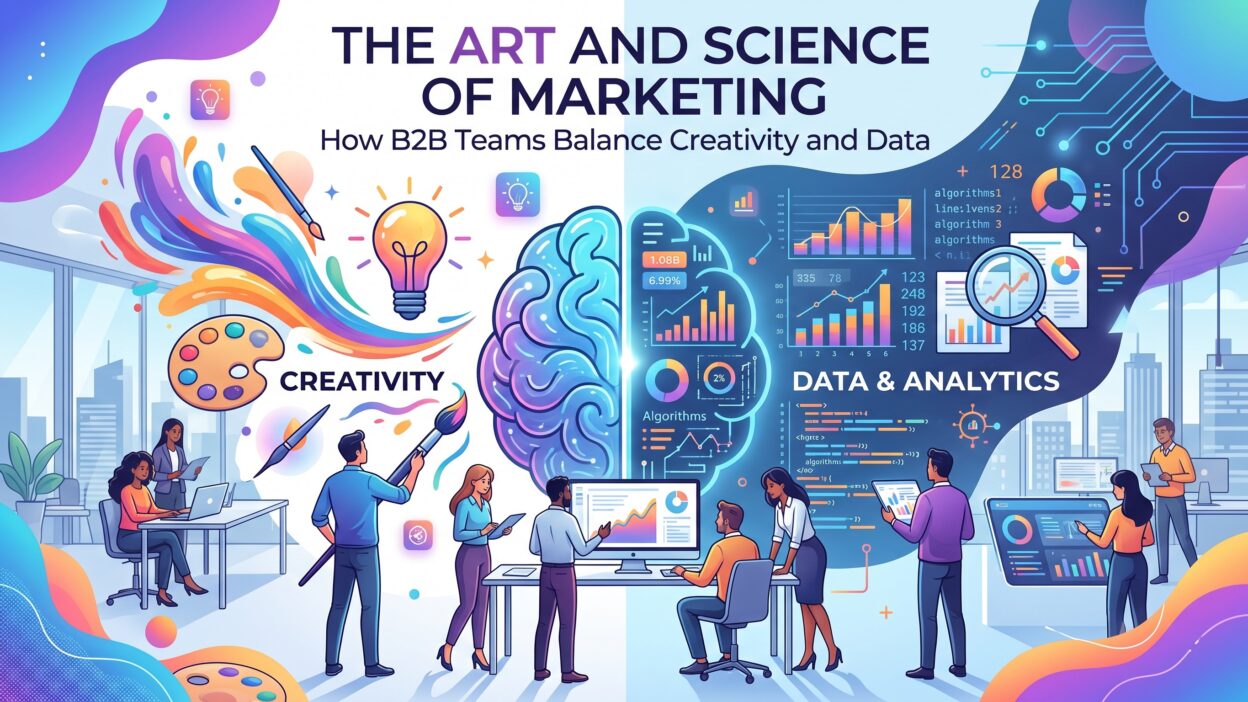
Great B2B Marketing blends a sharp creative instinct with hard numbers. A campaign can look stunning and still fail. A campaign can convert well and still feel flat. Neither outcome helps a business grow. The goal is a mix: ideas that move people, backed by data that shows what works.
This blog breaks down both sides of B2B Marketing. You’ll see where creativity fits, where data fits, and how top teams combine them without losing either one. You’ll also find practical steps you can use this week, not just theory for a slide deck.
Table of Contents
What Is B2B Marketing Today
From Cold Calls to Content Systems
B2B Marketing used to mean cold calls and trade show booths. A sales rep pitched a product. A buyer said yes or no. The whole process ran on relationships and gut feel.
That model doesn’t work anymore. Buyers research on their own now. They read reviews. They compare vendors. They watch demo videos before they ever talk to a salesperson. B2B Marketing today builds trust long before a sales call happens.
Content sits at the center of this shift. Blogs, case studies, webinars, and email sequences do the early convincing. A buyer forms an opinion about your company before your sales team says a word.
Why B2B Marketing Looks Different in 2026
Buying committees have grown. A single purchase can involve six or seven people across different departments. Each person cares about something different. A finance lead wants cost savings. An IT lead wants security. A marketing lead wants ease of use.
This means B2B Marketing can’t run one message for everyone. Teams build different content for different roles. They track how each piece performs. They adjust based on what the data shows, not just what feels right.
The result is a discipline that looks more like product design than old-school advertising. Test, measure, refine, repeat.
The Art Side of B2B Marketing
Brand Storytelling That Builds Trust
Buyers don’t remember spec sheets. They remember stories. A strong brand story explains why your company exists and who it serves. It gives buyers a reason to care beyond price.
Storytelling in B2B Marketing works differently than in consumer marketing. The story needs substance. A vague mission statement won’t convince a procurement team. The story needs to connect to real outcomes: time saved, revenue gained, risk reduced.
The best B2B brands treat every piece of content as part of one larger story. A blog post, a case study, and a sales deck all echo the same voice. That consistency builds recognition over time.
Creative Campaigns That Break Through Noise
Every inbox is full. Every LinkedIn feed is crowded. A safe, generic campaign gets ignored. B2B Marketing teams need creative risk to earn attention.
Creative risk doesn’t mean reckless. It means a fresh angle on a familiar problem. A software company selling to accountants might use humor about tax season stress. A cybersecurity firm might use a stark visual about breach costs. The idea grabs attention first, then the message lands.
Creativity also shows up in format. Interactive tools, short videos, and podcast interviews often outperform another whitepaper. Buyers are tired of static PDFs. A creative format can make dense information easy to absorb.
Design and Visual Identity
Design carries weight that many B2B teams underrate. A cluttered website or an inconsistent color palette signals a company that doesn’t sweat details. Buyers notice, even if they can’t say why.
Clean design builds credibility fast. A polished landing page, a clear product screenshot, and a simple navigation menu all shape first impressions. B2B Marketing lives or dies on these small, visual signals during a buyer’s first visit.
The Science Side of B2B Marketing
Data Driven Decision Making
Data turns guesswork into direction. A marketing team without data picks campaigns based on opinion. A marketing team with data picks campaigns based on results.
Data driven marketing starts with clear goals. A team needs to know what success looks like before a campaign launches. Is the goal more leads? More qualified leads? Faster deal cycles? Each goal points to different metrics worth tracking.
Good data also protects budgets. A campaign that isn’t working gets caught early. Spend shifts to channels that perform. This discipline separates strong B2B Marketing teams from ones that burn budget on hope.
Marketing Analytics and Attribution
Attribution answers a simple question: what actually drove the sale? A buyer might read a blog post, download a case study, attend a webinar, and then convert. Attribution tries to credit each step fairly.
B2B sales cycles run long, often months. This makes attribution harder than in consumer marketing. Multi-touch attribution models help here. They spread credit across every touchpoint instead of giving all credit to the last click.
Without attribution, teams often overvalue the final touch and undervalue the early content that built trust. Good analytics fix this blind spot.
A/B Testing and Optimization
Testing removes opinion from small decisions. A subject line, a headline, a call-to-action button color, all of these can get tested against real audiences.
B2B Marketing teams that test consistently learn faster than teams that guess. A test might show that a direct headline beats a clever one. Another test might show the opposite for a different audience. The only way to know is to test.
Optimization never really ends. Each test result feeds the next idea. Over time, small gains stack into meaningful growth.
Why B2B Teams Need Both Creativity and Data
The Risk of Too Much Data
A team that only trusts data can lose its edge. Numbers show what happened in the past. They don’t always predict what will work next. A campaign based only on old data can feel stale and safe.
Over-reliance on data also breeds caution. Teams start avoiding anything untested. Bold ideas get killed before they launch, because no data exists yet to support them. This kills the exact creativity that could open new growth.
The Risk of Too Much Creativity
A team that only trusts creativity can waste money fast. A bold campaign might win awards and still generate zero leads. Without data, teams can’t tell a genuinely strong idea from one that simply looked good in a meeting.
Creative teams without data also struggle to defend their budgets. Leadership wants proof of return. A campaign that can’t show results, even a beautiful one, becomes hard to justify next quarter.
B2B Marketing needs both guardrails. Data keeps creativity honest. Creativity keeps data interesting.
How Top B2B Marketing Teams Balance Both
Building Cross Functional Teams
The strongest B2B Marketing teams mix skill sets on purpose. A copywriter sits near an analyst. A designer sits near someone who understands SQL. This proximity matters more than most companies realize.
When creative and analytical people work side by side, ideas get pressure-tested early. A designer proposes a bold new landing page. An analyst checks how similar pages performed before. The idea improves before it ever reaches a customer.
Using Data to Guide Creative Direction
Data doesn’t have to kill creativity. It can point creativity in a smarter direction. If data shows that video content gets three times the engagement of blog posts, a creative team can lean into video without losing its voice.
The best B2B Marketing teams use data as a starting point, not a cage. They look at what content performs, then build something new and better within that space. This approach keeps ideas fresh while staying grounded in proof.
Testing Creative Ideas Before Scaling
A bold idea doesn’t need to launch at full scale on day one. Smart teams test creative concepts on a small audience first. A new tone, a new format, a new offer, all of these can run as a limited test.
If the small test performs well, the team scales it with confidence. If it flops, the team learns cheaply instead of expensively. This process protects budget while still leaving room for creative risk.
B2B Marketing strategy works best when it treats every big idea as a hypothesis first, not a guaranteed win.
Tools That Support Both Art and Science in B2B Marketing
Creative Tools
Design platforms like Canva and Figma help teams build polished visuals fast, even without a full design department. Video tools like Descript and CapCut make short-form content easier to produce. Writing tools help maintain a consistent brand voice across every piece of content.
These tools lower the barrier to strong creative output. A small B2B Marketing team can now produce content that once required a much bigger budget.
Analytics Tools
Platforms like HubSpot, Google Analytics, and Salesforce track buyer behavior across the entire funnel. Attribution tools like Bizible or Dreamdata connect marketing touchpoints to actual revenue. Heatmap tools like Hotjar show exactly where visitors click and where they drop off.
Together, these tools give B2B Marketing teams a clear view of what’s working. The art creates the content. The science proves whether it worked.
Common Mistakes in B2B Marketing
Many teams chase vanity metrics instead of real business outcomes. A high open rate means nothing if no one converts into a customer. B2B Marketing needs metrics tied to revenue, not just engagement.
Another common mistake is ignoring the buyer’s journey stage. Content built for someone ready to buy won’t work for someone who just discovered the problem. Matching content to the right stage takes real planning.
Some teams also copy competitors instead of building their own voice. This makes a brand forgettable. Buyers can’t tell one company apart from the next when every message sounds the same.
Finally, many teams treat creative and data functions as separate departments that rarely talk. This creates friction and slows everything down. B2B Marketing works best when both sides sit at the same table from day one.
The Future of B2B Marketing: Balancing AI, Data, and Human Creativity
AI tools now help B2B Marketing teams move faster. They draft first versions of content, summarize research, and predict which leads are most likely to convert. This speed frees up time for deeper creative work.
But AI can’t replace human judgment. It can suggest patterns from past data. It can’t invent a genuinely new idea that hasn’t been tried before. The teams that win in the next few years will use AI to handle repetitive tasks, while people focus on strategy and original ideas.
Data will keep growing in importance too. Privacy changes and cookie restrictions are pushing teams toward first-party data, built directly from their own audience relationships. This makes strong content even more valuable, since it’s often the reason someone shares their information in the first place.
B2B Marketing will keep needing both sides. The tools will change. The balance between creativity and proof won’t.
Frequently Asked Questions
What is B2B Marketing?
B2B Marketing means promoting products or services from one business to another business, rather than to individual consumers. It usually involves longer sales cycles, multiple decision makers, and content built around solving specific business problems.
Why does B2B Marketing need both creativity and data?
Creativity captures attention and builds a memorable brand. Data proves what actually works and protects budget from waste. A B2B Marketing strategy built on only one of these tends to fail over time.
What is the difference between B2B and B2C marketing?
B2B Marketing usually targets a group of decision makers instead of one person. Sales cycles run longer. Content tends to focus on ROI, efficiency, and risk reduction rather than emotion alone.
How do B2B Marketing teams measure success?
Most teams track metrics like qualified leads, pipeline generated, deal velocity, and customer acquisition cost. Vanity metrics like page views matter less than metrics tied directly to revenue.
What tools do B2B Marketing teams use most?
Common tools include HubSpot and Salesforce for CRM and automation, Google Analytics for website data, Figma and Canva for design, and attribution platforms like Dreamdata for tracking what content actually drives sales.
Is content marketing part of B2B Marketing?
Yes. B2B content marketing forms a core part of most B2B Marketing strategies. Blogs, case studies, webinars, and guides build trust with buyers long before a sales conversation starts.
Read More:-Why Resume Keywords Are Failing Your AI Hiring Strategy (And What to Do About It)
Conclusion

B2B Marketing works best as a partnership, not a competition. Creativity gives a brand its voice. Data gives that voice direction and proof. Teams that pick only one side end up either forgettable or ineffective.
The strongest B2B Marketing teams build systems where these two forces support each other. They test bold ideas instead of avoiding them. They use data to sharpen creative work instead of replacing it. This balance turns marketing from a cost center into a real growth engine.
Start small if your team leans too heavily on one side today. Pair a creative idea with a clear metric. Test it. Learn from it. Repeat. That simple habit, done consistently, builds the kind of B2B Marketing that actually moves a business forward.