Introduction
TL;DR Recruiters built an entire hiring system around resume keywords for two decades. Match the right words, get past the filter. This logic feels broken in 2026. Strong candidates still get rejected. Weak candidates still slip through. Something in this old system stopped working.
AI hiring tools promised a fix for this problem. Instead, many teams stacked AI screening on top of the same keyword logic that already failed them. The result feels faster, but it still misses great candidates every single week. Keyword matching alone cannot capture what makes a person right for a role.
This blog breaks down why resume keywords keep failing modern hiring teams. It explains how AI screening quietly inherited the same flaws as old applicant tracking systems. It also gives a clear path forward for teams ready to fix this problem properly.
Hiring leaders read this guide to understand a real gap in their process. Recruiters read this guide to learn what actually predicts a strong hire. Both groups walk away with steps they can apply this week, not vague theory.
Resume keywords still matter in one narrow sense. They help a system find a starting point among thousands of applications. The real problem starts when a team treats keyword matches as the whole story instead of a first filter. Skilled candidates use different words for the same skill. A resume built around keyword tricks can beat a resume built around real experience.
This guide covers the technical reason keywords fail, the hidden cost of bad matches and a clear framework to fix an AI hiring strategy without starting from scratch. Every section includes real detail a hiring team can use right away.
Table of Contents
How Resume Keywords Became the Default Hiring Filter
Applicant tracking systems arrived decades ago with one core promise. Sort thousands of resumes fast using simple text matching. Recruiters typed a job title and a few skills into a search box. The system pulled resumes containing those exact words.
This method worked fine when hiring volume stayed low and roles stayed simple. A recruiter could still review every match by hand. This keyword filter acted as a helpful shortcut, not a full decision maker in this earlier era.
Hiring volume grew fast over the following years. Recruiters leaned harder on keyword filters just to keep up with application counts. The shortcut slowly became the entire system, and few teams noticed the shift happening in real time.
Why This System Never Matched Real Skill
A keyword match tells a system almost nothing about actual skill level. A candidate can list a tool once on a resume without real hands on experience. Another candidate can master that same tool but describe it using different words entirely.
This scoring method rewards candidates who know how to write for a machine, not candidates who perform best on the job. This gap grew wider every year as job seekers learned to reverse engineer these systems through online guides and forums.
Industry terms shift faster than most hiring systems can track. A software role once listed under one job title now appears under three or four different titles across different companies. A keyword list built around one company’s language often misses a perfect candidate from a different company using slightly different terms for the exact same job.
Regional differences make this problem worse. A candidate trained in one country might describe a skill using a term common in that region, while a hiring manager in another region expects a different word for the same ability. A rigid keyword list has no room for this kind of natural variation, and it quietly punishes candidates for a difference in geography rather than a difference in real skill.
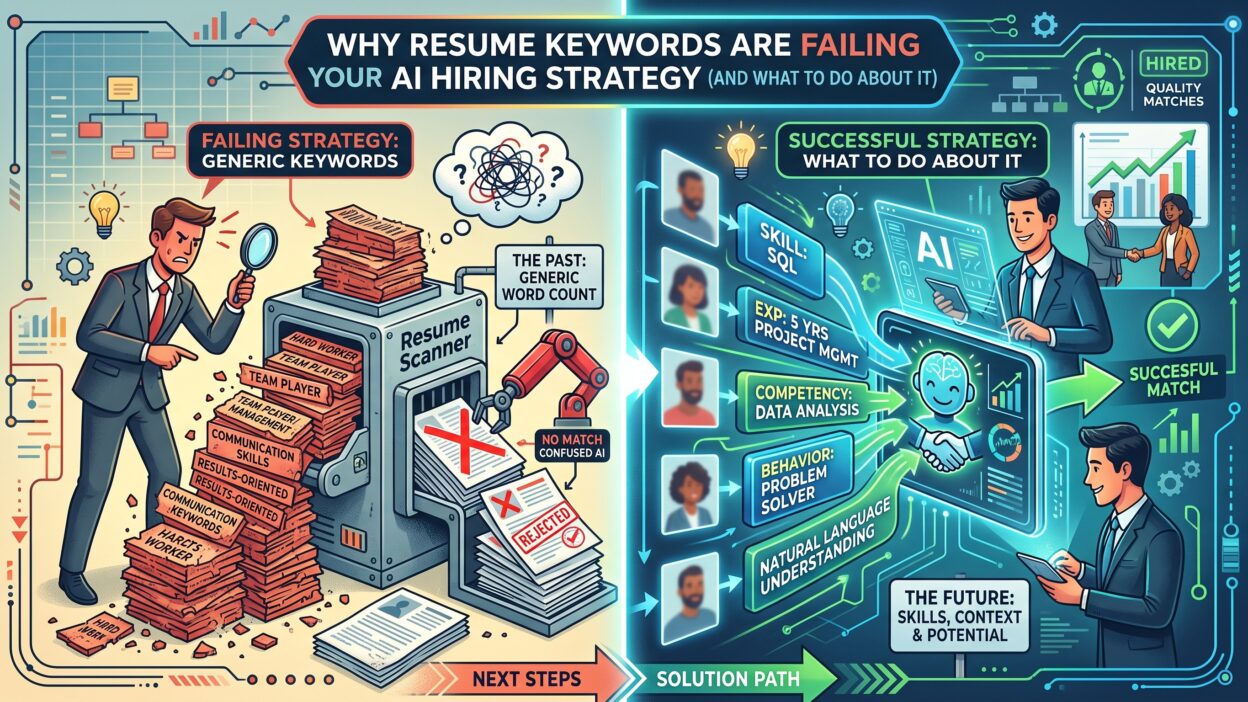
Why Resume Keywords Are Failing Your AI Hiring Strategy Today
AI hiring tools promised something better than a basic keyword search. Many tools still run keyword logic underneath a shinier interface. A recruiter sees a modern dashboard, but the core matching method barely changed from a decade ago.
Resume keywords fail hardest in fast moving fields. Job titles shift constantly in tech, healthcare and marketing roles. A candidate with the exact skill a company needs might use a completely different term on their resume than the term a job posting uses.
AI Tools Inherited an Old Problem
Many AI hiring tools train on old resume data filled with the same keyword patterns recruiters used for years. This training data teaches a new AI system to repeat the same narrow matching logic instead of a smarter approach.
This logic becomes a trap here. A tool built on biased training data keeps rejecting strong candidates who describe their skills honestly instead of stuffing a resume with buzzwords a system expects.
False Confidence in Automated Screening
Teams trust an AI score more than they should. A high keyword match score feels like solid proof of a strong candidate. That confidence often turns out misplaced once a hiring manager finally reviews the actual person behind the score.
Resume keywords create a dangerous illusion of accuracy. A number on a dashboard feels objective, even when the underlying method still misses real talent hiding behind unusual phrasing.
The Real Cost of Over Relying on Resume Keywords
Bad screening carries a real financial cost most teams never calculate properly.
Losing Strong Candidates Before a Human Ever Sees Them
A rejected candidate never gets a second chance in most hiring pipelines. This keyword filter removes this person before a recruiter opens the file. That candidate might have been the strongest applicant in the entire pool.
This silent loss never shows up on a hiring report. Leadership only sees open roles staying open too long, without understanding the root cause sitting inside a broken keyword filter.
Diversity suffers quietly under this same pattern. Candidates from nontraditional backgrounds often describe their experience using language that differs from a standard job posting. A rigid filter removes these candidates first, long before a hiring manager gets a chance to notice the pattern or question the process behind it.
Referral programs mask this damage for a while. A candidate who knows someone inside a company can skip the keyword filter entirely through a personal introduction. This workaround hides the real scale of the problem, since a company only sees the candidates who found a side door around a broken front gate.
Slower Time to Hire Despite Faster Tools
Teams expect AI screening to speed up hiring. Instead, many roles stay open longer because a small pool of keyword matched candidates keeps failing later interview stages. Recruiters restart a search from scratch, which wastes weeks already spent on a weak shortlist.
This early match rate creates a false sense of progress early in a search. That early speed disappears once bad matches fall apart during real interviews later in the process.
What to Do About Failing Resume Keywords
Fixing this problem does not require throwing out every tool a team already owns.
Shift Toward Skills Based Screening
Skills based hiring looks at what a candidate can actually do, not just the words on a page. A short skills assessment reveals real ability faster than any keyword scan. Teams that add this step catch strong candidates that a keyword filter would miss early.
This shift takes real effort upfront. Teams that build one solid assessment per role save far more time later during interviews and onboarding.
Train AI Tools on Broader Language Patterns
Many AI vendors now offer settings that expand keyword matching beyond exact phrases. A recruiter can teach a system that certain terms mean the same skill, even when the wording differs completely.
Keyword matching works better once a system understands synonyms and related terms properly. A recruiter should test this setting on a real batch of past resumes before trusting it on new roles.
Building a simple synonym list takes less effort than most teams expect. A recruiter can pull ten past job postings and ten resumes from strong hires, then note every different term used for the same core skill. This short list becomes the seed for a smarter matching system that catches candidates a strict exact match would reject on the spot.
Add a Human Review Step Before Rejection
No automated system should reject a candidate without any human check at all. A quick human scan of borderline resumes catches strong candidates a keyword filter almost missed completely.
This step adds a small amount of time per role. Teams that skip this check often regret it once a strong hire from a competitor turns out to be someone their own system rejected months earlier.
How to Build an AI Hiring Strategy That Goes Beyond Resume Keywords
A stronger hiring strategy treats resume keywords as one signal among many, not the whole decision.
Combine Multiple Signals Into One Score
Strong hiring teams blend keyword matches with skills tests, work samples and structured interview notes. No single signal decides a candidate’s fate alone. This blended approach catches strong candidates that a narrow keyword filter would miss on its own.
These matches still play a role here, just a smaller one than before. A recruiter treats a keyword match as a starting clue, not a final verdict on a person’s ability.
Weighting matters as much as the number of signals a team uses. A company might give a skills test forty percent of a total score, a structured interview forty percent and a keyword match only twenty percent. This kind of weighting keeps the fast sorting benefit of keyword search while stopping it from deciding a candidate’s fate on its own.
Teams should also track which signal predicts a strong hire best over time. A quarterly look back at past hires shows whether skills tests or keyword matches lined up better with actual job performance. This kind of tracking turns a blended score from a guess into a system built on real evidence.
Review and Update Screening Criteria Every Quarter
Job requirements shift fast in most industries. A screening system built two years ago probably misses new tools and terms candidates use today. Teams that review their keyword lists every quarter catch this drift before it costs them a strong hire.
This review does not need a huge project team. One recruiter and one hiring manager can update a keyword list and test it against recent resumes within a single afternoon each quarter.
A simple calendar reminder keeps this habit alive past the first quarter. Teams that treat this review as a one time project let their keyword list go stale again within a year, right back to the same problem they set out to fix. A quarterly habit, tracked on a shared calendar, costs almost nothing and protects a hiring team from repeating an old mistake.
Common Mistakes Teams Make When Fixing Resume Keyword Problems
Teams often overcorrect once they realize this filtering method caused real damage.
Removing All Automation at Once
Some teams panic and drop every automated tool the moment they spot a problem. This move creates a new bottleneck, since a small recruiting team cannot manually review thousands of resumes by hand.
A better path keeps automation in place while adding smarter checks around it. This filtering still helps sort a huge pile fast, as long as a human stays in the loop for close calls.
Adding Too Many New Steps at Once
Other teams add five new screening steps overnight, which slows hiring down instead of fixing it. A skills test, a human review and a synonym update all launched together confuse a team and frustrate candidates waiting for a response.
A slow rollout works better. Add one fix, measure results for a month, then add the next fix once a team trusts the first change.
ATS Resume Keywords and Resume Screening Software: What Changed in 2026
ATS resume keywords still drive most first round decisions across large companies. Applicant tracking systems scan a resume the moment it lands, long before a recruiter opens the file. This first pass decides which candidates ever reach a human reviewer at all.
Resume screening software vendors added AI branding to almost every product this year. Many of these tools still rely on the same exact match logic underneath a new interface. A recruiter testing a new platform should ask a direct question about how matching actually works before trusting the score it produces.
Keyword stuffing on resumes grew as a common job seeker tactic once online guides explained how these systems work. Candidates pack a resume with terms copied straight from a job posting, sometimes in white text a human eye never sees. This tactic beats a basic filter, but it says nothing real about a candidate’s actual skill level.
AI hiring strategy conversations now include a debate about how much weight a keyword score should carry. Some hiring leaders push to remove keyword scoring entirely. Most experienced recruiters land on a middle path instead, where a keyword match earns a candidate a look, not an automatic pass or automatic rejection.
Skills based hiring keeps gaining ground as a response to weak keyword matching. Companies that add a short skills test alongside keyword screening report stronger hires within a single quarter. This combination catches candidates that a keyword filter alone would miss, while still keeping the process fast enough for high volume roles.
Resume keyword matching accuracy varies wildly across vendors right now. Some platforms understand that a candidate listing “customer support” means the same thing as “client service,” while other platforms treat these as two unrelated terms. Teams should test this behavior directly using old resumes from past strong hires before trusting a new platform with live candidates.
Compliance concerns around this filtering method grew this year too. Regulators in several regions now ask companies to explain how an automated system reaches a hiring decision. A company relying purely on keyword matching struggles to answer this question clearly, since the logic behind a rejection often boils down to a missing word rather than a missing skill.
Teams building a real AI hiring strategy in 2026 treat keyword scoring as one data point inside a larger system, not the entire system on its own. This shift protects a company from compliance risk while also catching stronger candidates that an older, narrower process would have missed completely.
Frequently Asked Questions
Why do resume keywords fail in modern hiring?
Resume keywords fail because candidates describe the same skill using different words. A system built around exact matches misses strong candidates who write their resume in plain language instead of matching a job posting word for word.
Do AI hiring tools fix the resume keyword problem?
Not automatically. Many AI tools still run keyword logic underneath a modern interface. Teams need to check how a tool actually matches candidates before assuming it solved the older keyword matching problem on its own.
Should companies stop using resume keywords entirely?
No. Resume keywords still help sort large applicant pools quickly. The fix involves adding human review and skills based tests around keyword matching, not removing keyword search from the process completely.
How often should a team update its resume keyword list?
Most teams should review their resume keyword list every quarter. Job requirements and common terms shift fast, and an outdated list keeps rejecting strong candidates who use newer language for the same skill set.
What replaces resume keywords in a stronger hiring process?
Nothing fully replaces resume keywords, but skills assessments, work samples and structured interviews add real signal around them. A blended scoring approach protects a team from relying on one narrow filter alone.
Read More:-Jiminny Review 2026: An Honest Assessment
Conclusion

Resume keywords built the foundation of modern hiring for a good reason. They sort huge applicant pools fast, and that speed still matters today. The real problem starts when a team treats a keyword match as the entire answer instead of a first filter among several.
AI hiring tools promised a smarter system, but many tools quietly kept the same narrow logic that failed recruiters for years. Strong candidates keep slipping through the cracks because they describe their skills honestly instead of gaming a keyword scan.
Fixing this problem does not mean throwing out every tool a team already built. It means adding a human check, testing broader language matching and blending keyword data with real skills signals. Small, steady changes work better than a sudden overhaul that confuses a whole team overnight.
Companies that treat resume keywords as one clue among many will out hire competitors still trusting a single filter to make every decision alone. Start with one fix this quarter. Measure the result. Add the next fix once the first one proves itself on real hiring data.
Hiring will keep moving fast through 2026, and the teams that fix their resume keyword problem now will fill roles faster with stronger candidates than teams still stuck on an outdated filter built for a job market that no longer exists.
The companies that win this decade will not be the ones with the fanciest AI dashboard. They will be the ones that ask a simple question before every hire. Does this process find the best person for the job, or does it just find the person who wrote the right words in the right order? Teams that keep asking that question will build stronger teams than any competitor still trusting a single score on a screen.