Introduction
TL;DR Every company sits on piles of data today. Spreadsheets, dashboards, customer records, and system logs stack up fast. Most teams still struggle to turn that pile into a real answer. Data intelligence fixes this gap. It gives every dataset context, meaning, and a clear owner. This guide explains what data intelligence means, why it matters in 2026, and how a team builds it step by step.
Data intelligence is not another dashboard tool. It sits underneath your existing systems and makes them trustworthy. A report only helps a business when the numbers behind it are accurate and understood. Data intelligence delivers that trust at scale, across every team that touches a number.
Most executives already sense the problem even without a name for it. Two departments pull different numbers for the same metric during a leadership meeting. Nobody trusts the dashboard fully, so people quietly rebuild their own spreadsheet instead. Data intelligence exists to end this pattern for good, and this guide breaks down exactly how that happens in practice.
Table of Contents
What Is Data Intelligence
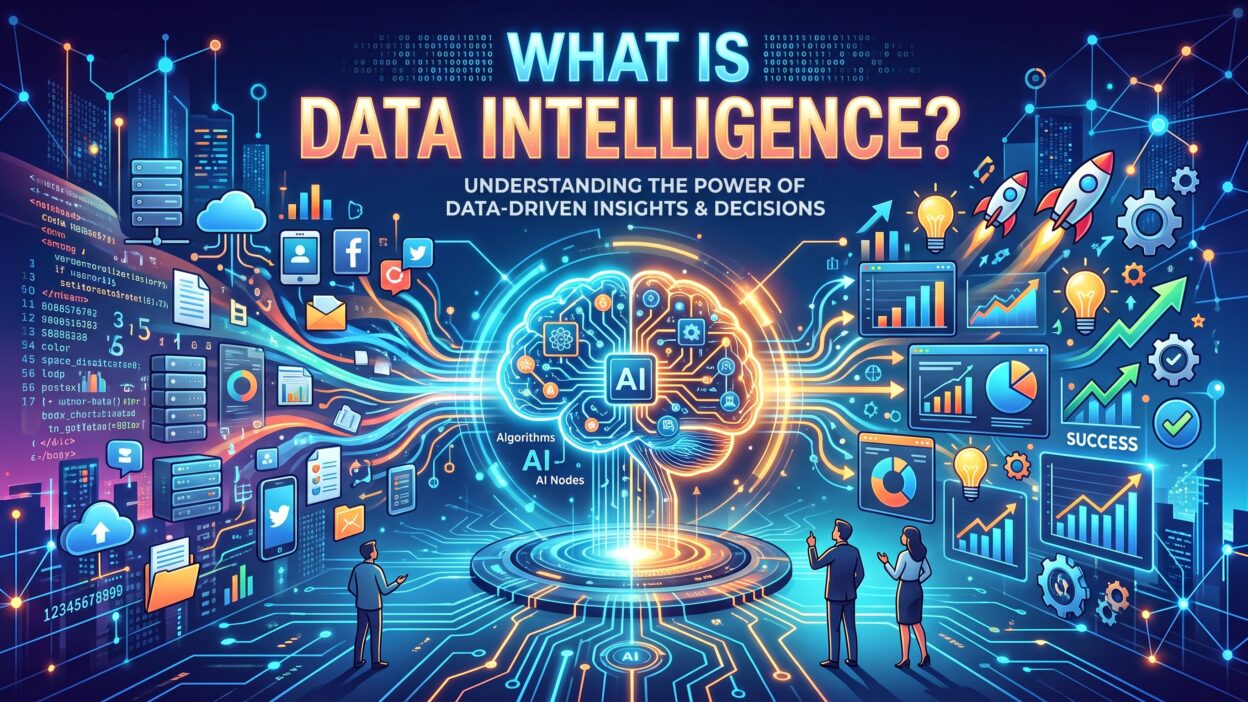
Data intelligence means the practice of collecting, organizing, and understanding data so people and machines use it correctly. It combines data catalogs, quality checks, governance rules, and business context into one connected layer. A raw table of numbers tells you nothing on its own. Data intelligence adds the missing context: where the data came from, who owns it, how fresh it is, and what it actually means for the business.
Think of data intelligence as a map layered on top of your data warehouse. The map shows every table, every field, and every relationship between them. Analysts stop guessing which metric is correct. Executives stop asking why two reports show different numbers for the same quarter. Data intelligence removes that confusion at its root.
The term grew out of data governance and business intelligence, but it goes further than both. Data intelligence covers the full lifecycle of a dataset, from the moment a system creates it to the moment a person or an AI model uses it in a decision.
Why Data Intelligence Matters in 2026
Enterprise data keeps growing every year, and most of it stays locked in unstructured silos. Reports from major data platforms show that a large share of enterprise data remains unusable simply because nobody documented where it lives or what it means. Data intelligence closes this gap directly.
AI adoption raises the stakes even higher this year. Companies now feed data straight into AI agents that make decisions automatically. A wrong number no longer just produces a bad report. It produces a bad action at machine speed. Data intelligence gives these systems the clean, well-documented data they need before they act.
Better Decisions
Leaders make faster calls when they trust the numbers in front of them. Data intelligence removes the back-and-forth over which report is correct. Teams spend less time debating data and more time acting on it.
Stronger Governance
Regulators now enforce privacy laws across more than a hundred countries. Data intelligence tracks who accessed a dataset, why they accessed it, and whether that access followed the rules. This turns compliance into a built-in feature instead of a yearly scramble.
Faster AI Adoption
AI models need clean, labeled, and well-understood data to perform well. Data intelligence supplies that foundation. Companies that invest here move AI projects from pilot to production much faster than companies still fighting messy data.
Core Components of Data Intelligence
A real data intelligence program rests on a few core pillars. Each pillar solves a different piece of the trust problem.
Data Catalogs
A data catalog lists every dataset a company owns, along with its description, owner, and usage history. Analysts search this catalog instead of asking around in Slack for the right table. A strong catalog turns data intelligence from theory into a daily habit for every team.
Semantic Layers
A semantic layer defines what each metric actually means across the business. Revenue means one thing to finance and something slightly different to sales without this layer in place. Data intelligence relies on semantic layers to keep every team speaking the same language around the same numbers.
Data Quality Management
Data quality management checks accuracy, completeness, and consistency before a number reaches a dashboard. Broken pipelines and duplicate records erode trust fast. Data intelligence treats quality checks as a continuous process, not a one-time cleanup project.
Data Governance
Governance sets the rules around who can access data and how that data gets used. Clear ownership and access policies protect a company during audits and security reviews. Data intelligence depends on governance to keep sensitive data safe while still making it usable for the people who need it.
Data Lineage
Data lineage traces a number back to its original source through every transformation along the way. Analysts see exactly which system created a field, which pipeline touched it next, and which report finally displayed it. Data intelligence uses lineage to debug broken numbers fast instead of guessing where the error happened.
Data Observability
Data observability monitors pipelines around the clock and flags anomalies before a human even notices. A sudden drop in row count or a missing daily update triggers an alert automatically. Data intelligence platforms increasingly bundle observability directly into the catalog, so teams catch problems within minutes instead of days.
How Data Intelligence Works
Data intelligence starts the moment a system creates a new dataset. Metadata gets attached automatically, capturing the source, the owner, and the format. This metadata feeds into a catalog that every employee can search.
Next, quality checks run against the dataset on a set schedule. These checks flag missing fields, duplicate rows, and values that fall outside an expected range. A failed check alerts the data owner before a broken number reaches a report.
Semantic definitions sit on top of this clean data. A single definition of “active customer” or “monthly revenue” applies across every dashboard and every AI model that touches the number. This step alone eliminates most cross-team disputes over conflicting metrics.
Governance rules run in the background through all of this. Access logs track every query. Sensitive fields stay masked for users without the right permission level. Data intelligence ties all four steps together into one continuous loop instead of four disconnected tools.
This loop repeats constantly, not just once during a big rollout. New data arrives every day, so the catalog, the quality checks, and the governance rules all update in near real time. A data intelligence platform that only runs once a quarter falls behind fast, and stale metadata causes just as much confusion as no metadata at all.
Data Intelligence vs Business Intelligence
Business intelligence focuses on reporting and dashboards. It answers a specific question with a chart or a number. Data intelligence sits one level deeper. It makes sure the data feeding that chart is accurate, documented, and consistent in the first place.
A business intelligence tool can display a wrong number just as easily as a right one. Data intelligence prevents that wrong number from reaching the dashboard at all. The two disciplines work together, but data intelligence acts as the foundation underneath every business intelligence report a company produces.
Think about a sales dashboard that suddenly shows a strange spike in revenue. A business intelligence tool simply renders that spike as a chart, without questioning where the number came from. Data intelligence catches the root cause instead, tracing the spike back to a duplicate record or a broken join in the pipeline before anyone presents the wrong figure to leadership.
Data Intelligence vs Data Analytics
Data analytics focuses on finding patterns and answering business questions through statistical methods. Analysts build models, run queries, and generate insights from existing datasets. Data intelligence supports this work by making sure the underlying data is clean and well understood before analysis even begins.
Without data intelligence, an analyst wastes hours hunting down the right table and confirming a metric’s true definition. With data intelligence in place, that same analyst jumps straight into the actual analysis. The output improves because the input already earned trust.
Data science teams feel this difference the most. A machine learning model trained on inconsistent or mislabeled data produces unreliable predictions no matter how sophisticated the algorithm is. Data intelligence gives these teams a documented, quality-checked dataset from the start, which shortens model development time and improves accuracy at the same time.
Data Intelligence Use Cases by Industry
Data intelligence looks different depending on the industry, but the core value stays the same: trusted data that people and machines actually use with confidence.
Financial Services
Banks and insurers deal with strict regulatory reporting every quarter. Data intelligence tracks exactly where each number in a compliance report originated. Auditors get a clear trail instead of a scramble through old spreadsheets. Fraud teams also benefit, since clean and well-labeled transaction data helps detection models catch real threats faster.
Healthcare
Hospitals and health systems manage patient records across dozens of disconnected systems. Data intelligence links these records safely while respecting strict privacy rules like HIPAA. Doctors and administrators pull a complete patient history without hunting through five separate portals, and researchers get cleaner datasets for clinical studies.
Retail and E-commerce
Retailers track inventory, customer behavior, and pricing across physical stores and online channels at once. Data intelligence keeps product data consistent across every channel, which prevents pricing errors and stock mismatches. Marketing teams also build more accurate customer segments once purchase history and browsing data reconcile properly.
Technology Companies
Software companies generate massive volumes of product usage data every single day. Data intelligence helps product teams trust their own metrics before making a roadmap decision. Engineering teams also rely on lineage tracking to debug data pipeline failures before they reach a customer-facing dashboard.
Signs Your Company Needs Data Intelligence
Some warning signs show up long before a company names its data problem. Two teams reporting different numbers for the same metric during a leadership review is usually the first clue. Nobody trusts the dashboard, so people quietly build their own version in a spreadsheet.
Slow answers to simple questions signal the same underlying issue. An executive asks for last quarter’s churn rate, and the answer takes three days instead of three minutes. That delay usually traces back to missing documentation, not a lack of effort from the analytics team.
Frequent data breaches or failed audits point to weak governance underneath a company’s reporting layer. A compliance review that turns into a weeks-long fire drill signals the absence of proper data intelligence. Companies that see these signs early save themselves far more pain than companies that wait for a major incident to force the investment.
Benefits of Data Intelligence
Companies that build strong data intelligence programs see returns across nearly every department. Finance teams close their books faster because numbers reconcile automatically instead of requiring manual checks. Marketing teams trust customer segments because the underlying records stay accurate and current.
Data intelligence also shortens the path from a business question to a confident answer. Executives stop waiting days for an analyst to confirm a number from three different systems. They pull one trusted answer directly from a governed source instead.
Security teams benefit too. A clear map of where sensitive data lives makes audits faster and breach response far more precise. Data intelligence turns what used to be a manual, stressful compliance exercise into a repeatable, documented process.
Common Challenges in Building Data Intelligence
Most companies start their data intelligence journey with fragmented systems. Data lives across a dozen tools, and nobody owns the full picture. This fragmentation slows every project down before it even starts.
Legacy systems create another obstacle. Old databases rarely include the metadata a modern data intelligence platform expects. Teams end up manually documenting years of undocumented tables before real progress begins.
Culture presents the hardest challenge of all. Data intelligence only works when people actually use the catalog and trust the governance rules behind it. A brilliant platform fails the moment analysts go back to old habits and skip the documented, governed path.
Budget constraints slow adoption too. Enterprise data intelligence platforms carry real licensing costs, and leadership needs a clear ROI case before signing off. Teams that start small, prove value on one use case, then expand tend to succeed more often than teams that attempt a full rollout on day one.
Skill gaps create a quieter but equally real challenge. Many organizations lack staff who understand both the technical side of data pipelines and the business context behind each metric. Data intelligence programs succeed faster when they pair a technical data steward with a business owner on every major dataset, rather than leaving either role to work in isolation.
How to Build a Data Intelligence Strategy
Start with an honest audit of your current data landscape. Map every major system, every data owner, and every known quality issue. This audit becomes the foundation your data intelligence program builds on top of.
Pick one high-value use case for your first rollout. A finance reconciliation project or a customer data cleanup effort both work well as starting points. Prove that data intelligence delivers real value here before expanding to the rest of the company.
Assign clear ownership for every dataset in scope. A dataset without an owner drifts out of date fast, and nobody notices until a report breaks. Data intelligence requires named accountability at every level, not just a shared responsibility model that nobody actually owns.
Train your teams on the new catalog and the new governance rules. Adoption fails when people don’t know a better tool exists or don’t understand why it matters. A short training session pays for itself the first time someone finds the right dataset in seconds instead of hours.
Measure progress with real numbers. Track how often teams use the catalog. Track how many quality issues get caught before they reach a report. Data intelligence programs that measure their own impact win budget for the next phase far more easily than programs running on faith alone.
Revisit the strategy on a set schedule instead of letting it run on autopilot. Quarterly reviews catch drift early, before an outdated catalog entry misleads an entire team. A data intelligence program treated as a living system, not a finished project, keeps earning trust long after the initial rollout ends.
Tools and Platforms for Data Intelligence
Several platforms now specialize in data intelligence as a standalone category. Data catalogs like Alation and Collibra help teams document and search their datasets. Semantic layer tools connect metric definitions directly to dashboards and AI applications. Data quality platforms run automated checks around the clock and flag problems before they spread.
Cloud data platforms increasingly bundle these capabilities together instead of selling them as separate tools. This convergence simplifies procurement for teams building a data intelligence program from scratch. A smaller team can now get catalog, quality, and governance features from a single vendor instead of stitching together four separate contracts.
Vendor choice matters less than most teams assume at the start. A mid-tier catalog tool used consistently beats a top-tier platform that sits half-configured after the initial rollout. Pick a platform that fits your current team’s skill level, then expand its use as your data intelligence program matures and proves its value across more departments.
Frequently Asked Questions
What is data intelligence in simple terms? Data intelligence means making data trustworthy and understandable across an entire company. It combines catalogs, quality checks, and governance so every team works from the same accurate numbers.
How is data intelligence different from artificial intelligence? Artificial intelligence builds models that make predictions or automate tasks. Data intelligence makes sure the data feeding those models stays clean, documented, and well governed. One depends heavily on the other.
Does a small business need data intelligence? Yes, though the scale looks different. Even a small team benefits from a clear map of where data lives and who owns it. Data intelligence prevents costly mistakes long before a company reaches enterprise size.
What roles usually own data intelligence inside a company? Data governance leads, analytics engineers, and chief data officers typically drive data intelligence programs. Individual department heads often own the quality of their own datasets within that broader structure.
How long does it take to build a data intelligence program? Most companies see early wins within three to six months on a focused use case. A mature, company-wide data intelligence program usually takes one to two years to reach full scale.
Can data intelligence work without a dedicated platform? Yes, at a small scale. Some teams start with shared documentation and manual quality checks. Growth eventually pushes most companies toward a dedicated data intelligence platform once manual processes stop scaling.
Does data intelligence replace a data warehouse? No. A data warehouse stores the raw data itself. Data intelligence sits on top of that warehouse, adding context, quality checks, and governance so the stored data becomes usable and trustworthy.
What is the biggest mistake companies make with data intelligence? Most companies try to solve every data problem at once instead of proving value on a single use case first. This approach burns budget and momentum before leadership sees any real return.
Read More:-Best Recruiting Agents in 2026: Separating Agents From Assistants
Conclusion

Data intelligence turns scattered, undocumented data into a real business asset. It gives every team a shared, trusted foundation instead of competing spreadsheets and conflicting reports. Companies that invest here move faster, govern better, and adopt AI with far less risk.
The work never really finishes, and that fact matters more than it sounds. New systems appear, old ones retire, and data keeps growing every single quarter. A living data intelligence program adapts alongside that growth instead of treating documentation as a one-time project.
Start small. Pick one use case, prove the value, and expand from there. Data intelligence rewards patience and clear ownership over rushed, company-wide rollouts. The companies that build this foundation now will move faster than competitors still arguing over whose number is correct.