Introduction
TL;DR Marketing teams face a hard choice every quarter. They need fresh contacts, real intent signals, and clean segments. Audience data providers solve this problem. They collect, verify, and package information about businesses and consumers. This guide ranks the 10 best audience data providers of 2026. You get real use cases, pricing signals, and a clear picture of who each platform serves best.
Picking the wrong vendor costs real money. Bad contact lists bounce emails and burn sender reputation. Weak consumer segments waste ad spend on people who never buy. Audience data providers exist to fix these problems, but only when a team picks the right one for its actual goal. This guide walks through pricing, coverage, and fit so you skip the guesswork.
Budgets in 2026 stretch thinner than before. Teams cannot afford a platform that promises scale but delivers stale records. Every provider on this list earned its spot through verified accuracy, real customer reviews, and a clear compliance record. Read each profile before you shortlist a vendor for your own stack.
Table of Contents
What Are Audience Data Providers
Audience data providers are companies that gather information about people and businesses, then sell it to marketers. They pull data from public records, website activity, surveys, and partner networks. Some providers focus on B2B contacts. Others focus on consumer demographics and shopping habits. A good audience data provider gives you accurate names, verified emails, job titles, and behavior signals. Sales teams use this data to find leads. Advertisers use it to build targeted campaigns. Without reliable audience data providers, teams waste budget on wrong contacts and irrelevant ads.
Types of Data Audience Data Providers Collect
Not every audience data provider sells the same product. Data types vary by category, and each type solves a different marketing problem.
Contact Data
Contact data includes names, verified emails, direct phone numbers, and job titles. Sales teams rely on this data to reach decision makers directly. Providers like ZoomInfo and Cognism build their entire product around verified contact records.
Intent Data
Intent data shows which companies research a topic right now. It comes from content consumption patterns across publisher networks. Bombora and 6sense both specialize in this category. Marketing teams use intent signals to prioritize outreach before a competitor gets there first.
Identity Data
Identity data connects a single person across devices, browsers, and apps. This matters because buyers switch between a phone, a laptop, and a tablet during research. LiveRamp leads this category through deterministic matching instead of guesswork.
Consumer Demographic Data
Consumer demographic data covers age, income, household size, and purchase history. Retail and CPG brands use this data to build lookalike audiences for national campaigns. Acxiom and Oracle Data Cloud both hold deep consumer datasets built for this exact purpose.
Firmographic and Technographic Data
Firmographic data covers company size, revenue, and industry. Technographic data shows which software tools a company already uses. B2B audience data providers combine both types to help sales teams qualify accounts before a first call happens.
Why Businesses Need Audience Data Providers in 2026
Privacy rules changed the entire data landscape this year. Eight new state privacy laws took effect in 2025. CPPA regulations started on January 1, 2026. Third-party cookies keep losing reach across major browsers. Teams now depend on audience data providers that offer consent-based and identity-based targeting instead of cookie tracking.
Better Targeting Accuracy
A strong audience data provider builds segments from verified signals. This cuts wasted ad spend. Sales reps stop chasing bad leads. Marketing teams reach real buyers instead of guessing.
Compliance and Trust
Every serious audience data provider now publishes its consent methodology. Buyers ask about GDPR and CCPA compliance before signing a contract. Vendors who dodge this question raise a red flag immediately.
Speed and Efficiency
Manual list building takes weeks. A modern audience data provider delivers enriched contacts and segments in minutes through direct integrations. Teams launch campaigns faster and close deals sooner.
How We Selected the Best Audience Data Providers
We reviewed data accuracy, refresh cycles, integration depth, and compliance posture for each platform. We compared pricing structures across B2B and B2C use cases. We also checked user reviews from G2 and Datarade to confirm real-world performance. This list reflects the audience data providers that consistently deliver clean, usable data at scale.
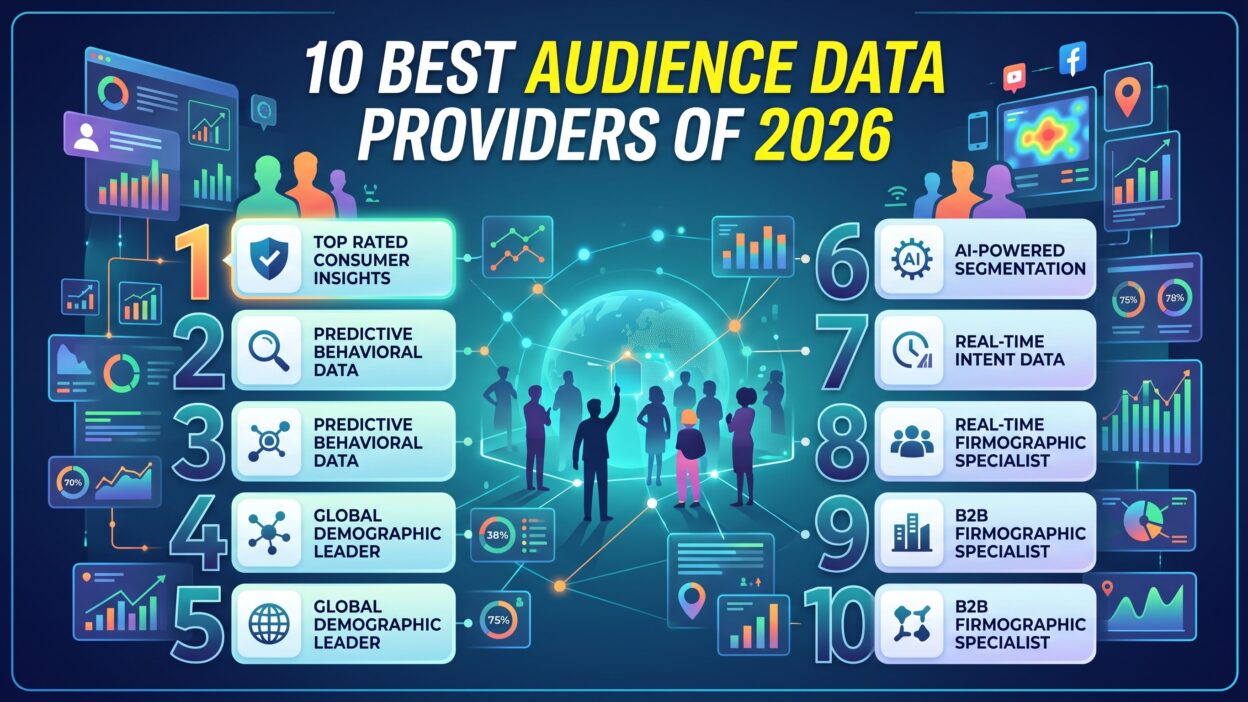
10 Best Audience Data Providers of 2026
Here are the 10 best audience data providers of 2026, ranked by data quality, coverage, and campaign performance.
1. ZoomInfo
ZoomInfo leads the B2B space among audience data providers. The platform combines contact data, intent signals, and firmographic details in one dashboard. Sales teams use ZoomInfo to identify decision makers inside target accounts. The intent engine tracks which companies research specific solutions online. Native CRM integrations sync new contacts automatically, which removes manual list uploads from a rep’s daily routine.
The platform also supports account scoring, so managers can rank territories by fit and readiness. Marketing teams pull the same data into ad platforms for account-based targeting. This overlap between sales and marketing use cases explains why so many enterprise teams standardize on one system instead of running separate tools. Pricing starts around $15,000 per year for full platform access. ZoomInfo works best for mid-market and enterprise teams that need contacts and intent under one roof.
2. LiveRamp
LiveRamp specializes in identity resolution. It connects customer records across devices without relying on cookies. The platform matches roughly 2.5 devices per input record on average, using a 90-day lookback window. Email-based matching performs better than mobile ad ID matching, especially since Apple limited tracking permissions.
Retailers and publishers use LiveRamp to onboard their own first-party data, then activate it across dozens of ad platforms without exposing raw customer records. This clean-room approach keeps sensitive data protected while still enabling precise targeting. LiveRamp’s Authenticated Traffic Solution helps brands activate audiences in privacy-safe environments as cookie support keeps shrinking across browsers. Annual pricing runs between $50,000 and $150,000 depending on scale. Choose LiveRamp when your core need is connecting first-party data to activation platforms rather than buying net-new contacts.
3. Nielsen
Nielsen built its reputation on audience measurement, not just segment sales. The platform offers over 20,000 custom and syndicated segments for programmatic campaigns. Nielsen’s real strength lies in connecting media consumption data with campaign planning.
Broadcast and streaming advertisers rely on Nielsen to validate reach across linear TV and digital channels, then compare that reach against competitor spend in the same category. Media planning teams use Nielsen data before a campaign launches, not only after it ends. This planning-first approach separates Nielsen from providers built purely for real-time targeting. Pricing is custom and usually bundled with broader Nielsen marketing packages. Nielsen fits teams that prioritize measurement alongside targeting, especially across TV and streaming budgets.
4. Bombora
Bombora built its name on B2B intent data. The platform tracks content consumption across a large publisher network to flag companies actively researching a topic. Marketing teams layer Bombora signals on top of existing CRM data to prioritize outreach. Sales reps stop cold calling accounts with zero buying interest.
The Company Surge score ranks accounts by spikes in research activity around specific business topics. Demand generation teams use this score to time email campaigns and ad spend around real buying windows. Bombora integrates with major marketing automation tools and ABM platforms, so intent scores flow directly into existing workflows without extra manual work. Pricing varies by data volume and typically starts in the five-figure range annually.
5. 6sense
6sense combines intent data with predictive analytics. The platform scores accounts based on buying stage, not just activity volume. Revenue teams use 6sense to know exactly when to reach out and through which channel. The predictive model reduces guesswork in account-based marketing programs.
Sales and marketing leaders use 6sense to align on the same account list instead of running separate spreadsheets. The platform flags anonymous website visitors and matches them back to known accounts, which surfaces pipeline that would otherwise stay invisible. 6sense integrates directly with Salesforce, HubSpot, and major ad platforms. Enterprise pricing starts in the tens of thousands annually. Choose 6sense when your team runs structured ABM campaigns at scale and needs one shared view of account readiness.
6. Acxiom
Acxiom focuses on consumer-side audience data instead of B2B contacts. The platform holds household-level demographic, purchase, and lifestyle data across the US population. Retail and CPG brands use Acxiom to build lookalike audiences for national campaigns.
Acxiom’s long history in data governance gives large advertisers confidence during compliance reviews. Legal teams at major brands often require this track record before a contract moves forward. The company maintains strict data governance standards, which large advertisers require before signing contracts. Acxiom also supports data collaboration between brands and retail partners, letting two companies match audiences without exposing raw customer lists to each other. Acxiom pricing depends on data volume and campaign scope, with custom quotes for most deals. Pick Acxiom for large-scale consumer targeting with verified demographic depth.
7. Oracle Data Cloud
Oracle Data Cloud serves consumer brands that need purchase pattern data at scale. The platform aggregates transaction data from retail partners, then builds audience segments around real buying behavior. Advertisers use Oracle to reach shoppers based on category spend, not just declared interests.
This transaction-based approach outperforms interest-based targeting for retail campaigns, since real purchase history predicts future purchases better than a stated preference. Grocery, beauty, and CPG brands lean on Oracle segments to plan seasonal campaigns around actual spending patterns instead of assumptions. The data integrates with major demand-side platforms for programmatic activation. Pricing scales with impression volume and segment complexity. Oracle Data Cloud suits brands running large consumer campaigns tied to purchase intent.
8. Comscore
Comscore measures audiences across digital, linear TV, and streaming platforms. Media buyers use Comscore to plan campaigns and verify delivery after launch. The platform’s cross-platform measurement helps brands avoid double-counting reach across channels.
Streaming services and broadcast networks depend on Comscore data to negotiate ad rates with confidence, since both sides trust the same third-party measurement standard. This shared trust reduces disputes during campaign settlement. Comscore also offers audience segments for programmatic targeting, though measurement remains its core strength. Pricing is custom based on media spend and reporting needs. Choose Comscore when cross-channel measurement matters as much as targeting.
9. GWI
GWI, formerly GlobalWebIndex, takes a survey-based approach instead of pure behavioral tracking. The platform runs consumer panels across more than 50 markets, capturing attitudes and motivations that pure activity data misses. Brand strategists use GWI to understand why an audience buys, not just what they buy.
Creative and brand teams pull GWI data before a campaign brief goes out, since messaging built on real attitudes performs better than messaging built on assumptions. Research teams also use GWI to track shifting consumer sentiment across international markets over time. This makes GWI valuable for positioning and messaging work, alongside targeting. Pricing starts with a limited free tier, and paid plans begin near $125 per month. GWI fits teams that need psychographic depth across global markets.
10. Cognism
Cognism focuses on verified B2B contact data with strong European coverage. The platform emphasizes phone-verified numbers, which improves connect rates for outbound sales teams. Cognism also layers intent signals on top of contact records to help reps prioritize accounts.
Sales development teams selling across multiple countries often struggle with inconsistent data quality outside the US. Cognism built its database specifically to close that gap across the UK, Europe, and parts of APAC. GDPR compliance sits at the center of Cognism’s data sourcing process, which matters for teams selling into European markets. Pricing is custom and typically quoted per seat. Cognism works well for sales teams that need direct-dial accuracy across international regions.
B2B vs B2C Audience Data Providers
B2B audience data providers focus on company information. They deliver job titles, firmographics, technographics, and buying intent signals. Sales and marketing teams use this data to prioritize accounts and reach decision makers directly. ZoomInfo, Bombora, 6sense, and Cognism all fall into this category.
B2C audience data providers focus on individual consumers instead. They track demographics, household data, and purchase history. Retail and consumer brands use this data to build lookalike audiences and run large-scale ad campaigns. Acxiom and Oracle Data Cloud represent this side of the market well.
The right choice depends entirely on your goal. B2B teams need contact-level precision. B2C brands need scale and demographic depth. Many companies end up using one provider from each category to cover both needs.
Common Mistakes Teams Make With Audience Data Providers
Many teams sign a contract before testing a sample list. This mistake costs the most money over time. A vendor’s homepage can promise millions of contacts, yet a real test often reveals high bounce rates once a team sends actual emails.
Another common mistake involves buying an all-in-one platform without checking the fit first. Some teams pay enterprise prices for intent data and contact data together, then only use one feature set. A smaller, focused audience data provider often covers the same real need at a fraction of the cost.
Teams also skip the compliance conversation too often. A vendor might store consumer records without a clear consent trail. This exposes a brand to legal risk the moment a regulator asks for documentation. Every audience data provider on a shortlist deserves a direct question about consent and lawful basis before money changes hands.
Finally, some teams treat third-party data as a replacement for first-party data instead of a supplement. Purchased contacts and segments work best alongside a company’s own customer records, not instead of them. First-party data stays the most accurate signal a business owns, and audience data providers should extend that signal, not override it.
How to Choose the Right Audience Data Provider
Start with your actual use case, not the biggest database on the market. A provider with 500 million contacts means nothing if 30 percent of those emails bounce. Ask every vendor for their verified accuracy rate on a sample list before you commit.
Check the refresh cycle next. Weekly refresh is the current benchmark among top audience data providers. Many enterprise vendors only refresh every six weeks, which leads to stale contacts and wasted outreach.
Confirm the matching methodology too. Deterministic matching links verified identities directly. Probabilistic matching relies on statistical guesses instead. The difference shows up fast in campaign performance, even though both terms sound similar on a sales call.
Finally, review the compliance posture of each audience data provider carefully. Ask for their lawful basis under GDPR and CCPA. A vendor who cannot answer this question clearly is not ready for your business.
Test integration depth before you sign anything. A provider might hold great data, yet a clunky export process still slows your team down every week. Look for native connections to your CRM, your ad platforms, and your marketing automation tool. A clean integration turns raw records into daily pipeline instead of a spreadsheet nobody opens.
Budget for the true cost, not the sticker price. Implementation, onboarding, and seat licenses often add 15 to 25 percent on top of a quoted contract. A vendor quoting $40,000 can become a $48,000 line item once your team gets fully set up. Ask for this number upfront so budget planning stays accurate.
Frequently Asked Questions
What do audience data providers actually sell? They sell verified contact information, firmographic details, intent signals, and consumer demographic data. Marketing and sales teams use this data to build targeted campaigns and prioritize outreach.
Are audience data providers still useful without third-party cookies? Yes. Many audience data providers now build cookieless solutions using authenticated identifiers and consent-based matching. This keeps targeting accurate even as browser tracking disappears.
How much do audience data providers cost? Pricing ranges widely. Contact-level providers can start under $50 per month on entry plans. Enterprise platforms with intent data and identity resolution often cost $15,000 to $150,000 annually.
Is one audience data provider enough for most teams? Usually not. Most teams pair a contact-level provider with an intent-data source. B2B teams often need both to cover outbound and account prioritization.
What separates a good audience data provider from a weak one? Verified accuracy, frequent refresh cycles, and clear compliance answers separate strong providers from weak ones. Scale alone does not indicate quality.
Do audience data providers work for small businesses? Yes. Several providers now offer free tiers or usage-based pricing built for small teams. This lets smaller companies test data quality before signing annual contracts.
Should audience data providers replace first-party data collection? No. Purchased data works best alongside a company’s own customer records, not instead of them. First-party data remains the strongest signal a brand owns, and a good audience data provider extends that signal rather than replacing it.
How often should a company switch audience data providers? Only when accuracy drops or pricing stops matching value delivered. Switching costs time and integration effort, so most teams re-evaluate their audience data provider once a year instead of chasing every new vendor on the market.
Read More:-Why Resume Keywords Are Failing Your AI Hiring Strategy (And What to Do About It)
Conclusion

Choosing among audience data providers comes down to three things. You need accurate data, a fast refresh cycle, and a clear compliance answer. ZoomInfo and Cognism lead the B2B contact space. LiveRamp and Bombora strengthen identity resolution and intent tracking. Acxiom and Oracle Data Cloud serve consumer brands running large-scale campaigns. Nielsen, Comscore, and GWI add measurement and psychographic depth to the mix.
No single provider covers every use case perfectly. Most successful teams pair a contact-level vendor with an intent or identity layer, then keep first-party data at the center of every decision. This combination costs less than a single all-in-one platform and often performs better in real campaigns.
Test each shortlisted provider on a small sample first. Verify the bounce rate. Confirm the refresh cadence. Ask direct questions about consent and compliance before any contract gets signed. Scale your investment only once the data proves itself through real campaign results, not through a sales deck.