Introduction
TL;DR Hiring teams hear a new buzzword every quarter. This year the word is agents. Vendors call every tool an agent now, even simple chatbots. This confusion makes it hard to spot the best recruiting agents from a basic assistant wearing a new label.
A real recruiting agent does more than answer questions. It sources candidates on its own. It screens resumes without a human pressing a button each time. It ranks candidates and schedules calls while a recruiter sleeps. An assistant waits for instructions. An agent acts on a goal and reports back.
This blog draws a clear line between the two. Readers learn what separates the best recruiting agents from tools that only look smart in a demo. Readers also get a practical way to test any tool before signing a contract.
Recruiting teams face real pressure in 2026. Budgets stay flat while hiring volume grows. Recruiters manage more open roles than last year, often with the same headcount on their own team. The best recruiting agents solve this exact problem. They take repetitive work off a recruiter’s plate and let humans focus on final interviews and offers.
This guide covers features, use cases, mistakes and a clear evaluation method. It also answers common questions hiring leaders ask before they buy. By the end, readers know exactly how to spot the best recruiting agents in a crowded market full of copycat tools.
Every section below includes real detail, not vague marketing language. Recruiters can use this guide during their next vendor call this week.
Table of Contents
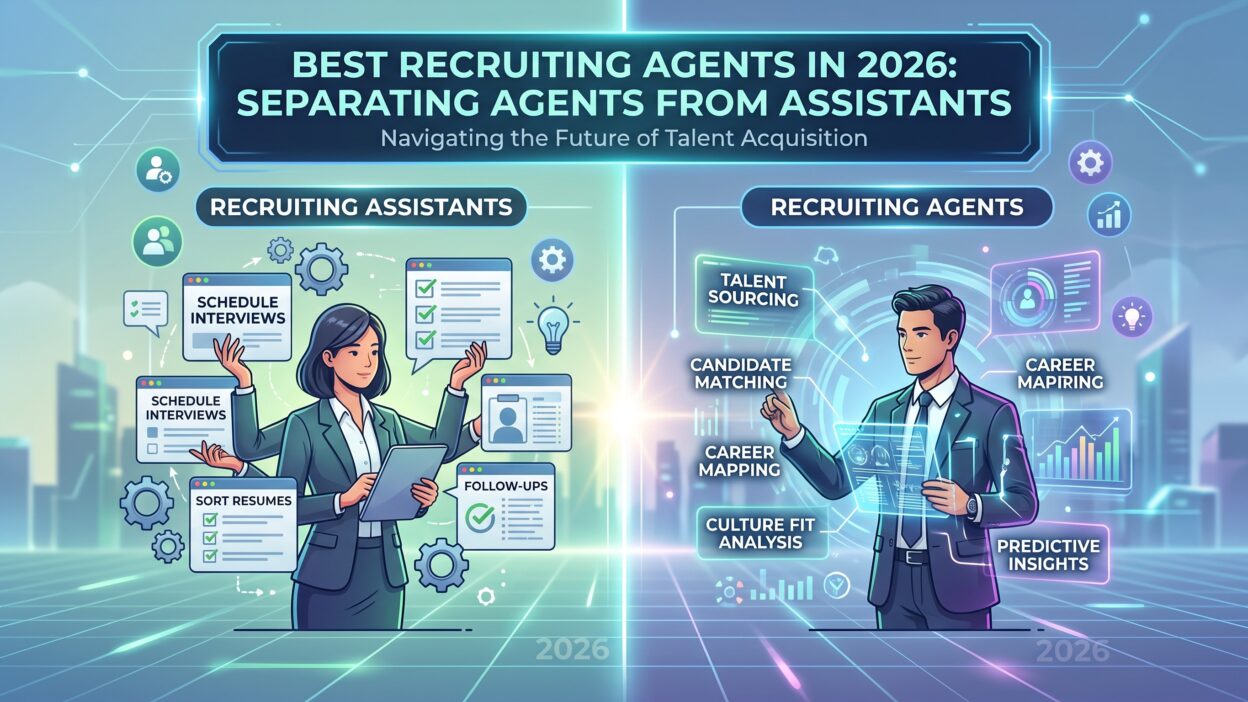
What Makes an Agent Different From an Assistant
An assistant follows a script. A recruiter types a command. The assistant runs that one task and stops. It cannot chain steps together on its own. It needs a human to press go every single time.
An agent works differently. A recruiter sets a goal, such as fill this sales role by month end. The agent breaks that goal into steps on its own. It searches job boards. It drafts outreach messages. It screens replies and books calls without waiting for approval at each stage.
The best recruiting agents combine both strengths in one system. They act independently on routine steps. They still flag major decisions, such as a final offer, for human review. This balance keeps humans in control while removing hours of manual work each week.
The Core Difference in Autonomy
Autonomy sits at the center of this whole debate. An assistant has zero memory between tasks. Ask it to find candidates today, and it forgets that request tomorrow. A true agent remembers context. It tracks which candidates already got a message. It adjusts its next move based on a reply from last week.
The best recruiting agents plan several steps ahead. They notice when a candidate goes quiet and follow up on their own schedule. They notice when a job posting gets weak response and suggest a new headline without a recruiter asking first. This forward planning marks the real gap between an agent and a basic assistant.
Recruiters testing a new tool should ask one direct question. Does this tool take the next step on its own, or does it wait for me every time? That single question exposes most fake agents within minutes.
Why Best Recruiting Agents Matter in 2026
Hiring volume keeps climbing this year across most industries. Recruiters juggle more roles than ever before, often across multiple countries and time zones. Manual sourcing cannot keep pace with this demand on its own.
The best recruiting agents close this gap without adding headcount. They run outreach around the clock. They screen hundreds of resumes in the time a human reviews ten. This speed matters most in industries with tight talent pools, such as software engineering and healthcare.
Candidate expectations shifted too. Job seekers expect a fast reply after they apply. A slow process pushes strong candidates toward a competitor within days. Agents respond within minutes, which keeps top talent engaged during a critical window.
The Hiring Market Pressure Behind This Shift
Budgets tightened across most companies this year. Leadership asks recruiting teams to do more with the same staff. This pressure pushes teams toward automation faster than any previous hiring cycle.
The best recruiting agents give recruiters back real hours each week. Those hours go toward interviews, offer calls and candidate experience instead of manual searches. Companies that adopt agents early report faster time to hire during this current market.
Competitors watch each other closely in this space. Once one company in an industry adopts strong recruiting agents, rivals follow within a few months to stay competitive on speed.
Key Features of the Best Recruiting Agents
Every strong recruiting agent shares a few core features. These features separate real agents from tools riding the current hype wave.
Autonomous Sourcing and Outreach
The best recruiting agents search multiple platforms without manual input from a recruiter. They pull candidates from job boards, professional networks and internal databases at the same time. They build a shortlist within minutes instead of hours.
Outreach happens automatically too. The agent drafts a message suited to each candidate’s background. It sends that message at the right time based on each candidate’s location. It follows up on its own schedule if a candidate stays silent for a few days.
This autonomy saves recruiters from the most repetitive part of the job. Recruiters review the shortlist an agent builds instead of building that list by hand every morning. This single shift often frees up several hours per week for a busy recruiter.
Independent Screening and Ranking
Screening ranks as another core strength among the best recruiting agents. The agent reads each resume against a role’s real requirements. It ranks candidates based on skill match, not just keyword count. This ranking method catches strong candidates that a basic keyword filter would miss.
Interview scheduling happens without back and forth emails too. The agent checks a recruiter’s calendar and a candidate’s availability together. It books a time slot that works for both sides within minutes, not days.
The strongest agents also learn from past hires. They notice which candidate traits led to a successful hire in prior rounds. They apply that pattern to future rankings, which improves match quality over time. This learning loop separates true agents from static tools that never improve.
Recruiting Agents vs Recruiting Assistants: A Clear Comparison
Many teams confuse these two categories during a vendor pitch. A clear comparison removes that confusion fast.
What Assistants Do Well
Assistants handle simple, single-step tasks well. They draft a job description when a recruiter asks. They answer basic candidate questions through a chat window. They schedule one meeting when given exact times to choose from.
Assistants work best for teams with light hiring volume. A small company filling two roles a quarter gets real value from a simple assistant. The task list stays short, so a lack of autonomy rarely causes friction in daily work.
Assistants also cost less than full agents in most cases. Teams on a tight budget can start here and upgrade later once hiring volume grows.
Where Agents Take Over
Agents shine once hiring volume grows past a few roles per month. The best recruiting agents manage dozens of open roles at the same time without losing track of any single candidate. They juggle outreach, screening and scheduling across every role at once.
Agents also adapt mid process. If a role gets zero strong applicants in the first week, the agent adjusts its search criteria on its own. An assistant would keep running the same failed search until a human notices and steps in.
Teams with high volume hiring, seasonal spikes or hard to fill technical roles get the most value from real agents. The extra cost pays off quickly once a team sees hours saved each week and faster time to hire.
Top Use Cases for the Best Recruiting Agents in 2026
Certain hiring situations show the clearest return from recruiting agents this year.
High Volume Hiring
Retail chains, call centers and warehouse operations hire hundreds of workers each season. Manual screening cannot handle this volume without a huge team behind it. These agents screen and rank hundreds of applicants within a single day.
Seasonal hiring spikes create the strongest case for agents. A retail brand hiring three hundred workers before a holiday season needs speed above all else. Agents handle this surge without extra temporary staff on the recruiting side.
Niche and Technical Roles
Specialized roles create a different challenge. Few candidates match strict technical requirements for a senior engineering or data science role. These agents search niche communities and technical forums that a generic job board would miss.
These agents also screen technical skill more precisely. They review a candidate’s project history and code samples against a role’s exact needs. This precision matters more for a hard to fill role than raw speed does.
Common Mistakes Companies Make When Choosing Recruiting Agents
Even strong hiring teams make avoidable mistakes during a recruiting agent rollout.
Picking Based on Hype Alone
Many teams buy the loudest tool at a conference instead of the best fit for their needs. Flashy demos hide weak performance on real data. A tool that looks impressive on stage often struggles with a company’s messy candidate database.
Teams should ask for a live test using their own job requisitions before signing any contract. This single step avoids most bad purchases in this space.
Skipping a Trial Run
Some teams skip a pilot phase entirely and roll out a new tool across every open role at once. This approach hides problems until they affect many candidates at the same time.
A short pilot on two or three roles reveals real strengths and weaknesses fast. Teams that skip this step often discover integration issues only after a bad hiring cycle already happened.
How to Evaluate and Choose the Best Recruiting Agents for Your Team
A clear evaluation method removes guesswork from this buying decision.
Start With One Role
Pick one open role as a test case first. Choose a role with steady applicant flow, not an extreme edge case. Watch how the agent sources, screens and schedules candidates for that single role over two weeks.
This focused test shows real performance without risking every open role a company has right now.
Check Integration With Your ATS
These tools connect directly to an existing applicant tracking system. Data should flow both directions without manual export and import work. A tool that fights with existing systems creates more work, not less, for a recruiting team.
Ask a vendor for a live integration demo using a company’s actual ATS setup before signing anything.
Measure Time to Hire
Track time to hire before and after a new agent goes live. This single number tells a clear story about real impact. A drop in time to hire within the first month signals a strong tool worth scaling further.
Teams that skip this measurement struggle to justify a renewal decision next year.
The Future of Recruiting Agents Beyond 2026
Recruiting agents will keep gaining ground next year and beyond. More companies will move budget away from basic assistants toward true autonomous agents as trust grows in this space.
Voice based screening calls will likely expand soon. An agent could conduct a first round phone screen without a human on the line at all. This shift would save even more recruiter time on early stage conversations.
Predictive hiring will grow too. These systems will forecast which candidates stay long term based on past hiring patterns, not just resume keywords alone. This shift moves hiring from a reactive process toward a proactive one built on real data.
Companies that build strong habits around agents now will hold a real edge later. Early adopters already understand how to test, measure and scale these tools properly across their teams.
Global hiring will push this trend further too. Remote work opened talent pools across many countries at once. A human recruiter cannot track time zones, language differences and local labor rules for every region alone. The best recruiting agents already handle some of this complexity, and that scope will only grow as more companies hire across borders next year.
Smaller companies will gain access to stronger agents as pricing drops over time. Right now, advanced agents often carry a cost that only larger companies can absorb easily. As competition among vendors grows, expect stronger tools to reach small and mid size teams at a price that fits a tighter budget.
AI Recruiting Agents and Recruiting Automation Tools: Extra Signals for 2026
AI recruiting agents now appear in almost every ATS marketplace listing this year. Vendors rush to add an agent label to old chatbot code. Hiring teams need a sharper eye to spot real automation from a rebranded assistant hiding behind new marketing copy.
Recruiting automation tools fall into two rough camps right now. Some tools automate a single step, such as sending a rejection email. Other tools automate an entire workflow from first contact through interview scheduling. The second camp fits closer to what most teams mean when they search for a true recruiting agent.
AI hiring agents earn their keep through consistency more than raw speed alone. A tired recruiter skips steps late on a Friday. An agent runs the same careful process at any hour, on any day, without a drop in quality. This consistency matters most during a busy hiring season when a team runs on fumes.
Recruiting agent software should fit into a team’s existing stack without a painful migration. A tool that forces a company to rebuild its entire ATS from scratch rarely earns back its cost within the first year. Strong vendors offer a clear path to connect with common platforms already in daily use.
AI recruiters vs recruiting assistants remains a common search among hiring leaders this year, and the confusion makes sense. Marketing pages blur this line on purpose to sell more licenses. A short trial run, tied to one real job requisition, cuts through that marketing noise faster than any sales call.
Talent acquisition teams should also watch how a tool handles bias during screening. Strong recruiting automation tools log every decision an agent makes during a search. This log lets a compliance team review choices later if a candidate raises a concern about fairness in the process.
Cost structure varies widely across this market too. Some vendors charge per hire. Others charge a flat monthly fee regardless of hiring volume. Teams with unpredictable hiring needs should favor a flexible pricing model over a rigid annual contract that punishes a slow quarter.
Talent teams that track these signals together, autonomy, integration, bias logging and flexible pricing, make stronger buying decisions than teams chasing a flashy product launch alone. These four signals matter more than any single feature list a vendor shows during a first sales call.
Frequently Asked Questions
What are the best recruiting agents in 2026?
The best recruiting agents source candidates, screen resumes and schedule interviews without constant human input at every step. They differ from basic assistants through real autonomy and memory across tasks over time.
How do recruiting agents differ from recruiting assistants?
Assistants wait for a command at each step. Agents plan several steps ahead and adjust their approach without waiting for approval. This autonomy lets agents handle higher hiring volume than a simple assistant can manage alone.
Which companies benefit most from recruiting agents?
Companies with high volume hiring, seasonal spikes or hard to fill technical roles see the strongest results. These systems save the most time when hiring volume grows past a few open roles each month.
How should a team test a recruiting agent before buying?
Start with one open role as a pilot. Watch sourcing, screening and scheduling over two weeks. Check integration with an existing ATS and track time to hire before scaling the tool to more roles.
Will recruiting agents replace human recruiters?
No single agent replaces a full recruiting team today. The best recruiting agents handle repetitive tasks so recruiters can focus on interviews, relationships and final hiring decisions that still need a human judgment call.
Read More:-How Snowflake Uses Technographic andFirmographic Data to Build Advanced Scoring
Conclusion

The gap between an agent and an assistant matters more than most vendors admit during a sales call. An assistant waits for instructions at every step. An agent plans ahead, adjusts on its own and reports results back to a recruiter. That single difference decides whether a tool actually saves time or just adds another dashboard to check each morning.
The best recruiting agents prove their value through real autonomy, not a flashy demo. They source candidates around the clock. They screen resumes with real precision. They adapt when a search comes up short instead of repeating the same failed steps.
Teams ready to choose a tool should run a small pilot first. Test one role. Check the ATS integration closely. Track time to hire before committing to a wider rollout across the whole team.
Hiring pressure will only grow through 2026 and beyond. Teams that adopt the best recruiting agents now build a real edge over competitors still relying on manual searches and slow email chains. Start small, measure results and scale once a tool proves itself on real hiring data, not just a polished pitch deck.
The market will keep shifting fast, and vendor claims will keep outrunning real product quality for a while longer. A recruiter who tests before buying, checks integration before signing and tracks time to hire before renewing stays protected against that noise. That discipline, more than any single feature, decides who wins with recruiting agents this year and who wastes a budget on a tool that never earns its keep.