Introduction
TL;DR Every manufacturer knows the feeling. A machine fails mid-shift. Orders stall. Workers stand idle. Repair crews scramble. Costs spike fast. Unplanned downtime costs manufacturers an estimated $50 billion globally every year. That number is staggering. The good news is that predictive maintenance AI manufacturing now makes most of that pain preventable.
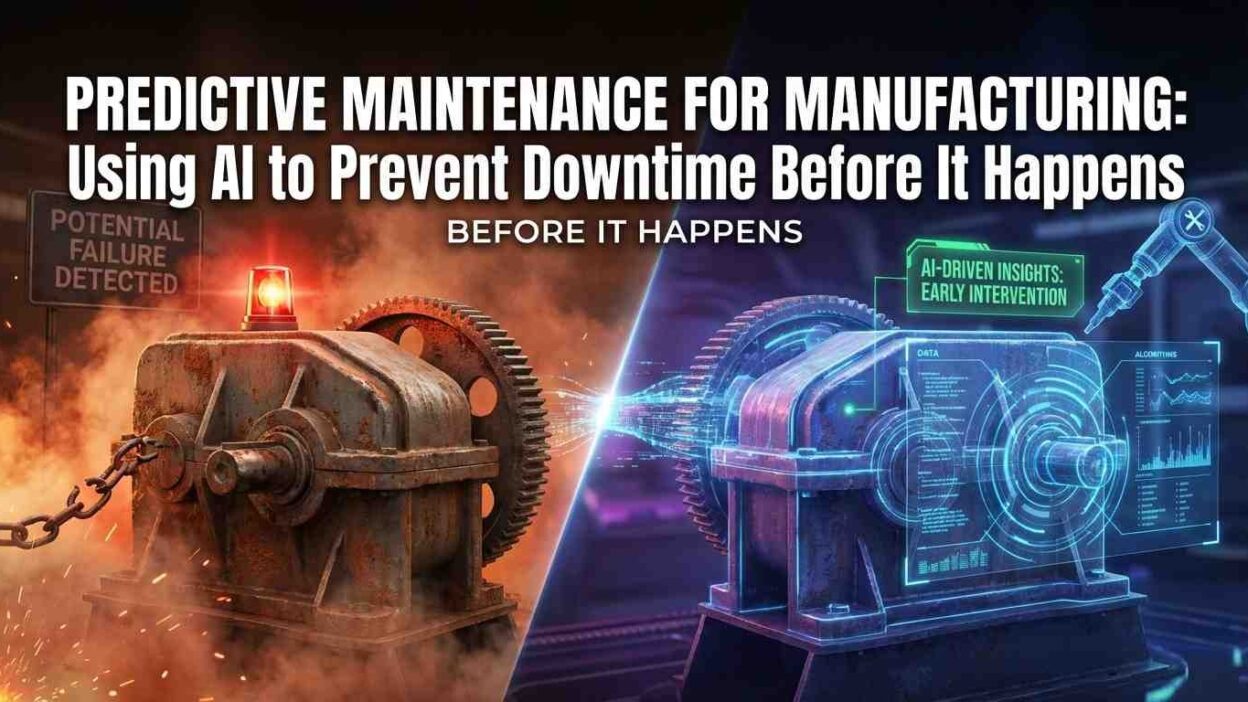
AI does not just react to equipment failure. It sees failure coming days or even weeks ahead. Sensors read machine behavior constantly. Algorithms detect subtle changes in vibration, heat, and pressure. Maintenance teams get early warnings and act before anything breaks.
This blog covers everything you need to know about predictive maintenance AI manufacturing. We look at how it works, what industries use it, what ROI looks like, and how to get started. If you manage operations, this read is worth your time.
Table of Contents
What Is Predictive Maintenance and Why Does It Matter?
Predictive maintenance is a proactive equipment management strategy. It uses real-time data to predict when a machine will fail. Maintenance happens at the right moment — not too early, not too late.
Traditional maintenance follows a calendar schedule. Technicians service machines every 30, 60, or 90 days regardless of actual condition. This wastes labor and parts. It also misses sudden failure events that happen between service intervals.
Reactive maintenance waits for something to break before fixing it. That approach is even more costly. Emergency repairs carry premium labor rates. Replacement parts rush-ordered cost three times more. Lost production during repair windows erodes margins fast.
Predictive maintenance AI manufacturing changes the entire equation. Machines communicate their own health status in real time. AI interprets that data and flags developing problems early. Maintenance teams plan repairs during scheduled downtime windows. Production lines keep running. Costs stay controlled.
The shift from reactive to predictive maintenance is one of the biggest operational improvements a plant can make. Companies that make this shift report 25% to 30% reduction in maintenance costs within the first year of full deployment.
How Does AI Power Predictive Maintenance in Manufacturing?
Predictive maintenance AI manufacturing works through a connected system of sensors, data pipelines, and machine learning models. Each layer plays a specific role. Together they create a continuous equipment health monitoring system.
IoT Sensors and Data Collection
Internet of Things sensors attach directly to machines and critical components. These sensors measure vibration, temperature, pressure, acoustic emissions, current draw, and rotational speed. They collect thousands of data points per second.
Modern sensors are small, wireless, and cheap. Installing them on existing equipment takes hours, not weeks. Battery-powered sensors eliminate wiring costs. Cloud connectivity means data flows automatically to central analytics platforms.
The data volume is enormous. A single manufacturing line with 20 machines generates millions of data points daily. Human analysts cannot process that volume manually. AI handles it effortlessly and spots patterns invisible to the human eye.
Machine Learning Models and Anomaly Detection
Machine learning models train on historical equipment data. They learn what normal operation looks like for each machine under varying load conditions. Once trained, these models monitor live sensor data continuously.
When sensor readings deviate from established normal patterns, the model flags an anomaly. Not every anomaly signals a serious problem. Advanced AI systems assign severity scores. Low-severity flags get logged for review. High-severity flags trigger immediate maintenance alerts.
Deep learning models go further. They identify the specific failure mode developing based on the pattern of sensor deviations. A bearing wear signature looks different from a lubrication failure signature. AI distinguishes between them and tells maintenance teams exactly what to inspect.
Digital Twins and Simulation
Digital twins are virtual replicas of physical machines. AI feeds real-time sensor data into the digital twin model. Engineers see exactly how the physical machine is performing without walking the shop floor.
Digital twins also run failure simulations. Engineers test how a developing fault will progress under different operating conditions. This helps maintenance teams decide whether to intervene immediately or monitor the situation for a few more days.
Leading manufacturers use digital twins across entire production lines. The virtual model reflects live plant conditions at all times. Maintenance decisions improve dramatically when teams have full visibility into machine health.
Predictive Analytics Dashboards
All sensor data and AI insights flow into centralized dashboards. Maintenance supervisors see equipment health scores for every machine on one screen. Color-coded alerts highlight machines needing attention. Trend charts show how conditions are evolving over time.
Mobile-compatible dashboards let technicians check equipment status from anywhere on the plant floor. Alerts push directly to smartphones. Maintenance teams respond faster because they know exactly which machine needs attention before they walk out the door.
Key Industries Benefiting from Predictive Maintenance AI Manufacturing
Automotive Manufacturing
Automotive plants run at brutal speeds. Assembly lines move every 60 seconds. One failed robot arm or conveyor belt stops the entire line. Predictive maintenance AI manufacturing helps automotive facilities achieve near-zero unplanned downtime.
Robotic welders, stamping presses, and paint shop equipment all carry sensors. AI monitors motor health, gripper wear, and hydraulic pressure constantly. Maintenance teams fix issues during shift changes and weekend windows. Line efficiency stays above 95%.
A major German automaker deployed predictive maintenance across 14 plants. Unplanned downtime dropped 70% in the first 18 months. Annual maintenance cost savings exceeded €40 million. The investment paid back in under 10 months.
Food and Beverage Processing
Food processing plants face unique challenges. Equipment must run at precise temperatures and speeds. Contamination risks make unexpected breakdowns dangerous, not just expensive. Regulatory compliance adds another layer of pressure.
Predictive maintenance AI manufacturing helps food processors monitor filling machines, conveyors, refrigeration systems, and packaging equipment. Early detection of seal wear or temperature drift prevents product spoilage and contamination events.
A large dairy processing company used AI-driven predictive maintenance to reduce equipment-related product waste by 34%. Fewer batches were lost to unexpected processing interruptions. Food safety compliance improved alongside operational efficiency.
Oil and Gas and Heavy Industry
Pumps, compressors, and rotating equipment in oil and gas facilities operate in extreme conditions. Failure consequences are severe. Unplanned shutdowns cost hundreds of thousands of dollars per hour. Safety incidents compound the financial damage.
AI-driven predictive maintenance AI manufacturing gives offshore and onshore operators early warning on compressor valve degradation, pump bearing wear, and seal failures. Maintenance crews reach equipment before failure occurs. Costly emergency shutdowns become rare events.
Offshore platforms using predictive AI report 45% reduction in critical equipment failures. The safety benefits match the financial ones. Workers face fewer emergency repair situations in hazardous environments.
Pharmaceuticals and Precision Manufacturing
Pharmaceutical manufacturing tolerates zero process variation. Tablet presses, mixing vessels, and packaging lines must perform within precise parameters at all times. FDA compliance and product quality demand it.
Predictive maintenance AI manufacturing ensures pharmaceutical equipment stays within calibration tolerances. AI detects drift in filling accuracy or mixing speeds before they affect product quality. Batch failures become rare. Regulatory audit results improve.
Real-World ROI: What Manufacturers Actually Gain
Talking about ROI in the abstract is easy. Real numbers matter more. Predictive maintenance AI manufacturing delivers measurable financial returns across multiple cost categories.
Reduction in Unplanned Downtime
McKinsey research shows predictive maintenance reduces unplanned downtime by 30% to 50%. For a plant losing $10,000 per hour during downtime events, that reduction saves millions annually. The math works at every scale of operation.
A mid-sized electronics manufacturer reduced unplanned downtime hours from 420 per year to 180 per year after deploying AI predictive maintenance. That 57% reduction translated to $2.3 million in recovered production capacity annually.
Lower Maintenance Costs
Predictive maintenance cuts total maintenance spend by 10% to 25% depending on industry and current practices. Unnecessary preventive maintenance stops. Emergency repair premiums disappear. Parts purchasing becomes plannable rather than reactive.
Planned parts procurement saves 20% to 40% on component costs. Buying a replacement bearing on a planned schedule costs far less than sourcing one overnight in an emergency. Labor efficiency improves when technicians work planned jobs rather than scrambling on emergency calls.
Extended Equipment Lifespan
Equipment that receives care at the right moment lasts longer. AI-guided maintenance catches developing faults before they cause secondary damage. A worn bearing caught early costs $200 to replace. A bearing that fails and damages the shaft costs $20,000 to repair.
Plants using predictive maintenance AI manufacturing report 20% to 40% extension in average equipment lifespan. Capital expenditure cycles stretch out. Replacement investments happen less frequently. Asset utilization improves across the board.
Energy Efficiency Gains
Degrading equipment works harder and consumes more energy. A motor running with failing bearings draws 15% more current than a healthy one. Detecting that degradation early restores energy efficiency and cuts power costs.
Industrial manufacturers using AI-driven maintenance report 5% to 15% reductions in energy consumption across monitored equipment. At industrial energy prices, those savings add up to significant annual cost reductions.
Challenges of Implementing Predictive Maintenance AI Manufacturing
No transformation is without friction. Predictive maintenance AI manufacturing requires serious commitment to succeed. Understanding the challenges upfront saves time and budget.
Data Quality and Sensor Coverage
AI is only as good as the data it receives. Dirty, incomplete, or inconsistent sensor data produces unreliable predictions. Plants with aging equipment often lack sensor infrastructure. Retrofit programs take time and capital to complete.
Start with the highest-value, highest-risk equipment first. Sensor a small number of critical machines. Build data quality processes early. Expand coverage as data reliability improves. Rushing sensor deployment across the whole plant often creates data management headaches.
Integration with Existing Systems
Most manufacturing plants run legacy SCADA systems, older PLCs, and siloed maintenance management software. Getting sensor data to flow reliably from the plant floor to AI analytics platforms requires integration work.
Industrial IoT platforms now offer pre-built connectors for most major SCADA and CMMS systems. Edge computing devices handle protocol translation at the machine level. Integration complexity is manageable with the right technology partners.
Workforce Skills and Change Management
Maintenance technicians trained on manual inspection and reactive repair need new skills. Reading AI dashboards, interpreting anomaly alerts, and acting on data-driven recommendations requires a shift in mindset and training.
Change resistance is real. Experienced technicians sometimes distrust AI recommendations that contradict their gut instincts. Cultural change programs matter as much as technology deployment. Involve frontline teams early. Show them how AI makes their jobs easier, not redundant.
Upfront Investment and Business Case
Sensor hardware, software platforms, integration services, and training carry upfront costs. Justifying that investment to finance teams requires a solid business case. Quantify current downtime costs. Model the savings from reduced unplanned failures. Project the maintenance cost reduction over three years.
Most manufacturers see full payback within 12 to 24 months. Some high-downtime facilities see payback in under 6 months. Building the business case with real plant data makes approval faster.
How to Get Started with Predictive Maintenance AI Manufacturing
The path to deploying predictive maintenance AI manufacturing does not have to be overwhelming. A phased approach reduces risk and builds internal confidence.
Identify Critical Assets
Start with a criticality assessment. Rank every major piece of equipment by two factors. How often does it fail? How much does each failure cost? High-frequency, high-cost failures become the first target for predictive maintenance deployment.
Most plants find that 20% of their equipment causes 80% of their downtime costs. Focusing AI monitoring on that 20% first delivers the fastest ROI and builds the internal business case for broader rollout.
Deploy Sensors and Connect Data
Select sensors appropriate for each machine type. Vibration sensors work best for rotating equipment. Thermal sensors suit electrical components and motors. Acoustic sensors detect bearing and gear mesh issues early.
Connect sensors to an industrial IoT gateway. Choose a gateway that supports your existing plant communication protocols. Cloud or on-premise data storage depends on your IT security policy. Both work well for predictive maintenance applications.
Train AI Models
AI models need historical data to train on. Collect at least 90 days of baseline sensor data before building initial models. More historical data improves model accuracy. Include data from both normal operation and any documented failure events.
Work with your predictive maintenance platform vendor to build and validate models for each asset type. Most modern platforms offer pre-trained models for common equipment categories like pumps, motors, compressors, and conveyors.
Build Maintenance Workflows Around AI Alerts
Technology alone does not deliver ROI. Maintenance workflows must connect to AI alerts. Define clear response protocols for different alert severity levels. Assign ownership for each alert type. Set response time targets for high-severity warnings.
Integrate AI alerts with your Computerized Maintenance Management System (CMMS). Work orders generate automatically when an AI alert crosses a defined severity threshold. Maintenance planners see AI-generated work orders alongside their regular planned maintenance schedule.
Measure, Refine, and Scale
Track key metrics from day one. Measure unplanned downtime hours, maintenance cost per machine, and mean time between failures. Compare pre-deployment and post-deployment numbers every quarter.
Use that data to refine AI models. False positive rates drop as models learn plant-specific operating patterns. As confidence in AI recommendations grows, expand sensor coverage to lower-priority equipment. Build a roadmap for plant-wide predictive maintenance AI manufacturing deployment over 24 to 36 months.
Future Trends in Predictive Maintenance AI Manufacturing
The field of predictive maintenance AI manufacturing keeps advancing. New capabilities emerge every year. Understanding where the technology is heading helps manufacturers make smarter platform investment decisions today.
Generative AI and Natural Language Interfaces
Generative AI brings conversational interfaces to maintenance management. Technicians ask questions in plain language. What machines need attention today? Which failure mode is developing on press number four? AI answers instantly with data-backed explanations.
This reduces the skill barrier for using predictive maintenance tools. Technicians without data science backgrounds access AI insights as easily as checking their phone. Adoption rates improve. Value realization speeds up.
Autonomous Maintenance Agents
Next-generation AI systems will not just alert humans to problems. They will take action automatically. Autonomous agents will adjust machine parameters, reduce load on degrading equipment, and schedule maintenance work orders without human input.
Early versions of this capability already exist in some advanced manufacturing environments. Fully autonomous maintenance management is still several years away for most plants. The trajectory is clear.
Edge AI and Real-Time Decision Making
Edge AI runs machine learning models directly on the sensor device or gateway. No data travels to the cloud for analysis. Decisions happen in milliseconds at the machine level. This enables ultra-fast responses to developing failure conditions.
Edge AI is particularly valuable for high-speed production equipment where a failure can cause serious damage in seconds. Immediate automated responses like reducing motor speed or triggering a safe shutdown protect equipment and workers without waiting for cloud processing.
FAQs:-
What types of machines benefit most from predictive maintenance AI?
Rotating equipment sees the greatest benefit first. Motors, pumps, compressors, fans, and conveyors develop predictable failure signatures that AI detects early. Hydraulic systems, CNC machines, and robotic systems also respond very well to AI-driven monitoring. Any asset with sensor-readable operating parameters is a strong candidate for predictive maintenance AI manufacturing.
How accurate are AI predictive maintenance systems?
Modern AI predictive maintenance systems achieve 85% to 95% accuracy in failure prediction when trained on sufficient quality data. Accuracy improves over time as models see more real-world failure events. False positive rates typically start around 10% and drop below 5% after six months of operation in most plants.
What is the difference between predictive and preventive maintenance?
Preventive maintenance follows a fixed time schedule. Machines receive service every 30 or 60 days regardless of actual condition. Predictive maintenance uses real-time data to determine exactly when service is needed. Predictive maintenance AI manufacturing eliminates unnecessary service events and catches failures that preventive schedules miss entirely.
How much does a predictive maintenance AI system cost?
Costs vary widely based on plant size and scope. A pilot program covering 10 to 15 critical machines typically costs between $50,000 and $150,000 including sensors, software, and implementation services. Plant-wide deployments covering hundreds of assets run $500,000 to several million dollars. ROI typically exceeds investment within 12 to 18 months for most manufacturers.
Do we need data scientists to run a predictive maintenance AI system?
Modern predictive maintenance platforms require minimal data science expertise to operate. Vendors provide pre-trained models, automated anomaly detection, and intuitive dashboards. Plant engineers and maintenance supervisors handle day-to-day operations without specialized AI knowledge. Data science skills help for advanced model customization but are not required to get started.
Can predictive maintenance AI integrate with our existing CMMS?
Yes. Most leading predictive maintenance AI manufacturing platforms offer standard integrations with popular CMMS systems including IBM Maximo, SAP PM, Oracle eAM, and Infor EAM. API-based integrations work for less common systems. Work orders flow automatically from AI alerts into existing maintenance workflows without manual data entry.
Read More:-Connecting LLMs to Your Internal Data: Best Practices for Secure Vector Search
Conclusion

Unplanned downtime is not an inevitable cost of doing business. It is a solvable problem. Predictive maintenance AI manufacturing gives plant operators the tools to see failure coming and act before anything breaks.
The technology works. The ROI is proven. Industries from automotive to pharmaceuticals report dramatic reductions in downtime, maintenance costs, and equipment failures after deploying AI-driven maintenance systems. The question is no longer whether predictive maintenance AI manufacturing delivers value. The question is how quickly your plant can capture it.
Start small. Focus on your highest-cost failure points first. Build internal confidence with early wins. Expand methodically across the plant. Every asset added to the predictive maintenance program reduces risk and improves performance.
Manufacturing leaders who act on predictive maintenance AI manufacturing today build a durable competitive advantage. Machines run longer. Costs stay lower. Production targets stay on track. The plants that embrace this shift now will be the ones setting the standard for operational excellence for the next decade.