Introduction
TL;DR Enterprise leaders face a defining moment right now. Generative AI delivered impressive demos. Pilot projects showed promise. But real transformation remains elusive for most organizations. The gap between AI experimentation and AI-at-scale is wide. Crossing it requires a fundamentally different approach. That approach is building an AI factory agentic workflows enterprise model that operates like a production system, not a science experiment.
The term AI factory is not marketing language. It describes a deliberate architecture. It means building the infrastructure, processes, teams, and governance to produce AI-driven outcomes continuously at enterprise scale.
Agentic workflows sit at the heart of this model. AI agents do not just answer questions. They take actions. They plan tasks, call tools, check results, and iterate toward a goal without constant human direction. Enterprises that master this capability gain a structural productivity advantage that compounds over time.
This blog is a practical roadmap. It covers what an AI factory agentic workflows enterprise looks like, how to build one, what mistakes to avoid, and what real business outcomes await organizations that get this right.
Table of Contents
What Is an AI Factory and Why Does It Matter for Enterprises?
An AI factory is an operating model that treats AI output as a manufactured product. Just as a physical factory converts raw materials into finished goods at scale, an AI factory converts data and business context into decisions, content, code, and automated actions at scale.
The concept goes beyond deploying a few AI tools. It means building repeatable systems. It means creating pipelines that intake business problems, apply AI reasoning, and deliver reliable outputs. The AI factory agentic workflows enterprise model makes AI a core production capability rather than an occasional experiment.
Nvidia CEO Jensen Huang popularized the term AI factory to describe the industrial infrastructure required for AI at scale. He was referring to GPU compute centers. Enterprise leaders should think even broader. An AI factory includes compute, data, models, orchestration layers, governance, and human oversight all working as one integrated system.
Why does this matter? Because the organizations building AI factories today will operate at cost and speed levels that competitors running manual processes simply cannot match. A legal team using agentic AI to review contracts in minutes versus days does not just save time. It changes what the legal department can take on entirely. That is a structural competitive shift.
Understanding Agentic Workflows: The Engine of the AI Factory
Agentic workflows are the operational core of any serious AI factory agentic workflows enterprise strategy. Understanding what makes them different from traditional automation is essential before building anything.
What Makes a Workflow Agentic?
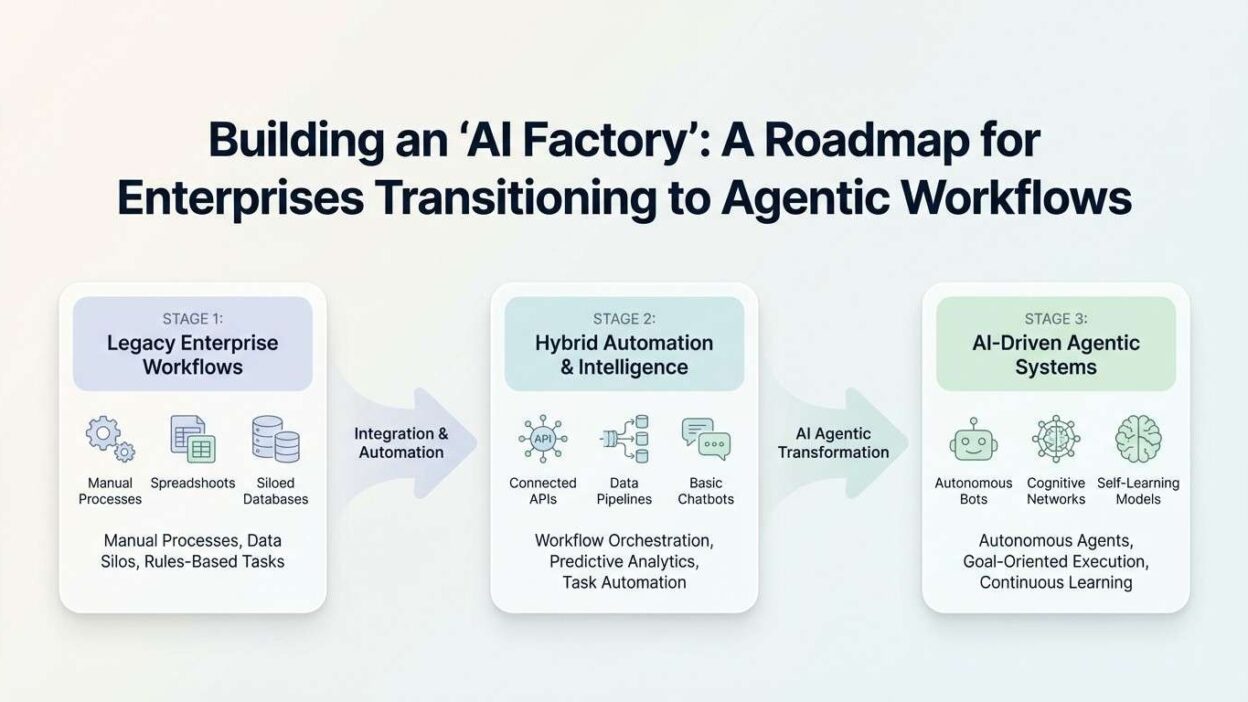
Traditional automation follows rigid scripts. Each step executes exactly as programmed. No deviation. No reasoning. When conditions change, the script breaks and a human intervenes.
Agentic workflows operate differently. An AI agent receives a goal, not a script. It plans a sequence of steps to achieve that goal. It uses tools like web search, database queries, code execution, and API calls to gather information and take actions. It evaluates results after each step. It adjusts its approach based on what it finds.
This capacity for goal-directed, adaptive behavior is what makes agentic workflows transformative. A single agent can handle tasks that previously required multiple human handoffs. Complex multi-step processes compress dramatically in time and cost.
Single-Agent vs. Multi-Agent Systems
A single agent handles one task or domain. A research agent summarizes market intelligence reports. A coding agent writes and tests software functions. A customer service agent resolves support tickets end to end.
Multi-agent systems assign specialized agents to different subtasks. An orchestrator agent breaks a complex goal into components and delegates to specialized agents. Each specialist completes its part. The orchestrator assembles the results. This mirrors how human teams work and scales far beyond what any individual could accomplish.
Enterprise AI factory agentic workflows enterprise deployments increasingly rely on multi-agent architectures. Complex business processes like new product development, procurement workflows, and financial reporting benefit most from coordinated agent teams.
Human-in-the-Loop Design
Fully autonomous agents work well for low-risk, high-volume tasks. Higher-stakes decisions benefit from human checkpoint design. Smart agentic workflow architecture builds human review gates at the right moments.
An agent drafts a vendor contract. A human reviews and approves before it sends. An agent identifies investment opportunities. A human approves before capital commits. Humans focus on judgment. Agents handle everything else. This division of labor maximizes both speed and reliability.
The Core Components of an Enterprise AI Factory
Building an AI factory agentic workflows enterprise capability requires assembling several distinct layers. Each layer must work reliably before the next delivers full value.
Data Infrastructure and Knowledge Pipelines
Agents are only as capable as the data they access. Enterprises need clean, connected, accessible data pipelines before deploying agentic systems at scale. Siloed data in disconnected systems cripples agent performance.
Enterprise knowledge graphs and vector databases store company-specific information that agents query during task execution. Retrieval-augmented generation connects agents to live enterprise knowledge. Agents find relevant policies, contracts, product specs, and historical decisions without hallucinating information.
Data governance matters enormously here. Agents must access the right data for their role and nothing beyond it. Role-based data access controls applied to AI agents reduce security risk significantly.
Model Layer: Choosing and Managing Foundation Models
Most enterprises do not train foundation models. They select and orchestrate them. Choosing the right model for each task matters. A large frontier model handles complex reasoning. A smaller, faster, cheaper model handles high-volume classification and routing tasks.
Model management includes version control, performance monitoring, and cost tracking. An AI factory runs multiple models simultaneously. Routing logic sends tasks to the right model based on complexity, cost tolerance, and latency requirements.
Fine-tuning foundation models on enterprise-specific data improves accuracy for domain-specific tasks. Legal document analysis, medical coding, financial report generation all benefit from models trained on domain vocabulary and context.
Orchestration and Agent Management Platforms
Orchestration platforms coordinate agent behavior. They manage task assignment, tool access, memory, and inter-agent communication. Enterprise-grade orchestration handles concurrency at scale, meaning thousands of agent tasks running simultaneously without collision.
LangChain, Microsoft AutoGen, CrewAI, and similar frameworks provide orchestration infrastructure. Enterprise platforms like Salesforce Agentforce and ServiceNow AI Agents embed orchestration directly into existing business application layers.
Choosing the right orchestration layer for your AI factory agentic workflows enterprise strategy depends on your existing technology stack, required integrations, and internal engineering capabilities.
Tool and Integration Layer
Agents need tools to act in the world. Tools include web search, code interpreters, database connectors, CRM APIs, ERP interfaces, document editors, email systems, and calendar access. The breadth of tool access determines what agents can actually accomplish.
Enterprise tool libraries require careful design. Each tool needs authentication, logging, error handling, and rate limiting. Security review of every tool an agent can call is non-negotiable. A misconfigured tool with excessive permissions creates serious enterprise risk.
Governance, Safety, and Monitoring
Governance is not optional in an enterprise AI factory. Agents making decisions and taking actions at scale require oversight infrastructure. This means logging every agent action, every tool call, and every decision output for audit purposes.
Guardrail systems prevent agents from taking prohibited actions. Content filters block harmful outputs. Rate limits prevent runaway agent loops that consume compute budget unnecessarily. Human escalation paths route edge cases to appropriate reviewers.
Real-time monitoring dashboards give operations teams visibility into agent performance, error rates, cost per task, and latency. The AI factory agentic workflows enterprise model must be observable end to end.
Building Your AI Factory: A Phased Roadmap
No enterprise builds a complete AI factory overnight. A phased approach reduces risk, builds internal capability, and delivers ROI at each stage.
Phase One: Foundation Building (Months 1 to 6)
The foundation phase focuses on infrastructure and quick wins. Assess your current data infrastructure. Identify gaps in data accessibility and quality. Clean up the highest-priority data domains that AI agents will need.
Select your model and orchestration platform. Run a small number of high-value agentic workflow pilots. Choose use cases where agent errors carry low risk and outcomes are measurable. Customer support triage, internal document summarization, and code review assistance work well as starting points.
Build the governance framework in parallel. Define acceptable use policies for AI agents. Establish logging and audit requirements. Create escalation paths for edge cases. Do not skip governance setup even in early pilots. Retrofitting governance onto live systems is painful and expensive.
Phase Two: Scaling and Integration (Months 6 to 18)
The scaling phase connects pilots to enterprise systems. Integrate agentic workflows with CRM, ERP, HRIS, and document management systems. Agents gain access to real enterprise data and begin delivering measurable business outcomes.
This phase introduces multi-agent architectures. Break complex business processes into agent teams. A procurement workflow might use a supplier research agent, a contract drafting agent, a compliance checking agent, and an approval routing agent working in sequence.
Training programs build internal AI literacy. Business unit leaders learn to identify agentic workflow opportunities in their domains. Prompt engineering and agent configuration skills develop in-house. The enterprise reduces dependence on vendor professional services.
Phase Three: Optimization and Enterprise-Wide Deployment (Months 18 to 36)
The optimization phase matures the AI factory agentic workflows enterprise model into a core operational capability. Performance data from scaled deployments informs model selection, tool design, and workflow architecture improvements.
Center of Excellence teams emerge to support AI factory operations across business units. Shared services models distribute agent capabilities to teams that lack engineering resources. Standard templates and pre-built agent configurations accelerate deployment of new use cases.
Cost optimization becomes a focus. Fine-tuned smaller models replace expensive frontier models for high-volume routine tasks. Caching strategies reduce redundant model calls. The cost per agentic workflow task falls significantly as optimization matures.
High-Value Use Cases for AI Factory Agentic Workflows in the Enterprise
Knowing where to deploy AI factory agentic workflows enterprise capabilities first is as important as building the infrastructure. The highest-value use cases share common traits. They are high-volume, multi-step, data-intensive, and currently labor-heavy.
Finance and Accounting Automation
Accounts payable, financial close processes, and audit preparation consume enormous human time in most enterprises. Agentic workflows handle invoice matching, exception identification, reconciliation, and report generation autonomously.
A global manufacturer deployed agentic workflows across its accounts payable function. Agents processed 85% of invoices without human intervention. Processing time fell from 7 days to 4 hours. The finance team redirected 40% of its capacity to strategic analysis work.
Legal and Compliance Operations
Contract review, regulatory monitoring, and compliance reporting demand expert attention that scales poorly. Agentic AI systems review standard contracts in minutes. They flag non-standard clauses and escalate to human lawyers only when needed.
Regulatory compliance monitoring agents scan regulatory databases continuously. They alert compliance teams to relevant changes and draft impact assessments automatically. Legal departments using this approach handle three times the contract volume with the same headcount.
Customer Experience and Service Operations
Customer service generates enormous interaction volume across multiple channels. Agentic workflows handle tier-one resolution end to end. Agents access CRM data, apply policy knowledge, execute account changes, and communicate resolution to customers without human involvement.
Complex or emotionally sensitive situations escalate to human agents with full context already documented. Resolution times improve. Customer satisfaction scores rise. Human agents spend time on cases where empathy and judgment matter most.
Research, Competitive Intelligence, and Strategic Analysis
Market research, competitor monitoring, and strategic landscape analysis consume senior analyst time that organizations can rarely afford. Agentic research workflows gather data from multiple sources, synthesize findings, identify trends, and produce structured briefing documents automatically.
Strategy teams using AI factory agentic workflows enterprise research capabilities produce analysis 10 times faster than manual methods. They spend their expertise evaluating AI-generated insights rather than collecting raw information. Decision quality improves. Response speed to market changes accelerates.
Software Development and IT Operations
Software engineering teams deploy agentic coding assistants that write, test, review, and document code. Agents handle routine bug fixes, test case generation, and documentation updates autonomously. Senior engineers focus on architecture, design, and complex problem-solving.
IT operations teams use agentic workflows for incident detection, root cause analysis, and initial remediation. Agents triage alerts, run diagnostic playbooks, and resolve known issue types without paging on-call engineers. Mean time to resolution drops sharply. Engineer burnout from alert fatigue decreases.
Common Mistakes Enterprises Make Building AI Factories
The path to a mature AI factory agentic workflows enterprise model includes predictable pitfalls. Knowing them in advance saves significant time and budget.
Starting with Technology Instead of Problems
Many enterprises buy orchestration platforms and AI tools before identifying the business problems worth solving. Technology without a clear problem statement generates demos rather than value. Start with high-cost, high-volume business pain points. Then find the right AI tools to address them.
Ignoring Data Readiness
Agentic systems require accessible, accurate, structured data. Enterprises that skip data preparation deploy agents that hallucinate, make errors, or fail to complete tasks. Data readiness assessment must precede agentic workflow deployment. This is not negotiable.
Under-investing in Governance
Agents acting autonomously at enterprise scale without robust governance creates compliance, security, and reputational risk. Enterprises that treat governance as an afterthought face painful retrofits later. Build logging, access control, guardrails, and human oversight design from day one.
Failing to Manage Change
Employees whose work changes due to agentic automation need clear communication, training, and role redefinition. Resistance to AI adoption often reflects inadequate change management rather than genuine technology failure. Invest in people alongside technology.
FAQs:
What is the difference between an AI factory and a traditional IT project?
A traditional IT project has a defined start and end. It delivers a specific system or application. An AI factory is an ongoing operating model. It produces AI-driven outputs continuously. It improves over time as data accumulates and models refine. Enterprises should think of an AI factory agentic workflows enterprise model the same way they think about a data analytics function — a permanent capability, not a one-time project.
How long does it take to build a functional AI factory?
Early pilots producing measurable value can launch within 60 to 90 days. A functional multi-agent architecture integrated with core enterprise systems typically takes 12 to 18 months. A mature, enterprise-wide AI factory operating at full scale usually requires a 24 to 36 month build timeline. Speed depends heavily on data readiness, internal talent, and organizational commitment.
What skills does an enterprise need to build an AI factory?
Core skills include AI/ML engineering, data engineering, prompt engineering, agent architecture design, and AI product management. Governance and risk management expertise specific to AI systems is increasingly critical. Most enterprises combine internal hiring with external vendor partnerships to cover skill gaps during the build phase. Building internal capability matters more as the AI factory matures.
How do you measure ROI from agentic workflows?
Measure ROI across four dimensions. Time savings quantifies hours reclaimed from manual tasks. Cost reduction captures labor and operational cost decreases. Revenue impact measures new capabilities or faster throughput that drives top-line growth. Quality improvements track error rate reductions, compliance improvements, and customer satisfaction gains. Track all four to build a complete picture of AI factory agentic workflows enterprise value.
Is it safe to give AI agents access to enterprise systems?
Yes, when done with proper access controls. Agents should receive minimum necessary permissions for their specific tasks. Role-based access controls apply to agents the same way they apply to human users. All agent actions require comprehensive logging. Human review gates protect high-stakes decisions. Security review of every tool and integration agents can access is mandatory before deployment.
What industries are leading in AI factory adoption?
Financial services, healthcare, technology, and manufacturing are furthest ahead in AI factory agentic workflows enterprise adoption. Financial services benefits from massive transaction volumes and high automation ROI. Healthcare uses agentic workflows for clinical documentation, prior authorization, and administrative workflows. Technology companies apply agentic AI to software development acceleration. Manufacturing uses AI agents for supply chain management, quality control, and maintenance operations.
Read More:-Beyond the Chatbox: Why Voice and Vision are the Next AI Frontiers
Conclusion
The enterprises winning with AI over the next decade will not be the ones that ran the most chatbot pilots. They will be the ones that built durable AI production capabilities. The AI factory agentic workflows enterprise model represents exactly that kind of durable capability.
Building an AI factory requires deliberate architecture. It demands serious data infrastructure, thoughtful model selection, robust orchestration, enterprise-grade governance, and disciplined change management. None of these elements work well in isolation. They must function as an integrated system.
Agentic workflows are the most powerful operational capability enterprises can build right now. Agents that plan, act, learn, and coordinate with other agents compress work that took days into hours. They handle volume that human teams cannot match. They free skilled people to focus on judgment, creativity, and relationship work that AI cannot replicate.
The roadmap is clear. Start with high-value, manageable pilots. Build the foundational infrastructure in parallel. Scale methodically with governance from the start. Measure outcomes at every stage. Refine continuously as the system matures.
The AI factory agentic workflows enterprise model is not a distant aspiration. Organizations are building it right now. The enterprises that start this year will hold a multi-year advantage over those that wait. The right time to begin is not when the technology matures further. The right time is now.