Introduction
TL;DR Text-based chatbots changed how businesses interact with customers. They automated support. They answered questions instantly. They handled volume no human team could manage alone.
But text has limits.
People do not experience the world through typed sentences. They hear sounds. They see images. They process visual and audio information constantly. Their natural mode of communication is spoken language backed by visual context.
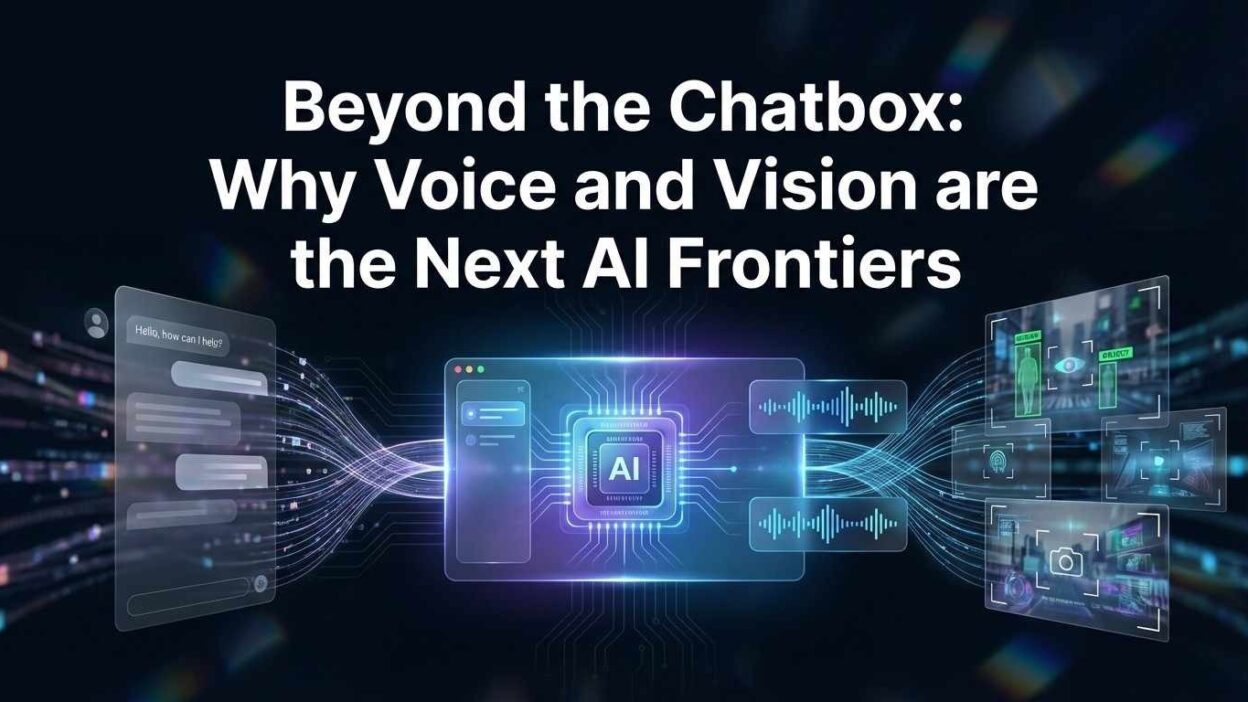
The voice and vision AI future closes the gap between how humans communicate naturally and how machines have traditionally processed input. It moves AI out of the chatbox and into the full sensory context of real life.
This shift is not distant. It is happening now. Businesses that understand it early will build products and processes that feel genuinely human. Those that ignore it will watch their chatbox-era tools feel increasingly outdated.
Table of Contents
The Limitations of Text-Only AI Interfaces
Text interfaces served their purpose well. Typed input is structured. It is easy for machines to process. It produces predictable outputs.
The problem is that most human problems are not text problems. A field engineer staring at a broken machine cannot describe every detail in typed words. A customer trying to return a product cannot explain the damage through a chat window easily. A doctor reviewing a patient’s wound needs to see it, not read about it.
Text input forces users to translate their actual experience into language. That translation loses information. It creates friction. It produces responses that miss the real context of the situation.
Voice and vision AI future development addresses this translation burden directly. Voice lets users speak their context naturally. Vision lets AI systems see what the user sees. Together they eliminate the compression that text input forces on human experience.
The shift away from text-only interfaces is not about novelty. It is about accuracy, speed, and the quality of outcomes AI systems produce when they have richer input to work with.
Why Voice AI Is Expanding Beyond Simple Commands
The Early Voice AI Problem
Early voice AI was brittle. Siri misheard names. Alexa struggled with accents. Google Assistant gave up on complex questions.
Those early systems relied on rule-based speech recognition. They matched phonemes to word databases. They broke on anything outside their training distribution.
Users learned to speak in short, simple commands. They shortened their natural language to fit what the machine could handle. The technology constrained the interaction instead of enabling it.
What Modern Voice AI Fundamentally Changed
Modern voice AI uses end-to-end neural models trained on massive multilingual speech datasets. OpenAI’s Whisper processes audio directly into accurate transcriptions across dozens of languages and accents.
Conversational AI systems now understand context across multiple spoken turns. A user does not need to restate their situation every time they ask a follow-up question. The model holds context and responds intelligently to natural spoken conversation.
Latency dropped dramatically. Real-time voice interaction with AI now feels genuinely conversational. The gap between speaking and receiving a relevant response shrank to the point where it no longer disrupts the flow of human communication.
The voice and vision AI future begins with this technical maturity. Voice AI is no longer the frustrating, limited assistant of 2015. It is a capable, context-aware communication channel.
Voice AI in Enterprise Applications
Enterprise teams deploy voice AI in workflows that benefit from hands-free operation. Warehouse workers use voice commands to pick orders without touching a screen. Surgeons receive voice-activated information during procedures without breaking sterile technique.
Field service teams use voice AI to log job notes, retrieve equipment manuals, and escalate issues while both hands stay on the work. The productivity gain from hands-free workflow is measurable and immediate.
Call centers use AI voice analysis to understand customer sentiment in real time. Supervisors receive alerts when conversations show signs of escalation. Response quality improves and customer satisfaction scores rise.
Customer-facing voice AI handles inbound calls for appointment scheduling, account inquiries, and order status updates. Natural language understanding means customers speak normally. They do not navigate menu trees. They do not repeat themselves three times before getting to a human.
Why Vision AI Is Transforming How Machines Understand the World
From Image Classification to Contextual Understanding
Early computer vision classified images. It answered one question: what object is in this photo?
That was useful for sorting images into categories. It was not useful for understanding scenes, relationships between objects, or the meaning of what a camera captured.
Modern vision AI understands context. It identifies what objects are present and what those objects are doing relative to each other. It reads text within images. It understands spatial relationships. It tracks movement across video frames.
This contextual understanding is the foundation of the voice and vision AI future in physical environments. A camera-equipped AI system does not just see a factory floor. It understands which station is idle, which equipment shows signs of wear, and which worker position indicates a safety concern.
Multimodal Vision Models and Their Capabilities
GPT-4o, Claude 3.5 Sonnet, and Gemini Pro Vision all process images alongside text. They answer questions about visual content. They describe what they see. They identify anomalies. They read diagrams and extract structured information.
These multimodal models interpret documents, receipts, medical images, product photos, architectural drawings, and handwritten notes with high accuracy.
A user photographs a restaurant menu and asks for the lowest-calorie option. The model reads the menu visually and answers. A technician photographs a wiring diagram and asks which circuit connects to a specific outlet. The model reads the diagram and responds with specific guidance.
The voice and vision AI future makes these multimodal interactions fluid. Questions get asked by voice. The camera captures the visual context. The model receives both simultaneously. The response arrives as natural speech.
Vision AI in Industrial and Healthcare Settings
Manufacturing plants use vision AI for quality control. Cameras inspect products on assembly lines at speeds and consistency levels impossible for human inspectors. Defect detection rates improve. Scrap rates drop.
Predictive maintenance uses vision AI to monitor equipment condition continuously. The system detects early signs of wear, misalignment, or heat buildup before failures occur. Planned maintenance replaces emergency repairs.
Healthcare uses vision AI for radiology support. AI models analyze X-rays, MRIs, and CT scans. They flag areas requiring attention. They provide radiologists with second-opinion analysis that catches findings human eyes may miss after hours of review fatigue.
Dermatology applications let patients photograph skin conditions and receive preliminary assessments. Ophthalmology tools analyze retinal images for signs of diabetic retinopathy. The reach of specialist-level visual analysis extends to settings where specialists are not physically present.
The Convergence: When Voice and Vision Work Together
Why Multimodal AI Is More Than the Sum of Its Parts
Voice AI and vision AI each carry value independently. Their combination produces something qualitatively different from either alone.
When a model receives both spoken language and visual input simultaneously, it can answer questions that neither modality could resolve alone. “What is wrong with this part?” typed as text produces a generic answer. The same question spoken while pointing a camera at the actual part produces a specific, actionable answer grounded in what the camera sees.
This combined input is what humans use naturally. When a person asks a colleague for help, they speak and show at the same time. They gesture toward the problem. They describe what they hear alongside what they see. The voice and vision AI future gives AI systems access to that same rich, multi-channel input.
Real-Time Navigation and Assistance
Navigation applications already combine voice and vision. Google Maps and Apple Maps give spoken turn-by-turn directions while reading visual street markers and road conditions.
The next generation of navigation AI processes live camera input to understand exactly what a driver or pedestrian sees. It identifies street signs, storefront names, and lane markings in real time. It reconciles what the camera sees with map data to give hyper-accurate guidance.
For visually impaired users, this combination is transformative. An AI system that both sees and speaks can describe the environment continuously. It identifies obstacles, reads signage, recognizes faces of known contacts, and provides spatial guidance through natural spoken language.
Voice and Vision in Customer Experience
Retail applications combine voice queries with visual product recognition. A customer points their phone camera at a product and asks “Is this available in a larger size?” or “What are the ingredients in this?” The system reads the product visually and answers the spoken question.
Shopping assistance becomes genuinely helpful rather than keyword-search-based. The customer describes what they want in natural speech while showing examples of what they mean visually.
Insurance claims use the same principle. A customer reports a claim by speaking a description of the damage while recording video of the affected area. The AI processes both inputs simultaneously. It extracts relevant details from the video, cross-references the spoken account, and creates a preliminary claim file with supporting visual evidence attached.
The voice and vision AI future reduces friction in customer interactions that previously required typing, uploading photos separately, and describing damage in ways that rarely captured the full picture.
Industries Being Reshaped by Voice and Vision AI
Education and Training
Instructional AI now delivers spoken explanations while analyzing what a student writes or draws on paper through a camera feed. The system watches a student work through a math problem by hand and speaks guidance in real time as mistakes appear.
Professional training uses vision AI to evaluate technique. A surgeon in training performs a procedure on a simulator. The vision system analyzes hand position, instrument angle, and movement efficiency. The voice component delivers feedback in the same moment the issue occurs rather than in a post-session review.
Language learning applications combine voice recognition with visual scene understanding. A learner points their camera at objects and asks how to say them in the target language. The spoken response models native pronunciation. The voice and vision AI future makes language immersion possible anywhere, not just in foreign countries.
Retail and E-Commerce
Physical retail stores deploy vision AI to track inventory, detect out-of-stock shelves, and analyze customer movement patterns. Store staff use voice interfaces to query current inventory levels hands-free while restocking shelves.
E-commerce uses visual search to match product images with catalog entries. A customer photographs a sofa they saw in a magazine and finds the exact product or visually similar alternatives in seconds.
Returns processing uses vision AI to assess product condition from submitted photos. Automated approval decisions for clear-cut cases reduce processing time and customer wait periods significantly.
Healthcare and Telemedicine
Remote consultations gain diagnostic capability through vision AI. A patient shows a physician their affected area through a camera during a video call. AI vision analysis runs simultaneously, flagging visual patterns consistent with specific conditions and presenting relevant clinical data to the physician.
Medication adherence systems use vision AI to verify that patients take their medications correctly. A camera observes the process. The system confirms correct dosage and timing. Voice prompts guide patients with complex medication regimens.
Physical rehabilitation uses vision AI to monitor exercise form during remote sessions. The therapist receives real-time analysis of patient movement quality. Voice prompts from the AI system correct form issues between human therapist interventions.
Logistics and Supply Chain
Warehouse operations use voice-directed picking systems. Workers hear instructions through headsets and confirm actions verbally. Vision AI at scanning stations verifies that picked items match order specifications.
Delivery verification uses vision AI to confirm package condition at handoff. The delivery agent photographs the package and delivery location. AI analysis confirms the package was undamaged at delivery and that delivery occurred at the correct address.
Fleet management uses in-cab vision AI to monitor driver alertness. The system detects signs of drowsiness and issues voice alerts before dangerous situations develop. Real-time coaching through voice prompts improves driving behavior and reduces accident rates.
Building Products for the Voice and Vision AI Future
Designing for Natural Multimodal Interaction
Products built for voice and vision AI future adoption start with natural interaction design rather than feature engineering.
Users should not need instructions for how to interact with a voice-vision system. They speak as they would to a knowledgeable colleague. They show what they mean visually without composing a formal description.
Interface design removes the barriers between user intent and system understanding. Microphones capture ambient speech accurately in noisy environments. Cameras provide adequate resolution for the visual analysis the system requires. Latency stays low enough that interaction feels real rather than delayed.
Privacy Architecture for Vision Systems
Camera-equipped AI systems collect sensitive visual data. Users filming their homes, workplaces, medical conditions, or faces need strong privacy guarantees.
On-device processing keeps visual data local. Images analyze on the user’s device without uploading to external servers. Only the extracted insights — not the raw image — send to the cloud for response generation.
Clear consent flows inform users exactly what the camera captures, where data processes, how long it stores, and what rights users have over their visual data. Privacy architecture is not an afterthought in voice and vision AI future products. It is a foundation requirement.
Accessibility as a Core Design Goal
Voice and vision AI opens digital interfaces to users who cannot use text-based systems effectively.
Users with motor impairments that prevent typing can interact fully through voice. Users with visual impairments benefit from vision AI that describes environments and reads visual content aloud. Users with reading difficulties interact through spoken language rather than written text.
Accessibility requirements should drive feature prioritization rather than appearing on a roadmap as future enhancements. The most inclusive voice and vision AI future products serve the broadest range of human abilities from their first release.
Challenges and Honest Limitations
Accuracy in Noisy Real-World Conditions
Lab-tested voice accuracy drops in real environments. Background noise, multiple simultaneous speakers, and poor microphone quality all degrade speech recognition performance.
Vision accuracy varies with lighting conditions, camera angles, and image resolution. A quality inspection system that works perfectly under controlled factory lighting may underperform in variable outdoor conditions.
Production deployments of voice and vision AI future systems need extensive real-world testing across the full range of conditions users will encounter. Lab benchmarks are insufficient.
Bias in Vision AI Systems
Computer vision models trained on non-representative datasets produce biased outputs. Facial recognition systems that perform poorly on darker skin tones reflect training data imbalance. Medical imaging models trained predominantly on one demographic may miss findings in underrepresented populations.
Addressing vision AI bias requires deliberate dataset curation, bias audit protocols, and ongoing monitoring of performance across demographic groups. It requires organizational commitment, not just technical effort.
The Latency Challenge for Real-Time Applications
Voice-vision applications require low latency to feel natural. A two-second delay between speaking and receiving a response breaks the conversational feel. A half-second delay in visual feedback during a manufacturing quality check misses defects moving on a conveyor.
Achieving low latency requires edge computing for time-sensitive applications, optimized model architectures, and efficient data pipelines. Cloud-only architectures often cannot meet the latency requirements of real-time voice and vision AI future applications.
Frequently Asked Questions
What is voice and vision AI?
Voice and vision AI refers to AI systems that process spoken language and visual input — either separately or simultaneously. Voice AI understands and generates natural speech. Vision AI understands images and video. Combined systems process both input types together, enabling richer, more natural human-machine interaction.
How is vision AI different from basic image recognition?
Basic image recognition classifies objects in images. Modern vision AI understands scenes, reads text within images, analyzes spatial relationships between objects, tracks movement in video, and answers contextual questions about visual content. It moves beyond classification into genuine understanding.
What industries benefit most from voice and vision AI?
Healthcare, manufacturing, retail, logistics, education, and field services all show strong early adoption. Any industry where workers need hands-free operation, remote visual assessment, or real-time guidance based on physical observation benefits from these technologies.
Is real-time voice and vision AI processing technically feasible today?
Yes. Modern hardware accelerators, optimized model architectures, and edge computing make real-time multimodal processing feasible. Commercial deployments across multiple industries already demonstrate production-ready performance at acceptable latency levels.
What privacy risks exist with vision AI systems?
Vision AI systems can collect sensitive visual data including faces, locations, medical conditions, and private spaces. Risks include unauthorized data retention, secondary use of captured imagery, and facial recognition without consent. On-device processing, strong consent frameworks, and data minimization practices mitigate these risks.
How accurate is modern voice AI with different accents?
Leading voice AI models trained on diverse multilingual datasets handle a wide range of accents well. Performance varies by language and accent. Some regional accents and dialects still show higher error rates. Ongoing training on representative data continues to improve performance across accent diversity.
What is multimodal AI?
Multimodal AI processes and generates content across multiple input and output types — text, voice, images, and video — within a single model or system. It enables interactions where users combine spoken language with visual context naturally, producing responses grounded in both modalities simultaneously.
How do businesses start implementing voice AI?
Start with a high-volume, low-complexity use case. Inbound call handling for appointment scheduling or order status queries offers clear ROI and manageable implementation scope. Measure accuracy, customer satisfaction, and cost per interaction. Expand to more complex use cases as the system proves reliability.
Will voice AI replace customer service agents?
Voice AI handles routine, high-volume interactions efficiently. Complex, emotionally sensitive, or highly variable interactions still benefit from human agents. The most effective customer service models combine AI handling for standard queries with seamless escalation to human agents for situations requiring empathy and judgment.
What should businesses look for when evaluating vision AI vendors?
Evaluate accuracy across your specific use case and environmental conditions. Assess bias testing documentation for demographic groups relevant to your users. Review data handling and privacy practices. Test latency under production conditions. Examine the vendor’s approach to ongoing model improvement and performance monitoring.
Read More:-The Cost of “Shadow AI”: Why Your Team’s Unregulated AI Use is a Security Risk
Conclusion

Text-based AI interfaces solved an important problem. They scaled communication, automated responses, and reduced cost per interaction across industries.
They also created a ceiling.
That ceiling exists because text forces humans to compress their experience into words. Real problems involve sounds, images, spatial context, and physical conditions that typed language captures poorly.
Voice and vision AI future development removes that ceiling. It meets humans at the level of their natural sensory experience. It processes what people hear and see without requiring them to translate that experience into typed text first.
The industries and businesses pulling ahead in AI adoption right now are not simply deploying better chatbots. They are building systems that hear customer problems clearly, see physical conditions accurately, and respond with the full context of both sensory inputs combined.
The technical foundations exist today. Voice models handle natural speech reliably. Vision models understand scenes with genuine contextual depth. Multimodal architectures combine both in single systems with low latency.
What remains is application. Identifying the workflows in your organization where typed interfaces create friction. Finding the customer interactions where visual context would dramatically improve response accuracy. Building the privacy architecture that earns user trust for camera-enabled systems.
The voice and vision AI future is not arriving in five years. It is arriving in the products being built and deployed right now by teams willing to move beyond the chatbox.
The question is not whether your industry will adopt voice and vision AI. The question is whether your organization builds with it early or catches up later.