Introduction
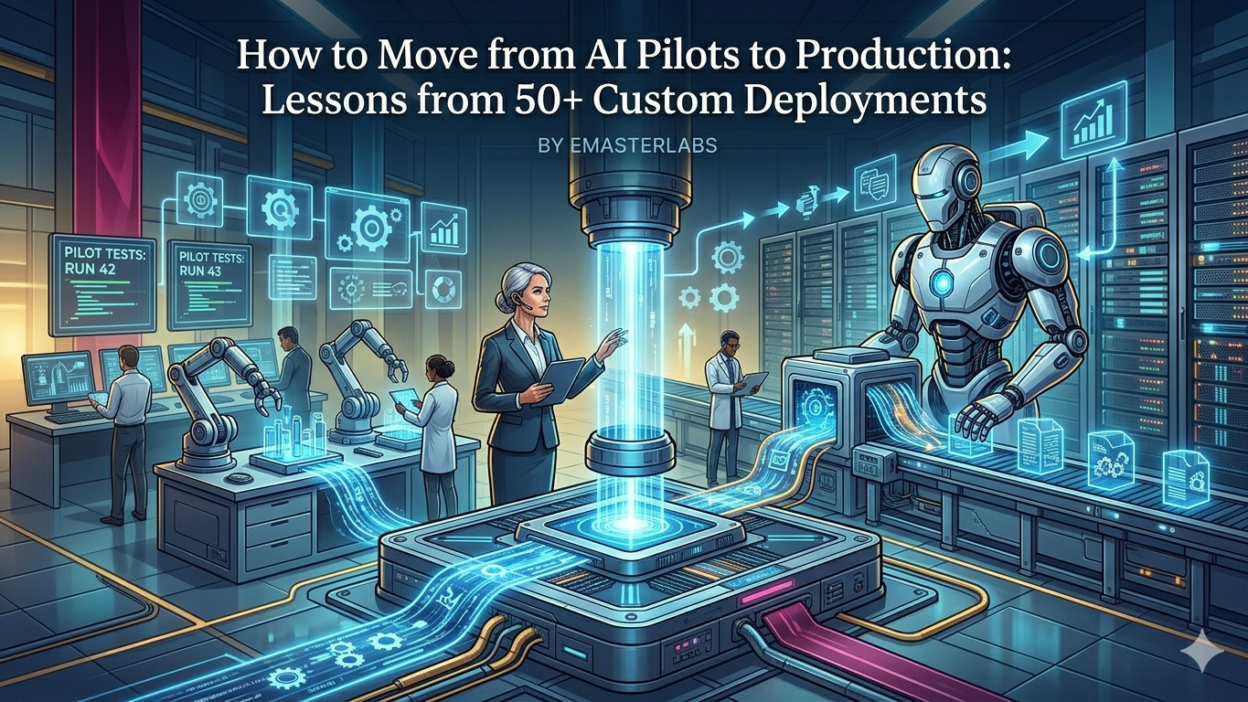
TL;DR Most AI projects do not fail in the lab. They fail in the hallway — somewhere between a promising demo and a working system that real employees use every day. This is the pilot trap. Organizations invest months building a proof of concept. The results look great in controlled conditions. Then the move AI from pilot to production moment arrives, and everything unravels.
Over 50 custom AI deployments across industries — healthcare, retail, finance, logistics, and manufacturing — reveal the same set of patterns. Some projects sail into production smoothly. Most stall. A few collapse entirely. The difference is rarely the technology. It is almost always the process.
This blog shares the real lessons from those deployments. It covers what breaks, what works, and what every organization must know before they attempt to move AI from pilot to production at scale.
Table of Contents
The Pilot Trap: Why AI Projects Stall Before Production
A pilot exists to prove an idea. Production exists to deliver value every single day. These are fundamentally different goals. Most teams build for the first without designing for the second.
A pilot runs on clean, curated data. A production system runs on messy, incomplete, real-world data. A pilot has a dedicated team watching every output. A production system runs unsupervised at 3 AM. A pilot is measured by accuracy. A production system is measured by uptime, latency, cost, and business impact.
When teams attempt to move AI from pilot to production, these gaps hit simultaneously. The model breaks on data it has never seen. The infrastructure buckles under real traffic. Stakeholders who loved the demo lose patience when the live system behaves differently. This is the pilot trap.
Gartner reports that fewer than 53% of AI pilot projects ever reach production deployment. Understanding why is the first step to beating that statistic.
The Three Root Causes of Pilot Failure
The first root cause is data optimism. Pilot teams select the best available data to train and test. Production systems encounter data from every source — API failures, missing fields, encoding errors, duplicate records. The model was never trained to handle this reality.
The second root cause is scope creep during transition. The business adds requirements as the system moves toward launch. What started as a document classifier becomes a multi-step workflow orchestrator. The architecture was never designed for this complexity.
The third root cause is absent ownership. A pilot has a champion. When production nears, responsibility fragments. IT owns infrastructure. Data science owns the model. Operations owns the users. No single person owns outcomes. Problems fall through the cracks between teams.
Define Production Before You Build the Pilot
The most successful deployments start with a production definition, not a pilot definition. Teams that move AI from pilot to production consistently write a one-page production brief before writing the first line of pilot code.
This brief answers five questions. What does production-ready mean for this specific use case? What volume of data or requests must the system handle daily? What uptime SLA is required? What accuracy threshold triggers a human review? Who is accountable when the system makes a wrong decision?
Teams that answer these questions upfront design pilots that prove production feasibility — not just technical possibility. Their pilots test edge cases, not just ideal scenarios. Their data choices reflect real-world variety, not curated perfection.
What a Production Brief Must Include
A solid production brief covers infrastructure requirements first. Cloud or on-premise? What compute budget? What data storage architecture? These decisions affect the model architecture and the serving layer. Getting them wrong in the pilot means rebuilding at the transition.
The brief covers the human-in-the-loop design next. Every production AI system needs a fallback. Low-confidence predictions need an escalation path. Errors need a correction mechanism. The team that can move AI from pilot to production reliably always builds these paths before launch, not after.
Compliance requirements belong in the brief too. GDPR, HIPAA, SOC 2, ISO 27001 — these are not post-launch concerns. They shape data handling, logging, retention, and access control from day one. Retrofitting compliance into a live system costs ten times more than building it in from the start.
Treat Data Engineering as a First-Class Discipline
Every deployment that struggled to move AI from pilot to production had the same underlying problem. Data engineering was treated as a support function, not a core competency. Data scientists got the spotlight. Data engineers got the tickets.
This is backwards. The model is only as good as the data pipeline feeding it. A world-class model on a broken pipeline delivers worse outcomes than a good model on a reliable pipeline.
Building Production-Grade Data Pipelines
Production data pipelines need four properties. They must be reproducible — every run on the same input must produce the same output. They must be monitored — data quality checks must run automatically and alert when distributions shift. They must be versioned — the exact data used for each model training run must be retrievable. They must be documented — every transformation step must have a clear owner and a clear rationale.
Most pilot pipelines have none of these properties. They are Jupyter notebooks with hardcoded paths. They are SQL queries that live in someone’s local machine. They are Python scripts with no logging and no error handling. Productionizing this code is often the longest part of any deployment project.
The Silent Production Killer
Data drift describes the phenomenon where real-world data distribution shifts away from the training data distribution over time. This kills production AI systems quietly. The model does not break suddenly. It degrades gradually. Accuracy drops. Business outcomes worsen. By the time someone notices, months of degradation have occurred.
Successful teams that move AI from pilot to production build drift detection into the monitoring stack from launch day. Tools like Evidently AI, WhyLabs, and Arize monitor feature distributions, prediction distributions, and outcome data. They alert when drift exceeds acceptable thresholds. Teams retrain or recalibrate before the system causes visible business damage.
Infrastructure Must Match the Use Case
Infrastructure decisions made in pilots are almost always wrong for production. Pilots run on developer laptops or shared notebooks. Production runs on dedicated compute with redundancy, autoscaling, and failover. The gap between these environments creates deployment surprises that kill timelines.
Teams that successfully move AI from pilot to production make infrastructure decisions early. They pick a serving architecture before the model is finalized, not after.
Batch vs. Real-Time Serving
Most AI use cases fall into one of two infrastructure patterns. Batch processing handles large volumes of data on a schedule — nightly fraud score updates, weekly customer churn predictions, monthly demand forecasts. Real-time serving handles individual requests with low latency — live recommendation engines, real-time document classification, instant fraud detection at checkout.
These patterns require completely different infrastructure. Batch workloads run on job schedulers like Apache Airflow or AWS Batch. Real-time workloads need low-latency model servers like FastAPI, TorchServe, or managed endpoints on AWS SageMaker or Google Vertex AI. Building the wrong architecture for the use case is a guaranteed production failure.
Model Serving at Scale
A model that runs in one second on a developer machine takes five seconds under production load if the serving layer is not optimized. Teams must load-test their model servers before launch. They must profile inference latency at the 50th, 95th, and 99th percentiles. They must quantize or distill models where latency is critical.
Container orchestration with Kubernetes or managed container services ensures the serving layer scales with demand. Auto-scaling policies prevent both over-provisioning and under-provisioning. Organizations that move AI from pilot to production without load testing almost always face a production incident within 30 days of launch.
Build Observability Into the System from Day One
You cannot manage what you cannot see. Production AI systems need observability — the ability to understand system behavior from its outputs. This goes beyond basic uptime monitoring. It covers model behavior, prediction quality, data quality, and business outcomes simultaneously.
Teams that move AI from pilot to production successfully instrument their systems at three levels. Infrastructure observability tracks compute usage, memory, latency, and error rates. Model observability tracks prediction distributions, confidence scores, and feature values. Business observability tracks downstream outcomes — revenue per recommendation, claims processed per hour, customer satisfaction after AI-assisted interactions.
The Monitoring Stack You Actually Need
Infrastructure monitoring uses established tools — Datadog, Prometheus, Grafana, or cloud-native equivalents. These handle uptime, latency, and resource metrics well. Model monitoring needs specialized tools. Evidently AI, Arize, and Fiddler provide prediction monitoring, drift detection, and model performance tracking designed specifically for AI systems in production.
Business outcome monitoring is the layer most teams skip. It connects AI predictions to the actual decisions made and the results those decisions produced. This feedback loop is essential for continuous improvement. Without it, teams cannot know whether a change to the model improved business outcomes or just moved metrics in the monitoring dashboard.
Alerting Without Alert Fatigue
Production AI systems generate a lot of signals. Not all signals matter equally. Poorly configured alerting creates alert fatigue — teams learn to ignore notifications because too many are false positives. This is dangerous.
Alert on outcomes, not just metrics. An accuracy drop from 97% to 95% may not matter if business outcomes are stable. A 2% accuracy drop that correlates with a 15% revenue drop matters immediately. Calibrate alerts to business thresholds, not model performance thresholds in isolation.
Change Management Is Half the Work
The technology is rarely the hardest part when teams move AI from pilot to production. People are. End users resist new systems. Middle managers protect existing processes. Executives lose patience with timelines. Without deliberate change management, technically sound deployments fail because no one uses them.
Securing Stakeholder Buy-In Before Launch
Stakeholder buy-in is earned through involvement, not announcement. Bring operational leaders into the design process early. Show them the pilot results. Explain the limitations honestly. Ask for their input on edge cases and failure modes. People support what they help build.
Identify a business champion in every department the AI system touches. This person is not technical. They understand the operational context. They translate AI capabilities into language their colleagues understand. They handle the informal change management that no process document can achieve.
Training Users for AI-Augmented Work
Users need to know three things when a new AI system goes live. First, what the system does and does not do. Setting correct expectations prevents both over-reliance and under-utilization. Second, how to identify when the system is wrong. Users who cannot recognize AI errors become amplifiers of those errors at scale. Third, how to provide feedback. Every user interaction is a data point. Structured feedback mechanisms turn users into contributors to model improvement.
Organizations that move AI from pilot to production with strong user training programs see adoption rates 40–60% higher than those that launch without structured onboarding. The training investment pays back within weeks.
Lesson 6: Start Small, Scale Deliberately
Full-scale production launches are high-risk. Shadow deployment and canary releases dramatically reduce that risk. Every organization that struggles to move AI from pilot to production tries to launch everywhere at once. Every organization that succeeds starts with a controlled rollout.
Shadow Deployment
Shadow deployment runs the AI system in parallel with the existing process without affecting outputs. The AI makes predictions. Those predictions go into a log, not into production decisions. The team compares AI predictions with actual human decisions over days or weeks. Discrepancies reveal failure modes before they cause harm.
Shadow deployment builds confidence with skeptical stakeholders. It generates real-world performance data before any business risk is taken. It also exposes data pipeline issues that only appear under production data conditions — issues that never showed up in the pilot environment.
Canary Releases and Gradual Rollout
A canary release sends a small percentage of real traffic to the new AI system — typically 1% to 5% — while the rest flows through the existing process. The team monitors canary traffic closely. If metrics stay healthy, the percentage increases incrementally. If problems appear, the rollout stops and rolls back instantly.
This approach means a production failure affects 1% of users, not 100%. It gives the team real-world signal without catastrophic risk. It also creates a natural pressure test — real traffic, real data, real latency — that controlled staging environments cannot replicate.
Create a Model Governance Framework
Governance sounds bureaucratic. In practice, it is the difference between a production AI system that stays healthy for two years and one that silently degrades for six months before anyone notices.
A model governance framework covers four areas. Model versioning tracks which model version runs in production at any moment and what data it was trained on. Model approval defines who must sign off before a new model version goes live. Model auditing records predictions, inputs, and outcomes for review and compliance. Model retirement sets the criteria for decommissioning a model and replacing it.
Retraining Schedules and Triggers
Models need retraining. The question is when. Time-based retraining — monthly, quarterly — is simple to implement but ignores performance signals. Trigger-based retraining responds to detected drift or accuracy degradation. This is more efficient and more responsive.
Teams that move AI from pilot to production at scale usually combine both approaches. They retrain on a baseline schedule and also trigger emergency retraining when monitoring alerts cross defined thresholds. Automated retraining pipelines using MLflow, Kubeflow, or SageMaker Pipelines make this practical without heavy manual effort.
FAQs: How to Move AI from Pilot to Production
How long does it take to move AI from pilot to production?
Timeline varies widely by complexity. Simple models with clean data and existing infrastructure can go from pilot to production in six to eight weeks. Complex multi-model systems with new data pipelines, compliance requirements, and large user bases take six to twelve months. The biggest timeline killers are data engineering backlogs, compliance reviews, and change management delays — not model development.
What is the most common reason AI pilots fail to reach production?
The most common reason is data infrastructure gaps. Pilots use curated data in controlled environments. Production systems encounter messy, incomplete, real-world data. When the data pipeline cannot handle production conditions reliably, the model performs worse than expected. Business stakeholders lose confidence. The project stalls or gets cancelled. Building production-grade data pipelines before or during the pilot prevents this failure mode.
How do you measure the success of an AI production deployment?
Success measurement requires connecting model performance to business outcomes. Accuracy, precision, and recall are model metrics. They matter, but they are not business metrics. Define business KPIs before launch — cost per transaction, error rate reduction, throughput increase, customer satisfaction score change. Track these alongside model metrics from day one. A model with 94% accuracy that improves business outcomes by 30% is more successful than a model with 98% accuracy that moves the business needle by 5%.
What team structure works best for AI production deployments?
The most effective team structure places a product owner as the single accountable decision-maker. Data scientists build and iterate the model. Data engineers own the pipeline. ML engineers own the serving infrastructure. A business analyst owns outcome monitoring and stakeholder communication. This cross-functional structure eliminates the ownership gaps that let production problems go unresolved.
Do you need MLOps to move AI from pilot to production?
You need MLOps practices, not necessarily an MLOps platform. Small teams can implement versioning, monitoring, and retraining workflows with lightweight tools and disciplined processes. Larger teams or organizations running multiple models in production benefit from dedicated MLOps platforms like MLflow, Weights and Biases, or Vertex AI Pipelines. The key practices — reproducibility, monitoring, versioning, and governance — matter regardless of the tools used to implement them.
How do you handle model failures in production?
Every production AI system needs a documented failure response plan before launch. The plan defines failure severity levels — degraded performance vs. system outage vs. safety-critical error. It assigns response owners for each level. It specifies rollback procedures, communication templates, and root cause analysis requirements. Teams that move AI from pilot to production without a failure response plan make every incident more chaotic and more damaging than necessary.
What role does executive sponsorship play in production AI success?
Executive sponsorship is critical and often underestimated. Production AI deployments require cross-functional decisions about budget, data access, process changes, and accountability structures. These decisions stall without executive authority to resolve them. An executive sponsor who understands the business case and can remove organizational blockers cuts deployment timelines by 20 to 40 percent in large organizations.
What Comes After Production: Continuous Improvement
Launching a production AI system is not the finish line. It is the starting line for continuous improvement. The best teams that move AI from pilot to production treat launch as the beginning of a learning cycle, not the end of a project.
Every week in production generates new data. User feedback reveals edge cases the pilot never exposed. Business outcomes reveal whether the model is actually solving the right problem. Monitoring data reveals drift, degradation, and new failure modes. All of this feeds the next iteration.
High-performing AI organizations build feedback loops from day one. They collect structured user feedback. They label model errors and feed them back into training data. They run A/B tests on model changes before full rollout. They review business outcome data weekly with cross-functional teams. This discipline separates organizations where AI compounds in value over time from those where AI stagnates after launch.
Read More:-E-commerce 2026: Beyond Chatbots—Building Agents that Handle Returns and Refunds
Conclusion
Fifty-plus deployments reveal a consistent truth. The technology is almost never the barrier when teams try to move AI from pilot to production. The barriers are process, people, data infrastructure, and governance.
Define production before building the pilot. Treat data engineering as a first-class discipline. Choose infrastructure that matches the use case, not the pilot environment. Build observability into the system from the first day of production traffic. Invest in change management as seriously as model development. Roll out in stages, not all at once. Govern models with the same rigor applied to any critical business system.
These seven lessons separate the projects that deliver lasting value from those that become expensive case studies in what not to do. Every organization has the capacity to move AI from pilot to production successfully. Few do it without learning from others who have made the mistakes first.
The pilot trap is real. The path out of it is clear. Start with the end in mind. Build for production from the first day. Instrument everything. Own outcomes, not just outputs. The organizations that internalize these principles will spend less time in pilots and more time compounding the value of AI systems that actually work at scale.
The goal was never an impressive demo. The goal was always a system that runs reliably, improves continuously, and delivers measurable business outcomes every single day. That is what it means to truly move AI from pilot to production.