Introduction
TL;DR Returns are the silent profit killer of e-commerce. Every returned item costs money twice — once when you shipped it and again when you process it back.
The average return rate in e-commerce sits between 20% and 30% depending on the category. Fashion returns run even higher, sometimes reaching 40%. These numbers represent millions of dollars in operational drag for mid-sized and enterprise retailers.
Chatbots tried to fix this problem for years. They gave customers a place to ask questions about return policies. They collected order numbers. They sent templated email responses. That was helpful in 2019. It is nowhere near enough in 2026.
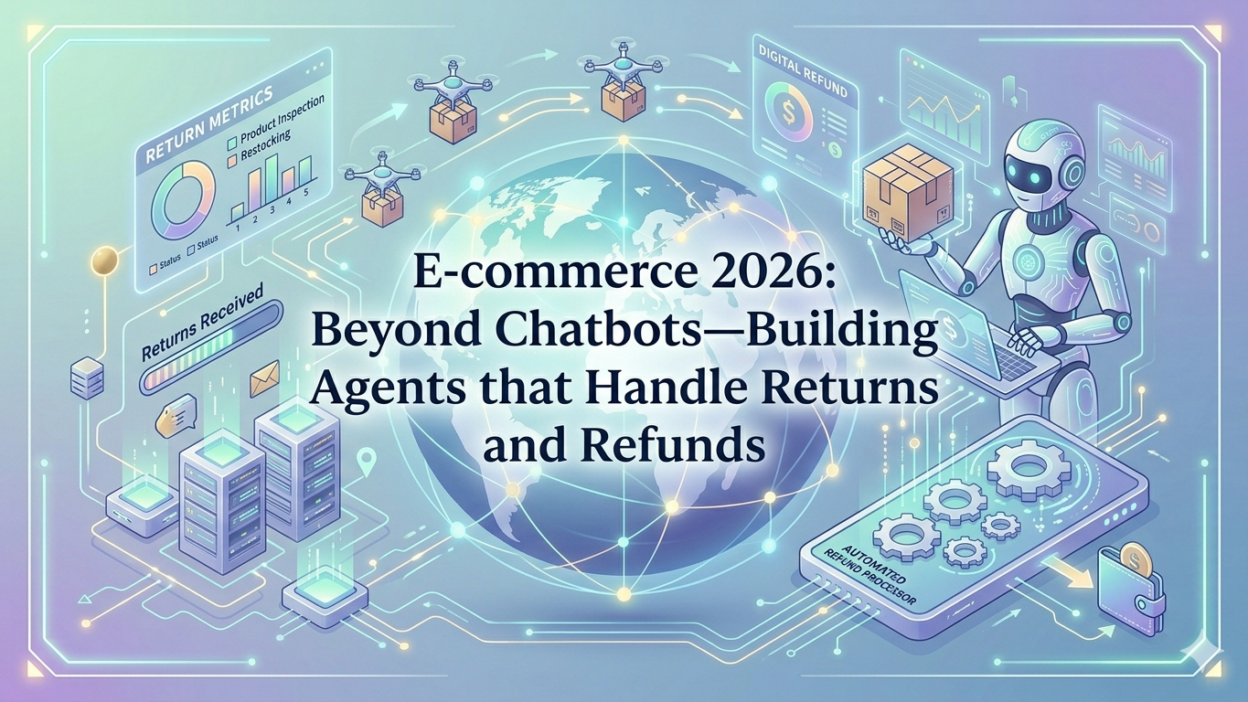
AI agents for e-commerce returns and refunds represent a fundamentally different approach. These agents do not just answer questions. They verify eligibility, inspect return reasons, evaluate fraud risk, initiate refunds, communicate with customers in real time, and close the loop — entirely on their own.
This blog breaks down exactly how these agents work, what separates them from basic chatbot automation, what technical and business considerations matter for implementation, and what the most forward-thinking e-commerce brands are building right now.
Table of Contents
Why Chatbots Failed the Returns Problem
The Chatbot Promise vs. Reality
Chatbots made a compelling promise. Automate customer service. Reduce agent headcount. Resolve inquiries faster. The reality did not match the pitch.
Most chatbot implementations in e-commerce handled a narrow slice of return interactions. They could tell a customer the return window. They could paste a link to the returns portal. They could collect a reason code and create a support ticket.
The moment a customer’s situation fell outside the script — an expired return window with a valid reason, a damaged item requiring photographic verification, a refund dispute on a subscription order — the chatbot handed off to a human agent.
That handoff model did not eliminate human labor. It just added a frustrating first step before the human labor began. Customers resented waiting. Agents inherited poorly documented conversations. Resolution times stayed long.
What Chatbots Cannot Do
A chatbot reads from a decision tree. It matches keywords to responses. It has no ability to reason about context, evaluate nuance, or make judgment calls.
It cannot look at an order’s history and determine that a customer with 50 successful purchases and one return request deserves policy flexibility. It cannot assess a photo of a damaged product and decide whether the damage matches the customer’s description. It cannot cross-reference a return request against a fraud pattern detected in a sister account.
AI agents for e-commerce returns and refunds do all of these things. The architectural difference is not incremental. It is categorical.
The Cost of the Chatbot Gap
Every interaction that a chatbot fails to resolve completely costs money. An average human-assisted return interaction costs between $5 and $15 in labor, depending on complexity and company size. Multiply that by hundreds of thousands of returns per year and the number gets significant fast.
What AI Agents Actually Are
Beyond Rules and Scripts
An AI agent is not a smarter chatbot. A chatbot follows rules. An AI agent reasons, plans, and acts.
The core architecture of a modern AI agent combines a large language model as the reasoning engine, a set of tools the agent can call, a memory layer for context retention, and an orchestration framework that manages the sequence of actions.
When a customer submits a return request, the agent does not look up the answer in a decision tree. It reads the request, retrieves the order details from the OMS, checks the return policy for that product category, evaluates the stated reason against past return patterns, determines eligibility, calculates the refund amount, and initiates the refund — all in a single continuous reasoning chain.
This is why AI agents for e-commerce returns and refunds represent a genuine operational leap rather than an incremental chatbot upgrade.
Agentic Architecture for Returns
A well-designed returns agent typically operates with several core tools. It connects to the order management system to retrieve order status, payment details, and delivery confirmation. It connects to the warehouse management system to log expected returns and update inventory. It accesses the fraud detection layer to flag suspicious patterns. It connects to the payment processor to issue refunds directly.
Each of these connections is a tool the agent calls when its reasoning determines that tool is needed. The agent does not follow a fixed sequence. It adapts the sequence based on what the current interaction requires.
The Role of Memory in Agent Performance
Memory is what separates a one-time interaction from a relationship. AI agents with memory access the full history of a customer’s interactions — past returns, purchase frequency, complaint history, and communication preferences.
That context changes decisions. A long-term customer requesting a return for a high-value item gets handled differently than an account with no purchase history requesting a refund on a first order. Memory enables that nuance without requiring a human to look it up manually.
Core Capabilities of AI Agents for Returns and Refunds
Automated Eligibility Verification
Return eligibility is not always binary. Most e-commerce companies have policies with exceptions, grace periods, product-specific rules, and customer tier considerations.
AI agents for e-commerce returns and refunds evaluate eligibility across all of these dimensions simultaneously. They check the purchase date against the return window. They verify the product category against category-specific policies. They assess the customer’s tier or loyalty status against any special return provisions.
When a return falls outside standard eligibility, the agent does not simply reject it. It evaluates whether an exception is warranted based on customer value, reason for return, and business rules defined by the operations team. High-value customers requesting a first return on a genuinely defective item often warrant a policy exception — and the agent makes that call automatically.
Real-Time Fraud Detection and Prevention
Return fraud costs U.S. retailers over $100 billion annually. Common fraud patterns include returning items never purchased from that retailer, returning used items as new, claiming non-delivery on orders that tracking confirms were received, and coordinated fraud rings exploiting generous return policies.
AI agents for e-commerce returns and refunds integrate with fraud detection engines to evaluate each return request in real time. The agent checks delivery confirmation status, cross-references return patterns with the customer’s account history, and flags requests that match known fraud signatures before any refund processes.
This automated fraud layer catches far more suspicious activity than manual review teams working through queues. Speed and pattern recognition at scale are areas where AI agents outperform human reviewers consistently.
Photo and Evidence Verification
Damaged item returns require evidence. A customer claiming their product arrived broken should submit photos. Traditionally, a human agent reviewed those photos and made a judgment call.
Modern AI agents for e-commerce returns and refunds include computer vision capabilities that analyze submitted photos automatically. The vision model checks whether the damage in the photo is consistent with the type of damage the customer described. It verifies that the product in the photo matches the product ordered. It flags inconsistencies for human review while approving clear-cut cases instantly.
This capability eliminates a major bottleneck in the returns workflow. Photo review queues that once took 24–48 hours to clear now resolve in seconds for straightforward cases.
Automated Refund Initiation and Communication
Once an AI agent determines a return request is eligible and legitimate, it initiates the refund without human involvement. It calculates the correct refund amount — accounting for partial returns, restocking fees, original shipping costs, and applicable promotions. It sends the refund to the correct payment method. It generates and sends a confirmation message to the customer.
The entire resolution cycle — from submission to refund confirmation — takes minutes rather than days. Customer satisfaction scores on returns interactions improve dramatically when resolution speed improves.
Escalation Intelligence
Not every return needs a human. But some returns do. AI agents for e-commerce returns and refunds know the difference.
The agent escalates when fraud probability crosses a defined threshold. It escalates when a customer expresses emotional distress that warrants empathetic human engagement. It escalates when a situation involves legal sensitivity — a safety complaint about a product, a regulatory concern, or a chargeback dispute. It escalates with full context already compiled, so the human agent who picks up the case starts informed rather than starting from scratch.
Building Your Returns Agent: Technical Foundations
System Integration Requirements
An AI agent for returns is only as capable as the systems it connects to. Before building the agent, audit your integration readiness across four core systems.
Your order management system must expose APIs that the agent can call to retrieve order details, status, and payment information. Your warehouse management system must accept inbound notifications about expected returns so inventory can update in real time. Your payment processor must support programmatic refund initiation through a secure API. Your customer data platform must give the agent access to purchase history, return history, and customer tier status.
AI agents for e-commerce returns and refunds built on incomplete system integrations produce incomplete results. The agent reasons only with the data it can access. Data gaps produce decision gaps.
Choosing the Right Agent Framework
Several mature frameworks exist for building production-grade AI agents. LangChain and LangGraph provide flexible orchestration with support for multi-step reasoning and tool use. CrewAI enables multi-agent architectures where specialized sub-agents handle discrete parts of the workflow. AutoGen from Microsoft supports conversation-driven agent coordination.
The right framework depends on your engineering team’s expertise, your infrastructure preferences, and the complexity of your returns logic. Simple single-step return flows work well in LangChain. Complex multi-product, multi-region return operations with fraud detection, warehouse integration, and multi-currency refund logic benefit from a multi-agent architecture.
Defining Agent Permissions and Guardrails
Autonomous agents need boundaries. A returns agent with unconstrained refund authority is a financial risk. Define clear permission boundaries before deployment.
Set maximum refund amounts the agent can approve autonomously. Above that threshold, require human approval. Define fraud score thresholds that trigger automatic escalation. Specify product categories where additional verification is always required — high-value electronics, luxury goods, and perishables often warrant stricter rules.
AI agents for e-commerce returns and refunds perform best when their autonomy level matches the confidence level of their decision-making. Expand permissions gradually as you validate agent accuracy on real-world cases.
Running Shadow Mode Before Full Deployment
Do not deploy a returns agent directly into production without validation. Run the agent in shadow mode first. Let it process every return request alongside your existing workflow, but do not let it take real actions.
Compare the agent’s recommended decisions against what your human agents actually did. Measure agreement rates. Identify categories where the agent consistently diverges from your team’s judgment. Tune the agent’s reasoning, policy prompts, and tool configurations based on what shadow mode reveals.
Shadow mode typically runs for four to eight weeks for a returns agent handling moderate volume. High-volume operations may need a shorter shadow period with statistical sampling.
Business Impact: What the Numbers Show
Resolution Time Reduction
The most immediate and measurable impact of AI agents for e-commerce returns and refunds is resolution time. Manual returns processing takes an average of three to five business days from request submission to refund confirmation. AI agents resolve straightforward cases in under five minutes.
Even at high volume, agents maintain that speed. A human team processing 500 returns per day has a capacity ceiling. An AI agent processes 500 returns in the same time it processes 50. Scale does not degrade performance.
E-commerce brands that have deployed full-cycle returns agents report 70–85% reductions in average resolution time. That speed improvement directly affects customer satisfaction scores and repeat purchase rates.
Cost Per Return Reduction
Human-assisted return processing costs between $5 and $15 per interaction when you factor in agent labor, management overhead, and quality assurance. Fully automated returns cost a fraction of that — typically under $0.50 per resolved case when amortized across agent infrastructure costs.
The cost reduction compounds at scale. An operation handling 100,000 returns per month at $8 average cost per return spends $800,000 monthly on returns processing. AI agents for e-commerce returns and refunds handling 80% of those cases autonomously reduce that spend to under $200,000 per month.
Fraud Loss Reduction
Returns fraud detection improves measurably when AI agents handle verification. Automated cross-referencing of delivery data, account history, and pattern analysis catches fraud that human reviewers miss — not because humans are less intelligent, but because they cannot hold as many data points in active consideration simultaneously.
Brands deploying AI-powered fraud detection on returns report 30–50% reductions in return fraud losses within the first year of operation.
Customer Satisfaction and Retention
Speed is the primary driver of returns satisfaction. Customers who receive a refund in minutes rate the experience significantly higher than customers who wait days. High returns satisfaction correlates strongly with repeat purchase intent.
AI agents for e-commerce returns and refunds turn a negative touchpoint — a product being returned — into a positive brand experience. That conversion matters enormously for long-term customer lifetime value.
Real-World Deployment Patterns
Tier-Based Automation
Smart retailers deploy returns agents with automation tiers based on case complexity. Tier one covers standard return requests — items within the return window, clear reason codes, no fraud flags. The agent handles these fully autonomously.
Tier two covers edge cases — expired return windows, high-value items, conflicting delivery data. The agent handles the data gathering and initial analysis, then presents a recommended decision to a human reviewer for final approval.
Tier three covers complex cases — fraud investigations, safety complaints, legal disputes. The agent compiles the full case file and escalates immediately to a specialized human team.
AI agents for e-commerce returns and refunds work most effectively inside a tiered structure that matches agent autonomy to case complexity. This model captures maximum automation efficiency while maintaining appropriate human oversight.
Multi-Channel Returns Handling
Customers initiate returns through multiple channels. Some submit through the website portal. Others email customer service. Others message through Instagram DMs or WhatsApp. Some call the phone support line.
Modern returns agents operate across all of these channels from a single reasoning layer. The agent receives the return request regardless of channel, pulls the same customer and order data, applies the same decision logic, and sends a resolution back through the channel the customer used.
This channel-agnostic capability eliminates inconsistent return experiences across touchpoints — a persistent problem in multi-channel retail operations.
Frequently Asked Questions (FAQ)
What makes AI agents different from automated return portals?
Automated return portals follow fixed rules and scripts. They process standard cases but fail on anything non-standard. AI agents for e-commerce returns and refunds reason dynamically. They evaluate context, make judgment calls, access multiple systems simultaneously, and handle edge cases without human intervention. The capability gap between the two is significant.
How long does it take to build a returns agent?
A basic returns agent with core eligibility verification and refund initiation capabilities takes four to eight weeks to build and validate for a team with existing API integrations in place. A full-featured agent with fraud detection, computer vision, multi-channel support, and multi-region policy logic takes three to six months. Timeline depends heavily on integration readiness.
Can AI agents handle international returns with different policies by region?
Yes. AI agents for e-commerce returns and refunds can operate with region-specific policy sets. The agent identifies the customer’s region from their order data and applies the correct regional policy rules. Multi-currency refund calculations, regional return windows, and country-specific compliance requirements all fit within a well-designed agent’s configuration.
What happens when a customer disputes an AI agent’s decision?
A clear escalation path must exist. When a customer disputes an agent’s decision, the case routes to a human customer service agent with the full interaction history and agent reasoning already documented. The human agent reviews and either upholds or overrides the agent’s decision. Overrides feed back into agent training data to improve future accuracy.
How do AI agents handle return fraud without alienating genuine customers?
The best AI agents for e-commerce returns and refunds use probabilistic fraud scoring rather than binary block decisions. A high fraud score triggers additional verification steps — photo submission, delivery confirmation review, or manual review — rather than an immediate rejection. This approach catches fraud while preserving the experience for customers who are flagged incorrectly.
Is AI agent deployment for returns practical for small e-commerce businesses?
At very small scale — fewer than 500 returns per month — the investment in building a custom returns agent may not deliver sufficient ROI. Small businesses benefit more from off-the-shelf returns management software with some AI assistance. AI agents for e-commerce returns and refunds deliver the strongest ROI for businesses processing thousands of returns monthly where automation savings outweigh implementation costs.
Read More:-Building an “AI Factory”: A Roadmap for Enterprises Transitioning to Agentic Workflows
Conclusion

The returns problem is not going away. As e-commerce grows, return volumes grow with it. The only path to managing that volume profitably is through intelligent automation that goes far beyond what chatbots can deliver.
AI agents for e-commerce returns and refunds represent where the industry is heading. The brands building these capabilities now are not just solving an operational headache. They are building a competitive advantage that compounds over time. Faster resolutions mean happier customers. Happier customers buy more. Better fraud detection means lower losses. Lower losses improve margins.
The shift from chatbots to agents is not a technology upgrade. It is a strategic repositioning of how e-commerce companies think about post-purchase experience. Returns are not a cost center to minimize. They are a customer relationship moment to win.
Building an AI agent for returns requires investment in integration infrastructure, clear policy definitions, thoughtful permission boundaries, and a validation process that earns trust before expanding autonomy. None of that is trivial. All of it is worth doing.
AI agents for e-commerce returns and refunds will define the operational baseline for competitive retailers by 2026. The companies that wait for the technology to mature further will find themselves playing catch-up against brands that already have millions of real-world return interactions training their agents.
Start with a scoped pilot. Pick one return category. Build the agent. Validate in shadow mode. Deploy with guardrails. The learning compounds faster than any roadmap predicts.
The era of the chatbot handling your returns is ending. The era of the AI agent managing your returns has already begun.