Introduction
TL;DR Automation is no longer optional for modern businesses. It is the backbone of every efficient operation, from marketing workflows to product deployments.
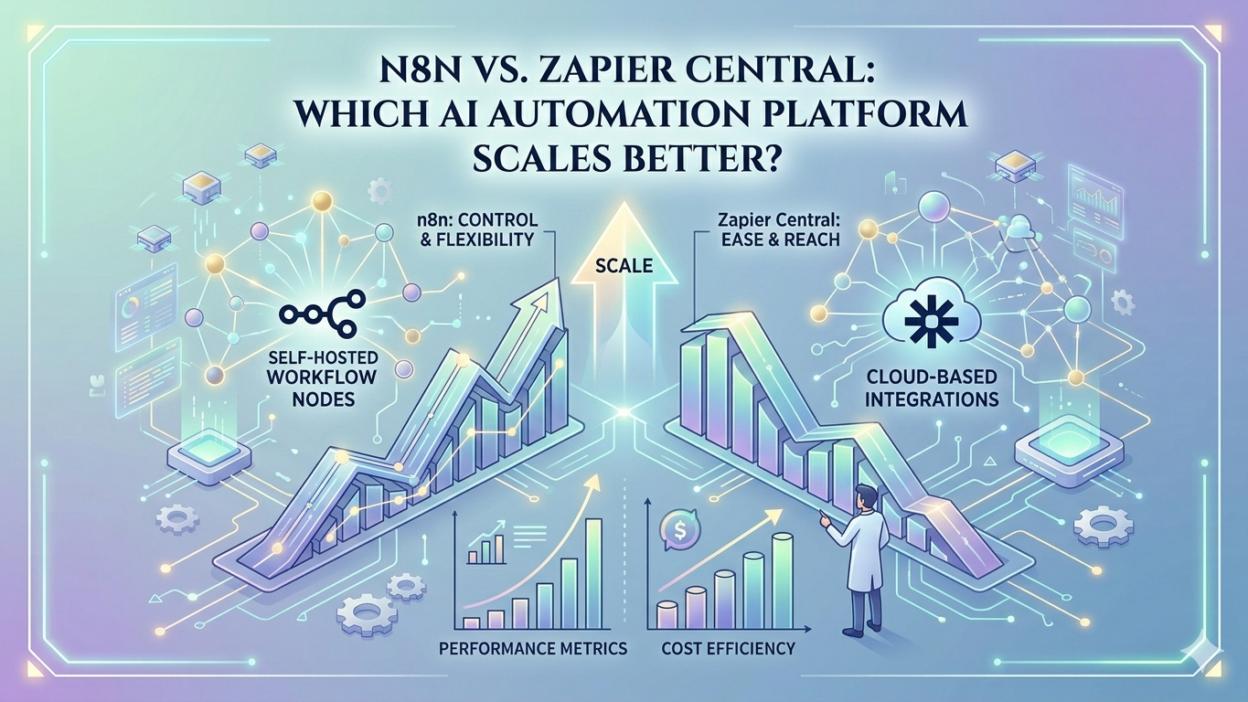
Two names dominate the conversation right now. n8n and Zapier Central both promise to eliminate manual work and connect your tools intelligently. But they serve very different types of users, teams, and scaling ambitions.
n8n vs Zapier Central is one of the most searched comparisons in the automation space today. The reason is simple. Businesses want to pick the right platform once and grow with it — not switch tools every eighteen months because they outgrew the system.
This blog gives you a clear, honest breakdown of both platforms. You will understand the core architecture differences, the pricing realities, the AI capabilities each platform brings, and the scale limitations that neither marketing page will tell you about.
Whether you run a startup moving fast, a mid-sized company managing complex data flows, or an enterprise building custom internal tools — this comparison covers your situation specifically.
By the end, you will know exactly which platform fits your team’s current needs and which one positions you better for growth. This is not a surface-level overview. This is the comparison that actually helps you decide.
Table of Contents
What Is n8n?
The Open-Source Workflow Automation Engine
n8n is an open-source, self-hostable workflow automation platform. It gives technical teams full control over their automation infrastructure, data, and logic.
The platform launched in 2019 and quickly earned a loyal following among developers, DevOps engineers, and data teams who needed more flexibility than no-code tools could offer.
n8n works through a visual node-based editor. Each node represents an action, a trigger, or a transformation. Users connect nodes to build workflows — called “workflows” on the platform — that can range from a simple two-step process to a complex multi-branch pipeline with conditional logic, loops, and error handling.
Who Builds with n8n
n8n appeals to technical users. Most n8n users have some coding background or work closely with developers. The platform supports JavaScript and Python code execution directly inside workflows. That flexibility makes it far more powerful than most visual automation tools.
Startups building internal tools, agencies managing client data pipelines, and enterprises needing self-hosted data processing all find n8n valuable. The ability to run n8n on your own infrastructure is a major draw for teams with strict data privacy requirements or GDPR compliance obligations.
n8n’s AI Capabilities
n8n introduced native AI agent nodes that allow users to build LLM-powered workflows. These agents can use tools, retrieve data from vector databases, and perform multi-step reasoning tasks — all within the familiar n8n workflow editor.
The platform integrates with OpenAI, Anthropic, Google Gemini, and local models through Ollama. This positions n8n as a serious contender for teams building AI-powered internal applications and automated data enrichment pipelines.
What Is Zapier Central?
Zapier’s AI-Native Automation Hub
Zapier Central is Zapier’s AI-powered workspace that goes beyond their original Zap builder. It introduces AI bots, real-time data connections, and conversational automation management — all inside a single hub.
Zapier built its reputation as the most accessible automation platform on earth. Non-technical users could connect apps in minutes without writing a single line of code. Zapier Central takes that accessibility and layers AI on top of it.
Central introduces a new concept for Zapier: bots. These bots use AI to run tasks, answer questions, monitor data changes, and take actions across connected apps. Users interact with them conversationally, which lowers the barrier for automation even further.
Who Uses Zapier Central
Zapier Central targets business users, operations teams, and marketing professionals who need automation without technical complexity. The typical Zapier Central user is not a developer. They are a marketing manager automating lead follow-up, a sales ops professional syncing CRM data, or an operations lead routing support tickets.
Zapier’s app ecosystem — over 6,000 integrations — makes it the widest-reaching automation platform for business app connectivity. That breadth is a core reason non-technical teams choose Zapier over more developer-focused tools.
Zapier Central’s AI Capabilities
Zapier Central’s AI layer focuses on accessibility. The bots can understand natural language instructions, pull live data from connected apps, and generate summaries or responses automatically.
These capabilities work well for common business automation scenarios. A bot can monitor a Google Sheet for new rows, enrich that data using AI, and send a personalized Slack message to a sales rep — all without a single conditional logic block.
Zapier Central is AI-assisted automation. n8n, by contrast, is AI-programmable automation.
n8n vs Zapier Central: Core Architecture Differences
Workflow Logic and Complexity
n8n vs Zapier Central reveals a fundamental architectural split the moment you build something non-trivial.
n8n supports branching, merging, looping, and error-handling logic natively. A single workflow can process data from multiple sources, apply conditional transformations, loop through records, and handle failures gracefully — all in one canvas.
Zapier’s architecture traditionally runs workflows linearly. Zapier Central adds AI-driven flexibility, but complex branching logic still requires workarounds that developers find limiting. Power users frequently hit walls when building workflows with more than four or five decision points.
For simple use cases — trigger, action, notify — Zapier Central wins on speed of setup. For complex, multi-step, data-heavy workflows, n8n handles the job more cleanly.
Self-Hosting vs. Cloud-Only
This is the biggest architectural difference in n8n vs Zapier Central. n8n offers full self-hosting. You deploy it on your own server, cloud instance, or Kubernetes cluster. Your data never touches n8n’s infrastructure unless you choose the cloud version.
Zapier Central is fully cloud-hosted. There is no self-hosted option. All data flows through Zapier’s servers. For teams handling sensitive customer data, healthcare records, or financial information, this is a significant constraint.
n8n’s self-hosted model gives enterprises the control they need to meet internal security policies and regulatory compliance requirements.
Integration Depth vs. Integration Breadth
Zapier wins on breadth. Over 6,000 app integrations means almost any business tool your team uses already has a Zapier connector. That breadth reduces setup time dramatically for common workflows.
n8n wins on depth. Its integrations tend to expose more of an app’s underlying API than Zapier does. When you need to access a specific endpoint, filter by a custom field, or send a non-standard payload, n8n usually delivers where Zapier falls short.
The n8n vs Zapier Central choice often comes down to this trade-off. Do you need to connect many apps quickly? Choose Zapier. Do you need deep control over how those connections behave? Choose n8n.
Execution Speed and Volume
n8n handles high-volume data processing efficiently, especially on self-hosted deployments with dedicated resources. Teams processing thousands of records per workflow run report strong performance with proper infrastructure setup.
Zapier Central throttles execution based on your plan tier. High-volume operations on lower Zapier plans hit task limits quickly and require expensive upgrades to continue running reliably.
Pricing Comparison: n8n vs Zapier Central
n8n Pricing Model
n8n uses a usage-based pricing model on its cloud version, anchored around workflow executions. The Starter plan begins at around $20 per month for a small number of active workflows. The Pro plan scales up with more workflows and executions. Enterprise pricing is custom.
The most compelling pricing option for technical teams is self-hosting. The n8n Community Edition is completely free and open-source. You pay only for your own infrastructure — a server, a cloud VM, or a container. For many teams, this means running full-featured automation at a fraction of the cost of any SaaS alternative.
n8n’s pricing model rewards technical investment. Teams willing to manage their own infrastructure get enormous value. Teams that need a fully managed service pay more but still find n8n competitive against enterprise automation platforms.
Zapier Central Pricing Model
Zapier pricing centers on tasks — each action a Zap completes counts as one task. Zapier Central features are available on higher-tier plans, meaning access to AI bots and real-time data features requires a Professional or Team plan.
The Free plan covers 100 tasks per month — enough for testing but not for real operations. The Professional plan starts around $19.99 per month for 750 tasks. The Team plan adds collaboration features and starts at $69 per month.
Task limits are the core frustration in n8n vs Zapier Central pricing debates. A single multi-step workflow can consume five or more tasks per execution. A workflow running hundreds of times daily burns through task allocations rapidly, forcing teams to upgrade or throttle automation.
Total Cost of Ownership at Scale
At small scale — a few hundred automations per month — Zapier Central’s pricing is reasonable and the managed service value justifies the cost.
At large scale — millions of task executions monthly — n8n on self-hosted infrastructure is dramatically more cost-effective. The n8n vs Zapier Central cost comparison at enterprise scale often shows a 5x to 10x difference in monthly spend.
Teams with engineering resources who can manage infrastructure should seriously evaluate n8n’s self-hosted option. Teams without those resources should factor the operational overhead into their true cost comparison.
AI Capabilities Deep Dive: n8n vs Zapier Central
n8n’s AI Agent Framework
n8n’s approach to AI is developer-first. The platform built a full AI agent framework directly into the workflow editor. Users can create LangChain-style agents that use tools, maintain memory, query vector stores, and reason through multi-step tasks.
An n8n AI agent can receive a user query, retrieve relevant documents from a Pinecone database, pass context to an OpenAI model, execute a follow-up API call based on the model’s response, and log the outcome — all in a single workflow.
This level of AI orchestration makes n8n genuinely powerful for teams building AI-powered applications. Customer service bots, data enrichment pipelines, and internal knowledge retrieval tools all become buildable without a dedicated AI engineering team.
n8n also supports local model execution through Ollama integration. Teams with data privacy requirements can run LLMs on their own infrastructure, keeping sensitive data entirely internal. This capability has no equivalent in Zapier Central.
Zapier Central’s AI Bot Framework
Zapier Central takes a different approach. The AI layer is designed for business users, not developers. Bots in Zapier Central understand natural language, connect to live app data, and perform tasks conversationally.
A Zapier Central bot can watch a CRM for new deal closures, pull relevant account data, generate a personalized congratulations message using AI, and post it to Slack — all configured through a conversational interface rather than a visual workflow editor.
This accessibility is powerful for non-technical teams. Configuring AI behavior in natural language lowers the barrier dramatically. Business users who would never touch a code block or a webhook can build meaningful AI-powered automations.
The limitation is flexibility. Zapier Central bots work well within the scenarios Zapier designed for them. Custom AI behavior, unusual data transformations, or multi-model workflows push beyond what the platform comfortably handles.
Which AI Approach Wins?
The n8n vs Zapier Central AI comparison is not about which platform is smarter. It is about which AI philosophy matches your team.
n8n gives you a programmable AI layer. You define the model, the tools, the memory strategy, and the reasoning chain. Full control comes with full complexity.
Zapier Central gives you an accessible AI layer. You describe what you want in plain language. Ease of use comes with reduced flexibility.
Technical teams building custom AI workflows choose n8n. Business teams automating common processes with AI assistance choose Zapier Central. Both choices are valid depending on your team’s skill set and goals.
Scalability Analysis: Which Platform Grows With You?
Startup Stage Scalability
At the startup stage, speed matters more than anything. You need automation live in hours, not days. You cannot afford weeks of engineering time configuring infrastructure.
Zapier Central wins the startup speed race. Connect apps, configure a bot or Zap, and your automation runs. The learning curve is minimal. The time-to-value is the fastest in the industry.
n8n at the startup stage requires more setup, especially self-hosted. But cloud-hosted n8n eliminates that friction and delivers more workflow power than Zapier at the same price point. Technical startups often find n8n’s cloud version the better long-term investment even at early stage.
The n8n vs Zapier Central startup comparison ultimately depends on your founding team’s technical comfort level.
Growth Stage Scalability
At the growth stage, complexity grows fast. Simple workflows become multi-branch logic trees. Data volumes increase. Teams want to collaborate on automation building. Security requirements tighten.
n8n handles growth-stage complexity better. Its workflow logic handles multi-branch scenarios cleanly. The self-hosted option solves security requirements. Workflow versioning helps teams collaborate without breaking production automations.
Zapier Central can handle growth-stage needs for business-focused automation — marketing, sales, and support workflows. Engineering-heavy workflows that require code execution, custom data transformation, or deep API control begin to strain Zapier at this stage.
Enterprise Scalability
Enterprise-scale automation has requirements that immediately separate n8n from Zapier Central. Data sovereignty, SSO, audit logs, role-based access control, SLA-backed uptime, and dedicated infrastructure all matter at enterprise scale.
n8n’s enterprise tier addresses these requirements. Self-hosted deployment handles data sovereignty. Enterprise plan features include SSO, advanced permissions, and dedicated support. Organizations running tens of thousands of workflow executions daily do so on n8n with custom infrastructure tuned for their load.
Zapier offers enterprise plans as well, but the cloud-only architecture remains a hard limit for organizations with strict data residency requirements. Enterprise customers in regulated industries — healthcare, finance, legal — consistently find n8n’s self-hosted model the only viable option.
The n8n vs Zapier Central enterprise comparison shows a clear winner for technical organizations: n8n. For business-process automation at enterprise scale where data residency is not a constraint, Zapier Enterprise remains competitive.
Use Case Fit: Who Should Choose What
Choose n8n When…
Your team includes developers or technically fluent operations staff. You need to process large data volumes without hitting task limits or paying per execution at scale. You handle sensitive data that cannot leave your infrastructure. You are building AI-powered internal tools or custom LLM workflows. You need deep API access and custom logic that visual tools cannot express.
The n8n vs Zapier Central decision tilts toward n8n for any team that views automation as core infrastructure rather than a productivity add-on.
Choose Zapier Central When…
Your team is non-technical or primarily business-focused. You need automations live quickly across a wide range of business apps. Your workflows are relatively linear — trigger, enrich, notify, or update. You want AI assistance without managing model configurations or API integrations. Your data volumes stay within reasonable monthly task limits.
Zapier Central is the right choice when accessibility and speed of deployment matter more than depth of control. It is the automation platform built for the business user who needs results without engineering involvement.
Hybrid Approaches
Many organizations do not make an either-or choice. They run Zapier Central for business team automations and n8n for technical infrastructure workflows. This hybrid model gives each team the tool that fits their skill set and requirements.
The operations team automates marketing workflows in Zapier Central. The engineering team builds data pipelines and AI applications in n8n. Both tools run in parallel without conflict.
The n8n vs Zapier Central question sometimes has a cooperative answer rather than a competitive one.
Community, Support, and Ecosystem
n8n Community and Resources
n8n has a strong and growing open-source community. The n8n forum hosts thousands of workflow templates, troubleshooting threads, and integration guides. GitHub contributors actively improve the platform and submit new integration nodes.
The community-driven model means n8n often adds integrations faster than commercial platforms. When a new API-enabled tool launches, the community frequently builds an n8n node within weeks.
Documentation quality has improved significantly. Beginners find the learning curve steep at first, but community templates dramatically accelerate the onboarding process.
Zapier Central Community and Resources
Zapier’s community is massive. Years of user-generated content, tutorials, and templates make Zapier one of the best-documented automation platforms in existence. Almost any business automation scenario has an existing Zapier template.
Zapier’s support team is professional and responsive. Paid plan users access priority support. The platform’s stability and uptime record is excellent — a result of Zapier’s mature infrastructure and dedicated operations team.
The n8n vs Zapier Central support comparison shows Zapier ahead for non-technical users who need reliable help quickly. n8n’s community support is strong but requires more self-sufficiency.
Frequently Asked Questions (FAQ)
Is n8n better than Zapier Central for developers?
Yes, for most developer use cases. n8n supports code execution, deep API access, self-hosting, and a full AI agent framework that developers can program precisely. The n8n vs Zapier Central comparison favors n8n strongly for technical teams building custom workflows or AI-powered tools.
Can non-technical users use n8n?
They can, but with limitations. n8n’s visual editor is accessible, and cloud-hosted n8n removes infrastructure complexity. However, complex workflows often require JavaScript knowledge or API familiarity. Zapier Central remains the better choice for non-technical users who need immediate productivity without a learning curve.
How does n8n vs Zapier Central pricing compare at scale?
n8n wins significantly at scale. Self-hosted n8n eliminates per-execution costs entirely. Zapier’s task-based pricing grows steeply as workflow volume increases. Large organizations processing millions of events monthly find n8n dramatically cheaper. The n8n vs Zapier Central cost gap widens the higher your volume grows.
Does Zapier Central support self-hosting?
No. Zapier Central is fully cloud-hosted with no self-hosted option. Organizations with strict data residency requirements, GDPR obligations, or internal security policies that prohibit third-party data processing must choose n8n or another self-hostable alternative.
Which platform has better AI automation features?
It depends on your definition of “better.” n8n offers a programmable, deeply flexible AI agent framework for technical teams. Zapier Central offers accessible, conversational AI bots for business users. The n8n vs Zapier Central AI comparison shows two different philosophies — neither is universally superior without knowing your team’s capabilities and goals.
Can I migrate from Zapier to n8n?
Yes, though the process requires effort. Workflows must be rebuilt in n8n’s editor since there is no direct migration tool. Many teams run both platforms simultaneously during a transition period. The n8n community provides migration guides and equivalent workflow templates for common Zapier use cases.
Read More:-Predictive Maintenance for Manufacturing: Using AI to Prevent Downtime Before It Happens
Conclusion

The n8n vs Zapier Central debate does not have a universal winner. It has a right answer for each specific situation.
Zapier Central is the fastest path to automation for non-technical teams. Its accessibility, massive app ecosystem, and conversational AI bots make it the best choice for business users who need automation live without engineering support. If your team values speed of deployment and ease of use above all else, Zapier Central delivers.
n8n is the deeper, more scalable choice for technical teams. Its open-source architecture, self-hosting capability, programmable AI agent framework, and cost-effective pricing at scale make it a serious infrastructure-grade automation platform. If your team builds custom logic, handles sensitive data, or plans to grow automation into a core technical capability, n8n is the stronger long-term investment.
The n8n vs Zapier Central comparison ultimately comes down to a single question. Does your team need automation as a business convenience or as a technical capability?
For convenience, choose Zapier Central. For capability, choose n8n.
Both platforms are actively investing in AI features, and both will look more powerful in twelve months than they do today. Choose the platform that fits your team’s current skills, your data requirements, and your realistic scale goals — not the one with the most impressive demo.
Start with a proof of concept on both platforms if your team is genuinely undecided. Real workflows reveal real trade-offs faster than any comparison article can. Build something actual.