Introduction
TL;DR Cloud infrastructure never sleeps. It grows. It breaks. It demands constant attention from engineers who are already stretched thin. Site Reliability Engineering teams carry that weight every single day.
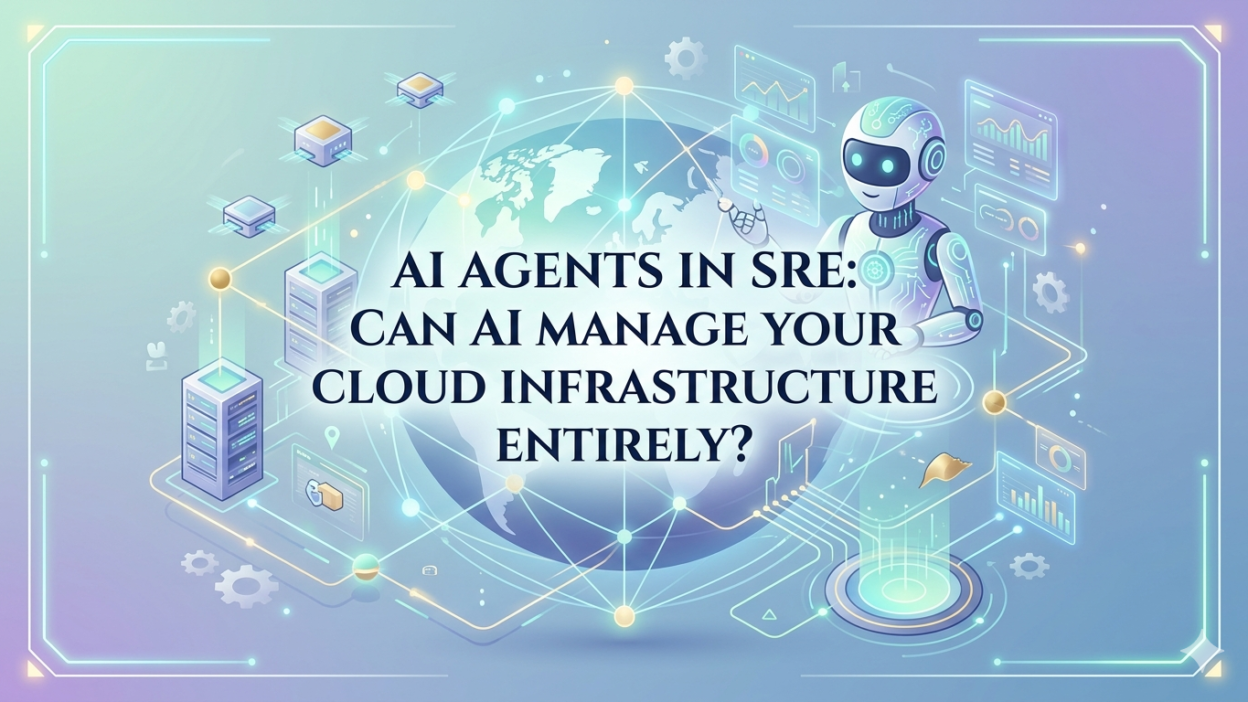
Now, a new shift is happening. AI agents in SRE cloud infrastructure automation are changing how teams think about reliability, scale, and operational speed. These agents do not just assist engineers. They observe, decide, and act on their own.
The real question is not whether AI can help. It already does. The question is whether AI agents can take over cloud infrastructure management entirely — without a human in the loop.
This blog breaks that question wide open. You will understand what AI agents actually do inside SRE workflows, where they genuinely outperform humans, and where they still fall short. You will also learn what forward-thinking engineering teams are doing right now to stay ahead.
Whether you run a small cloud setup or manage enterprise-grade infrastructure at scale, this guide gives you a clear picture of where AI agents fit, what risks come with full automation, and what the future of SRE looks like as AI gets smarter.
Table of Contents
What Are AI Agents in SRE? Defining the Core Concept
An AI agent is not a chatbot. It is not a dashboard. It is an autonomous software entity that perceives its environment, makes decisions, and takes actions to reach a defined goal.
In the context of Site Reliability Engineering, that environment is your cloud infrastructure. The agent watches metrics, reads logs, interprets alerts, and responds — often without waiting for a human to approve the next step.
AI agents in SRE cloud infrastructure automation sit at the intersection of machine learning, observability, and automated workflows. They combine large language models, reinforcement learning systems, and rule-based engines to create something more powerful than any one of those technologies alone.
How They Differ from Traditional Automation
Traditional automation follows scripts. Someone writes the script. The script runs when triggered. It does exactly what it was programmed to do — nothing more.
AI agents work differently. They learn from patterns. They adapt to new failure modes that no script ever anticipated. They make probabilistic decisions based on context, not just predefined rules.
A traditional script rolls back a deployment when an error rate crosses a threshold. An AI agent detects the anomaly earlier, cross-references it with recent code changes, checks downstream dependencies, and decides whether a rollback, a traffic reroute, or a targeted fix is the right response.
The Role of Large Language Models
Modern AI agents in SRE cloud infrastructure automation use large language models as their reasoning layer. The LLM reads alert summaries, incident histories, runbooks, and infrastructure configs. It generates a response plan in natural language — then executes that plan through connected tools and APIs.
This combination of reasoning and action is what separates today’s AI agents from the automation tools of five years ago.
Engineers still write runbooks. Now, AI agents read and execute those runbooks on their own. The human writes the knowledge once. The agent applies it continuously.
Core Capabilities of AI Agents in Cloud Infrastructure
Anomaly Detection and Proactive Monitoring
Human engineers monitor dashboards. AI agents monitor everything at once. They ingest telemetry from hundreds of services simultaneously, spot statistical deviations milliseconds after they appear, and raise precise alerts rather than noisy ones.
AI agents in SRE cloud infrastructure automation reduce alert fatigue significantly. They correlate signals across metrics, traces, and logs before notifying an engineer. By the time a human sees an alert, the agent has already mapped the probable cause.
This proactive posture shifts SRE teams from reactive firefighting to strategic oversight. Engineers spend less time staring at Grafana dashboards and more time improving system architecture.
Automated Incident Response
When something breaks in the middle of the night, the cost of slow response is high. Every minute of downtime translates directly to lost revenue, degraded user experience, and strained customer trust.
AI agents in SRE cloud infrastructure automation can begin incident response within seconds. They page the right on-call engineer, gather diagnostic context, propose a remediation plan, and in many cases, execute standard recovery steps before the engineer even reads the page.
This does not eliminate human judgment. It accelerates the first critical minutes of incident handling when speed matters most.
Capacity Planning and Resource Optimization
Cloud costs spiral when no one watches resource utilization carefully. Overprovisioned instances sit idle. Underprovisioned services collapse under unexpected load. Both outcomes hurt the business.
AI agents continuously analyze usage trends, predict load patterns, and recommend — or automatically execute — resource scaling decisions. They understand seasonality, business cycles, and traffic spikes. They right-size infrastructure before problems surface.
AI agents in SRE cloud infrastructure automation make capacity planning less of a quarterly exercise and more of a continuous, intelligent process running in the background at all times.
Configuration Drift Detection and Remediation
Configuration drift is subtle and dangerous. A single misconfigured parameter can cascade into a major outage hours or days later. Manual audits catch drift too slowly.
AI agents scan infrastructure state continuously. They compare live configurations against the desired state defined in version control. When drift appears, they flag it immediately. Many agents can auto-remediate low-risk drift without human approval.
Change Management and Deployment Safety
Deployments are the number one source of production incidents. AI agents in SRE cloud infrastructure automation improve deployment safety by analyzing change risk in real time.
They review pull requests, assess blast radius, monitor deployment health, and automatically roll back when error budgets are at risk. They learn from past deployment failures and apply that knowledge to future release decisions.
Where AI Agents Excel Over Human SREs
Speed at Scale
Humans cannot monitor a thousand microservices simultaneously. AI agents can. Speed and scale are where AI agents in SRE cloud infrastructure automation hold an undeniable advantage.
A distributed system generating millions of events per minute produces more data than any engineering team can process manually. AI agents absorb that data, filter the noise, and act on genuine signals within milliseconds.
At scale, this speed difference is not a nice-to-have. It is the difference between a 30-second incident and a 30-minute outage.
Consistency and Zero Fatigue
Human engineers get tired. They get distracted. They make different decisions at 2 AM than they make at 2 PM. AI agents do not. They apply the same logic every single time, regardless of hour, workload, or stress level.
This consistency makes AI agents in SRE cloud infrastructure automation particularly valuable for repetitive operational tasks. Toil that drains human engineers — log rotation, certificate renewals, routine scaling events — gets handled automatically with zero quality degradation.
Pattern Recognition Across Historical Data
AI agents have access to the full incident history of your infrastructure. They recognize when today’s anomaly resembles a failure mode from eight months ago. Human engineers may not remember that incident, especially if they joined the team recently.
This institutional memory at scale is a genuine competitive advantage. AI agents in SRE cloud infrastructure automation get smarter the longer they run. Each incident teaches the system something new about your specific environment.
Always-On Availability
Cloud infrastructure does not have office hours. AI agents work continuously. They do not take vacations. They do not get sick. The coverage gap that plagues on-call rotations disappears when AI agents handle first-level response around the clock.
Where AI Agents Still Fall Short
Novel Failure Modes
AI agents are excellent at patterns they have seen before. Novel failure modes — the kind that have never happened in your environment — expose the limits of pattern-matching systems.
A cascading failure triggered by an unusual combination of network conditions, application bugs, and third-party API failures may fall outside the agent’s model. Human intuition, creativity, and cross-domain knowledge remain essential in these moments.
AI agents in SRE cloud infrastructure automation handle known failure patterns with speed and precision. Unknown failure patterns still need experienced human judgment.
Business Context and Trade-off Decisions
Should you sacrifice database performance to maintain API availability? That depends on business priorities, user contracts, and strategic context that AI agents do not naturally understand.
Humans understand that a 20-minute degradation during a product launch is a different situation than a 20-minute degradation on a Sunday morning. AI agents see metrics. They do not read business context unless explicitly provided and structured in advance.
High-stakes trade-off decisions that involve business impact, customer relationships, or contractual obligations still belong with human engineers and leadership.
Ethical and Accountability Gaps
When an AI agent takes an autonomous action that causes harm — deleting the wrong resource, scaling down a critical service, or blocking legitimate traffic — who is responsible?
Accountability gaps are real. AI agents in SRE cloud infrastructure automation operate without moral agency. They optimize for defined objectives. If the objective is defined imprecisely, the agent will pursue it precisely and cause unintended damage.
Organizations need clear governance frameworks before deploying autonomous AI agents in production environments. Blind trust in automation is not SRE practice — it is operational recklessness.
Complex Multi-System Coordination
Large enterprise environments involve dozens of teams, legacy systems, vendor dependencies, and political dynamics. An AI agent can optimize one system. Coordinating a major infrastructure change across ten teams requires human negotiation, communication, and leadership.
AI agents in SRE cloud infrastructure automation are tools — powerful tools — but they are not replacements for engineering leadership, cross-functional collaboration, or organizational change management.
Real-World Use Cases of AI Agents in SRE
Self-Healing Infrastructure
Netflix, Google, and Cloudflare have pioneered self-healing infrastructure. AI agents detect failures, isolate affected components, reroute traffic, and restore service — all automatically. Engineers are notified after the fact, with a full incident report already prepared.
This model works because these organizations invested years in building reliable observability, robust runbooks, and carefully scoped agent permissions. Self-healing does not happen overnight.
AI agents in SRE cloud infrastructure automation make self-healing infrastructure achievable for mid-sized companies, not just tech giants. Modern tooling has democratized capabilities that once required massive internal platform teams.
AIOps Platforms in Enterprise SRE
Enterprise SRE teams use AIOps platforms like Dynatrace Davis AI, Moogsoft, and BigPanda to power AI-driven incident correlation and response. These platforms sit on top of existing monitoring infrastructure and add an intelligent layer above it.
They reduce mean time to detect (MTTD) and mean time to resolve (MTTR) significantly. Organizations using AI agents in SRE cloud infrastructure automation through AIOps platforms report 40–60% reductions in alert noise and measurably faster incident resolution times.
FinOps Automation
Cloud cost optimization is a massive SRE responsibility. AI agents monitor spending in real time, identify waste, and execute cost-saving actions like turning off idle instances, right-sizing overprovisioned workloads, and optimizing reserved instance coverage.
AI agents in SRE cloud infrastructure automation bring FinOps discipline to environments where manual cost management simply cannot keep pace with infrastructure growth.
Intelligent On-Call Augmentation
On-call engineers using AI agent copilots report faster incident diagnosis. The agent pulls relevant runbooks, recent changes, similar past incidents, and upstream/downstream dependency status — all before the engineer types their first command.
This augmentation model treats AI agents as force multipliers, not replacements. Human judgment stays central. Cognitive load drops dramatically.
How to Implement AI Agents in Your SRE Workflow
Start with Observability Foundations
AI agents need data. Rich, reliable, structured data. Before deploying AI agents in SRE cloud infrastructure automation, invest in observability maturity.
That means comprehensive metrics collection, structured logging, distributed tracing, and meaningful service-level objectives. An AI agent operating on incomplete observability data will make poor decisions confidently — which is worse than no automation at all.
Audit your current telemetry coverage. Fix blind spots. Define SLIs and SLOs clearly before introducing agents that will act on those signals.
Define Scope and Permission Boundaries Carefully
Not every AI agent action should be fully autonomous. Define a clear tiered permission model.
Low-risk actions — restarting a pod, scaling a service, rotating a log file — can run autonomously. Medium-risk actions — updating load balancer rules, modifying database connection pools — should require confirmation. High-risk actions — deleting infrastructure, changing security group rules, modifying IAM policies — should always need explicit human approval.
AI agents in SRE cloud infrastructure automation work best when their authority matches their confidence level. Tighten permissions as you gain trust. Expand them as the agent proves reliable.
Run Agents in Shadow Mode First
Before letting AI agents take real actions, run them alongside human processes in shadow mode. Let the agent observe, analyze, and recommend — without executing anything.
Compare the agent’s recommendations against what your engineers actually did. Measure accuracy. Identify gaps. Tune the system. Only after shadow mode validates agent quality should you move to supervised automation and then full autonomy.
Build Feedback Loops into Every Decision
AI agents in SRE cloud infrastructure automation improve when they learn from outcomes. Connect agent decisions to incident post-mortems. When an agent action contributed to an incident, feed that signal back into the training or configuration layer.
Good agent governance means constant feedback, not set-and-forget deployment. Treat AI agents like junior engineers who need coaching, correction, and context.
Invest in Human-Agent Collaboration Skills
SRE teams working with AI agents need new skills. They need to understand how to write effective runbooks that agents can execute. They need to know how to audit agent decisions, interpret agent reasoning, and override agents when necessary.
The human role in SRE evolves from doing operational tasks to governing the AI systems that do operational tasks. That shift requires investment in training, tooling, and organizational mindset.
The Future of AI Agents in SRE
Autonomous SRE: A Realistic Timeline
Full autonomy — where AI agents manage cloud infrastructure entirely without human oversight — is not the near-term future. It is a long-term trajectory that requires advances in reasoning, safety, and trust.
The near-term future is augmented SRE. AI agents in SRE cloud infrastructure automation handle the high-volume, repetitive, pattern-matching work. Human SREs focus on architecture, governance, novel problem-solving, and cross-team coordination.
Within five years, expect AI agents to handle the majority of tier-1 incidents autonomously. Within ten years, AI agents may manage full infrastructure lifecycle events — provisioning, scaling, deprecation — with minimal human involvement.
Multi-Agent Systems in Infrastructure Management
The next evolution is multi-agent systems where specialized agents collaborate. One agent monitors network performance. Another manages deployment pipelines. A third oversees cost optimization. A coordinator agent orchestrates their actions to prevent conflicts.
AI agents in SRE cloud infrastructure automation will function as collaborative networks, not isolated tools. This shift mirrors how large engineering organizations operate — specialized teams working toward shared reliability goals.
The Human SRE Role in an AI-Driven World
Human SREs will remain essential for the foreseeable future. Their role will shift toward higher-leverage work — defining reliability standards, governing AI agent behavior, designing self-healing systems, and managing organizational risk.
The engineers who thrive in an AI-driven SRE environment will be those who learn to direct AI agents effectively, interpret their outputs critically, and build the governance frameworks that keep automation safe.
Frequently Asked Questions (FAQ)
Can AI agents fully replace human SREs?
Not currently. AI agents in SRE cloud infrastructure automation handle repetitive, pattern-based operational tasks with speed and consistency that humans cannot match. Human SREs remain essential for novel problems, business context decisions, ethical judgment, and cross-team coordination. Full replacement is not the near-term trajectory — meaningful augmentation is.
What tools enable AI agents in SRE today?
Popular tools include Dynatrace with Davis AI, PagerDuty’s AIOps features, Moogsoft, BigPanda, Shoreline.io for automated remediation, and platforms built on LangChain or AutoGen for custom agent workflows. Cloud providers like AWS and Google Cloud offer native AI-driven operations features within their platforms.
How do I measure the ROI of AI agents in SRE?
Track MTTD, MTTR, alert noise reduction, on-call incident volume, and error budget burn rate before and after agent deployment. Also measure engineer toil hours saved. AI agents in SRE cloud infrastructure automation typically show ROI within six to twelve months through reduced incident resolution times and lower operational overhead.
What are the biggest risks of autonomous AI agents in cloud infrastructure?
Permission scope creep, incorrect root-cause attribution, optimizing for the wrong objective, and lack of accountability when agents cause harm. Mitigate these risks through tiered permissions, shadow mode testing, continuous feedback loops, and clear governance policies before deploying AI agents in SRE cloud infrastructure automation in production.
How does AI agents fit within Google’s SRE model?
Google’s SRE model emphasizes reliability through engineering discipline, error budgets, and reducing toil. AI agents fit naturally into the toil-reduction pillar. Google’s own infrastructure uses AI-driven systems extensively for anomaly detection, capacity management, and automated remediation. AI agents in SRE cloud infrastructure automation align with the core SRE philosophy of using software to manage software.
Read More:-Microsoft Copilot for Sales vs. Salesforce Einstein: A Real-World ROI Battle
Conclusion
The answer to the central question — can AI manage your cloud infrastructure entirely? — is nuanced. Not yet. Not fully. But the trajectory is clear.
AI agents in SRE cloud infrastructure automation are not a future concept. They are a present reality transforming how engineering teams operate. The speed, scale, and consistency they bring to incident response, anomaly detection, and resource optimization are measurable and significant.
The organizations winning with AI agents are not those who handed over full control. They are those who built a foundation of strong observability, defined clear permission boundaries, ran agents in shadow mode before trusting them with production actions, and invested in building human skills for governing AI systems.
The SRE engineer of the near future is not obsolete. That engineer is the architect of intelligent infrastructure. They design the systems that AI agents execute. They write the runbooks that AI agents follow. They define the standards that AI agents enforce.
AI agents in SRE cloud infrastructure automation amplify what great engineering teams can do. They do not replace engineering judgment. They free engineers from the work that does not require judgment — so humans can focus entirely on the work that does.
Start small. Define scope carefully. Build feedback loops. Trust incrementally. The teams that approach AI agent deployment with discipline and intention will build infrastructure that is faster to recover, cheaper to run, and more reliable at scale than anything a purely human team can maintain alone.