Introduction
TL;DR Standard RAG breaks under complexity. GraphRAG fixes that — by structuring knowledge as relationships, not just text chunks. Here is how to build it right.
The Problem With Standard RAG
Retrieval-Augmented Generation changed how AI systems access knowledge. It gave language models the ability to pull in fresh, external information at query time. That was a massive step forward.
Standard RAG works well for simple, factual queries. Ask a single question with a clean answer — a date, a name, a figure — and RAG retrieves the relevant chunk and delivers the answer.
Complex queries break that model fast. Multi-hop questions require reasoning across several facts at once. Standard RAG retrieves isolated chunks. It misses the relationships between those chunks entirely.
That gap is where errors creep in. The model gets partial information. It hallucinates bridges between disconnected facts. The answer looks confident but falls apart on inspection.
This is the exact problem that GraphRAG implementation solves. It replaces flat chunk retrieval with graph-structured knowledge traversal. Relationships become first-class citizens in the retrieval process.
“Standard RAG retrieves facts. GraphRAG retrieves meaning — because meaning lives in relationships, not isolated paragraphs.”
Engineers building knowledge systems for medicine, law, finance, and research are discovering that GraphRAG implementation is not optional for their use cases. It is the only approach that scales to real-world complexity.
Table of Contents
What GraphRAG Actually Is
GraphRAG combines knowledge graphs with retrieval-augmented generation. The name comes from the graph structure that sits at its core. Entities — people, companies, concepts, events — become nodes. Relationships between entities become edges.
A knowledge graph captures that “Company A acquired Company B in 2021, which triggered a regulatory review by Agency C.” Standard RAG might retrieve those facts separately. GraphRAG retrieves the full connected structure in one traversal.
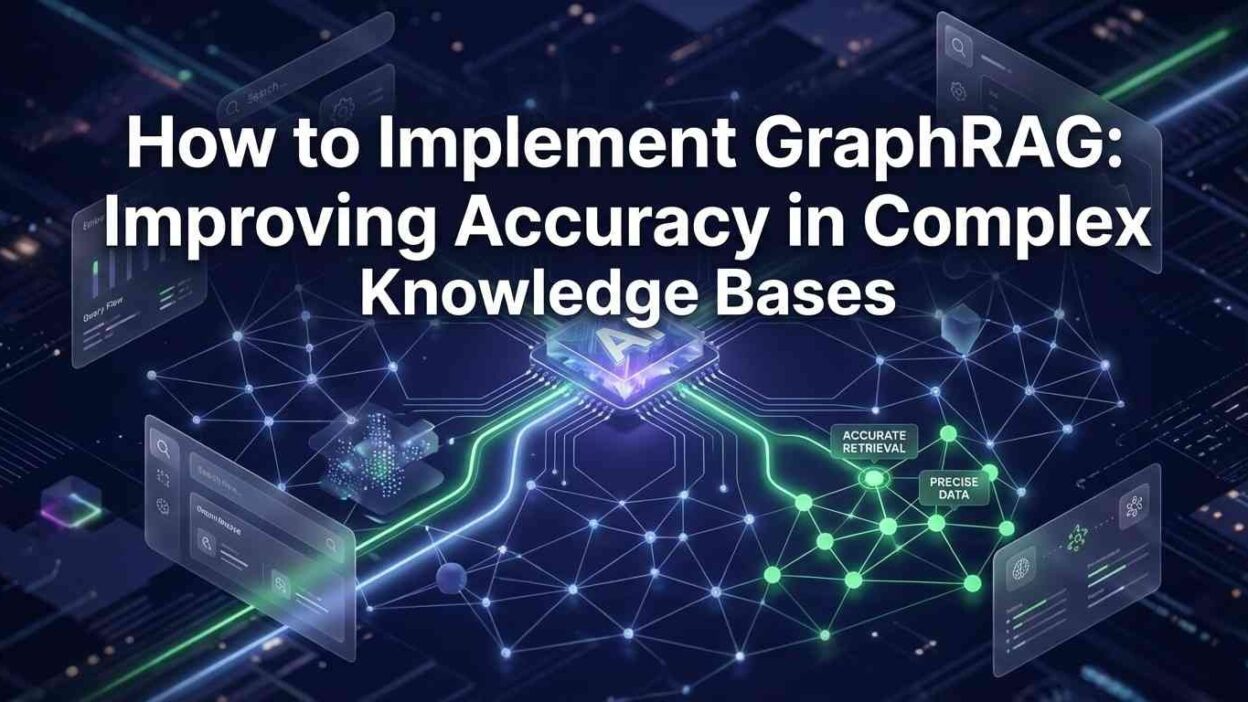
The retrieval step in GraphRAG implementation queries the graph directly. It finds relevant nodes. It follows edges to related nodes. It assembles a subgraph of connected information. That subgraph becomes the context window for the language model.
The result is a richer, more coherent context. The model reasons across real relationships rather than guessing at implied ones. Answer quality improves dramatically for complex queries.
Microsoft Research published foundational work on GraphRAG in 2024. Their approach used community detection to organize graph structure into hierarchical summaries. Those summaries enabled global reasoning across an entire corpus — something standard RAG cannot do at all.
The core insight is simple. Knowledge is relational. Any retrieval system that ignores relationships is working with an incomplete picture. GraphRAG implementation builds the complete picture into the retrieval architecture itself.
Core Components of a GraphRAG System
The Knowledge Graph Layer
The knowledge graph is the foundation of any GraphRAG implementation. It stores entities and their relationships in a structured format. Graph databases like Neo4j, Amazon Neptune, and Weaviate all support this structure.
Building the graph requires entity extraction. Named entity recognition (NER) tools scan source documents. They identify people, organizations, locations, products, events, and domain-specific concepts. Each identified entity becomes a node in the graph.
Relationship extraction follows entity extraction. The system identifies how entities relate to each other. “CEO of,” “acquired,” “regulated by,” “published in” — these become typed edges in the graph. The richer the relationship vocabulary, the more powerful the graph becomes.
Graph quality determines retrieval quality. Incomplete or inaccurate entity extraction produces a sparse graph. A sparse graph produces weaker context. Investing in high-quality extraction pipelines pays off directly in answer accuracy.
The Retrieval Layer
The retrieval layer translates a user query into a graph traversal. It identifies the anchor entities in the query. It executes a graph query — using Cypher in Neo4j or SPARQL in RDF-based systems — to find relevant subgraphs.
Traversal depth matters. A depth of one hop retrieves direct relationships. A depth of two or three hops reveals indirect connections that standard RAG would never surface. Calibrating traversal depth for your use case is a key engineering decision in any GraphRAG implementation.
Hybrid retrieval combines graph traversal with vector similarity search. The vector search finds semantically related nodes even when the exact entity match is absent. The graph traversal then expands from those seed nodes. Together they provide breadth and precision.
The Context Assembly Layer
Raw subgraph data needs formatting before it enters the language model’s context window. The context assembly layer serializes the subgraph into structured text. It orders the facts logically. It trims noise from peripheral nodes that add length without value.
Prompt engineering at this layer is critical. The language model needs to understand what it is reading. Clear entity labels, explicit relationship descriptions, and structured formatting all improve reasoning quality in the final generation step.
Step-by-Step GraphRAG Implementation Guide
Define Your Domain Ontology
Every GraphRAG implementation starts with an ontology. An ontology defines the entity types and relationship types that matter for your domain. A medical knowledge base uses different entity types than a financial compliance system.
Spend real time on this step. A poorly designed ontology creates structural debt. Fixing it later means re-extracting and re-ingesting your entire corpus. Get the entity taxonomy right before writing any code.
Work with domain experts. Engineers understand graph structure. Domain experts understand what relationships carry meaning in their field. The best ontologies come from that collaboration.
Build the Ingestion Pipeline
The ingestion pipeline processes raw documents and populates the knowledge graph. It has four stages. Document parsing converts PDFs, HTML, and database records into plain text. Entity extraction identifies nodes. Relationship extraction identifies edges. Graph loading writes the results to your graph database.
Tools like spaCy, Stanford NER, and LLM-based extraction pipelines all handle the NER step. For complex domains, fine-tuned models on domain-specific corpora outperform general-purpose extractors significantly.
LLM-based extraction is the current state of the art for relationship extraction. GPT-4 class models can identify and classify relationships with high accuracy when given a well-designed extraction prompt and a clear ontology schema.
Configure Graph Traversal Logic
Traversal logic defines how the system moves through the graph in response to a query. Write parameterized graph queries for your most common query patterns. Test traversal depth. Measure context window utilization at each depth level.
Implement community detection for global query support. The Leiden algorithm and Louvain method both work well for identifying tightly connected clusters. Those clusters become community summaries — compact representations of related entity groups that support broad, thematic questions.
Efficient GraphRAG implementation uses tiered retrieval. Local queries traverse the graph directly. Global queries use community summaries. Map-reduce over community summaries enables answers to corpus-wide questions that no single subgraph traversal could answer alone.
Integrate the Language Model
LLM integration sits at the end of the pipeline. The assembled subgraph context feeds into the model’s prompt. The model generates its answer grounded in the structured relational context.
Choose a model with a large context window for complex subgraphs. GPT-4o, Claude, and Gemini all handle the long-form structured inputs that graph traversal produces. Smaller models struggle with the density and complexity of rich subgraph context.
Add a citation layer. Map each claim in the generated answer back to the source nodes in the graph. This produces verifiable, traceable answers — a critical requirement in enterprise and regulated environments.
Evaluate and Iterate
Evaluation is where most GraphRAG implementation projects either succeed or stall. Build a test set of complex, multi-hop queries with known correct answers. Measure answer accuracy, completeness, and faithfulness to source material.
Track graph coverage metrics. What percentage of queries anchor to existing graph nodes? Low coverage signals gaps in entity extraction. High coverage with poor accuracy signals relationship extraction errors. Each metric points to a specific fix.
GraphRAG vs Standard RAG: When to Choose Each
Standard RAG wins on simplicity and speed. It requires no graph database, no entity extraction pipeline, and no ontology design. For simple factual retrieval over homogeneous document collections, it delivers acceptable results with far less engineering effort.
Choose standard RAG for customer support bots with FAQ databases. Choose it for document search over well-structured technical documentation. Choose it when query complexity is low and deployment speed matters more than answer depth.
Choose GraphRAG implementation when queries require multi-hop reasoning. Choose it when relationships between entities carry as much meaning as the entities themselves. Choose it when accuracy in complex queries is non-negotiable.
Research platforms, clinical decision support tools, legal knowledge bases, and financial intelligence systems all fall into the GraphRAG category. The cost of a wrong answer in these domains justifies the additional engineering investment.
“If your users are asking ‘how does X relate to Y through Z,’ standard RAG will fail them. GraphRAG was built for exactly that question.”
Hybrid architectures work well for systems with mixed query complexity. Route simple queries to standard RAG for speed. Route complex queries to the GraphRAG implementation pipeline for accuracy. Build a query classifier to handle routing automatically.
Common Challenges and How to Solve Them
Entity Resolution
Entity resolution is the process of recognizing that “Apple Inc.,” “Apple,” and “AAPL” all refer to the same entity. Without it, your graph fragments into multiple disconnected nodes for the same real-world object. Retrieval quality collapses.
Use canonicalization rules for known entities. Apply fuzzy matching with similarity thresholds for unknown ones. Maintain an entity registry that maps surface forms to canonical identifiers. Investing in entity resolution early saves enormous pain later in a GraphRAG implementation project.
Graph Sparsity
A sparse graph returns thin, incomplete subgraphs for most queries. The language model receives insufficient context. Answer quality suffers. Sparsity usually traces back to extraction pipeline limitations.
Improve coverage by diversifying extraction approaches. Combine rule-based extraction, NER models, and LLM-based extraction. Each method catches different relationship types. Together they produce a denser, more useful graph structure.
Latency at Scale
Graph traversal adds latency compared to vector database lookup. For large graphs, this becomes noticeable. Multi-hop traversals across millions of nodes can take seconds without optimization.
Solve this with graph indexing. Pre-compute common traversal paths. Cache community summaries. Use approximate nearest-neighbor methods for the vector search component. A well-tuned GraphRAG implementation can serve complex queries in under 500 milliseconds at production scale.
Maintaining Graph Freshness
Knowledge graphs go stale. New documents arrive. Existing facts change. Entities merge, split, or disappear. A static graph built once degrades in quality over time.
Build incremental update pipelines from the start. Process new documents as they arrive. Flag outdated relationships for review. Version your graph schema so updates do not break existing traversal queries. Freshness maintenance is an ongoing operational responsibility in any mature GraphRAG implementation.
Tools and Frameworks for GraphRAG in 2025
The tooling ecosystem for GraphRAG implementation matured rapidly after Microsoft’s 2024 publication. Several mature options now cover the full stack.
Microsoft’s open-source GraphRAG library provides the complete pipeline out of the box. It handles ingestion, entity extraction, community detection, and query serving. It is the fastest path to a working GraphRAG prototype for teams starting fresh.
LangChain and LlamaIndex both offer GraphRAG integration modules. They work with multiple graph databases and support hybrid retrieval combining vector search with graph traversal. Teams already using either framework can add GraphRAG capabilities without rebuilding their entire pipeline.
Neo4j is the dominant graph database choice for production GraphRAG implementation. Its Cypher query language is expressive and well-documented. Its ecosystem includes dedicated LLM integration tools, vector index support, and graph analytics algorithms built into the database engine.
NebulaGraph and Amazon Neptune serve teams with cloud-native or high-scale requirements. Weaviate and Qdrant support hybrid architectures where vector and graph storage coexist in a single system. Choosing the right database depends on graph size, query patterns, and existing infrastructure.
For extraction, spaCy, Hugging Face NER pipelines, and GPT-4 function calling all serve different points on the accuracy-speed tradeoff curve. Benchmark each option on a representative sample of your domain documents before committing.
Read More:-Predictive Maintenance for Manufacturing: Using AI to Prevent Downtime Before It Happens
Frequently Asked Questions
What is GraphRAG implementation in simple terms?
GraphRAG implementation is the process of building a retrieval system that uses a knowledge graph to answer questions. Instead of searching through text chunks, it queries a structured map of entities and relationships. This gives language models richer, more accurate context for complex queries.
How is GraphRAG different from standard RAG?
Standard RAG retrieves text chunks based on semantic similarity. GraphRAG retrieves structured subgraphs based on entity relationships. Standard RAG works well for simple queries. GraphRAG handles multi-hop, relational queries that require reasoning across connected facts — where standard RAG consistently fails.
What graph database should I use for GraphRAG?
Neo4j is the most widely adopted choice for production GraphRAG systems. It offers a mature query language, strong LLM integration tools, and an active community. Amazon Neptune suits teams in AWS environments. Weaviate works well for hybrid architectures combining vector and graph storage in a single system.
How long does GraphRAG implementation take?
A prototype using Microsoft’s open-source GraphRAG library can run in days. A production system with custom entity extraction, domain-specific ontology design, and enterprise-grade reliability typically takes two to four months. Ongoing graph maintenance is a continuous operational responsibility after launch.
Does GraphRAG work for real-time applications?
Yes, with proper optimization. Graph indexing, traversal path caching, and pre-computed community summaries all reduce latency. Well-tuned GraphRAG systems serve complex queries in under 500 milliseconds. Real-time applications need careful benchmarking and infrastructure sizing to meet latency requirements consistently.
What industries benefit most from GraphRAG?
Healthcare, legal, financial services, and scientific research benefit most. These fields share complex knowledge structures where relationships between entities carry critical meaning. Clinical decision support, legal research, financial risk analysis, and drug discovery all require the multi-hop reasoning accuracy that GraphRAG implementation provides.
Can I combine GraphRAG with standard RAG?
Yes. Hybrid architectures route queries based on complexity. Simple factual queries go to standard vector RAG for speed. Complex relational queries route to the GraphRAG pipeline for accuracy. A lightweight query classifier handles routing automatically. Hybrid systems offer the best performance across diverse query workloads.
Read More:-Microsoft Copilot for Sales vs. Salesforce Einstein: A Real-World ROI Battle
Conclusion
Complex knowledge bases demand more than flat retrieval. Standard RAG delivers speed and simplicity. It stops delivering accuracy the moment queries require multi-hop reasoning across connected facts.
GraphRAG implementation fills that gap directly. It structures knowledge as relationships. It retrieves subgraphs instead of chunks. It gives language models the relational context they need to reason accurately across complex domains.
The engineering investment is real. Ontology design, entity extraction pipelines, graph database management, and traversal optimization all require deliberate effort. The teams that build these systems well report accuracy improvements that standard RAG simply cannot match.
Start with a focused use case. Pick a domain where multi-hop queries matter and wrong answers carry a cost. Build the ontology carefully. Validate extraction quality early. Measure answer accuracy on real queries from real users.
The tooling ecosystem is mature. Microsoft’s open-source library, Neo4j’s integration ecosystem, and LangChain’s modular framework all accelerate the path from prototype to production. A working GraphRAG implementation is achievable in weeks for motivated engineering teams.
Knowledge is relational. Retrieval should be too. The teams that internalize that principle — and build their AI systems around it — will deliver knowledge applications that consistently outperform every flat-retrieval alternative in the market.