Introduction
Tl;DR Every product and technology leader hits this wall at some point. The question lands hard and the stakes are real. The buy vs build AI SaaS decision is one of the most consequential choices a company makes today.
AI capabilities are no longer optional. Customers expect smart features. Competitors ship them fast. The pressure to act quickly is everywhere.
Buying an AI SaaS product feels fast and safe. Building a proprietary system feels powerful and differentiated. Neither path is obviously right.
This blog cuts through the noise. It examines both sides with honesty. It gives you a clear framework to make the call that fits your company — not someone else’s.
The goal is not to sell you on one approach. The goal is to help your team ask better questions and reach a sharper answer.
Table of Contents
Understanding the Core of the Buy vs Build AI SaaS Decision
The buy vs build AI SaaS decision is not a new problem. Companies have wrestled with software make-or-buy trade-offs for decades. AI makes the stakes dramatically higher.
AI systems are not like standard software. They require training data, model infrastructure, MLOps pipelines, and specialized talent. The cost of getting it wrong is steep.
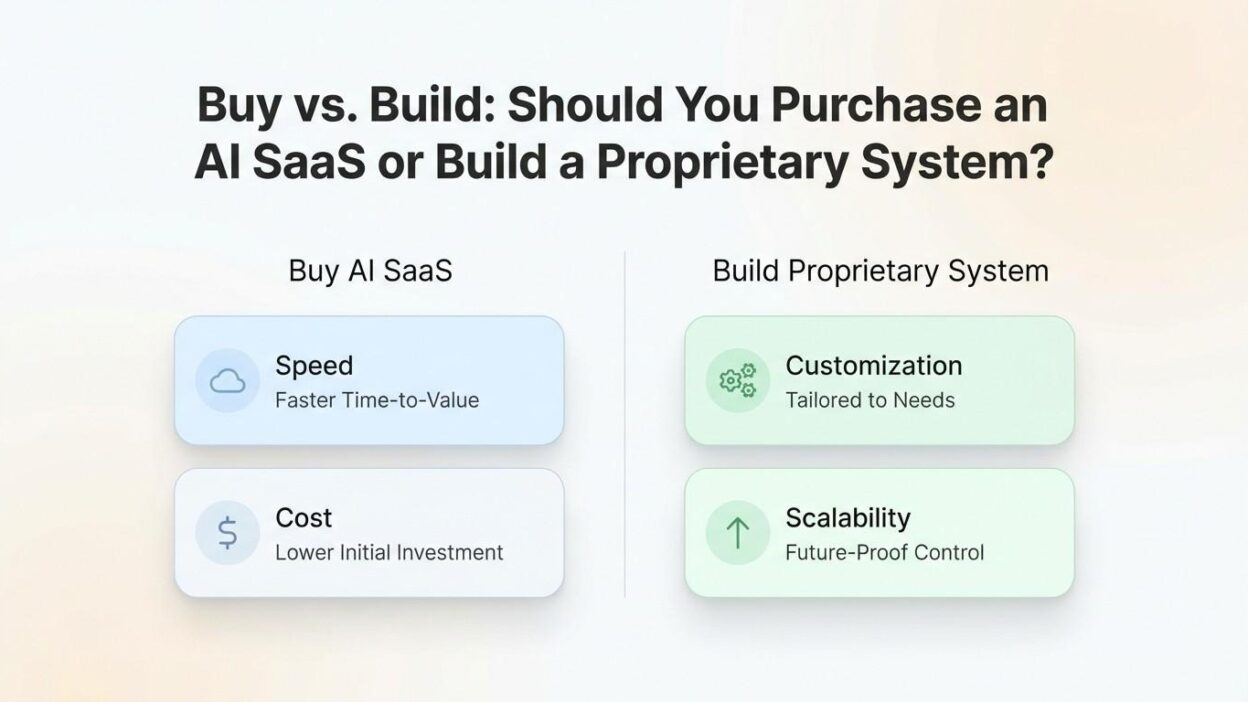
Buying means procuring a ready-made AI platform or tool. You pay a vendor. You get features, support, and SLAs. You move fast.
Building means your team designs, trains, and maintains a custom AI system. You own the IP. You control every part of the stack. You move slower.
Both options carry real costs. Both carry real risks. The buy vs build AI SaaS decision changes based on your company size, AI maturity, and competitive landscape.
One important truth: most companies get this wrong by defaulting to one side without actually evaluating the other.
Why This Decision Has Become More Complex in the AI Era
Traditional software was relatively stable. AI systems drift, degrade, and evolve. A bought AI SaaS today might be obsolete in 18 months.
Foundation models from OpenAI, Anthropic, and Google have changed the calculus. You can now build powerful AI features on top of APIs without training models from scratch.
This narrows the traditional build gap. The real question today is about data, workflow integration, and competitive differentiation.
The Case for Buying an AI SaaS Product
Speed is the most powerful argument for buying. A mature AI SaaS vendor spent years building what you want. You get that value in days, not months.
Procurement replaces engineering. Your team focuses on integration and adoption rather than infrastructure. This matters enormously for resource-constrained organizations.
Vendors maintain and improve the product on their roadmap. Security patches, model upgrades, and new features arrive without your team writing a single line of code.
Enterprise AI SaaS products carry compliance certifications. SOC 2, HIPAA, GDPR-ready configurations — vendors handle the audit trail. Your legal and compliance teams breathe easier.
Support and SLAs provide operational safety nets. When something breaks at 2am, you call a vendor. You do not wake up your own engineers.
The buy vs build AI SaaS decision often favors buying for companies entering AI for the first time. The learning curve is too steep to build well on the first attempt.
When Buying an AI SaaS Makes Strong Business Sense
Your problem is not unique. If dozens of companies share your use case, a SaaS vendor already solved it well. Customer support automation, document extraction, and AI-powered analytics are prime examples.
Your team lacks ML expertise. Hiring senior ML engineers takes 6 to 12 months. A SaaS vendor already has them. You get access to that talent through the product.
Time to market matters more than customization. Launching an AI feature in Q1 beats building a perfect one for Q3.
Your data volume is low or moderate. AI SaaS products deliver strong performance at mid-tier data volumes without needing custom model training.
Risks of Buying That Leaders Often Underestimate
Vendor lock-in is real. Migrating AI workflows and data pipelines from one platform to another takes significant engineering effort.
You give up control of the model. The vendor changes the underlying model. Your outputs change. You may not even get advance notice.
Pricing scales with usage. What costs $50k per year at 10,000 users can cost $800k at 500,000 users. Financial exposure grows fast.
Customization hits hard ceilings. Every SaaS product has limits. When your workflow needs something the vendor never built, you work around it or leave.
The Case for Building a Proprietary AI System
Building gives you complete ownership. Your model, your data pipeline, your deployment infrastructure. No vendor can change terms, hike prices, or shut down.
Competitive differentiation is the strongest argument for building. If your AI capability is core to your product, giving that to a SaaS vendor hands your moat to someone else.
Custom models trained on your proprietary data outperform generic ones on domain-specific tasks. A legal tech company training on its own case law beats a general-purpose LLM on legal reasoning.
You control the data entirely. In regulated industries, keeping training data and inference within your own infrastructure is not optional. It is legally required.
Building forces institutional learning. Your engineers develop deep AI expertise. That knowledge compounds over time and creates long-term organizational advantage.
The buy vs build AI SaaS decision leans toward building when AI is the product, not a feature inside the product.
When Building a Proprietary AI System Makes Sense
Your use case is genuinely unique. No SaaS vendor targets your exact workflow with adequate depth. Building is the only path to solving it well.
Your data is a strategic asset. Proprietary training data creates models competitors cannot replicate. This moat only exists if you build on top of that data yourself.
You have the engineering talent. ML engineers, data scientists, and MLOps specialists are available and already hired. Idle capacity in the right skill sets tips the decision toward building.
Long-term cost projection favors build. At very high usage volumes, running your own infrastructure on cloud GPUs is dramatically cheaper than per-seat or per-call SaaS pricing.
Risks of Building That Leaders Underestimate
Underestimating timelines is the most common mistake. Most AI build projects take two to three times longer than initially scoped.
Model maintenance is ongoing and expensive. Models degrade. Data drifts. Retraining cycles require dedicated team capacity that never goes away.
The talent risk is significant. If the two engineers who built your AI system leave, the institutional knowledge leaves with them.
Opportunity cost is invisible but brutal. Every engineering month spent building AI infrastructure is a month not spent on core product features your customers want today.
Key Factors That Should Drive the Buy vs Build AI SaaS Decision
Strategic Differentiation Assessment
Ask one sharp question first. Is AI a competitive differentiator or a cost center for your business? The answer changes everything.
If AI is your product’s core value proposition, buying that capability from a vendor is dangerous. Competitors access the same vendor. Differentiation disappears.
If AI is infrastructure behind your product, buying is rational. You do not build your own cloud servers. You do not need to build your own AI inference layer either.
The buy vs build AI SaaS decision gets much clearer when you map AI to your strategic value chain honestly.
Team Capability and Talent Availability
Audit your team honestly before deciding. Do you have production ML engineers? Do you have data labeling infrastructure? Do you have MLOps tooling in place?
Building without these capabilities adds 12 to 18 months of foundational work before the AI feature ships. Buying skips all of that.
If your engineering team is strong in full-stack development but thin on ML, buying is almost always the right call in the short term.
Total Cost of Ownership Analysis
Most teams compare purchase price against engineering cost. That is incomplete. Real TCO includes maintenance, retraining, monitoring, infrastructure, and talent retention.
Build projects carry hidden costs. Model evaluation tooling, data annotation workflows, compute bills, and observability platforms all add up.
Run a three-year TCO model for both scenarios. Most teams are surprised by how close the numbers get at medium scale, and how clearly build wins at very large scale.
Data Privacy and Regulatory Requirements
Regulated industries face hard constraints. Healthcare data under HIPAA cannot go to a third-party SaaS without a Business Associate Agreement. Finance data carries its own restrictions.
Even with BAAs in place, some data cannot leave your environment. Building becomes a compliance requirement, not just a technical preference.
In the buy vs build AI SaaS decision, data sovereignty requirements can eliminate the buy option entirely for some enterprise segments.
Time to Market Pressure
Competitive timing changes the equation fast. If a key competitor just shipped an AI feature and you have no comparable offering, buying is your fastest route to parity.
Buying buys time. It gets you to market while your team evaluates whether the long-term case for building is strong enough to justify the investment.
Many companies buy first and build later. They use the SaaS period to learn what their users actually need from an AI system before committing to a custom build.
The Hybrid Approach: Buy the Platform, Build the Differentiation
The buy vs build AI SaaS decision does not have to be binary. Many successful enterprise AI strategies combine both approaches.
You buy the foundational AI infrastructure. APIs from OpenAI, Anthropic, or Google handle base model capabilities. Cloud ML platforms like SageMaker or Vertex AI handle training infrastructure.
You build the differentiated layer on top. Custom fine-tuning on proprietary data. Domain-specific retrieval systems. Unique orchestration workflows that competitors cannot replicate.
This hybrid approach is increasingly the dominant enterprise AI pattern. It minimizes build time on commodity capabilities. It maximizes investment in genuinely unique differentiation.
The key discipline is knowing where the commodity ends and the differentiation begins. Drawing that line well is the most important strategic skill in enterprise AI today.
How to Implement a Hybrid AI Strategy Successfully
Start with clear API abstraction layers. Write your application code against your own internal AI service interface, not directly against vendor APIs. This preserves optionality.
Identify your proprietary data assets early. These are your raw materials for differentiation. Build your fine-tuning and RAG infrastructure around them.
Treat vendor APIs as interchangeable infrastructure, not as permanent partners. The model landscape changes quarterly. Lock in behavior, not specific vendors.
Real-World Decision Scenarios
Series B SaaS Startup Needs AI Features
A 60-person SaaS company needs to add AI-powered document summarization to its product. The engineering team has 8 developers. Zero ML specialists.
The buy vs build AI SaaS decision here is clear. Buy. Use OpenAI or Anthropic APIs. Ship the feature in three weeks. Evaluate whether to customize based on user feedback later.
Building would take six months minimum, require two new hires, and delay the entire product roadmap. The math does not work.
Enterprise FinTech Scaling AI Across 10 Million Users
A 500-person FinTech company processes 10 million transactions daily with AI fraud detection. Current SaaS AI spend is $2.4M annually. Data cannot leave their cloud environment.
The buy vs build AI SaaS decision shifts toward build. Regulatory constraints rule out most third-party SaaS. At this scale, building saves over $1M per year. The engineering investment is justified.
Healthcare Tech Company in a Regulated Market
A health tech company needs clinical NLP for medical records. HIPAA requirements restrict data movement. PHI cannot go to external model APIs without robust controls.
A hybrid approach fits best. They buy a HIPAA-compliant AI infrastructure platform. They build custom clinical models on top using their own de-identified patient data. They get speed and compliance together.
FAQs:
What is the biggest mistake companies make in the buy vs build AI SaaS decision?
The biggest mistake is deciding without a TCO model. Most teams compare upfront costs only. They ignore model maintenance, retraining cycles, and talent retention. The true cost of building almost always comes in higher than the initial estimate.
How long does it take to build a proprietary AI system?
A basic AI feature built on top of foundation model APIs takes 4 to 8 weeks. A fully custom trained model for a domain-specific task takes 6 to 18 months. A production-grade AI platform with MLOps infrastructure takes 12 to 24 months. Timeline depends heavily on existing tooling and team expertise.
Can a small team realistically build its own AI system?
Yes, with the right tools. Open-source frameworks like Hugging Face, LangChain, and LlamaIndex lower the barrier significantly. Small teams can build impressive AI systems by fine-tuning existing foundation models rather than training from scratch. The key is scoping the problem tightly.
What questions should I ask an AI SaaS vendor before buying?
Ask what model powers the product and how often it changes. Ask what happens to your data after inference. Ask what customization options exist. Ask how pricing scales with usage. Ask for the contract exit clause and data portability terms. These questions surface the hidden risks fast.
Is the buy vs build AI SaaS decision permanent?
No. Many companies buy first and build later once they understand the problem deeply. Some companies build first and replace with a better SaaS vendor when one emerges. The decision is a strategic position, not a permanent commitment. Build your architecture to preserve optionality wherever possible.
How do I evaluate vendor AI quality versus building my own?
Run benchmark evaluations on your own data. Generic accuracy scores mean little for domain-specific tasks. Take the top two SaaS vendors and your build prototype through the same evaluation set. Score on precision, latency, and failure modes. Let your real-world data decide.
Read More:-Building an “AI Factory”: A Roadmap for Enterprises Transitioning to Agentic Workflows
Conclusion

The buy vs build AI SaaS decision does not have a universal right answer. Every company faces a different combination of constraints, capabilities, and competitive pressures.
Buying wins on speed, simplicity, and risk reduction. It is the right move for teams without ML expertise, companies under time pressure, and use cases that vendors already solve well.
Building wins on control, differentiation, and long-term cost at scale. It is the right move when AI is your core product value, when data sovereignty requirements demand it, or when usage volumes make SaaS pricing prohibitive.
The hybrid path is increasingly the most intelligent answer. Buy the commodity. Build the differentiation. Draw that line clearly and revisit it every 12 months as the AI market shifts.
The buy vs build AI SaaS decision shapes your AI roadmap for years. Treat it with the same rigor you give to your most important product bets.
Evaluate honestly. Model the costs fully. Audit your team’s real capabilities. Then commit with clarity and execute without hesitation.
The teams that win with AI are not the ones who picked the perfect platform. They are the ones who moved decisively with the right information.