Introduction
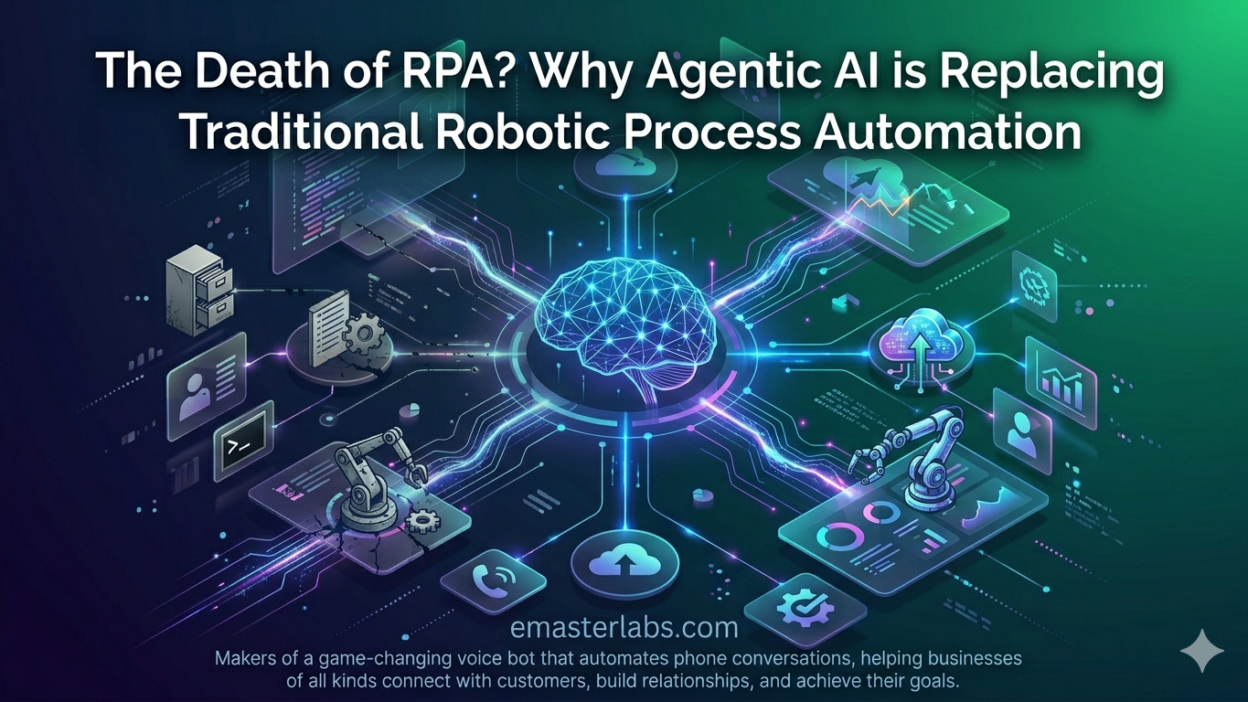
TL;DR Something big is happening inside enterprise automation. It does not make headlines every day. It happens in boardrooms, IT roadmaps, and budget reviews.
Robotic Process Automation had a great decade. It automated millions of repetitive tasks. It saved companies billions of dollars. Businesses called it a revolution.
Now, a new force is eating RPA’s lunch. Agentic AI vs RPA is the most important technology debate in enterprise software today. The outcome will reshape how organizations operate.
This blog breaks down the entire story. You will learn what went wrong with RPA, what agentic AI does differently, and why smart organizations are already making the switch.
Table of Contents
What Is Robotic Process Automation (RPA)?
RPA uses software robots to mimic human actions on a computer. These robots click buttons, fill forms, copy data, and follow step-by-step rules.
A robot handles tasks like extracting data from emails, entering it into a spreadsheet, and uploading it to a database. It does this fast, without errors, and without breaks.
RPA became popular in the 2010s. Companies like UiPath, Automation Anywhere, and Blue Prism led the market. Enterprise adoption exploded. The global RPA market grew to billions of dollars.
Why Businesses Loved RPA
RPA delivered fast results. You could automate a boring process in weeks. No coding skills were needed. Business teams could deploy their own robots.
Cost savings were real and measurable. A robot could do the work of several full-time employees at a fraction of the cost. ROI calculations looked impressive in executive presentations.
RPA also reduced errors. Humans make mistakes when doing repetitive work. Robots do not. Data accuracy improved across finance, HR, and operations.
The Hidden Cracks in the RPA Foundation
RPA always had limitations. Nobody talked about them much during the hype cycle. Now those limitations define why agentic AI vs RPA matters so much.
RPA robots are brittle. They follow exact rules. Change the layout of a webpage or the format of a document, and the robot breaks. Someone has to fix it manually.
RPA cannot think. It cannot handle exceptions. If something unexpected happens, the robot stops and waits for a human. The promise of full automation never fully materialized.
Maintenance costs piled up. Every software update, every UI change, every new process required robot reprogramming. IT teams spent more time maintaining robots than building new ones.
What Is Agentic AI?
Agentic AI refers to AI systems that can set goals, make decisions, take actions, and learn from outcomes. These systems do not just follow instructions. They reason through problems.
An agentic AI does not need a rigid script. Give it a goal, and it figures out how to achieve it. It chooses which tools to use. It adapts when things go wrong.
The technology behind agentic AI includes large language models, reinforcement learning, and tool-use frameworks. Modern systems like Claude, GPT-4, and Gemini power many of these agents.
The Core Capabilities That Define Agentic AI
Agentic AI can read and understand natural language. It processes emails, documents, contracts, and messages without rigid parsing rules.
It can use tools. Give it access to a browser, a database, a calendar, or an API, and it decides how and when to use each tool to complete a task.
Agentic AI handles uncertainty. When it encounters an unexpected situation, it reasons through options and makes a decision. It does not freeze and wait.
It can plan across multiple steps. Complex tasks that require dozens of actions get broken into logical sequences. The agent executes them in order, adjusting as needed.
Agentic AI vs RPA: The Fundamental Difference
This is the heart of the agentic AI vs RPA debate. RPA follows rules. Agentic AI applies reasoning.
RPA needs someone to define every step in advance. Agentic AI needs someone to define the goal. The agent handles the steps on its own.
RPA breaks when reality does not match the script. Agentic AI adapts when reality changes. That one difference changes everything about how automation works in practice.
Where RPA Falls Short in Today’s Business Environment
The business world moves fast. Data formats change. Software updates daily. Customer expectations shift. Regulations evolve.
RPA was built for a stable world. Today’s world is anything but stable. This is the fundamental mismatch that fuels the agentic AI vs RPA conversation.
The Maintenance Nightmare
Large enterprises run hundreds of RPA bots. Each bot requires regular maintenance. A single software update can break multiple bots simultaneously.
IT teams dedicate significant resources just to keeping bots running. The automation that was supposed to free people up actually creates new maintenance work.
Research from major consulting firms shows that RPA maintenance costs often exceed original development costs within two years. That erodes the ROI case significantly.
The Exception Handling Problem
Real business processes have exceptions. A customer submits a form with missing fields. A vendor invoice has an unusual format. A transaction falls outside normal parameters.
RPA cannot handle these exceptions independently. Every exception requires human intervention. High-exception processes deliver far less automation value than projected.
In industries like insurance, banking, and healthcare, exception rates can be very high. This limits RPA’s effectiveness precisely where automation is most needed.
The Scalability Ceiling
RPA scales horizontally. You add more bots to handle more volume. But each new bot needs development, testing, and maintenance.
Agentic AI scales differently. One agent can handle a wide variety of tasks. It does not need a separate bot for each process variant. That is a fundamental scalability advantage in the agentic AI vs RPA comparison.
The Intelligence Gap
RPA processes structured data well. It struggles with unstructured data like emails, PDFs, handwritten notes, and voice recordings.
Most business information is unstructured. RPA was never equipped to handle the majority of enterprise data. Agentic AI processes all of it natively.
Why Agentic AI is Winning the Automation Race
Agentic AI does not just fix RPA’s weaknesses. It opens up entirely new categories of automation that were never possible with traditional robots.
Cognitive Process Automation
Agentic AI automates cognitive work, not just mechanical work. It can review a contract and flag unusual clauses. It can analyze customer sentiment and escalate negative cases. It can research a topic and produce a summary report.
None of these tasks suit RPA. All of them fit naturally within agentic AI capabilities. The automation frontier expands dramatically.
Self-Healing Workflows
When an agentic AI encounters a broken step in a workflow, it does not stop. It reasons about alternative approaches. It finds another way to complete the task.
This self-healing capability eliminates most of the maintenance burden that plagues RPA deployments. Processes keep running even when the environment changes.
Natural Language Interaction
Business users can instruct agentic AI in plain English. No need for technical specifications or flowcharts. You describe the outcome you want, and the agent works toward it.
This democratizes automation. Department heads and team leaders can deploy automation without IT involvement. The speed of automation deployment increases dramatically.
In the agentic AI vs RPA comparison, this ease of use represents one of the most compelling advantages for non-technical business leaders.
Multi-System Orchestration
Modern businesses use dozens of software systems. Salesforce, SAP, Workday, ServiceNow, Slack, email, spreadsheets, and custom databases all coexist.
Agentic AI orchestrates work across all of these systems simultaneously. It understands context from one system and applies it in another. RPA connects systems too, but without understanding context.
Real Business Scenarios Where Agentic AI Outperforms RPA
Abstract comparisons only go so far. Here are concrete scenarios that illustrate why agentic AI vs RPA is not a close contest in practical business settings.
Procurement and Vendor Management
An RPA bot can extract data from a standard invoice format and enter it into an ERP system. It breaks the moment a vendor changes their invoice layout.
An agentic AI reads invoices in any format. It understands what each field means regardless of layout. It flags discrepancies, checks against purchase orders, and routes exceptions to the right person with context already attached.
Employee Onboarding
RPA handles structured onboarding steps. Create an account here, assign a badge there, send a welcome email to this address.
Agentic AI handles the entire onboarding experience. It reads the job description, identifies what tools the new employee needs, coordinates with IT and HR, answers the employee’s questions, and checks in after the first week.
Customer Complaint Resolution
RPA routes complaints based on predefined categories. If the complaint fits a known category, it moves to the right queue. Unknown categories go to a human.
Agentic AI reads the complaint, understands the customer’s history, assesses urgency, drafts a resolution, and sends a personalized response. It escalates only when genuinely necessary. This is the agentic AI vs RPA gap in customer experience terms.
Financial Reconciliation
RPA matches transactions row by row against predefined rules. Mismatches trigger human review, regardless of significance.
Agentic AI understands materiality. It knows the difference between a rounding error and a significant discrepancy. It investigates anomalies, traces them to root causes, and provides context to human reviewers.
Is RPA Dead? The Honest Answer
Let us address the question directly. RPA is not dead today. But it is in serious trouble.
Many enterprises have hundreds of millions of dollars invested in RPA infrastructure. They will not abandon that investment overnight. RPA will continue running for years in organizations that already deployed it.
New RPA deployments, though, are slowing. Organizations evaluating automation for the first time increasingly choose agentic AI frameworks. The growth trajectory of agentic AI vs RPA favors agents decisively.
The Hybrid Period We Are Living Through
Many organizations run both RPA and agentic AI today. Legacy RPA handles established, stable workflows. Agentic AI handles new, complex, or exception-heavy processes.
This hybrid approach makes practical sense during a transition. It preserves existing investments while building new capabilities.
Over time, as agentic AI proves its value and RPA maintenance costs accumulate, more organizations will migrate away from pure RPA approaches. The trajectory points one way.
What the Major Vendors Are Doing
UiPath, Automation Anywhere, and Blue Prism are all integrating AI capabilities into their platforms. They know RPA alone is not enough.
These vendors add AI layers on top of RPA foundations. But adding intelligence to a rigid system is harder than building intelligence into a flexible one from the start.
The agentic AI vs RPA debate is partly a debate between legacy vendors retrofitting AI and native AI platforms built for reasoning from day one.
How to Transition from RPA to Agentic AI: A Practical Roadmap
If your organization runs RPA today, here is how to approach the transition intelligently.
Audit Your Current RPA Deployments
Start by cataloging every active RPA bot. Document what each bot does, how often it runs, and how much maintenance it requires.
Identify your high-maintenance bots. These are the best candidates for replacement with agentic AI. They cost the most to maintain and often deliver the least reliable automation.
Identify High-Value Agentic AI Targets
Look for processes that involve unstructured data, frequent exceptions, or complex decision-making. These processes frustrate RPA teams and produce inconsistent results.
These are exactly the processes where agentic AI shines. Prioritize them for your initial agentic deployments.
Start with a Focused Pilot
Choose one process for your first agentic AI deployment. Pick something meaningful but not mission-critical. You want room to learn without risking core operations.
Measure the results carefully. Track automation rate, exception handling, maintenance requirements, and business outcomes. Compare them honestly against your RPA benchmarks.
Build Internal Expertise
Agentic AI requires different skills than RPA. Your team needs to understand prompt engineering, agent frameworks, and tool integration.
Invest in training. Hire people with AI agent experience. Partner with vendors who specialize in agentic deployments. Build expertise before scaling broadly.
Plan a Phased Migration
Do not attempt a big-bang migration. Replace RPA bots with agentic AI in phases. Retire bots as agentic alternatives prove themselves in production.
This approach manages risk. It builds organizational confidence. It lets your team develop competence with agentic AI before taking on your most complex processes.
Security and Governance Considerations
Agentic AI introduces new governance challenges. These must be addressed before broad deployment.
Access Control for Autonomous Agents
Agentic AI agents need access to systems, data, and tools to do their work. That access must be carefully controlled.
Define the minimum access each agent needs. Audit agent actions regularly. Revoke access immediately when an agent is retired or repurposed. Governance discipline matters enormously here.
Human Oversight Requirements
Not every agentic AI decision should run without human review. High-stakes decisions need human checkpoints built into the workflow.
Design your agentic processes with clear escalation rules. Identify which decisions require human approval. Build those checkpoints into the agent’s operating logic from the start.
Auditability and Explainability
Regulators and auditors want to understand how decisions get made. Agentic AI must provide explainable audit trails.
Choose agentic platforms that log agent reasoning, tool calls, and decision points. This logging is essential for compliance in regulated industries.
The Future Landscape of Enterprise Automation
Where does this all lead? The trajectory of agentic AI vs RPA points toward a fundamentally different automation landscape within five years.
AI-Native Process Design
Organizations will stop designing processes for humans and then automating them. They will design processes for AI agents from the start.
This shift changes how companies think about workflows, data structures, and system architecture. AI-native design produces better automation outcomes than retrofitting.
The Rise of Multi-Agent Enterprises
Future enterprises will run networks of specialized AI agents. One agent handles customer communications. Another manages supply chain decisions. A third monitors financial compliance.
These agents collaborate, share context, and coordinate through protocols like Model Context Protocol. The enterprise becomes a network of intelligent automation.
Human Work Redefined
As agentic AI takes over more routine and complex tasks, human work shifts toward strategy, creativity, relationship management, and oversight.
This is not about job elimination. It is about job elevation. Humans focus on what humans do best. Agents handle everything else.
RPA as a Legacy Technology
Within a decade, RPA will likely occupy the same position that mainframe programming occupies today. Still running in some organizations. Still maintained by specialists. But no longer the future of anything.
Organizations building automation strategies today should plan for an agentic future. The agentic AI vs RPA question will have a clear answer soon enough.
Frequently Asked Questions: Agentic AI vs RPA
Can agentic AI completely replace RPA right now?
Not immediately for every organization. Many enterprises have deep RPA investments. A phased transition makes more sense than an immediate replacement. Agentic AI handles new and complex processes well today. It will handle most RPA use cases within a few years as the technology matures.
Is agentic AI more expensive than RPA?
Initial deployment costs can be higher. But total cost of ownership often favors agentic AI over time. Lower maintenance requirements, higher automation rates, and broader process coverage reduce long-term costs significantly. The agentic AI vs RPA cost comparison looks better for agents over a three-to-five year horizon.
What industries benefit most from agentic AI over RPA?
Industries with high exception rates, complex documents, and regulatory complexity benefit most. Financial services, healthcare, insurance, legal, and professional services see the greatest performance gap between agentic AI and RPA.
Do I need to replace my RPA team to adopt agentic AI?
No. RPA professionals can transition to agentic AI roles. Their process knowledge is valuable. They need additional training in AI agent frameworks, prompt engineering, and tool integration. Experienced automation professionals make excellent agentic AI implementers.
How long does it take to deploy an agentic AI solution?
Simple agentic deployments can go live in weeks. Complex enterprise deployments take months. This compares favorably to complex RPA projects, which often take quarters. Speed of deployment is an underappreciated advantage in the agentic AI vs RPA comparison.
What is the biggest risk of moving to agentic AI?
The biggest risk is insufficient governance. Autonomous agents making decisions without proper oversight can create errors, compliance issues, and unintended consequences. Build strong governance frameworks before broad deployment. Governance is not optional.
Read More:-How to Move from AI Pilots to Production: Lessons from 50+ Custom Deployments
Conclusion

RPA had a great run. It delivered real value to real organizations for more than a decade. That contribution deserves acknowledgment.
The world changed, though. Business complexity increased. Data volumes exploded. Customer expectations rose. The rigid, rule-based nature of RPA struggles to keep pace.
Agentic AI meets the moment. It reasons. It adapts. It handles complexity. It scales without proportional increases in maintenance overhead.
Agentic AI vs RPA is not a fair fight anymore. Agentic AI handles processes RPA never could. It reduces maintenance burdens RPA always created. It opens automation to knowledge work RPA could never touch.
Organizations that recognize this shift early will build significant competitive advantages. Those that cling to RPA-only strategies will find themselves outpaced by more agile competitors.
The transition will take time. It will require investment, learning, and governance discipline. The destination, though, is worth the journey.
Agentic AI vs RPA is the defining automation debate of this decade. The verdict is becoming clear. Start planning for an agentic future today.