Introduction
TL;DR Artificial intelligence is reshaping how enterprises operate. Decisions that once took weeks now happen in seconds. Predictions that once needed large analyst teams now run automatically. The speed is impressive. The scale is remarkable.
Yet something critical is breaking beneath the surface. Enterprise leaders are deploying AI models they cannot explain. Boards ask how a decision got made. Legal teams need clear answers. Regulators demand documentation. Stakeholders want accountability. Nobody can provide it.
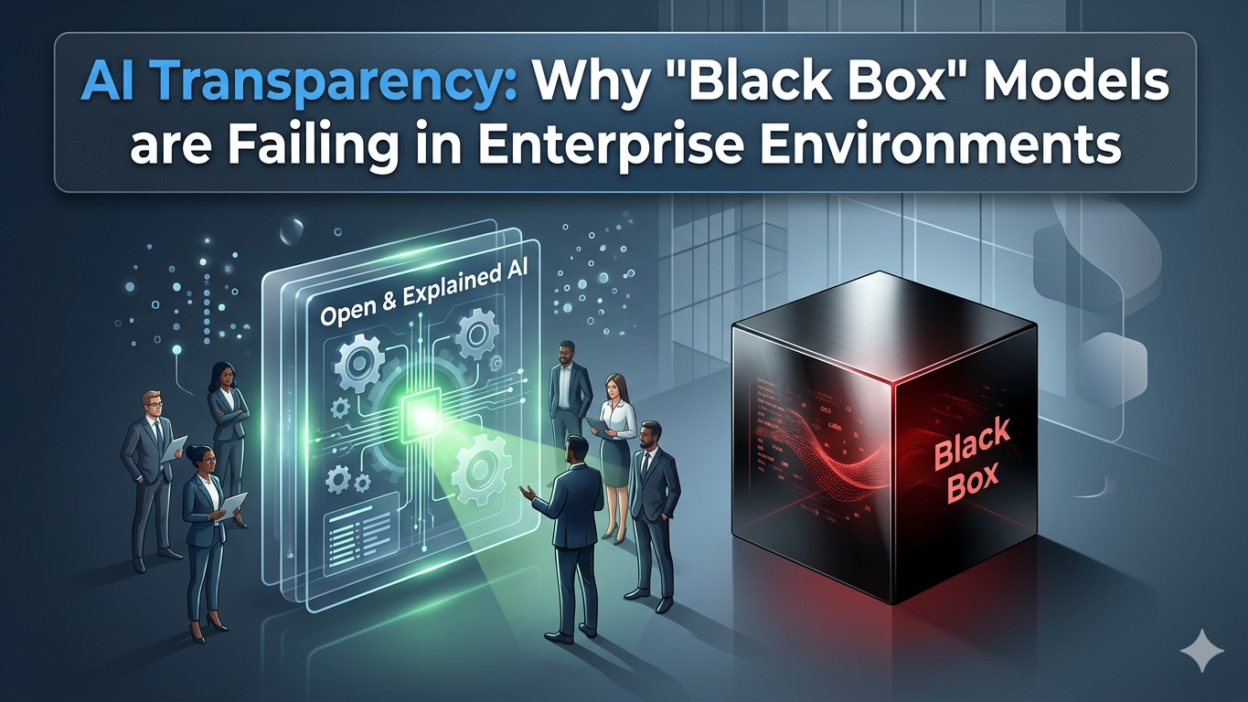
This is the black box problem. AI model transparency in enterprises has become one of the most urgent challenges in modern business. Companies are not just losing trust. They are losing control of their most consequential decisions.
This blog unpacks why black box models fail in enterprise environments. It explains what transparency actually means. It outlines how companies can build AI systems that perform and explain themselves clearly.
What Is a Black Box AI Model?
The Core Definition
A black box AI model produces outputs without showing its reasoning. You put data in. A decision comes out. What happens in between remains hidden — even from the people who built the model. Complex architectures like deep neural networks create this opacity by design. Layers of computation obscure the logic.
This opacity may seem harmless in low-stakes applications. A music recommendation engine does not need to justify its playlist choices. The stakes are low. The consequences are minor. Enterprise environments are different. Every decision carries weight. Every output has real consequences.
Why Opacity Becomes a Problem at Scale
Small companies can absorb bad AI decisions more easily. Large enterprises cannot. A single unexplainable decision at scale can affect millions of customers, billions in revenue, or the company’s entire regulatory standing.
AI model transparency in enterprises matters precisely because scale amplifies every flaw. When a black box model makes a biased lending decision, thousands of applicants suffer the same injustice simultaneously. When a black box model misprices risk, the consequences hit every portfolio managed by that system.
The bigger the enterprise, the more dangerous unexplainable AI becomes.
Why Enterprises Adopted Black Box Models in the First Place
The Performance Argument
Black box models often outperform simpler, more interpretable alternatives. A deep learning model may predict customer churn with 94% accuracy. A logistic regression model may achieve only 78%. That performance gap is real. It is also genuinely valuable.
Enterprises chose accuracy over explainability for years. The trade-off seemed reasonable at the time. More accuracy meant better business outcomes. Explainability felt like a secondary concern — important in theory but rarely urgent in practice.
The Speed-to-Market Pressure
Enterprise teams under competitive pressure deploy fast. They want results. They do not always want to slow down for interpretability audits or governance reviews. Black box models reach production quickly. They generate results immediately. Leadership celebrates the speed.
The deeper cost of that speed shows up later. Regulators knock. Auditors question. Employees distrust. Customers complain. The initial time saved becomes a much larger time debt.
The Vendor Lock-In Reality
Many enterprises rely on third-party AI platforms. These platforms provide powerful models but minimal transparency. The vendor controls the architecture. The enterprise controls only the inputs and outputs. AI model transparency in enterprises becomes structurally impossible when vendors treat their model logic as proprietary.
Enterprises accepted these constraints because switching costs felt too high. Now those constraints threaten compliance, governance, and legal standing simultaneously.
The Real Cost of Black Box Failures in Enterprise
Regulatory Penalties Are Growing
Governments worldwide are tightening AI regulations. The European Union’s AI Act classifies many enterprise AI applications as high-risk. High-risk systems require explainability documentation, human oversight mechanisms, and audit trails. Black box models cannot satisfy these requirements. Fines for non-compliance are substantial.
In financial services, the Fair Credit Reporting Act and Equal Credit Opportunity Act already require explanations for adverse decisions. Banks using black box credit models face serious legal exposure. AI model transparency in enterprises is not just a best practice — it is a legal obligation in many sectors.
Trust Erodes Internally First
External regulators get the headlines. Internal trust breaks down first. Data scientists who cannot explain their models lose credibility with business stakeholders. Business leaders who cannot justify AI-driven decisions lose authority with boards. Employees who interact with opaque AI outputs feel disempowered and skeptical.
This internal erosion is dangerous. When people stop trusting the AI, they stop using it correctly. They find workarounds. They ignore outputs they cannot understand. The investment delivers no value because adoption collapses from within.
Bias Goes Undetected and Unchallenged
Black box models can encode and amplify bias invisibly. A model trained on historical hiring data may penalize candidates from certain universities. A model trained on historical loan data may systematically disadvantage specific demographic groups. Without transparency, nobody spots these patterns until significant harm occurs.
AI model transparency in enterprises creates the visibility needed to catch bias early. Explainable models reveal which features drive decisions. Auditors can check whether protected attributes influence outcomes. Problems surface before they scale.
Operational Risk Climbs Unpredictably
Black box models fail in ways nobody anticipates. Their performance can degrade silently. An input distribution shifts slightly. The model produces confidently wrong answers. Nobody detects the drift because nobody understands the model’s internal logic well enough to recognize the warning signs.
Enterprises experience operational disasters from this dynamic regularly. A fraud detection model starts flagging legitimate transactions. A demand forecasting model consistently over-orders inventory. A pricing model undercuts margins systematically. Each failure could have been caught earlier with greater transparency.
What AI Model Transparency in Enterprises Actually Means
Transparency Is Not One Thing
Many people conflate transparency with a single concept. It is actually several distinct capabilities working together. Interpretability means humans can understand how the model reaches individual conclusions. Explainability means the model can articulate its reasoning in plain language. Auditability means every decision leaves a traceable record. Fairness visibility means the model’s outputs get examined for discriminatory patterns.
AI model transparency in enterprises requires all four capabilities working together. Interpretability alone is insufficient. A model that is technically interpretable but produces no audit trail still fails compliance requirements. Transparency is a system, not a feature.
Global vs. Local Explanations
Global explanations describe how a model behaves across all decisions. They reveal which input features matter most overall. Local explanations describe how the model reached one specific decision. They answer the question for a single customer, transaction, or outcome.
Enterprises need both types. Global explanations serve regulators and auditors who want to understand system-wide behavior. Local explanations serve business users who need to justify individual outcomes to affected stakeholders. Robust AI model transparency in enterprises delivers both levels on demand.
Explainability for Different Audiences
A technical explanation satisfies a data scientist. A plain-language summary satisfies a compliance officer. A simple customer-facing statement satisfies a rejected loan applicant. The same underlying explanation needs multiple presentation layers.
Enterprises that invest in AI model transparency build translation capabilities between these audiences. They do not produce one explanation document and call it done. They create explanation systems that serve every stakeholder who has a legitimate need for clarity.
Industries Where AI Transparency Failures Hit Hardest
Financial Services and Banking
Banks and insurers use AI for credit scoring, fraud detection, underwriting, and investment management. Every one of these applications carries regulatory scrutiny. Black box models in financial services create simultaneous legal, reputational, and operational risk.
AI model transparency in enterprises is especially critical here. Regulators expect banks to explain every adverse decision to affected customers. They expect documented evidence that models do not discriminate. They expect audit trails that survive legal discovery. Black box architectures make all of this impossible.
Healthcare and Clinical Decision Support
Clinical AI tools recommend diagnoses, suggest treatments, and predict patient deterioration. A clinician who cannot understand why the model flagged a patient cannot evaluate whether to trust the flag. Black box clinical AI puts patients at risk and clinicians in an impossible position.
AI model transparency in enterprises drives better clinical outcomes. Explainable models help clinicians understand the basis of a recommendation. They can confirm it matches their own clinical judgment. They can override it confidently when their experience suggests a different conclusion.
Human Resources and Talent Management
HR teams use AI to screen resumes, predict candidate success, and identify high-potential employees. These applications directly affect people’s careers and livelihoods. Biased or unexplainable HR AI creates discrimination liability and reputational damage simultaneously.
Explainable AI in HR lets companies audit their screening models for bias. They can verify that gender, ethnicity, and age do not influence scores. AI model transparency in enterprises is not optional in this domain — it is an ethical and legal requirement.
Legal and Compliance Functions
Legal teams increasingly use AI to review contracts, flag risks, and predict litigation outcomes. When a legal AI tool misses a clause or misjudges a risk, the stakes are enormous. Lawyers need to understand why the tool reached its conclusion before they can responsibly advise their clients.
Opaque legal AI removes the human judgment layer that makes the profession function. Transparency restores it.
Approaches That Build AI Transparency in Enterprise Environments
Explainable AI Frameworks
Several technical frameworks exist specifically to add interpretability to complex models. SHAP (Shapley Additive Explanations) quantifies each feature’s contribution to individual predictions. LIME (Local Interpretable Model-Agnostic Explanations) approximates complex model behavior with simpler, interpretable models locally. Integrated Gradients attribute prediction importance to input features in neural networks.
These tools do not replace model architecture choices. They add an explanation layer on top of existing complexity. Enterprises can deploy powerful models while maintaining the ability to explain outputs. AI model transparency in enterprises becomes achievable without sacrificing performance.
Model Cards and Datasheets
Model cards are standardized documentation that describes what a model does, how it performs across different groups, and where it is appropriate to use. Datasheets for datasets describe the origin, composition, and known limitations of training data.
Both practices formalize transparency at the documentation level. They create artifacts that regulators can review, auditors can examine, and stakeholders can reference. Enterprises that adopt model cards build institutional knowledge about their AI systems that persists even as teams change.
Governance Structures That Enforce Transparency
Technical tools alone do not create transparent AI. Governance structures do the real work. Enterprises need AI review boards that approve model deployments. They need documented processes for escalating unexplainable decisions. They need clear accountability when a model fails.
AI model transparency in enterprises lives or dies in organizational culture. Technical solutions enable transparency. Governance structures require it. Both must exist simultaneously for transparency to become real.
Choosing Interpretable Architectures When Stakes Are High
Some decisions are simply too important to entrust to opaque models. Loan approvals, medical diagnoses, criminal risk assessments, and employment decisions carry consequences that demand full explainability. In these cases, enterprises should deliberately choose interpretable models even when they sacrifice some accuracy.
A decision tree that achieves 82% accuracy and full explainability is often better than a neural network that achieves 89% accuracy and zero explainability. The 7-point accuracy gap is real. The legal, ethical, and reputational protection of explainability is more valuable.
Building an AI Transparency Strategy for Your Enterprise
Start with a Transparency Audit
Map every AI system currently in production. Identify what decisions each system makes. Classify each decision by its potential impact on people and regulatory exposure. Rank systems by their current transparency level. Prioritize the least transparent, highest-stakes systems for immediate attention.
This audit creates a clear picture of where opacity risk currently lives. It gives leadership a starting point that feels concrete and manageable rather than overwhelming.
Define Transparency Standards by Risk Level
Not every AI system requires the same level of transparency. A marketing personalization engine needs less rigorous explainability than a credit risk model. Create tiered standards. High-risk systems require full local and global explainability plus documented audit trails. Medium-risk systems require global explainability and periodic bias audits. Low-risk systems require basic documentation and performance monitoring.
AI model transparency in enterprises works best when standards match the actual stakes. Applying uniform maximum rigor to every system wastes resources. Applying insufficient rigor to high-stakes systems creates catastrophic exposure.
Train Your Teams on Explainability Tools
Data scientists need training on SHAP, LIME, and other interpretability frameworks. Business stakeholders need training on how to read model explanations. Compliance teams need training on what regulators expect from AI documentation.
Nobody can build transparent AI without understanding what transparency requires. Training is not optional. It is the foundation on which every other transparency initiative rests.
Embed Transparency Requirements into Procurement
When purchasing third-party AI tools, require transparency documentation as a condition of purchase. Ask vendors to provide model cards. Ask them to explain their explainability capabilities. Ask whether their API provides explanation outputs alongside predictions.
Vendors who cannot answer these questions clearly represent significant risk. AI model transparency in enterprises extends to every third-party system the enterprise deploys, not just internally built models.
Create Continuous Monitoring Systems
Model performance drifts over time. Training data becomes stale. Input distributions shift. A model that was transparent and accurate at launch may become opaque and unreliable twelve months later. Continuous monitoring catches drift early.
Build dashboards that track key performance indicators alongside explanation quality metrics. When explanation quality drops, investigate immediately. Degrading explainability often signals broader model health problems.
The Business Case for Prioritizing AI Transparency
Transparency Builds Customer Trust
Customers increasingly demand to understand how companies use AI to make decisions about them. A bank that can explain its credit decision builds more trust than one that says the algorithm decided. A healthcare provider that can explain its AI diagnostic tool builds more confidence than one that cannot.
Trust translates directly to retention, referrals, and revenue. AI model transparency in enterprises is not just a compliance cost. It is a competitive differentiator that sophisticated customers actively seek.
Transparency Accelerates Regulatory Approval
Companies pursuing regulatory approval for AI-powered products move faster when they prioritize transparency from the start. Regulators do not block transparent AI — they approve it. Companies that build explainability into their AI from day one spend less time in regulatory review and more time generating value.
The short-term investment in transparency pays back in dramatically reduced regulatory friction over time.
Transparency Reduces Legal Liability
A company that can demonstrate its AI system is explainable, auditable, and fair has a strong defense when litigation arises. A company that cannot explain how its AI works has almost no defense. Legal liability exposure drops substantially when AI model transparency in enterprises is a documented, demonstrable priority.
Insurance premiums for AI-related risks respond to transparency investments as well. Underwriters offer better terms to companies with mature AI governance frameworks.
Transparency Improves Model Quality
Explainability tools reveal which features drive predictions. This information helps data scientists build better models. They discover when their model relies on spurious correlations. They catch when training data introduces systematic bias. They find opportunities to improve feature engineering that pure accuracy metrics never surface.
Transparent AI is better AI. The discipline of explaining model behavior forces data scientists to understand it more deeply.
The Future of AI Transparency in Enterprise
Regulation Will Only Get Stricter
The EU AI Act is the opening movement of a global regulatory symphony. Similar legislation is advancing in the United States, United Kingdom, Canada, and Singapore. Enterprises that have not yet invested in AI model transparency in enterprises will face mounting pressure from multiple regulatory directions simultaneously.
Companies that build transparency infrastructure now will comply easily with new regulations as they arrive. Companies that delay will scramble to retrofit transparency into systems that were never designed for it.
Transparency Will Become a Market Signal
Enterprise software buyers are adding AI transparency to their vendor evaluation criteria. Fortune 500 procurement teams are asking vendors to demonstrate explainability capabilities before signing contracts. AI transparency certifications and standards are emerging as market differentiators.
The enterprise AI market is moving toward transparency as a baseline expectation. Early movers will define what good looks like. Late movers will pay premiums to catch up.
Multimodal AI Will Intensify the Challenge
AI systems are expanding beyond text and numbers into images, audio, and video. Explainability for these modalities is significantly harder than for tabular data. A model that analyzes medical scans or customer service calls adds new layers of interpretability complexity.
Enterprises that invest in AI model transparency in enterprises today build the organizational muscles needed to handle tomorrow’s more complex transparency challenges. The habits, tools, and governance structures transfer directly.
FAQs About AI Model Transparency in Enterprises
What does AI model transparency mean in a business context?
AI model transparency in enterprises means that AI systems can explain their decisions clearly to all relevant stakeholders — including regulators, auditors, business users, and affected customers. It encompasses interpretability, explainability, auditability, and fairness visibility working together as a unified capability.
Why are black box AI models a problem for enterprises specifically?
Enterprises operate at scale, under regulatory scrutiny, and in high-stakes domains. Black box models cannot satisfy regulatory explanation requirements, cannot be audited for bias, and cannot be trusted when they fail unexpectedly. The combination of scale and stakes makes opacity far more dangerous for enterprises than for smaller organizations.
Which industries face the most urgent need for AI transparency?
Financial services, healthcare, human resources, and legal functions face the most immediate transparency requirements. Regulatory frameworks in these industries explicitly demand explainability and audit trails. Companies operating in these sectors that use black box AI face serious legal and reputational exposure.
What tools help enterprises achieve AI model transparency?
SHAP and LIME are the most widely deployed explainability frameworks. Model cards provide standardized documentation. Continuous monitoring platforms track explanation quality over time. Governance frameworks ensure that transparency requirements get enforced throughout the AI development and deployment lifecycle.
How does AI transparency affect regulatory compliance?
AI model transparency in enterprises is directly required by regulations including the EU AI Act, the Equal Credit Opportunity Act, and GDPR. Transparent AI systems can produce the documentation regulators demand. Opaque systems cannot. Companies using black box models in regulated domains face significant compliance risk.
Can enterprises maintain model performance while improving transparency?
Yes. Modern explainability tools add interpretability layers to complex models without degrading their performance. In some cases, the insights gained from explainability tools actually improve model performance by revealing opportunities to refine features and remove spurious correlations.
How long does it take to build enterprise AI transparency capabilities?
Basic transparency capabilities — including explainability tooling and initial governance frameworks — can be operational within three to six months. Comprehensive enterprise-grade transparency infrastructure, including tiered standards, continuous monitoring, and full audit trail systems, typically requires twelve to eighteen months of sustained investment.
Read More:-LangChain vs. LlamaIndex: What Should You Use to Build Your Internal AI Agent?
Conclusion

Black box AI models promised enterprises the world. They delivered performance metrics that looked impressive in dashboards. They did not deliver accountability, trust, or regulatory safety.
Enterprises are paying the price for years of prioritizing accuracy over explainability. Regulators are tightening. Legal exposure is growing. Internal trust is eroding. Customers are demanding answers that black box systems cannot provide.
AI model transparency in enterprises is not a luxury or a future consideration. It is a present-tense business requirement. Every enterprise deploying AI today needs a transparency strategy that covers governance, tooling, documentation, and continuous monitoring.
The companies winning with AI over the next decade will not simply be the ones with the most powerful models. They will be the ones with the most trustworthy models. Trustworthy means explainable. Explainable means transparent.
Start the transparency audit. Define the standards. Train the teams. Embed transparency into every AI procurement decision. Build the governance structures that enforce accountability.
AI model transparency in enterprises is the foundation on which sustainable, scalable, defensible AI adoption gets built. Build that foundation now. Every day without it is a day of compounding risk.