Introduction
TL;DR Logistics is the backbone of every industry. Products move from factories to warehouses. Warehouses to distributors. Distributors to customers. Every step in that chain costs money, time, and fuel. When any step runs inefficiently, the entire supply chain suffers.
Fleet managers and logistics directors have battled inefficiency for decades. Manual route planning consumes hours every morning. Drivers hit unexpected traffic and lose time. Vehicles sit idle during maintenance windows that nobody predicted. Fuel costs climb without clear explanation. Customers wait longer than promised and complain loudly.
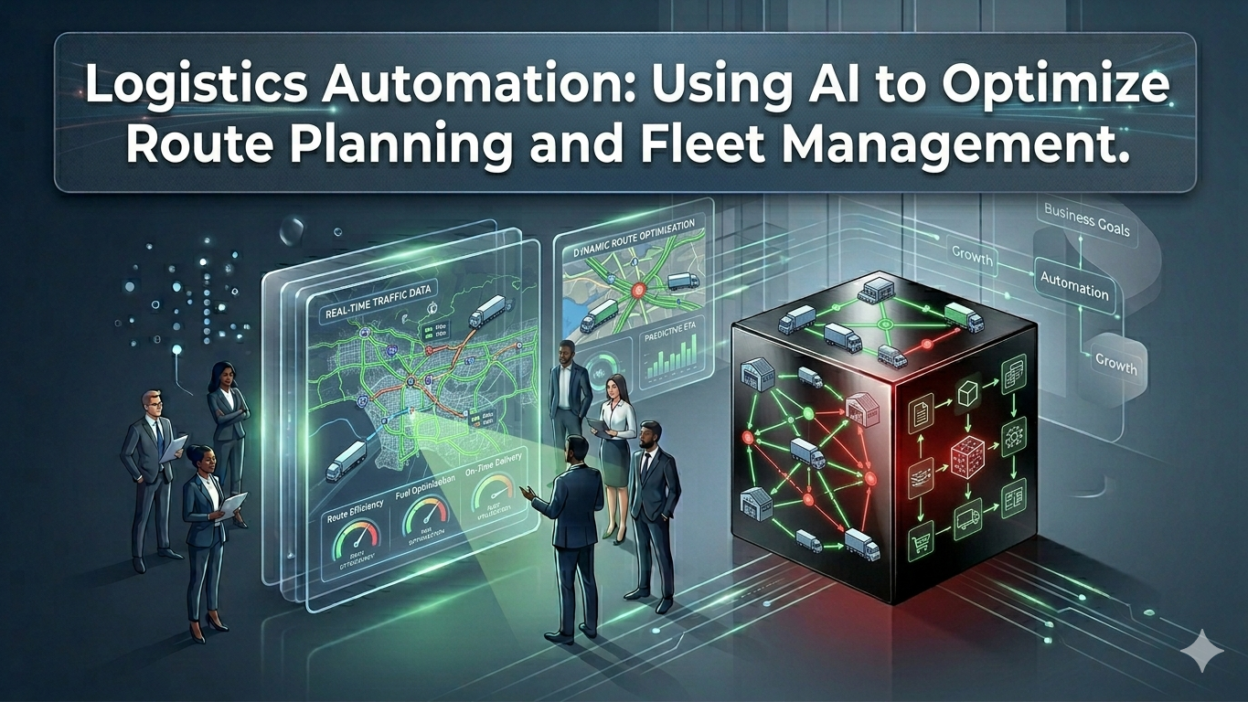
AI route optimization and fleet management changes this entire reality. Artificial intelligence processes thousands of variables simultaneously — traffic patterns, delivery windows, vehicle capacity, driver hours, weather conditions, and fuel costs — to produce smarter decisions than any human team can generate manually. The result is faster deliveries, lower costs, fewer vehicle breakdowns, and happier customers.
This blog explains exactly how AI transforms logistics operations, what the technology makes possible, and how companies can implement it effectively to gain lasting competitive advantage.
Table of Contents
The Real Cost of Inefficient Route Planning and Fleet Management
What Inefficiency Actually Looks Like
Most logistics operations accept a baseline of inefficiency as normal. Drivers take familiar routes rather than optimal ones. Dispatchers assign vehicles based on availability rather than suitability. Maintenance schedules follow calendar intervals rather than actual vehicle condition. Fuel consumption data sits in spreadsheets that nobody analyzes systematically.
This accepted inefficiency has a real price tag. Industry research estimates that poor route planning alone wastes 20–30% of total fuel expenditure in typical fleet operations. Unplanned vehicle breakdowns cost three to five times more than scheduled preventive maintenance. Missed delivery windows trigger penalty clauses, customer complaints, and lost contracts. The costs compound silently until they become impossible to ignore.
The Human Limit in Complex Logistics
A skilled dispatcher managing a fleet of fifty vehicles makes dozens of routing decisions every morning. Each decision involves driver availability, vehicle load capacity, delivery time windows, geographic clustering, and traffic prediction. The human brain handles this with reasonable success on a normal day.
Add an unexpected road closure, three driver call-outs, a priority same-day delivery, and a regional weather warning simultaneously, and the complexity exceeds human capacity to optimize reliably. Decisions become reactive rather than strategic. Costs spike. Service quality drops. AI route optimization and fleet management exists precisely to handle this complexity without cognitive strain or decision fatigue.
How AI Route Optimization Works
The Core Technology Behind Route Planning AI
AI route optimization combines several distinct technologies into a unified decision-making system. Machine learning models analyze historical route performance data to identify patterns that human analysts miss. Optimization algorithms — including genetic algorithms, ant colony optimization, and reinforcement learning — compute route combinations across thousands of possibilities in seconds. Real-time data feeds integrate live traffic, weather, road condition, and event data to adjust decisions continuously.
The system considers constraints that manual planning approximates. Vehicle weight limits, refrigeration requirements, hazardous materials regulations, driver hours-of-service rules, customer delivery windows, and road access restrictions all enter the optimization simultaneously. AI route optimization and fleet management produces solutions that satisfy every constraint while minimizing total cost.
Dynamic Re-Routing in Real Time
Static route plans fail the moment reality diverges from prediction. A traffic accident blocks the planned route thirty minutes into a driver’s shift. Manual re-routing requires a dispatcher call, driver deliberation, and several minutes of lost time. AI re-routing happens automatically within seconds.
The AI monitors every vehicle continuously through GPS telemetry. When conditions change, it recalculates optimal routes for all affected vehicles simultaneously. Drivers receive updated navigation instructions instantly. Delivery time estimates update in customer portals without manual intervention. AI route optimization and fleet management makes the entire fleet responsive to real-world conditions in ways that static planning cannot achieve.
Multi-Stop Optimization at Scale
Delivering to twenty stops sounds manageable. Delivering to two hundred stops with varying time windows, vehicle capacities, and geographic clusters is a combinatorially complex problem. The number of possible route sequences for two hundred stops exceeds the number of atoms in the observable universe.
AI solves this problem practically. The system clusters stops geographically. It assigns vehicle types to load requirements. It sequences stops to minimize backtracking while respecting time window constraints. It balances workloads across drivers to prevent overtime violations. The resulting route plan for two hundred stops takes seconds to generate and outperforms manually created plans consistently on every cost metric.
AI-Powered Fleet Management Capabilities
Predictive Maintenance and Vehicle Health Monitoring
Vehicle breakdowns destroy logistics schedules. A broken-down truck blocks a route, strands a driver, delays deliveries, and triggers expensive emergency repair callouts. Traditional maintenance schedules replace parts at calendar intervals regardless of actual wear. AI-powered fleet management changes this fundamentally.
AI route optimization and fleet management systems connect to vehicle telematics to monitor engine parameters, brake wear, tire pressure, transmission temperature, and dozens of other health indicators continuously. Machine learning models recognize the early signatures of component failure weeks before the failure occurs. The system schedules maintenance proactively during periods of low operational demand. Parts arrive before they are needed. Mechanics prepare before vehicles arrive. Downtime drops dramatically.
Driver Behavior Monitoring and Coaching
Fuel consumption varies significantly based on driving behavior. Harsh acceleration, aggressive braking, excessive idling, and high-speed highway driving all increase fuel costs measurably. Manual supervision of driver behavior across a large fleet is practically impossible. AI monitoring makes it systematic.
The AI analyzes telematics data from every vehicle continuously. It identifies drivers whose behavior consistently costs more in fuel and vehicle wear. It generates individual coaching reports that supervisors can use in regular performance conversations. Some systems send real-time alerts to drivers when behavior patterns shift toward costly habits. Gradual behavior improvement across the entire fleet compounds into substantial fuel savings over time.
Load Optimization and Capacity Utilization
Empty truck space is wasted money. A vehicle running at 60% capacity costs nearly as much to operate as one running at 95% capacity. AI route optimization and fleet management analyzes order data to maximize load efficiency before vehicles depart.
The system groups orders by geographic destination, delivery time requirement, and physical compatibility. It calculates optimal loading sequences that respect vehicle weight limits and fragility requirements. It identifies consolidation opportunities that reduce the total number of vehicle trips required. Higher capacity utilization means fewer vehicles, less fuel, lower driver hours, and reduced emissions — all from smarter loading decisions.
Fleet Utilization and Right-Sizing Analysis
Many companies operate more vehicles than their actual demand requires. Excess vehicles sit idle, depreciate, consume insurance premiums, and require maintenance without generating revenue. AI analysis of fleet utilization patterns reveals the true vehicle count needed to serve actual operational demand.
The AI models operational scenarios at different fleet sizes. It quantifies the service level impact of reducing the fleet by different amounts. It identifies peak demand periods that require full fleet capacity and off-peak periods when idle vehicles could be decommissioned or redeployed. Fleet right-sizing decisions based on AI analysis consistently reveal significant cost reduction opportunities that intuition-based fleet management misses.
Industries Benefiting Most from AI Route Optimization and Fleet Management
Last-Mile Delivery and E-Commerce Fulfillment
Last-mile delivery is the most expensive and complex segment of the logistics chain. Urban environments add density, parking constraints, building access challenges, and concentrated time-window demand simultaneously. E-commerce growth has pushed last-mile complexity to levels that manual planning cannot manage effectively.
AI route optimization and fleet management is transforming last-mile operations for major carriers and regional delivery companies alike. Route density algorithms minimize the distance between consecutive stops in dense urban zones. Dynamic time-window management adjusts delivery sequences based on real-time customer availability signals. Failed delivery prediction identifies high-risk stops in advance so drivers can prioritize confirmed deliveries.
Food and Beverage Distribution
Food distribution requires temperature-sensitive routing, strict delivery time windows, and compliance with food safety regulations. A dairy distributor cannot deliver at the wrong temperature. A beverage company cannot miss a restaurant’s pre-opening delivery window. The margin for error is minimal.
AI route optimization and fleet management handles food distribution constraints with precision that manual planning struggles to match consistently. The system tracks refrigerated compartment temperatures alongside route planning. It priorities time-sensitive deliveries in route sequencing. It alerts dispatchers immediately when a vehicle’s temperature monitoring signals a deviation. Food safety compliance improves while route efficiency increases simultaneously.
Field Service and Utility Operations
Field service companies dispatch technicians to customer sites for installations, repairs, and inspections. Scheduling the right technician with the right skills and parts to the right location at the right time is a complex optimization problem that directly affects customer satisfaction and operational cost.
AI route optimization and fleet management matches technician skills to job requirements, minimizes travel time between appointments, and predicts appointment duration based on job type and technician experience. Dynamic re-scheduling handles cancellations and emergency callouts without disrupting the entire day’s schedule. Technicians complete more appointments per day. Customers wait less. First-time fix rates improve.
Construction and Heavy Equipment Logistics
Construction logistics involves moving heavy equipment between sites, coordinating material deliveries with project schedules, and managing specialized vehicles with routing restrictions. Bridge weight limits, low clearance routes, and permit requirements constrain routing options significantly.
AI route optimization and fleet management encodes all these constraints into its optimization engine. The system identifies compliant routes for oversize loads automatically. It schedules equipment transfers between sites to minimize idle time on projects. It coordinates material delivery timing with construction schedules to avoid costly site delays waiting for supplies.
Implementing AI Route Optimization and Fleet Management Successfully
Assess Your Current Operational Baseline
Effective implementation begins with measurement. Document current route performance metrics before deploying any AI system. Track average delivery time per stop, fuel consumption per kilometer, on-time delivery rate, vehicle utilization percentage, and maintenance cost per vehicle per month.
These baseline metrics become the benchmark against which AI performance improvements measure. Without baseline data, it is impossible to quantify return on investment accurately. The data also reveals which operational areas suffer most from current inefficiency and therefore benefit most from AI route optimization and fleet management intervention.
Choose the Right Technology Platform
The AI route optimization and fleet management market includes specialized platforms for different fleet sizes and industry verticals. Some platforms excel at last-mile urban delivery optimization. Others specialize in long-haul intercity routing. Some focus on field service scheduling. Others handle mixed fleet operations with diverse vehicle types.
Evaluate platforms against your specific operational requirements. Consider integration capability with your existing transportation management system, ERP, and customer order management platform. Assess the quality of real-time data feeds the platform connects to. Review the platform’s approach to constraint handling for your specific regulatory and operational environment. A platform that fits your exact use case outperforms a general-purpose tool consistently.
Integrate Telematics and Real-Time Data Sources
AI route optimization and fleet management requires data feeds to function at full capability. GPS telemetry from every vehicle provides the location data the system needs to monitor progress and trigger re-routing. Vehicle diagnostic data enables predictive maintenance. Traffic data APIs provide real-time congestion information. Weather APIs supply condition data that affects routing decisions.
Invest in quality telematics hardware for every vehicle before deploying AI optimization software. Inconsistent or missing data produces degraded optimization results. The quality of AI decisions depends directly on the quality and completeness of data inputs. Comprehensive telematics coverage is the infrastructure prerequisite that all other AI capabilities build upon.
Train Dispatchers and Fleet Managers
AI route optimization and fleet management augments human decision-making rather than replacing it entirely. Dispatchers and fleet managers need training to understand what the AI recommends, why it recommends it, and when human override is appropriate. An AI recommendation that a dispatcher does not understand is a recommendation the dispatcher will not trust or follow.
Training should cover how to read AI-generated route plans, how to interpret vehicle health alerts, how to handle exception scenarios where AI recommendations require human judgment, and how to use reporting dashboards to monitor operational performance. Confidence in the tool drives consistent adoption. Consistent adoption produces the full efficiency gains the technology promises.
Pilot, Measure, and Scale Deliberately
Begin with a pilot program covering a defined subset of your fleet and operational area. Run AI route optimization and fleet management alongside existing manual processes for an initial period. Compare AI-generated outcomes against manually planned alternatives using objective performance metrics.
A well-designed pilot reveals optimization gains accurately, exposes integration issues before full deployment, and builds internal confidence through demonstrated results. Expand deployment progressively as the pilot validates performance. Scale to full fleet coverage after confirming the system performs reliably across the operational diversity of your actual business.
Measuring ROI from AI Route Optimization and Fleet Management
Fuel Cost Reduction
Fuel represents 25–35% of total fleet operating cost in most logistics operations. AI route optimization and fleet management consistently reduces fuel consumption by 10–20% in documented implementations. This reduction comes from shorter routes, fewer empty miles, improved vehicle speed profiling, and reduced idle time. Fuel savings alone typically justify the investment in AI optimization for fleets larger than twenty vehicles.
Calculate fuel ROI by multiplying baseline fuel expenditure by the reduction percentage the AI delivers in your pilot. Project savings across fleet scale and twelve-month horizon. Compare to total platform cost including implementation, integration, and ongoing licensing. Most operations achieve full payback within twelve to eighteen months.
On-Time Delivery Rate Improvement
On-time delivery rate directly affects customer retention, contract compliance, and penalty avoidance. AI route optimization and fleet management improves on-time rates by producing more accurate delivery time estimates, adapting routes to real-time conditions, and prioritizing time-sensitive stops appropriately.
Track on-time delivery rate before and after AI implementation. Each percentage point improvement has a dollar value attached through reduced penalty payments, improved customer retention, and reduced re-delivery costs. Operations that improve on-time rate from 87% to 95% generate measurable revenue protection through better customer retention.
Maintenance Cost Reduction
Predictive maintenance driven by AI vehicle health monitoring reduces total maintenance expenditure by 15–25% in typical fleet operations. Scheduled preventive maintenance costs significantly less than emergency breakdown repair. Component replacement before failure avoids secondary damage that breakdowns often cause. Reduced breakdown frequency cuts driver downtime and associated administrative costs.
Track total maintenance expenditure per vehicle per month as a core AI route optimization and fleet management performance metric. Declining maintenance cost per vehicle indicates the predictive capability is functioning effectively and preventing expensive failures successfully.
Fleet Size Optimization Savings
When AI analysis reveals that a fleet of sixty vehicles can serve the same operational demand with fifty vehicles, the cost savings are substantial. Ten fewer vehicles means ten fewer insurance premiums, ten fewer registration fees, ten fewer maintenance budgets, and ten fewer depreciation charges annually. AI route optimization and fleet management analysis that enables fleet right-sizing delivers savings that extend far beyond operational efficiency improvements.
Common Challenges and How to Overcome Them
Data Quality and Completeness Issues
AI optimization is only as reliable as the data it consumes. Incomplete GPS coverage, inconsistent vehicle diagnostic reporting, and inaccurate order data all degrade optimization quality. Invest in data infrastructure before deploying AI optimization. Audit data completeness across every vehicle and every data source the system requires.
Establish data quality standards and monitoring processes that flag gaps immediately. Assign responsibility for data quality maintenance to specific team members. AI route optimization and fleet management performs at full capability only when the underlying data foundation meets quality standards consistently.
Change Resistance from Experienced Drivers and Dispatchers
Experienced drivers trust their own route knowledge. Dispatchers with years of operational experience resist AI recommendations that contradict their intuition. This resistance is understandable and requires deliberate management.
Involve drivers and dispatchers in the implementation process early. Share AI performance data that demonstrates where optimized routes outperform familiar ones. Create feedback channels where experienced staff can flag situations where AI recommendations seem incorrect. Collaborative implementation builds trust faster than top-down mandate. AI route optimization and fleet management adoption improves dramatically when front-line staff feel like partners rather than recipients.
Integration Complexity with Legacy Systems
Many logistics operations run on transportation management systems, ERPs, and fleet management platforms built years ago. Integrating AI optimization with legacy systems requires careful technical work. Data format mismatches, API limitations, and system architecture differences create integration friction.
Work with vendors who have demonstrated integration experience with your specific legacy platforms. Budget realistically for integration engineering time. Plan integration in phases rather than attempting full simultaneous connection of all systems. Successful integration unlocks the full value of AI route optimization and fleet management. Failed integration limits it severely.
The Future of AI Route Optimization and Fleet Management
Autonomous Vehicle Integration
Autonomous delivery vehicles are moving from pilot programs toward commercial deployment in specific use cases. AI route optimization and fleet management systems are evolving to coordinate mixed fleets of autonomous and human-driven vehicles simultaneously. The same optimization engine that currently plans routes for human drivers will coordinate autonomous vehicle dispatch, charging schedules, and operational zones within a unified fleet management framework.
Sustainability and Carbon Emission Optimization
Environmental regulations and corporate sustainability commitments are making carbon emission reduction a primary fleet management objective alongside cost. AI route optimization and fleet management is expanding to treat carbon emissions as an optimization variable with equal weight to fuel cost and delivery time.
Future systems will optimize across three simultaneous objectives: cost, service level, and carbon footprint. Electric vehicle charging management, route selection based on grid carbon intensity, and emission reporting will integrate natively into fleet management AI. Companies that build this capability now will meet tightening regulations without operational disruption.
Collaborative Logistics Networks
AI is enabling logistics networks where competing companies share fleet capacity on routes where their demand overlaps. A manufacturer’s outbound deliveries share truck space with a retailer’s inbound shipments on the same geographic corridor. AI route optimization and fleet management coordinates these collaborative arrangements at a scale and complexity level that makes them practically achievable for the first time.
FAQs About AI Route Optimization and Fleet Management
What fleet size justifies investment in AI route optimization?
Fleets as small as ten to fifteen vehicles can justify AI route optimization and fleet management investment when delivery complexity is high. Larger fleets of thirty or more vehicles typically see clear ROI within twelve months regardless of operational complexity. The denser and more time-constrained your delivery network, the faster the payback at any fleet size.
How accurate are AI delivery time estimates compared to manual estimates?
AI delivery time estimates are typically 15–25% more accurate than manual estimates because they account for traffic, stop duration variability, and driver performance patterns simultaneously. More accurate estimates improve customer satisfaction and reduce the customer service contacts that arise from missed time windows.
Does AI route optimization work in rural areas with limited traffic data?
AI route optimization and fleet management performs well in rural environments even with limited real-time traffic data. Historical route performance data and geographic optimization algorithms deliver meaningful efficiency improvements independent of real-time traffic feeds. Real-time data integration adds additional value in urban environments where traffic variability is highest.
How does AI handle regulatory constraints like hours-of-service rules?
Quality AI route optimization and fleet management platforms encode hours-of-service regulations as hard constraints that the optimization engine cannot violate. The system plans routes that keep drivers within legal limits automatically. It flags schedules that approach limits and recommends breaks or driver changes proactively before violations occur.
Can AI route optimization integrate with customer delivery tracking portals?
Yes. Most enterprise AI route optimization and fleet management platforms provide APIs that connect to customer-facing tracking portals. Real-time vehicle location and updated delivery time estimates flow to customer portals automatically without manual dispatcher updates. Customer visibility improves while dispatcher workload decreases simultaneously.
What happens when AI route recommendations conflict with driver experience?
The most effective implementations create feedback mechanisms where drivers can flag route recommendations that conflict with their local knowledge. Valid driver feedback updates the AI’s route preference model over time. The system learns from experienced driver input while maintaining optimization discipline. Human knowledge and AI computation work best as complements rather than competitors.
How long does full AI fleet management implementation typically take?
Basic route optimization deployment takes four to eight weeks for fleets with clean data and compatible existing systems. Full implementation including predictive maintenance integration, driver behavior monitoring, and reporting dashboard configuration typically takes three to six months. AI route optimization and fleet management complexity scales with fleet size and integration requirements.
Read More:-Mastering MCP (Model Context Protocol): How to Connect Any Tool to Your AI
Conclusion

Logistics has always rewarded precision. The company that delivers faster, cheaper, and more reliably than competitors earns the business. For decades, precision in logistics depended on experienced human judgment operating at the limits of cognitive capacity.
AI route optimization and fleet management removes that cognitive ceiling. The technology processes complexity that overwhelms human planning, adapts to conditions that static plans cannot anticipate, and improves continuously as it learns from operational data. The result is logistics operations that perform better every month rather than plateauing at the limit of human planning capacity.
Companies implementing AI route optimization and fleet management report consistent improvements across every critical metric. Fuel costs decline. On-time delivery rates climb. Vehicle breakdowns decrease. Driver productivity increases. Fleet utilization improves. Customer satisfaction follows naturally from operations that work as reliably as the technology powering them.
The competitive advantage of smarter logistics is not temporary. Companies that build AI route optimization and fleet management capability now develop operational muscle that compounds over time. Their routes get better with every delivery. Their maintenance predictions get sharper with every vehicle health reading. Their fleet utilization improves with every capacity analysis.
The logistics industry is changing. The companies building AI capabilities today are setting the standard that everyone else will spend years trying to match. Start with a clear operational baseline. Choose a platform that fits your specific requirements. Pilot deliberately. Scale confidently. The efficiency gains waiting inside your current logistics operation are larger than most companies realize until they let AI find them.