Introduction
TL;DR Every founder knows the growth dilemma. Revenue climbs. Work multiplies. The team stretches thin. The obvious answer feels like hiring. More people means more capacity. More capacity means more output. More output means more growth.
That logic made sense for a long time. It no longer holds the same way.
Hiring is expensive, slow, and risky. Recruiting takes months. Onboarding takes more months. A bad hire costs three to six times the annual salary in lost productivity, management time, and eventual replacement costs. Growing headcount to match revenue growth creates a cost structure that makes profitability harder to achieve and maintain Scaling teams with AI automation offers a fundamentally different path. Companies today are building operations that deliver enterprise-level output with startup-sized teams. AI handles the volume. Humans handle the judgment. The combination creates businesses that grow faster, spend less, and operate with remarkable efficiency.
This blog explains exactly how that works, which functions benefit most, and how any organization can start building an AI-augmented team that scales without proportional headcount growth.
Table of Contents
What “Lean Team” Really Means in the AI Era
The Old Definition of Lean
Lean teams used to mean skeleton crews doing the bare minimum. Small headcount implied limited ambition or aggressive cost-cutting. Lean was a constraint, not a strategy. Companies grew out of lean as fast as possible because lean meant limited.
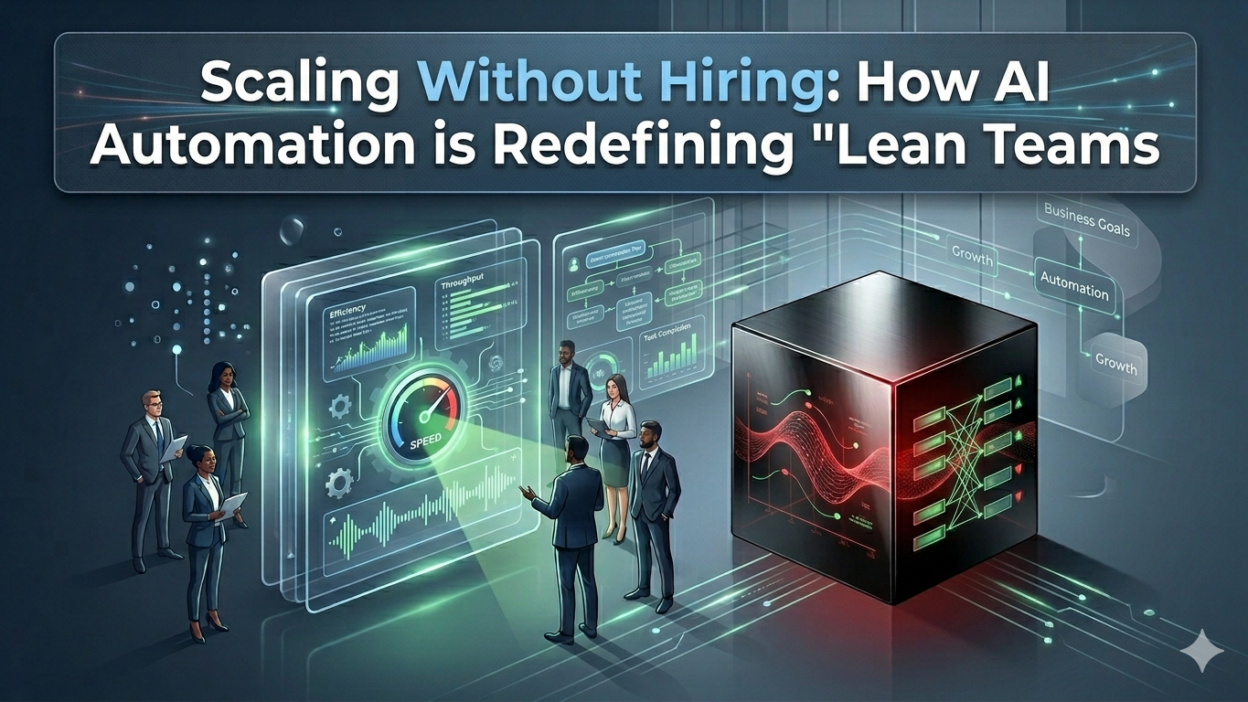
That definition no longer applies. Scaling teams with AI automation redefines lean as a competitive architecture. A lean team today means a small group of highly skilled people supported by AI systems that handle volume, repetition, and data processing. The team is lean by design, not by limitation. Output rivals teams three or four times the size.
The Multiplier Effect of AI on Human Capacity
A marketing team of three with the right AI tools produces content, manages campaigns, analyzes performance, and runs A/B tests at the throughput of a ten-person department. A customer service team of five with AI-powered support handles inquiry volumes that previously required twenty agents. A finance team of four with automated reporting and forecasting delivers insights that once needed a full analyst department.
Scaling teams with AI automation works because AI multiplies human output rather than simply adding to it. One skilled person directing AI tools accomplishes what previously required a team. The math changes fundamentally. Headcount stops being the primary variable in capacity planning.
Why This Matters More Now Than Ever
Business conditions in 2026 demand capital efficiency. Investors expect more from less. Customers expect faster responses and better service simultaneously. Competitive markets reward the organizations that grow output without proportionally growing cost.
Scaling teams with AI automation addresses all three pressures directly. It reduces cost per unit of output. It accelerates response speed. It enables small teams to compete against larger rivals who rely on headcount for capacity. The organizations that master this model now are building structural advantages that compound with time.
Functions Where AI Automation Delivers the Highest Leverage
Marketing and Content Operations
Marketing generates enormous content volume requirements. Blog posts, social media content, email campaigns, ad copy, landing pages, SEO content, and product descriptions all need continuous creation and optimization. Manual content production at scale requires large teams. AI changes the production equation entirely.
Scaling teams with AI automation in marketing means one content strategist can brief, generate, edit, and publish content at five times the previous volume. AI tools draft initial content from strategic briefs. Writers edit, refine, and approve rather than creating from blank pages. Campaign performance data feeds AI optimization models that adjust ad creative and targeting continuously. A three-person marketing team operates with the content throughput of a fifteen-person department.
Customer Support and Service
Customer support scales with customer count in traditional models. More customers generate more inquiries. More inquiries require more agents. The ratio feels fixed. AI breaks the ratio.
AI-powered support systems handle tier-one inquiries autonomously. Common questions about order status, product specifications, return policies, and account management resolve without human involvement. Complex or sensitive inquiries route to human agents with full context already assembled by the AI. Agents focus exclusively on interactions requiring genuine human judgment, empathy, or authority.
Scaling teams with AI automation in customer support enables five agents to effectively serve a customer base that previously required twenty-five. Resolution speed improves because AI handles simple cases instantly. Human agents handle complex cases with better context and less cognitive load from routine queries.
Sales Development and Lead Management
Sales development requires persistent, high-volume outreach to qualify prospects and book meetings for account executives. Traditionally this function needs large teams of sales development representatives making hundreds of calls and sending thousands of emails weekly. The work is repetitive, data-driven, and highly systematizable.
AI automates prospect research, personalized outreach sequencing, follow-up timing, and initial qualification through conversational AI tools. Sales development representatives focus on prospects who have engaged meaningfully rather than cold outreach volume. Scaling teams with AI automation in sales means two senior sales development representatives directing AI outreach systems outperform eight traditional representatives working manually.
Finance, Reporting, and Data Analysis
Finance teams spend enormous time on data collection, report compilation, reconciliation, and standard analysis that follows predictable patterns. These tasks are time-consuming, error-prone when done manually, and primarily valuable as inputs to actual decision-making rather than valuable in themselves.
AI automates data extraction, report generation, variance analysis, and financial modeling updates. Finance professionals spend their time on interpretation, strategic recommendation, and judgment-intensive decisions rather than data assembly. A finance team of three professionals with AI-powered automation delivers analytical output that previously required eight people and produces fewer errors simultaneously.
Human Resources and People Operations
HR teams handle high-volume transactional work alongside genuinely complex people challenges. Recruiting coordination, onboarding administration, benefits processing, policy communication, and compliance documentation all consume significant HR capacity without requiring deep human judgment.
Scaling teams with AI automation in HR means recruiting coordinators use AI to screen applications, schedule interviews, send candidate communications, and compile evaluation summaries. Onboarding systems deliver personalized orientation content automatically. HR professionals focus on culture development, complex employee relations, and strategic people initiatives instead of administrative coordination.
Building the Infrastructure for AI-Augmented Teams
Identify Automation Opportunities Systematically
Not every task in every function deserves automation. Automation delivers the highest value on tasks that are high-volume, rule-based, time-consuming, and low in unique judgment requirement. Tasks requiring creative synthesis, complex interpersonal judgment, ethical navigation, or novel problem-solving typically need human intelligence at the center.
Map every function’s work across these dimensions. Identify which specific tasks consume the most time. Assess which of those tasks follow consistent patterns that AI can learn. Prioritize the highest-time, highest-pattern tasks for initial automation investment. Scaling teams with AI automation works best as a systematic program rather than a collection of individual tool experiments.
Choose an AI Stack That Connects
Individual AI tools create productivity improvements. A connected AI stack creates genuine scale. When the AI tool that handles customer inquiries shares context with the CRM that tracks customer relationships, which connects to the reporting system that measures service quality, the entire operation runs with intelligence rather than just speed.
Evaluate AI tools not just on their individual capability but on their integration potential. Choose platforms with robust APIs and documented integration patterns. Build data flows that allow AI systems to share context across functions. Scaling teams with AI automation at the organizational level requires AI systems that work together, not just tools that work individually.
Invest in Prompt Engineering and AI Direction Skills
The quality of AI output depends directly on the quality of human direction. A skilled person who knows how to brief AI systems, structure prompts, evaluate outputs critically, and iterate quickly produces dramatically better results than a skilled person using the same tools without that capability.
Scaling teams with AI automation requires deliberate investment in AI direction skills across your team. Train staff on effective prompting for their specific function. Build prompt libraries that capture best practices for common tasks. Create feedback loops where output quality continuously improves the prompts and processes driving it. AI direction skill is the new core competency that determines how much leverage each team member creates.
Create Quality Control Systems That Scale
AI output requires human oversight. Not every output needs deep review, but every output type needs a defined review process. High-stakes outputs — customer communications, financial reports, public content, strategic recommendations — require careful human review before use. Lower-stakes outputs may need only spot-check review processes.
Design review workflows that match review intensity to output stakes. Build quality metrics that track AI output quality over time. Establish feedback mechanisms that flag quality issues for prompt and process improvement. Scaling teams with AI automation does not mean removing human judgment from the operation. It means applying human judgment where it matters most and trusting AI systems for the rest.
The Organizational Model for AI-Augmented Lean Teams
Generalists Who Direct Specialists
Traditional organizational design values specialization. Deep specialists handle narrow domains with expertise. AI changes the optimal human contribution profile in many functions. The most valuable human in an AI-augmented team is often a generalist with strong judgment who can direct AI tools across multiple domains rather than a specialist who handles one domain manually.
A marketing generalist who understands strategy, can brief AI content tools, evaluate output quality, and interpret performance data delivers more value in an AI-augmented team than three separate specialists in content, distribution, and analytics. Scaling teams with AI automation rewards breadth paired with strong judgment over narrow depth in many team configurations.
Redefining Roles Around Human Judgment
Every role in an AI-augmented organization needs redesign around the question of where human judgment is genuinely necessary. Job descriptions that list tasks AI can now handle waste human capacity. Job descriptions that specify judgment, relationships, strategy, and escalation handling make human contribution clear and valuable.
Redesign job scopes explicitly. Define what AI handles. Define what humans handle. Create clear escalation paths from AI systems to human judgment for edge cases. Scaling teams with AI automation requires organizational redesign, not just tool deployment. Teams that deploy AI tools without redesigning roles find their people still spending time on work the AI could handle because no one explicitly transferred responsibility.
Managing Performance in AI-Augmented Teams
Performance measurement needs to update alongside job scope. Measuring a content creator on content volume when AI handles volume is measuring the wrong thing. Measuring them on content quality, strategic alignment, and business impact reflects their actual contribution correctly.
Scaling teams with AI automation demands updated performance frameworks that measure human judgment quality, AI direction effectiveness, and business outcomes rather than activity volume. Managers need training on how to evaluate AI-augmented performance. Clear expectations about human versus AI contribution prevent the confusion and resentment that emerges when performance standards do not reflect actual job design.
Real-World Examples of Teams Scaling with AI Automation
The Five-Person Startup Competing with Fifty-Person Rivals
Technology startups in 2025 and 2026 are shipping products, serving customers, and generating revenue at scales that once required fifty or more employees. Founding teams of five use AI tools for customer support, content marketing, code generation, financial reporting, and sales outreach simultaneously.
Scaling teams with AI automation allows these startups to reach product-market fit faster by redirecting human energy toward customer learning and product iteration rather than operational execution. They grow revenue without growing cost at the same rate. They reach profitability at smaller revenue figures. They outmaneuver larger, slower competitors still dependent on headcount for capacity.
The Mid-Market Company Holding Headcount Flat Through Growth
Established companies using AI automation to scale through growth phases without proportional hiring are documenting remarkable productivity improvements. A professional services firm with forty employees generating the revenue of an eighty-person firm has a fundamentally different cost structure and profit margin profile.
This is exactly what scaling teams with AI automation makes achievable in established organizations. The challenge is cultural as much as technical. Leaders must commit to growing output per person rather than defaulting to hiring when capacity feels stretched. Teams must trust AI tools enough to rely on them for execution. The organizations that make this shift report that the capability advantage compounds over time.
The Enterprise Function Running Lean by Design
Large enterprises are carving out specific functions and running them as AI-augmented lean teams deliberately. A marketing function that previously had forty people now runs with fifteen, producing more content at higher quality with better performance data. A customer service function that previously needed two hundred agents now handles the same volume with eighty agents and AI handling the remainder.
Scaling teams with AI automation at enterprise scale requires structured governance, careful change management, and investment in AI infrastructure that smaller organizations may not need. The efficiency gains at scale are enormous. Enterprise functions running AI-augmented lean teams deliver results that fund further AI investment from the savings they generate.
Challenges to Expect and How to Navigate Them
Resistance from Team Members Who Fear Replacement
AI automation creates genuine anxiety about job security. Team members who see AI handling tasks they previously owned worry about their own relevance. This anxiety, when unaddressed, creates active resistance to adoption that undermines the entire program.
Address this directly and honestly. Communicate clearly that scaling teams with AI automation aims to grow output per person, not to reduce headcount. Show team members how AI tools change their work rather than eliminate it. Involve them in identifying automation opportunities and designing new workflows. People who co-design the change feel ownership over it rather than threat from it.
Quality Degradation When Oversight is Insufficient
Teams eager to capture productivity gains sometimes reduce oversight too aggressively. AI output runs to customers, stakeholders, or public channels without adequate review. Quality problems emerge. Trust in AI-augmented processes erodes quickly when early quality failures create reputational damage.
Build quality control infrastructure before scaling AI output volume. Define review requirements for every output category. Track quality metrics from the start. Fix quality problems at the process and prompt level rather than simply increasing human review of everything. Scaling teams with AI automation requires robust quality management as a foundational investment, not an afterthought.
Tool Sprawl Without Integration
Organizations that deploy many individual AI tools without integration strategy end up with fragmented workflows, duplicate data entry, and context that never transfers between systems. The efficiency gains from individual tools disappear into coordination overhead between disconnected systems.
Govern your AI tool portfolio actively. Evaluate new tools on integration capability before adoption. Retire tools that duplicate functionality without adding unique value. Invest in integration engineering that connects AI tools into coherent workflows. Scaling teams with AI automation delivers compounding returns when AI systems work together and diminishing returns when they operate in isolation.
Measuring the Impact of Scaling Teams with AI Automation
Output Per Employee as the Core Metric
Revenue per employee, tasks completed per person per week, and customer served per team member are all versions of the output per employee metric that best captures AI augmentation impact. Tracking this metric over time reveals whether AI investment is genuinely multiplying human capacity or simply adding tool cost without proportional output gain.
Set baseline output per employee metrics before deploying AI tools. Track monthly. Expect improvement to accelerate as teams build skill with AI direction and workflows mature. Scaling teams with AI automation consistently shows improvement curves that steepen over the first six to twelve months as human-AI collaboration patterns develop.
Time Reallocation Tracking
Track where team members spend time before and after AI deployment. The goal is time moving from execution tasks to judgment tasks. An AI-augmented team should show measurably less time on data collection, report compilation, first-draft creation, and scheduling coordination — and measurably more time on strategy, client relationships, complex problem-solving, and creative direction.
Time reallocation data reveals whether AI automation is genuinely changing how people work or whether people are simply doing more of the same work at higher volume. Scaling teams with AI automation aims for the former. When time tracking shows the latter, workflow redesign is needed to ensure AI handles execution rather than just supporting humans doing execution manually.
Quality Metrics by Function
Track quality alongside volume to ensure AI augmentation improves or maintains output quality rather than trading quality for speed. Customer satisfaction scores measure service quality. Content engagement metrics measure marketing quality. Error rates measure financial reporting quality. First-contact resolution rates measure support quality.
Scaling teams with AI automation should show quality improvement alongside output improvement over time. Early deployments sometimes show temporary quality dips as teams calibrate AI direction skills and review processes. Quality should recover and improve as those capabilities mature. Persistent quality decline signals a process problem requiring urgent attention.
FAQs About Scaling Teams with AI Automation
Does scaling with AI automation mean teams never need to hire?
No. Scaling teams with AI automation means companies can grow revenue and output faster than they grow headcount. Hiring still happens for genuinely human-essential roles, new capability areas, and growth beyond what AI augmentation alone can handle. The ratio of output growth to headcount growth improves dramatically. Headcount growth does not stop entirely.
Which team functions are hardest to automate?
Functions requiring deep interpersonal trust, novel creative synthesis, complex ethical judgment, and high-stakes relationship management are hardest to automate effectively. Executive leadership, complex sales relationships, product strategy, and senior client management retain high human-essential value. Scaling teams with AI automation works best in the execution layers beneath these judgment-intensive functions.
How much does building an AI-augmented team cost?
Tool costs vary widely from hundreds of dollars monthly for small teams to tens of thousands for enterprise-grade AI platforms. The real investment includes implementation time, integration engineering, training, and workflow redesign — which typically cost more than the software itself in the first year. Most organizations find scaling teams with AI automation delivers positive ROI within twelve to eighteen months of serious implementation.
What skills do team members need to work effectively with AI tools?
Critical thinking and output evaluation skills matter most. Team members need to recognize good AI output from poor AI output in their domain. Effective prompt construction and iteration skills follow closely. Workflow design thinking helps team members see how to integrate AI into existing processes intelligently. Scaling teams with AI automation amplifies people who already think clearly about their work and their output.
How do you prevent AI automation from reducing team creativity?
Design roles where AI handles execution and humans direct strategy and creative vision. Ensure humans set the creative brief rather than simply editing AI output. Create space for human-originated creative work alongside AI-augmented production. Scaling teams with AI automation increases creative output when humans focus on creative direction and AI handles creative execution. It reduces creativity only when organizations allow AI to set creative direction rather than execute it.
Is AI automation suitable for regulated industries?
Yes, with appropriate governance. Regulated industries including financial services, healthcare, and legal services successfully deploy AI automation with compliance frameworks that define what AI can handle autonomously and what requires human review and approval. Scaling teams with AI automation in regulated contexts requires more rigorous quality control and audit trail design but delivers comparable efficiency benefits.
How long before an AI-augmented team reaches full productivity?
Most teams reach meaningful productivity improvement within four to eight weeks of tool deployment. Full optimization of human-AI workflows typically takes three to six months as teams develop AI direction skill, refine prompts and processes, and redesign roles around the new capability model. Scaling teams with AI automation shows the steepest improvement curve between months three and nine in most implementations.
Read More:-The Death of RPA? Why Agentic AI is Replacing Traditional Robotic Process Automation.
Conclusion

The era of hiring headcount to buy capacity is ending. Not because people have become less valuable — quite the opposite. Human judgment, creativity, relationship depth, and strategic thinking matter more than ever. The work humans do best is increasingly the work that determines competitive outcomes.
What AI automation removes from the equation is the need to hire humans for high-volume, repeatable, data-intensive execution work that machines now handle better and faster. The lean team of the AI era is not a compromised team doing less with less. It is a powerful team doing more with more — more tools, more data, more leverage per person.
Scaling teams with AI automation is the defining organizational capability of this decade. Companies building this capability now are creating structural advantages in cost efficiency, output speed, and talent leverage that competitors relying on traditional headcount scaling will find increasingly difficult to match.
The path forward is clear. Map the execution work that AI can handle. Deploy tools that handle it reliably. Redesign roles around human judgment, direction, and oversight. Measure output per person rather than activity per person. Invest in the AI direction skills that determine how much leverage each team member generates.
Scaling teams with AI automation does not require a massive organization, a massive budget, or a massive AI research team. It requires a clear strategy, deliberate tool selection, and the organizational commitment to genuinely change how work happens rather than just adding AI tools to unchanged workflows.
Start with one function. Demonstrate the output improvement. Build the organizational confidence. Expand the program. The lean team of the future is not something you hire toward. It is something you build, one automated workflow at a time.