Introduction
TL;DR Hiring the right tech talent is one of the hardest jobs in HR today. Companies post roles and receive hundreds of applications within days. Screening each candidate manually burns time, money, and energy. HR teams struggle to keep up. Recruiters miss good candidates. The process becomes slow and unreliable.
AI technical screening automation changes all of this. It brings speed, accuracy, and consistency to one of the most painful parts of talent acquisition. Companies that adopt it gain a real competitive edge. They hire faster, smarter, and with far less effort.
This blog walks you through the full picture of AI technical screening automation. You will understand what it is, how it works, why it matters, and how to get started.
What Is AI Technical Screening Automation?
Defining the Core Concept
AI technical screening automation uses artificial intelligence to evaluate candidates during the early stages of hiring. It removes the need for human recruiters to conduct every first-round interview. The system asks relevant questions, evaluates answers, and ranks candidates based on skill and fit.
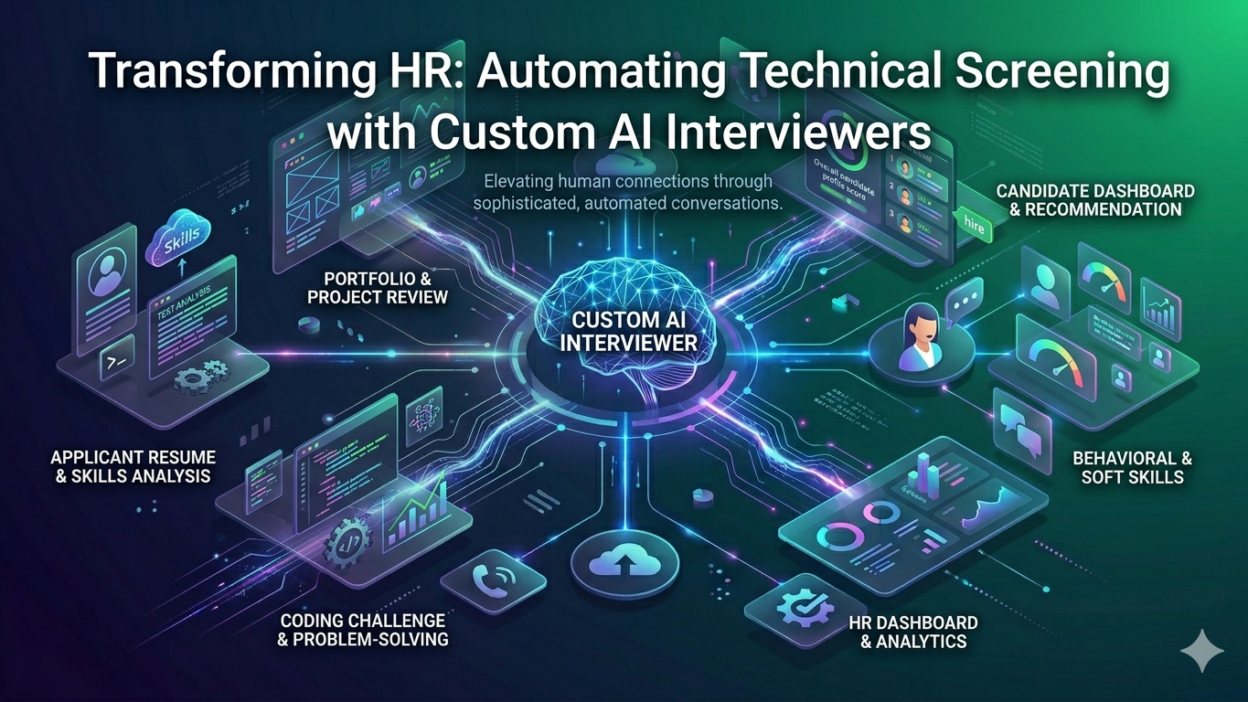
Custom AI interviewers are at the heart of this process. These are AI-powered tools built to mimic a real technical interviewer. They ask role-specific questions. They assess coding, logic, and communication. They produce detailed candidate reports without anyone lifting a finger.
How It Differs from Traditional Screening
Traditional screening relies on resume reviews and manual phone calls. Recruiters spend hours doing work that offers little insight into actual skills. AI technical screening automation flips this model. It evaluates real ability, not just a well-formatted CV.
The AI asks candidates to solve problems live. It measures how they think. It records their responses. It scores them against a consistent rubric. Every candidate gets the same fair experience. No bias. No fatigue. No inconsistency.
Why Companies Are Moving to AI Technical Screening Automation
The Volume Problem Is Real
Most tech companies today receive 200–500 applications per open role. A recruiter can realistically speak to 10–20 people per week. That gap creates a massive bottleneck. Good candidates get lost. Offers go cold. Hiring timelines stretch beyond acceptable limits.
AI technical screening automation solves the volume problem directly. The system can screen 500 candidates in the time a human screens 10. Quality stays high. Speed increases dramatically. HR teams can focus on final-round evaluations and offer negotiations instead of early-stage calls.
Bias Reduction Is a Major Benefit
Human screeners carry unconscious bias. Name, gender, accent, and tone all affect snap judgments. AI technical screening automation evaluates candidates on pure performance. Every applicant answers the same questions. Every answer gets scored the same way.
This creates a more equitable process. Companies build more diverse teams. They avoid discrimination claims. They make decisions rooted in data, not impression.
Cost Savings Add Up Quickly
Every hour a recruiter spends on phone screens has a dollar value attached. Multiply that by hundreds of roles per year, and the cost becomes significant. AI technical screening automation cuts that cost substantially. Teams redirect their energy toward high-value activities. Productivity rises without adding headcount to HR.
How Custom AI Interviewers Work
The Architecture Behind the Tool
Custom AI interviewers are built on large language models and machine learning frameworks. They understand natural language. They generate contextual follow-up questions. They assess both technical accuracy and communication quality.
The setup involves configuring the AI to match specific role requirements. A backend engineering role gets different questions than a data science position. The AI learns the skills the company cares about. It asks targeted questions that reveal real competence.
The Candidate Experience
Candidates receive a link to the AI interview session. They log in and begin. The AI greets them professionally. It walks them through the process calmly. Candidates feel prepared, not ambushed.
Questions are delivered clearly. The AI listens to responses. It follows up when answers need more depth. Candidates can complete the interview on their own schedule. This flexibility removes the stress of coordinating time zones and calendar conflicts.
How Scoring Works
Scoring in AI technical screening automation happens through multiple layers. The AI checks technical accuracy first. It then evaluates communication clarity. It looks at problem-solving approach. It notes how candidates handle ambiguity.
Each response gets a score. Scores aggregate into an overall candidate rating. Recruiters receive a detailed report. The report highlights strengths, weaknesses, and areas to probe in later rounds. Decision-making becomes data-driven and defensible.
Key Features to Look for in an AI Technical Screening Tool
Role-Specific Customization
Every company has different hiring needs. A strong AI technical screening automation platform lets you customize everything. You define the skills matrix. You set the question bank. You decide the scoring weights. The tool adapts to your standards, not the other way around.
Generic tools produce generic results. Custom AI interviewers that align with your specific job requirements deliver much better signal. They surface candidates who actually match what you need.
Integration with Your ATS
AI technical screening automation works best when it connects seamlessly with your applicant tracking system. Candidates flow from application to AI interview without manual steps. Results populate directly into candidate profiles. Recruiters see everything in one place.
Look for native integrations with platforms like Greenhouse, Lever, Workday, and Breezy. API access matters too. A good tool plugs into your existing workflow rather than creating a new silo.
Multilingual Support
Global hiring requires language flexibility. Leading AI technical screening automation platforms support multiple languages. Candidates can respond in their native language. The AI evaluates with equal accuracy. This expands your talent pool significantly.
Real-Time Analytics
Data is the most valuable output of AI technical screening automation. Good platforms provide dashboards with real-time insights. You see pass rates, drop-off points, average scores, and time-to-complete metrics. These insights reveal where your process needs improvement. They help you refine your screening criteria over time.
Industries Benefiting Most from AI Technical Screening Automation
Technology and Software Development
Software companies have the most urgent need for AI technical screening automation. They hire at scale. Roles require specific technical depth. Traditional screening cannot keep pace. Custom AI interviewers evaluate coding skills, system design thinking, and debugging ability with precision and speed.
Financial Services and Fintech
Fintech companies hire engineers, data scientists, and quantitative analysts constantly. Each role demands proven technical ability. AI technical screening automation ensures only genuinely skilled candidates advance. It reduces the cost of a bad hire in a high-stakes industry.
Healthcare Technology
Healthtech firms build products that impact lives. Hiring mistakes cost more than just money. AI technical screening automation ensures technical candidates meet strict competency standards before reaching human interviewers. Quality of hire improves across the board.
E-Commerce and Retail Tech
Scaling e-commerce businesses need large engineering teams fast. AI technical screening automation enables rapid hiring without sacrificing quality. Retailers can scale their tech teams seasonally or during growth phases without overwhelming HR.
Implementing AI Technical Screening Automation: A Practical Roadmap
Audit Your Current Process
Start by mapping your existing screening workflow. Identify the biggest pain points. Calculate how many hours go into first-round interviews per role. Quantify the cost of your current approach. This data becomes your baseline for measuring improvement.
Define Role-Specific Requirements
Work with hiring managers to build detailed competency frameworks for each role. Identify the core skills, secondary skills, and deal-breaker gaps. This framework becomes the foundation for your custom AI interviewers. Precision here leads to better outcomes later.
Choose the Right Platform
Evaluate AI technical screening automation vendors carefully. Prioritize customization, ATS integration, reporting depth, and candidate experience quality. Request demos. Run pilot programs with real roles. Choose a platform that your team will actually use consistently.
Train Your Recruiters
AI technical screening automation works best when recruiters understand its outputs. Train your team to read candidate reports correctly. Help them understand scoring methodology. Teach them how to use AI insights to sharpen their final-round interview questions.
Monitor, Measure, and Improve
Track your key metrics from day one. Monitor time-to-screen, pass rates, candidate satisfaction scores, and quality-of-hire outcomes. Use this data to refine your AI configuration regularly. AI technical screening automation gets sharper the more you tune it.
Common Challenges and How to Overcome Them
Candidate Resistance
Some candidates feel uncomfortable with AI-led interviews. They prefer human interaction. Address this openly. Communicate what the AI interview involves before it begins. Make the experience welcoming and straightforward. Candidates who understand the process accept it much more readily.
Over-Reliance on Scores
AI technical screening automation produces scores, not final verdicts. Scores are a guide, not a guarantee. Recruiters must still apply judgment in later stages. Train your team to treat AI outputs as a powerful filter, not a replacement for human evaluation entirely.
Data Privacy Concerns
Candidates share personal information during AI interviews. Companies must handle this data responsibly. Choose platforms that comply with GDPR, CCPA, and relevant local data laws. Communicate clearly to candidates how their data gets used and stored. Trust is essential to a positive candidate experience.
Keeping the AI Updated
Roles evolve. Skills in demand change. Your AI interviewer must reflect current job market realities. Schedule regular reviews of your question banks and scoring rubrics. Keep the AI aligned with what your company actually needs from new hires.
The ROI of AI Technical Screening Automation
Time Savings
Companies that implement AI technical screening automation cut their time-to-screen by 60–80%. A process that once took three weeks now takes three days. Hiring timelines compress. Offers go out faster. Companies win more top candidates before competitors even schedule a first call.
Cost Per Hire Reduction
HR teams report 40–50% reductions in cost per hire after deploying AI technical screening automation. Fewer recruiter hours go into low-value early-stage work. Agency fees drop because internal pipelines become more efficient. Budget moves to where it creates real value.
Improved Offer Acceptance Rates
Speed matters to candidates. When companies move fast, candidates feel wanted. AI technical screening automation accelerates early stages. Candidates reach offer stage sooner. Offer acceptance rates climb. Candidate experience improves across every touchpoint.
Better Quality of Hire
Structured, skills-based screening produces better employees. Companies using AI technical screening automation report higher 90-day performance scores among new hires. The right people get in. The wrong people get filtered out early. Teams become stronger over time.
The Future of AI Technical Screening Automation
Adaptive Questioning
The next generation of AI technical screening automation tools will adapt in real time. The AI will adjust question difficulty based on how a candidate performs mid-interview. Strong candidates get harder questions. Struggling candidates get redirected to different skill areas. This creates a more accurate picture of each person’s true capability range.
Video and Emotion Analysis Integration
Future tools will analyze video responses alongside text. They will assess confidence, clarity, and communication style through facial expression and tone. This adds a new dimension to candidate evaluation. Soft skills become measurable. Holistic assessment becomes more achievable.
Predictive Hiring Models
AI technical screening automation will connect to performance data from existing employees. The system will learn which early signals predict long-term success. Screening criteria will update automatically based on what actually works inside each organization. Hiring becomes a self-improving system.
Deeper Personalization for Candidates
AI will create fully personalized interview experiences for each candidate. Questions will reflect the candidate’s resume, background, and stated preferences. The interaction will feel less like a standard test and more like a relevant conversation. Candidate experience will reach a new standard.
FAQs About AI Technical Screening Automation
What roles is AI technical screening automation best suited for?
AI technical screening automation works best for roles with clear, measurable technical requirements. Software engineering, data science, DevOps, product management, and cybersecurity roles are ideal starting points. The more defined the skill set, the more accurate the screening.
Does AI technical screening automation replace human recruiters?
No. AI technical screening automation handles early-stage screening so human recruiters can focus on higher-value work. Humans remain essential for evaluating culture fit, negotiating offers, and building relationships with candidates. AI and humans work best together.
How accurate is AI technical screening compared to human screening?
Studies show AI technical screening automation achieves equal or higher accuracy than human phone screens when properly configured. The consistency of AI eliminates the variability that comes from human mood, fatigue, and bias. Accuracy improves as the AI learns from more data.
Is AI technical screening automation fair to all candidates?
When built and configured correctly, AI technical screening automation is more fair than human screening. It evaluates every candidate on the same criteria. No names, photos, or personal details influence the score. Equity is built into the process by design.
How long does implementation take?
Most companies complete basic implementation of AI technical screening automation within two to four weeks. Full optimization, including custom question banks and ATS integration, takes four to eight weeks. Ongoing tuning continues indefinitely as the company learns what works best.
What data does AI technical screening automation collect?
Platforms collect candidate responses, scores, time spent, and interaction patterns. Some collect video and audio data if the platform supports video interviews. Companies should publish a clear data policy so candidates understand their rights and how data gets handled.
Can small companies benefit from AI technical screening automation?
Absolutely. Small companies often have the least HR capacity. AI technical screening automation gives them enterprise-level screening capability without enterprise-level budgets. Even hiring for five roles per year benefits significantly from automation. The ROI is strong at any scale.
Read More:-Multi-Modal AI: How to Use Video and Images in Your Automated Workflows
Conclusion
The way companies hire is changing. Speed, fairness, and data-driven decisions are no longer optional. They are the new standard. AI technical screening automation makes all three achievable at scale.
Custom AI interviewers remove the burden of early-stage screening from your HR team. They evaluate candidates fairly, consistently, and at a pace no human team can match. The result is a faster, better, cheaper hiring process.
Companies that embrace AI technical screening automation right now will build stronger teams, reduce costs, and outpace competitors in the talent market. The technology is ready. The ROI is proven. The only question is how quickly your organization will make the shift.
Start small if you need to. Pick one role type. Configure a custom AI interviewer. Run a pilot. Measure the results. The numbers will speak for themselves.
AI technical screening automation is not the future of HR. It is the present. The companies winning the talent war today are already using it.