Introduction
TL;DR Every company wants faster growth. Every team wants better results with less guesswork. Go-to-Market AI Strategies give businesses that edge, but only when the data behind them works together. Scattered spreadsheets and disconnected tools slow teams down. Unified data changes that story completely.
This blog breaks down how unified data fuels Go-to-Market AI Strategies. You will learn what these strategies mean, why data unification matters, and how to build a system that actually works for your sales and marketing teams.
Table of Contents
What Are Go-to-Market AI Strategies
Go-to-Market AI Strategies combine artificial intelligence with the plans a company uses to launch products and reach customers. These strategies use AI models to predict buyer behavior, score leads, and personalize outreach. Sales teams use them to close deals faster. Marketing teams use them to target the right audience at the right time.
A strong Go-to-Market AI Strategy relies on clean, connected data. Without that foundation, even the best AI model produces weak results. Data quality shapes every prediction and every recommendation the system makes.
Companies often confuse automation with intelligence. Automation follows fixed rules. AI adapts based on new signals. This difference matters when a business builds its first data-driven growth plan. Real intelligence needs a steady stream of accurate information, not just a set of scripted triggers.
Why Companies Need Go-to-Market AI Strategies Now
Buyers today expect fast, relevant experiences. They do not wait for a slow sales process. They expect brands to know their needs before the first call happens. Go-to-Market AI Strategies help companies meet that expectation.
Competition has grown sharper across every industry. Manual processes cannot keep pace with buyer demands anymore. AI-driven strategies help teams act on real-time signals instead of outdated reports. This shift saves time and improves conversion rates across the funnel.
Budgets face more pressure than ever before. Leaders want proof that every dollar spent produces revenue. A data-backed growth plan gives finance teams that proof. It shows exactly which channels, campaigns, and reps drive real results.
The Connection Between Data and AI Strategies
AI models learn from data. Bad data creates bad predictions. Good data creates strong, actionable insights. This simple truth sits at the center of every successful Go-to-Market AI Strategy.
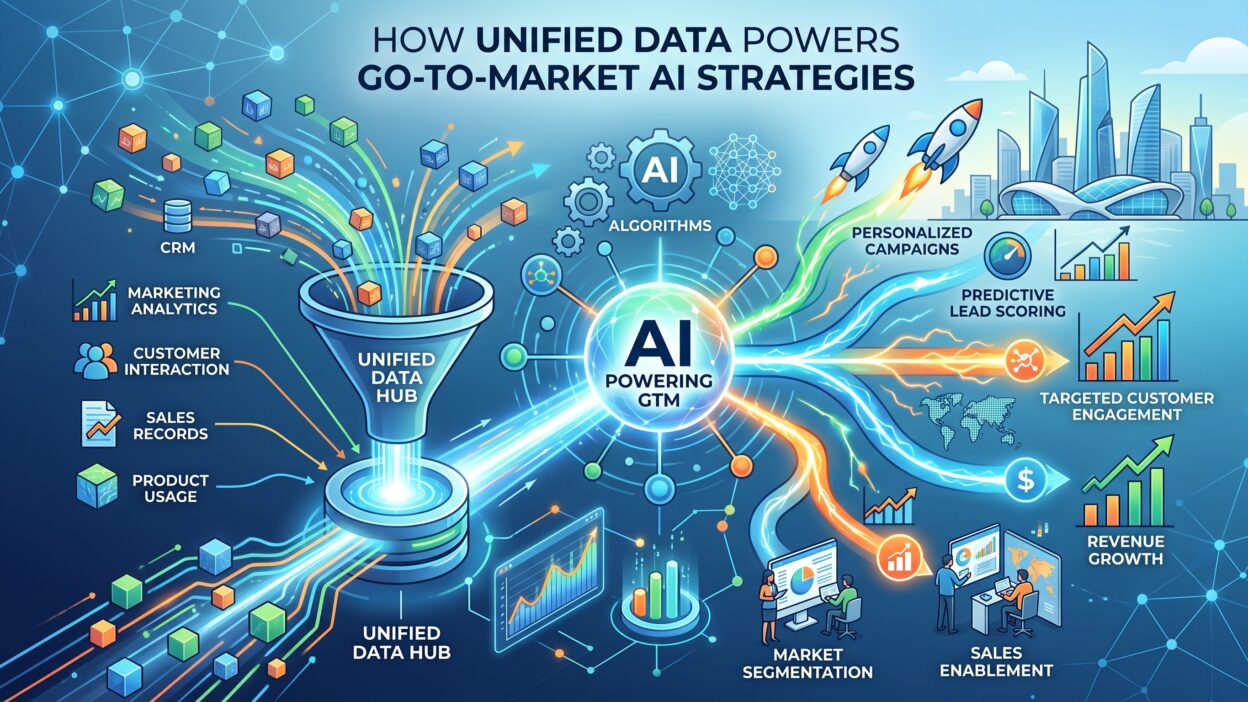
Companies that unify their data give their AI systems a complete picture of the customer. Sales history, website behavior, support tickets, and marketing engagement all combine into one clear view. That clarity drives smarter decisions across every department.
Think about a model trying to predict churn. It needs billing history, support complaints, and product usage together. A model missing even one piece guesses instead of predicting. Complete data turns a guess into a reliable forecast.
Why Unified Data Matters for Go-to-Market AI Strategies
Unified data means every team pulls information from one connected system instead of ten disconnected tools. This single structure removes confusion and builds trust in the numbers everyone sees.
Go-to-Market AI Strategies depend heavily on this kind of structure. AI cannot analyze what it cannot access. When customer data sits locked in separate systems, the AI model only sees part of the story. Unified data fixes that gap and gives AI full visibility into the customer journey.
The Problem With Scattered Data
Most companies store customer information in many places. Marketing keeps data in one platform. Sales keeps data in a CRM. Support keeps data in a helpdesk tool. These systems rarely talk to each other.
This separation creates blind spots. A sales rep might not know a customer already filed three support tickets. A marketing team might target someone who just canceled their subscription. These gaps hurt customer trust and slow down revenue growth.
Scattered data also wastes hours every week. Analysts pull reports from five systems and stitch them together by hand. That manual work leaves less time for actual strategy. Teams end up managing spreadsheets instead of managing customers.
Creating One Source of Truth
A single source of truth means every team sees the same customer record. This record updates in real time and reflects every interaction across the business. This foundation makes any AI-driven growth plan far more accurate.
Building this system takes effort, but the payoff is huge. Teams stop arguing over whose numbers are correct. Everyone works from the same facts. AI models trained on this unified data produce sharper, more reliable results.
Picture two reps looking at the same account. One sees an active deal. One sees a churned customer. Without a single record, both reps act on wrong information. A unified record stops that confusion before it starts.
Connecting Sales Marketing and Support Data
Sales, marketing, and support teams each hold a piece of the customer puzzle. When these pieces connect, the full picture appears. A Go-to-Market AI Strategy built on this connected data can predict churn, flag upsell opportunities, and personalize every touchpoint.
This connection also improves internal communication. Teams stop working in silos. They start working from shared goals backed by shared data. That alignment speeds up decision making across the entire company.
Core Components of a Unified Data System
Building a unified data system requires the right tools and the right structure. Companies need to invest in technology that connects data sources without creating more complexity. This section covers the key building blocks every Go-to-Market AI Strategy needs.
Customer Data Platforms
A customer data platform, often called a CDP, collects data from every touchpoint and stores it in one place. This platform becomes the backbone of most Go-to-Market AI Strategies. It pulls in website visits, email opens, purchase history, and support interactions.
CDPs give AI models a clean, structured dataset to learn from. This structure matters because AI struggles with messy, inconsistent data. A well-built CDP removes that mess and gives every model a strong starting point.
Integration Tools and APIs
Integration tools connect different software systems so data flows automatically between them. APIs act as bridges that let one platform send information to another without manual work. These tools reduce errors and save time for busy teams.
Go-to-Market AI Strategies rely on these connections to stay current. A lead that fills out a form should instantly appear in the sales system. A customer who churns should instantly update the marketing database. Integration tools make this instant flow possible.
Real Time Data Pipelines
Real time data pipelines move information the moment it gets created. This speed matters for AI systems that need fresh signals to make accurate predictions. Old data leads to outdated recommendations and missed opportunities.
Companies running strong Go-to-Market AI Strategies invest heavily in these pipelines. They want their AI models reacting to what customers do right now, not what they did last month. This real-time approach keeps every strategy sharp and relevant.
Data Governance and Security
Unified data brings power, but it also brings risk. More connected systems mean more places where sensitive information can leak. Data governance sets clear rules for who can access what, and it keeps customer information safe.
Strong governance also improves AI accuracy. Clean permissions stop unauthorized edits that corrupt records. Regular audits catch errors before they spread across every connected system. Companies that skip this step often pay for it later through compliance fines or lost customer trust.
How Unified Data Powers Go-to-Market AI Strategies in Real Business Use
Theory only goes so far. Businesses need to see how unified data actually improves results. This section breaks down four real applications that show the strength of Go-to-Market AI Strategies built on connected data.
Smarter Lead Scoring
Lead scoring ranks prospects based on their likelihood to buy. AI models score leads using signals like website visits, email engagement, and past purchases. Unified data feeds these signals into one model instead of scattering them across systems.
This complete view produces sharper scores. Sales reps spend their time on leads most likely to convert. Weak leads get filtered out early, saving time and effort across the team.
Consider a lead who visits the pricing page five times but never opens a sales email. A fragmented system misses that signal. A unified system flags this lead as high intent, even without direct contact. Reps reach out at exactly the right moment.
Precise Customer Segmentation
Segmentation groups customers based on shared traits and behaviors. AI models handle this task far better than manual spreadsheets ever could. Unified data gives these models the full customer picture needed for precise grouping.
Strong segmentation targets each group with messaging that actually fits their needs. This precision increases response rates and builds stronger customer relationships over time.
A software company might group users by feature usage instead of company size. One group needs onboarding help. Another group needs advanced training. Segmenting by real behavior beats segmenting by guesswork every time.
Personalized Campaigns at Scale
Personalization used to mean adding a first name to an email. Today it means tailoring the entire message based on customer behavior and intent. AI models handle this personalization automatically when they have access to unified data.
Marketing teams running Go-to-Market AI Strategies can send different messages to thousands of customers, each based on real signals. This scale was impossible with manual processes. Unified data makes it simple and repeatable.
Accurate Sales Forecasting
Forecasting predicts future revenue based on current pipeline data. Poor data creates poor forecasts, which leads to bad planning decisions. Unified data solves this problem by feeding AI models a complete, accurate view of every deal.
Sales leaders trust these forecasts because the underlying data reflects reality. This trust helps companies plan hiring, budgets, and resources with far more confidence.
A forecast built on incomplete data might miss a stalled deal sitting in a rep’s inbox. A forecast built on unified data catches that stall immediately. Leaders adjust their plans before a missed quarter becomes a real problem.
Industry Examples of Unified Data in Action
Different industries apply these ideas in different ways. A retail brand might unify purchase history with browsing data to time promotional emails perfectly. A software company might combine product usage data with support tickets to spot churn risk early. A financial services firm might blend transaction data with customer service logs to flag fraud faster.
Each of these examples shares one trait. The business connects information that used to sit apart. That connection turns raw numbers into a clear next step for a sales or marketing team.
Business Benefits of Unified Data for Go-to-Market AI Strategies
Companies that invest in unified data see clear, measurable benefits. These benefits touch every part of the business, from daily operations to long-term growth planning.
Faster Decisions
Teams waste less time searching for information across multiple systems. Unified data puts everything in one place, so decisions happen faster. Go-to-Market AI Strategies thrive in this kind of fast-moving environment.
Leaders can pull real-time reports instead of waiting for manual updates. This speed gives companies a real advantage over slower competitors still working with fragmented systems.
A product launch decision that once took three weeks of report gathering now takes three days. Executives see live numbers instead of stale summaries. Fast, accurate decisions become the norm rather than the exception.
Lower Costs
Disconnected systems cost money. Companies pay for multiple tools that do similar jobs, and they pay employees to manually reconcile data between them. Unified data removes much of this waste.
A well-connected data system reduces manual work and cuts down on redundant software costs. Teams work more efficiently, and budgets stretch further across the business.
Many companies pay for three or four tools that store the same customer fields. Unifying that data often means retiring old subscriptions. Those savings add up fast across a growing organization.
Better Customer Experience
Customers notice when a company understands their needs. Unified data lets every team, from sales to support, see the same customer history. This visibility creates smoother, more personal interactions at every stage.
Go-to-Market AI Strategies built on this foundation help companies respond faster and more accurately to customer needs. That responsiveness builds loyalty and drives repeat business.
Challenges Companies Face With Unified Data
Building a unified data system is not simple. Companies run into real obstacles along the way. Understanding these challenges helps teams plan better and avoid costly mistakes.
Data Quality Problems
Bad data ruins good strategies. Duplicate records, missing fields, and outdated entries confuse AI models and produce weak results. Companies need strong data cleaning processes before they can trust any AI output.
Any AI-driven growth plan is only as strong as the data feeding it. Teams must audit their data regularly and fix quality issues before they scale their AI efforts.
A single duplicate customer record can throw off an entire segmentation model. Multiply that error across thousands of records, and the damage grows fast. Regular cleanup keeps small errors from turning into large ones.
Integration Complexity
Connecting old systems with new tools takes time and technical skill. Many companies run legacy software that was never built to share data easily. This complexity slows down unification projects.
Companies need patient planning and the right technical partners to solve this problem. Rushing the integration process often creates more errors than it fixes.
A rushed migration might map the wrong fields between two systems. Customer names might swap with company names. These small mistakes create big headaches for teams trying to trust their new unified system.
Team Alignment Gaps
Technology alone does not solve data problems. Teams need to agree on shared definitions, shared goals, and shared processes. Without this alignment, unified data systems fall apart quickly.
Leaders must invest in training and open communication across departments. Every team needs to understand why data unification matters and how it helps their daily work.
Sales might define a lead differently than marketing does. Support might track a ticket differently than the product team does. These small mismatches create big reporting problems once systems connect. Shared definitions solve this before it starts.
Best Practices to Build Strong Go-to-Market AI Strategies
Companies that succeed with these strategies follow a clear set of practices. These practices reduce risk and speed up results.
Set Clear Business Goals
Every data project needs a clear purpose. Companies should define exactly what they want their Go-to-Market AI Strategy to achieve before building any system. Clear goals guide every technical decision that follows.
Vague goals lead to wasted resources and confused teams. Specific goals keep projects focused and measurable.
A goal like “improve lead quality by twenty percent” gives a team something to build toward. A goal like “get better at AI” gives them nothing to measure. Specific targets keep every project honest.
Pick the Right Data Infrastructure
Not every tool fits every business. Companies need to evaluate their size, budget, and technical skill before choosing a data platform. The right infrastructure supports growth without creating unnecessary complexity.
Any strong AI-driven growth plan starts with infrastructure that matches real business needs, not just trendy technology. A ten-person startup rarely needs the same stack as a thousand-person enterprise. Matching tools to actual scale saves money and reduces future headaches.
Train Teams to Use Data Well
Even the best system fails without proper training. Teams need to understand how to read reports, trust the data, and act on AI recommendations. This training builds confidence across the organization.
Companies that skip this step often see low adoption rates, even after spending heavily on new technology. A simple weekly walkthrough of new dashboards keeps teams engaged and comfortable with the system.
Track Results and Adjust Often
No strategy stays perfect forever. Markets shift, customers change, and AI models need regular updates. Companies should track performance closely and adjust their approach as new data comes in.
This ongoing review keeps strategies sharp and prevents outdated assumptions from creeping back into decision making. A quarterly review often catches drift before it turns into a bigger revenue problem.
The Future of Go-to-Market AI Strategies
AI technology keeps advancing fast. Companies that unify their data today will hold a strong advantage as these tools grow more powerful.
Predictive Analytics Will Lead
Predictive analytics will play a bigger role in every Go-to-Market AI Strategy going forward. These models will forecast customer needs before customers express them directly. Unified data will remain the fuel behind these predictions.
Companies with clean, connected data will adopt these advances faster than competitors still working with scattered systems. Early movers will spot demand shifts months before slower rivals notice them.
Autonomous Systems Will Grow
AI systems will soon handle more decisions without human input. Autonomous lead routing, automatic campaign adjustments, and self-optimizing pricing models will become common. These systems will need unified data to function safely and accurately.
Businesses that build strong data foundations now will adapt to these changes with far less friction later. Waiting until these tools mature only widens the gap between fast-moving companies and slow ones.
Human Oversight Will Still Matter
AI will handle more tasks, but people still need to guide the strategy. Humans set the goals, check the ethics, and catch edge cases a model might miss. The strongest companies will pair smart automation with steady human judgment.
This balance keeps growth sustainable. A model can suggest an action, but a person should still understand why that action makes sense.
Frequently Asked Questions
What is a Go-to-Market AI Strategy?
A Go-to-Market AI Strategy uses artificial intelligence to guide how a company reaches, converts, and retains customers. It relies on data to predict behavior and personalize outreach across sales and marketing.
Why does unified data matter for AI strategies?
AI models need complete, accurate data to produce reliable results. Unified data removes gaps between systems and gives AI a full view of the customer, which leads to better predictions and stronger outcomes.
What tools support unified data systems?
Customer data platforms, integration tools, and real-time data pipelines all support unified data systems. These tools connect information from marketing, sales, and support into one accessible source.
How long does it take to build a unified data system?
Timelines vary based on company size and existing technology. Small companies may unify their data in a few months. Larger companies with legacy systems often need a year or more to complete full integration.
Can small businesses use Go-to-Market AI Strategies?
Yes. Small businesses can start with simple tools and grow their data systems over time. Many affordable platforms now offer AI features that once required large budgets and technical teams.
What is the biggest risk in skipping data unification?
The biggest risk is building AI models on incomplete information. These models make confident predictions that turn out wrong. Teams lose trust in the technology and often abandon good tools too early.
How do companies measure return on investment?
Companies track metrics like lead conversion rate, sales cycle length, and customer retention before and after unification. A clear rise in these numbers shows the investment paid off. Most teams see measurable gains within two or three quarters.
Read More:-7 Best Xactly Alternatives [2026]
Conclusion

Unified data sits at the heart of every strong Go-to-Market AI Strategy. Companies that connect their sales, marketing, and support data give their AI models the fuel they need to succeed. This connection leads to faster decisions, lower costs, and better customer experiences.
Building this kind of system takes real effort. Companies must clean their data, choose the right tools, and train their teams well. The payoff is worth the work. Businesses that commit to unified data today will lead their markets tomorrow with stronger, smarter Go-to-Market AI Strategies.