Introduction
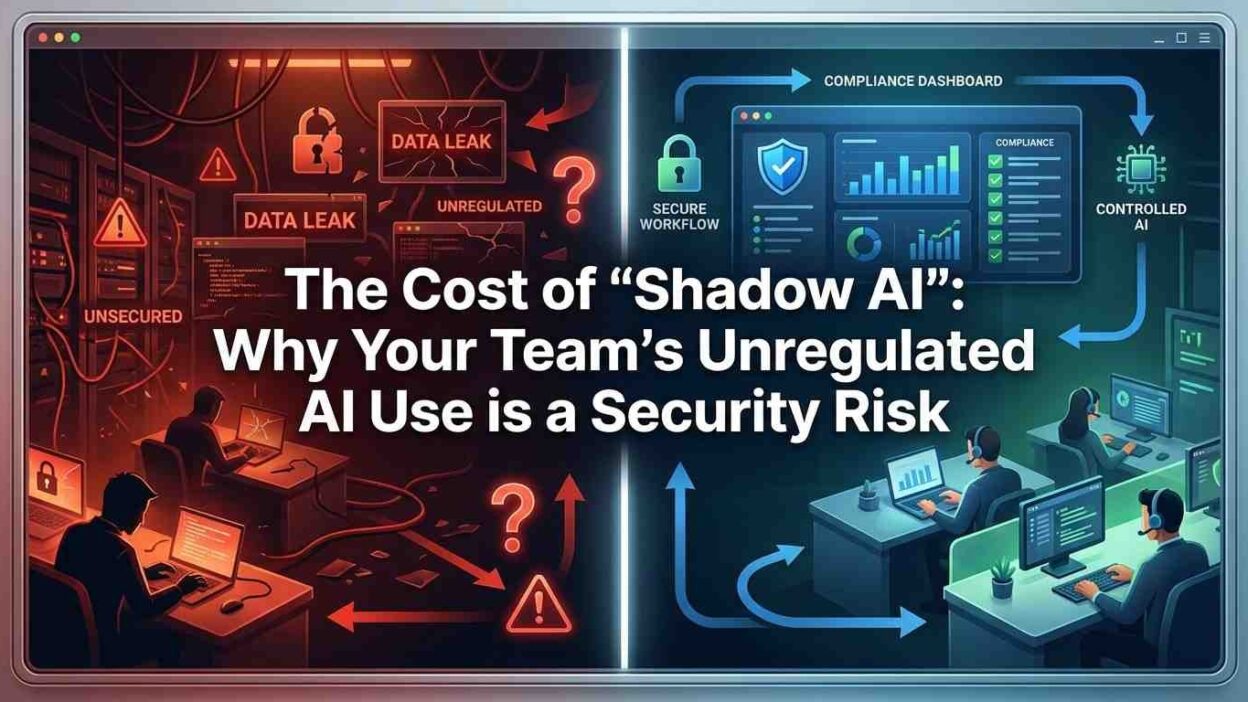
TL;DR Your team is using AI tools right now. Some of those tools you did not approve. Some you do not even know about. That is shadow AI. It is spreading fast across organizations of every size. Shadow AI security risk is not a future problem. It is happening on your network today.
Employees want speed. They find AI tools that help them work faster. They use ChatGPT for drafting emails. They use AI coding assistants for writing scripts. They use AI summarizers for reading legal documents. These tools are not evil. But using them without oversight creates serious vulnerabilities.
Security leaders face a hard reality. The tools that make teams productive can also expose sensitive data, violate compliance rules, and open doors to breaches. Shadow AI security risk sits at the intersection of productivity and peril. Understanding it is the first step to managing it.
This blog breaks down what shadow AI is, why it grows, what it costs, and how to build a governance framework that protects your organization without killing innovation.
Table of Contents
What Is Shadow AI? A Clear Definition for Security Leaders
Shadow AI refers to any AI tool, application, or model that employees use without formal IT or security approval. It mirrors the older concept of shadow IT but carries greater risk because AI tools process language, code, data, and documents in ways that older software did not.
A developer who pastes proprietary code into an AI assistant is creating a shadow AI security risk. A finance analyst who uploads a confidential spreadsheet to an AI summarizer is doing the same thing. The employee means no harm. The risk is real regardless of intent.
Shadow AI grows because the barrier to access is nearly zero. Anyone with a browser and a credit card can access a powerful AI model. Enterprise procurement cycles are slow. AI tools move fast. Employees fill the gap themselves.
The problem compounds because most AI tools trained on user inputs may retain that data. Terms of service vary widely. Some tools store conversations. Some use inputs for model training. Employees rarely read those terms. Security teams often have no visibility at all.
Shadow AI vs. Shadow IT: Understanding the Difference
Shadow IT typically involved unauthorized software installs or cloud storage use. Shadow AI goes further. AI tools can ingest, interpret, and store sensitive content at scale. One AI session can process more data than a rogue USB drive ever could. Shadow AI security risk is therefore broader and deeper than traditional shadow IT.
Shadow IT was mostly about unauthorized access. Shadow AI is about unauthorized data exposure. The distinction matters when you assess your threat surface and design your response.
Why Shadow AI Is Growing Faster Than Security Teams Can Track
The pace of AI adoption inside organizations has outrun governance. A 2024 survey by Cyberhaven found that employees send sensitive data to AI tools millions of times per week. Most security teams have no monitoring in place for this activity.
The reasons are structural. AI tools deliver immediate, visible value. Employees see the productivity gain right away. The risk is invisible and delayed. That asymmetry drives adoption without approval.
Management pressure adds fuel. Leaders demand efficiency. Teams respond with AI tools. When a team delivers results faster using an unapproved AI tool, the business rarely asks how. The shadow AI security risk remains hidden beneath the success metric.
Remote and hybrid work makes this worse. Employees work across personal devices, home networks, and corporate laptops. Monitoring scope narrows. The attack surface widens. Security teams struggle to maintain visibility across distributed environments.
Vendor marketing also plays a role. AI tool vendors target individual professionals directly. They offer free tiers designed to hook users. Once the individual is hooked, the tool spreads through teams via word of mouth. Security was never part of that adoption journey.
The Departments Most Affected by Shadow AI
Engineering teams use AI coding assistants that can expose proprietary source code. Legal teams use AI tools to review contracts, often uploading sensitive client documents. HR teams use AI to draft job descriptions and performance reviews that contain personal data. Finance teams use AI to analyze budgets and forecasts that include confidential figures.
Each of these use cases carries a distinct shadow AI security risk profile. The data type differs. The regulatory exposure differs. A one-size-fits-all security response will miss the nuances that matter most in each department.
The Real Costs of Shadow AI Security Risk
Data Breach and Exposure
When an employee submits sensitive data to an unvetted AI tool, that data leaves your controlled environment. It enters a third-party server you did not audit. You do not know the tool’s data retention policy. You do not know who else can access that data. That is a breach in all but legal name.
Actual breaches have occurred. Samsung famously experienced an internal data leak when engineers used ChatGPT to debug proprietary semiconductor code. The code was uploaded to OpenAI’s servers. Samsung had no way to retrieve it. That single incident triggered a global ban on AI tools at the company.
Your organization faces the same risk every day. Shadow AI security risk materializes the moment sensitive data crosses into an unapproved system. Prevention requires visibility before the transfer, not investigation after it.
Regulatory and Compliance Penalties
Data protection laws govern how organizations handle personal data. GDPR in Europe, HIPAA in healthcare, CCPA in California, and PCI-DSS in financial services all impose strict obligations. Uploading personal data to an unapproved AI tool may constitute a regulatory violation, regardless of intent.
Regulators do not accept ignorance as a defense. If your employee uploads patient records to an AI tool and that tool retains the data, your organization carries liability. Shadow AI security risk therefore carries direct financial exposure in regulated industries.
Fines under GDPR can reach four percent of global annual turnover. HIPAA violations can reach $1.9 million per violation category per year. These are not theoretical numbers. They apply the moment unregulated AI use touches protected data.
Intellectual Property Theft
Source code, product roadmaps, marketing strategies, and trade secrets are all forms of intellectual property. AI tools can expose IP without any malicious actor involved. The tool itself becomes the exposure vector.
Some AI models learn from user inputs. If your proprietary code or strategy document enters a shared training dataset, competitors may eventually surface that information through their own AI queries. Shadow AI security risk extends from data exposure to IP erosion over time.
Reputational Damage
A data breach linked to unregulated AI use carries reputational consequences beyond the legal penalties. Customers lose trust. Partners question your security posture. Talent avoids organizations perceived as careless with data. Reputation damage is slow to build and slow to recover.
How to Detect Shadow AI in Your Organization
You cannot manage what you cannot see. Detecting shadow AI requires deliberate effort. The goal is visibility, not surveillance. Employees who feel monitored without explanation disengage. Frame detection as a security initiative, not a performance audit.
Network Traffic Analysis
Start with DNS logs and outbound traffic analysis. Look for connections to known AI tool endpoints. ChatGPT, Claude, Gemini, Perplexity, GitHub Copilot, Jasper, and Midjourney all have identifiable traffic signatures. A spike in traffic to these endpoints signals active shadow AI use.
Deploy a Cloud Access Security Broker (CASB) solution. CASB tools provide visibility into cloud app usage across your organization. They identify unapproved applications and flag data transfers in real time. Many enterprise CASB platforms now include specific shadow AI security risk detection capabilities.
Employee Surveys and Interviews
Technical monitoring catches traffic. It does not catch intent. Run anonymous surveys asking employees which AI tools they use for work. The results are often surprising. Teams openly admit using tools that IT had no record of. This qualitative data shapes your governance response.
Structured interviews with department heads reveal use patterns specific to each team. A legal team’s AI use differs from an engineering team’s. Custom governance rules require custom understanding of actual behavior.
Browser Extension Audits
Many AI tools operate as browser extensions. A developer may install an AI coding assistant as a Chrome extension. That extension runs inside the browser and bypasses network-level monitoring. Regular audits of approved and installed browser extensions surface AI tools that traffic analysis misses.
Enforce a managed browser policy that restricts unapproved extension installations. This single control reduces shadow AI security risk from browser-based tools significantly.
Data Loss Prevention (DLP) Tools
Modern DLP solutions monitor what data leaves your environment. Configure DLP policies to detect sensitive data patterns: credit card numbers, health records, source code, employee IDs. Flag transfers to known AI endpoints. Alert security teams before the data leaves, not after.
DLP tools require tuning. Overly aggressive policies create alert fatigue. Start with high-confidence rules targeting clearly sensitive data categories. Expand coverage as your team calibrates the system.
Building an AI Governance Framework That Reduces Shadow AI Security Risk
Detection without response is pointless. You need a governance framework that reduces shadow AI security risk while preserving the productivity benefits employees value. A framework built on prohibition alone will fail. Employees will find workarounds. A framework built on structure, approval, and education will succeed.
Create an AI Tool Approval Process
Establish a formal process for evaluating and approving AI tools. Define the criteria clearly. Security review, data retention policy, compliance certifications, and vendor reputation all belong on the checklist. Assign ownership to a cross-functional team that includes IT, security, legal, and a business stakeholder.
Publish the approved tool list. Make it easy to find. Update it regularly. When employees know an approved path exists, most will take it. The approved path removes the incentive to go rogue. Reducing shadow AI security risk starts with making the right choice easy.
Define an AI Acceptable Use Policy
Write a clear AI acceptable use policy. Define what employees can use AI tools for. Define what data they must never submit to AI tools. Define the consequences of policy violations. Make the policy readable, not legalistic. Employees must understand it to follow it.
Include the policy in onboarding. Reinforce it in security awareness training. Update it as the AI landscape evolves. A policy that was written in 2023 may miss tools that launched in 2024. Shadow AI security risk evolves with the tool landscape.
Deploy Approved Enterprise AI Tools
The strongest antidote to shadow AI is a better approved alternative. Deploy enterprise-grade AI tools that meet your security requirements. Microsoft 365 Copilot, Google Workspace AI, and AWS Bedrock all offer AI capabilities inside controlled, compliant environments.
When employees have access to an approved AI tool that works well, the motivation to seek unapproved alternatives drops sharply. Governance works best when it pairs restriction with enablement.
Run Regular AI Security Training
Most employees who create shadow AI security risk do not know they are doing it. They see a productivity tool, not a threat vector. Security awareness training must close that gap. Show real examples of AI-related data leaks. Explain what data is sensitive. Teach employees how to recognize unsafe AI tools.
Training should be specific to job roles. An engineer’s training differs from a marketer’s. Generic training loses relevance fast. Role-specific training lands harder and sticks longer.
Secondary Topic Deep-Dive: AI Data Privacy, Compliance, and Vendor Risk
AI Data Privacy Risks Beyond GDPR
Many organizations focus on GDPR when thinking about AI data privacy. The exposure is wider. State-level privacy laws in the US continue to expand. India’s Digital Personal Data Protection Act imposes new obligations. Singapore’s PDPA applies strict rules. If your organization operates globally, your shadow AI security risk spans multiple regulatory regimes simultaneously.
Vendor contracts matter too. When an employee signs up for a free AI tool individually, no enterprise data processing agreement exists. That gap creates direct compliance exposure. Enterprise procurement includes data processing agreements. Individual employee sign-ups do not.
Third-Party AI Vendor Risk Assessment
Not all AI vendors maintain equivalent security standards. Before approving any AI tool, assess the vendor’s SOC 2 compliance, data residency commitments, encryption standards, and incident response procedures. A vendor that cannot provide clear answers to these questions fails the basic security bar.
Revisit vendor assessments annually. AI vendors update their products frequently. A tool that passed your 2023 review may have changed its data handling practices by 2025. Continuous vendor risk management is part of sustainable shadow AI security risk reduction.
Frequently Asked Questions About Shadow AI Security Risk
Q1: What is the simplest definition of shadow AI?
Shadow AI is any AI tool an employee uses for work without formal IT or security approval. It parallels shadow IT but carries greater risk because AI systems process and may retain sensitive data at a scale and speed that traditional software does not.
Q2: Is shadow AI illegal?
Shadow AI itself is not illegal. The consequences of shadow AI use can be illegal. Uploading personal data to an unapproved AI tool may violate GDPR, HIPAA, or other data protection laws. The employee’s action may breach internal policy. The resulting data exposure may create legal liability. Legality depends on what data was shared and with which tool.
Q3: How do I explain shadow AI security risk to my executive team?
Use a simple analogy. Ask executives to imagine an employee emailing sensitive client data to a personal Gmail account. They would immediately recognize the risk. Shadow AI is the same risk at greater scale and speed. The AI tool is the uncontrolled destination. The data is the same sensitive information that executives already know to protect.
Q4: Can AI tools be used safely in the workplace?
Yes. Approved, enterprise-grade AI tools with proper data handling agreements are safe to use. The key is governance. Tools vetted by security teams, governed by an acceptable use policy, and monitored through DLP and CASB solutions carry far lower risk than unvetted free tools. Safe AI use is possible with the right framework.
Q5: What is the first step to reduce shadow AI security risk?
Start with visibility. You cannot govern what you cannot see. Deploy traffic monitoring and CASB tooling. Run an employee survey. Audit browser extensions. Map where AI tools currently enter your environment. That map becomes the foundation of your governance strategy.
Q6: How often should organizations update their AI acceptable use policy?
Review it every six months at minimum. The AI tool landscape changes rapidly. New tools launch constantly. New regulatory guidance emerges regularly. A static policy becomes obsolete fast. Assign a policy owner who tracks AI developments and triggers reviews when significant changes occur.
Q7: Does blocking AI tools solve the shadow AI problem?
Blocking alone does not solve it. Employees find alternatives. They use personal devices on home networks. They use mobile hotspots to bypass corporate filters. Blocking without an approved alternative drives shadow AI underground. The better approach pairs selective restriction with approved enterprise alternatives and clear policy.
The CISO’s Action Plan: Reducing Shadow AI Security Risk in 90 Days
Day one through thirty focuses on visibility. Deploy CASB monitoring. Analyze outbound traffic to AI endpoints. Run an anonymous employee survey. Compile a list of AI tools currently in use across departments. This inventory is your baseline.
Day thirty-one through sixty focuses on policy and process. Draft your AI acceptable use policy. Stand up an AI tool approval process. Identify two or three enterprise AI tools to approve and deploy. Brief department heads on the policy before it publishes. Department buy-in accelerates adoption.
Day sixty-one through ninety focuses on training and enforcement. Launch role-specific AI security awareness training. Configure DLP rules targeting AI endpoints. Set up alerts for high-risk data transfers. Begin quarterly shadow AI security risk reviews with your security team.
Ninety days does not solve everything. It creates the foundation. Shadow AI security risk management is continuous. The tool landscape evolves. Employee behavior evolves. Your governance program must evolve with it.
What Good AI Governance Looks Like in Practice
Good governance does not feel like restriction. It feels like clarity. Employees know which tools they can use. They know what data they can share. They know how to request approval for new tools. The process is fast enough that they do not feel compelled to bypass it.
Forward-thinking organizations treat AI governance as a competitive advantage. Fast, secure AI adoption beats slow, risky adoption. A well-governed AI environment lets employees capture AI productivity gains without the shadow AI security risk that unsupervised use creates.
Security teams that partner with business units build better policies than those that operate in isolation. When the engineering lead helps design the AI policy for their team, adoption improves. When the legal team co-designs their AI tool guidelines, compliance improves. Governance works best as a collaboration, not a mandate.
Measure your governance program. Track the number of unapproved AI tools in use over time. Track policy violations. Track the time from tool request to approval. Metrics reveal gaps. Gaps drive improvement. Improvement reduces shadow AI security risk over the long term.
Read More:-Why Generic AI Tools Fail for Specialized Engineering Firms
Conclusion

Shadow AI is not going away. The tools are too useful, the access too easy, and the productivity gains too visible. Security leaders who try to eliminate AI use entirely will lose the battle and the war. The goal is not elimination. The goal is governance.
Shadow AI security risk is real, measurable, and manageable. It demands visibility, policy, approved alternatives, and continuous education. Organizations that invest in these four pillars reduce their exposure without sacrificing the innovation that AI tools enable.
Your team is already using AI. Some of that use creates risk you cannot see today. The cost of inaction grows with every unvetted tool that enters your environment. Start with visibility. Build toward governance. Execute with urgency.
Shadow AI security risk is the defining security challenge of the AI era. CISOs and tech leads who address it now will build organizations that use AI safely, at scale, and with confidence. Those who ignore it will face the consequences that Samsung and others already learned the hard way.
The time to act is now. Map your shadow AI exposure this week. Your organization’s security posture depends on it.