Introduction
TL;DR Every engineering firm wants smarter workflows. AI promises speed, efficiency, and cost savings. Firms invest in popular AI platforms. Months pass. The results disappoint. This is a pattern many specialized engineering teams know well.
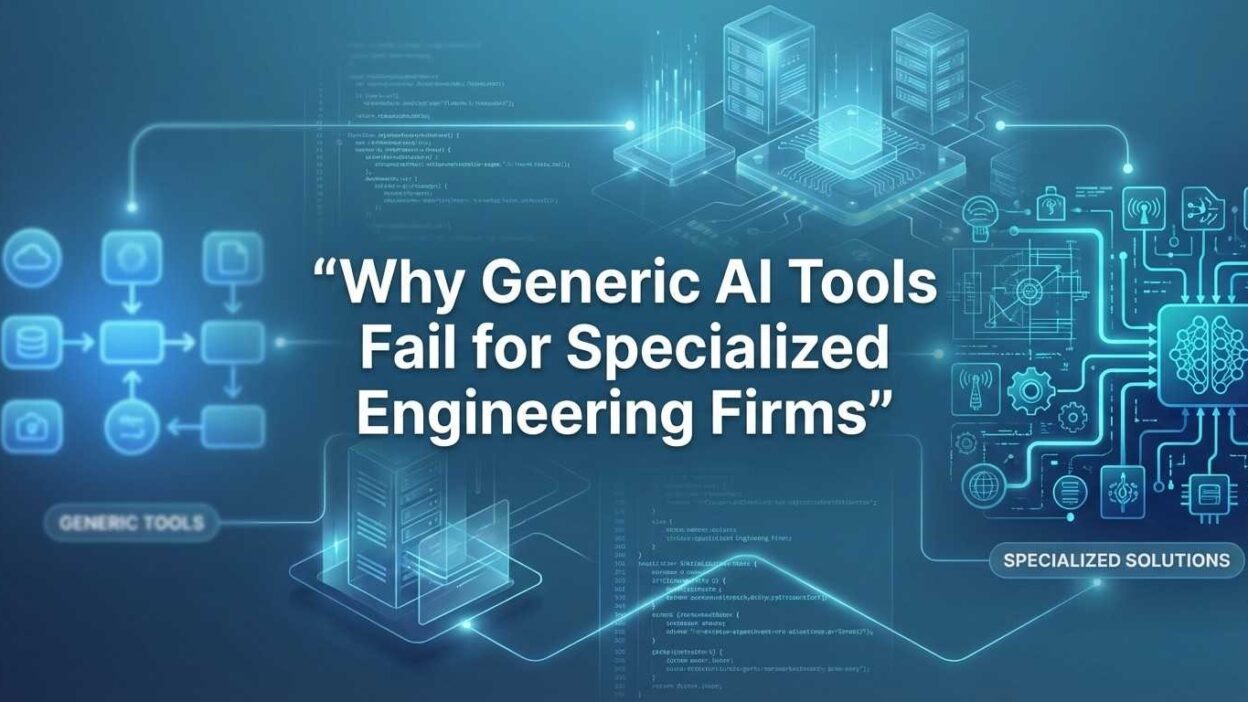
The hard truth is that generic AI tools fail for specialized engineering firms more often than vendors admit. These tools are built for broad audiences. Engineering work is never broad. It is precise, regulated, and deeply technical.
This blog breaks down the exact reasons why this failure happens. It also explains what specialized engineering firms actually need from AI.
Table of Contents
Understanding the Problem: What Makes Engineering Work Different
Engineering is not a general profession. Structural engineers calculate load tolerances. Chemical engineers model fluid dynamics. Electrical engineers design circuit compliance systems. Each discipline carries its own language, standards, and risk levels.
A generic AI tool is trained on vast data from many industries. It learns patterns across healthcare, marketing, finance, and logistics. It handles everyday tasks well. Ask it to write an email or summarize a report — it performs confidently.
Ask it to verify a seismic load calculation against ASCE 7 standards — it struggles. Ask it to generate compliant mechanical drawings for an ASME-certified component — it guesses. This is exactly where generic AI tools fail for specialized engineering firms.
The Gap Between General Intelligence and Domain Knowledge
AI models are not experts. They are pattern recognizers. A generalist model recognizes common engineering patterns but misses the specialized ones. It may output plausible-sounding answers that are technically wrong.
In engineering, a technically wrong answer is not a minor error. It can mean structural failures. It can mean regulatory violations. It can mean project shutdowns or legal liability.
This is not a small software limitation. It is a fundamental design mismatch.
5 Core Reasons Why Generic AI Tools Fail for Specialized Engineering Firms
1. No Understanding of Industry-Specific Standards
Engineering work runs on standards. Every country and discipline has its own set. ISO, ASTM, ASME, IEEE, IEC, ASCE — these are not optional guidelines. They are legal requirements. Compliance is mandatory.
Generic AI tools have limited knowledge of these standards. They may reference them by name. They rarely understand how to apply them correctly in context. Ask a generic tool to cross-check a design against IEC 61508 safety requirements. The output will look reasonable. It will miss critical details.
This is one major reason generic AI tools fail for specialized engineering firms. The tool cannot distinguish between a compliant and a non-compliant design. Engineers catch the error later. That costs time and money.
2. Inability to Handle Proprietary Engineering Data
Specialized engineering firms have unique data. CAD models, sensor outputs, simulation results, proprietary formulas — these data types require specific handling. A generic AI tool is not built for this.
It cannot read native CAD file formats without significant integration work. It cannot interpret FEA (Finite Element Analysis) results accurately. It has no ability to understand custom material databases or proprietary testing outputs.
Generic tools process text and common data formats. Engineering firms need tools that process engineering data natively.
3. Weak Performance on Technical Documentation
Engineering firms produce massive amounts of documentation. Design specifications, RFIs, submittals, inspection reports, compliance certificates — each has a specific format and technical vocabulary.
Generic AI tools write documentation that sounds professional. The technical accuracy often falls short. They use incorrect terminology. They miss required data fields. They produce outputs that engineers must rewrite from scratch.
This defeats the purpose of AI automation entirely.
4. No Memory of Project Context
An engineering project spans months or years. It involves thousands of decisions, revisions, and dependencies. Context matters enormously.
Generic AI tools lack persistent memory across sessions. Each conversation starts fresh. The tool does not remember the project scope from last week. It does not track revision history. It cannot reason about earlier design decisions in the current conversation.
Specialized engineering firms need AI that maintains project context. Generic tools simply cannot do this at a useful level.
5. Failure to Support Collaboration Between Disciplines
Large engineering projects involve multiple disciplines. Civil, mechanical, electrical, and environmental engineers work together. They share data. They review each other’s work. Decisions in one discipline affect all others.
Generic AI tools operate in isolation. They help one user at a time. They do not understand how a civil engineer’s structural change affects the HVAC design. They cannot flag interdisciplinary conflicts automatically.
This siloed behavior is another reason generic AI tools fail for specialized engineering firms. Engineering work is inherently collaborative and interdisciplinary.
The Hidden Costs of Using the Wrong AI Tool
Firms often underestimate the true cost of mismatched AI adoption. The licensing fee looks reasonable. The onboarding seems straightforward. Problems emerge weeks later.
Time Lost on Manual Corrections
Engineers spend hours correcting AI outputs. Every wrong calculation must be rechecked. Every poorly worded specification must be rewritten. The AI saves time on basic tasks but creates new work on technical ones. Net productivity often drops.
Increased Risk of Errors in Deliverables
Not every AI error gets caught before submission. Some slip through. A client receives a design document with incorrect load assumptions. An inspector finds a compliance gap in a submitted report. These errors damage a firm’s reputation.
Generic AI tools fail for specialized engineering firms in ways that carry real professional risk.
Employee Frustration and AI Skepticism
Engineers who try generic tools and fail become skeptical of all AI. Adoption resistance grows. Even when a better, specialized tool arrives later, convincing the team becomes harder. The failed experiment creates lasting damage to the firm’s AI culture.
Wasted Budget
Subscription costs, integration efforts, training sessions — these add up. A firm that invests in a generic tool and abandons it six months later has wasted real budget. That budget could have funded a specialized AI solution from the start.
What Specialized Engineering Firms Actually Need from AI
The failure of generic tools does not mean AI has no place in engineering. It means engineering firms need purpose-built AI solutions.
Domain-Trained Models
A specialized AI tool is trained on engineering data. It learns from technical manuals, standards documents, inspection reports, and design databases. It understands engineering vocabulary at a deep level. It can interpret a P&ID diagram reference or a geotechnical boring log with real accuracy.
This is fundamentally different from a general language model trying to guess engineering context.
Standards Integration
A purpose-built engineering AI embeds standards compliance into its outputs. It checks calculations against relevant codes automatically. It flags non-compliant sections in documents. It updates when new versions of standards are released.
This capability alone would eliminate one of the top reasons generic AI tools fail for specialized engineering firms.
Engineering File Format Support
Specialized tools handle CAD files, BIM data, IFC formats, and simulation outputs natively. Engineers can upload a Revit model or an AutoCAD drawing and get meaningful analysis. They do not need to convert files or manually extract data before using AI.
Project Memory and Version Control
A good engineering AI maintains context across a project’s lifetime. It tracks design revisions. It remembers stakeholder decisions. It connects current queries to earlier project data. Engineers can ask questions in natural language. The AI answers with full project context in mind.
Multi-Discipline Collaboration Features
Specialized AI platforms support team workflows. Multiple engineers from different disciplines can use the same AI system. The tool understands how different disciplines interact. It flags conflicts and dependencies across design areas. This is the collaborative intelligence engineering projects require.
Real-World Scenarios Where Generic AI Falls Short
Infrastructure Design Review
A civil engineering firm uses a generic AI tool to review bridge design documents. The tool reads the documents quickly. It summarizes key sections. It misses three load combination errors that violate AASHTO LRFD Bridge Design Specifications. The errors reach the client. The project faces delays.
A specialized AI trained on bridge engineering standards would flag those errors immediately.
Regulatory Submission for a Chemical Plant
A chemical engineering firm asks a generic AI tool to help draft a Process Hazard Analysis (PHA) report. The tool generates a document with proper formatting. It omits several required elements mandated by OSHA PSM regulations. The submission fails review. The firm restarts the process manually.
Again, generic AI tools fail for specialized engineering firms at exactly the moments when accuracy matters most.
Electrical System Documentation
An electrical engineering firm uses a generic AI to generate panel schedule documentation. The tool creates a clean spreadsheet. It uses incorrect labeling conventions that violate NEC (National Electrical Code) requirements. The project inspector rejects the submittal.
An AI built for electrical engineering would apply NEC conventions by default.
How to Evaluate AI Tools for Your Engineering Firm
Selecting the right AI tool requires a structured evaluation. Firms should not rely on vendor demos alone. Real-world testing with actual project data reveals a tool’s true capabilities.
Test with Real Engineering Data
Ask vendors for a trial period. Use actual project files. Upload real CAD drawings, actual specification documents, real compliance reports. Evaluate how the AI handles your specific data types.
Evaluate Standards Knowledge
Ask the tool direct questions about standards relevant to your discipline. Check its answers against your own expertise. A specialized tool should cite standards accurately. A generic tool will often give vague or slightly wrong responses.
Check Integration Capabilities
A useful engineering AI must integrate with tools your team already uses. Autodesk products, Bentley software, AVEVA systems, ERP platforms — the AI should fit into your existing workflow. If integration requires months of custom development, the tool is not ready.
Measure Accuracy on Technical Tasks
Run parallel tests. Have an engineer complete a task manually. Have the AI do the same task. Compare the outputs on accuracy, completeness, and compliance. The results will tell you everything you need to know.
Look for Engineering-Specific Support
Vendors who truly understand engineering will offer specialized onboarding. They will have customer success teams with engineering backgrounds. Generic software vendors will assign general IT support. The quality of post-sale support often reflects the quality of the tool itself.
The Future of AI in Specialized Engineering
AI adoption in engineering is growing. Firms that adopt the right tools early gain real competitive advantages. Faster project delivery, fewer errors, better compliance, and lower costs all follow from a well-matched AI strategy.
The engineering AI market is maturing. Purpose-built tools for civil, structural, mechanical, chemical, and electrical engineering are emerging. These tools close the gap that generic AI tools fail for specialized engineering firms to bridge.
Firms that recognized this distinction early are seeing real results. They use AI for automated drawing reviews, predictive maintenance modeling, compliance auditing, and simulation data analysis. These outcomes require specialized AI — not a general-purpose chatbot.
AI-Assisted Engineering Will Become Standard Practice
Within five years, AI-assisted design review will be as common as CAD software. Firms without AI capabilities will struggle to compete on speed and cost. The question is not whether to adopt AI. The question is which AI to adopt.
Choosing wrong is costly. Generic AI tools fail for specialized engineering firms at scale. The damage compounds over time as wrong habits form and bad data accumulates in firm workflows.
Investing in the Right Solution Now Pays Off
Early investment in specialized AI yields compounding returns. Engineers become more productive. Projects deliver faster. Clients receive more accurate work. The firm builds a reputation for precision and efficiency.
Generic tools may seem like the safer choice. They are familiar. They are marketed everywhere. They feel low-risk. The actual risk is higher because of the specific ways generic AI tools fail for specialized engineering firms.
Frequently Asked Questions
Can generic AI tools work for some engineering tasks?
Yes. Generic tools handle administrative tasks reasonably well. Writing client emails, summarizing meeting notes, drafting procurement requests — these are suitable use cases. The problems begin when firms apply generic tools to technical engineering work. That is where accuracy and compliance gaps appear.
What industries face the biggest challenges with generic AI?
Structural engineering, chemical processing, aerospace, nuclear power, and electrical systems face the highest risk from generic AI use. These industries have strict regulatory requirements and zero tolerance for error. Generic tools do not meet the bar.
How much does a specialized engineering AI cost compared to generic tools?
Specialized tools typically cost more upfront. They cost far less in the long run. The savings come from fewer errors, faster compliance, reduced rework, and lower liability exposure. Total cost of ownership favors specialized tools significantly.
Are there AI tools designed specifically for structural engineering?
Yes. Several platforms now focus specifically on structural, civil, and mechanical engineering. Some integrate directly with Autodesk Revit or Bentley STAAD. Firms should evaluate these against their specific workflow requirements.
How do I get my engineering team to adopt AI tools successfully?
Start with a small pilot on a real project. Choose a tool built for your discipline. Involve experienced engineers in the evaluation. Show measurable results before a full rollout. Adoption improves dramatically when engineers see real value in their daily work.
What is the biggest mistake firms make when adopting AI?
The biggest mistake is choosing based on brand recognition or low price. Many firms pick popular generic tools without testing them on real engineering tasks. This is the primary reason generic AI tools fail for specialized engineering firms. The mismatch between tool capability and firm needs is clear from day one — but firms often ignore it.
Read More:-Fine-tuning vs RAG: Which One Is Right for Your Specific Use Case?
Conclusion
Engineering is one of the most demanding professional fields in the world. It requires precision, compliance, and deep domain knowledge. Generic AI tools are designed for none of these things specifically.
This is why generic AI tools fail for specialized engineering firms at a fundamental level. The gap is not a technical glitch. It is a design mismatch. General tools serve general needs. Engineering needs are specific, regulated, and high-stakes.
Firms that invest in purpose-built engineering AI gain a real advantage. They reduce errors. They improve compliance. They complete projects faster. They protect their professional reputation.
The AI revolution in engineering is real. Firms that navigate it well will choose specialized tools matched to their discipline. Firms that default to generic platforms will keep experiencing the same failures. The choice defines the trajectory of the firm.
Now is the time to evaluate your current AI stack honestly. Ask whether your tools were designed for engineering work. If the answer is no, the cost of staying with the wrong tool will only grow.