Introduction
TL;DR Every AI team hits the same wall. The base model is smart. It answers questions well. But it does not know your product. It does not know your company’s data. It does not reflect your brand voice. You need more. That is when the debate around fine-tuning vs RAG begins.
Both approaches improve AI performance. Both have real value. Yet they solve very different problems. Picking the wrong one wastes time, money, and engineering effort. This blog breaks down each method clearly. You will see exactly when to use one over the other.
Table of Contents
What Is Fine-Tuning?
Fine-tuning means retraining a pre-trained language model on your own dataset. The base model already knows language. Fine-tuning teaches it your specific domain, tone, or task. You feed it labeled examples. The model updates its internal weights. After training, the model behaves differently. It mirrors the patterns in your data.
Think of it like hiring an expert. The expert already has general knowledge. You train them further on your company’s processes. After that, they respond the way your business needs.
How Fine-Tuning Works Under the Hood
You start with a base model like GPT, LLaMA, or Mistral. You prepare a dataset of input-output pairs. These pairs teach the model your use case. The training process runs gradient descent. It adjusts weights to minimize prediction errors. After several training epochs, you get a customized model. That model is baked with your knowledge.
Fine-tuning is powerful for changing model behavior. It helps with tone, style, and structured output formats. Legal firms use it for formal writing. Gaming companies use it for character dialogue. Customer service teams use it to match brand voice.
Common Fine-Tuning Techniques
Full fine-tuning updates every parameter in the model. It is thorough but expensive. LoRA (Low-Rank Adaptation) is a lighter approach. It updates a small subset of parameters. This cuts cost dramatically. QLoRA goes even further. It uses quantization to reduce memory usage. Most teams today use LoRA or QLoRA. They deliver strong results without massive compute budgets.
What Is RAG?
RAG stands for Retrieval-Augmented Generation. It does not change the model’s weights. Instead, it gives the model access to external documents at query time. When a user asks a question, the system retrieves relevant chunks from a knowledge base. Those chunks go into the model’s prompt. The model generates an answer based on that context.
In the fine-tuning vs RAG debate, RAG wins on flexibility. You can update the knowledge base anytime. No retraining needed. Just add or edit documents. The model pulls fresh information on every query.
The RAG Pipeline Explained
A RAG pipeline has three core stages. First, documents get chunked and embedded. An embedding model converts text into vectors. These vectors go into a vector database like Pinecone, Weaviate, or Chroma. Second, when a user asks a question, the system embeds that question too. It searches the vector database for the most similar chunks. Third, those retrieved chunks attach to the prompt. The language model reads them and generates a grounded response.
This approach keeps the model’s knowledge current. It also improves factual accuracy. The model cites real documents instead of relying on memorized weights.
Types of RAG Systems
Naive RAG just retrieves and prompts. It works for simple use cases. Advanced RAG adds query rewriting, re-ranking, and hybrid search. Modular RAG breaks the pipeline into swappable components. Agentic RAG uses reasoning loops. The agent decides what to retrieve and when. Most enterprise teams start with advanced RAG. They graduate to modular or agentic setups as complexity grows.
Fine-tuning vs RAG: Core Differences at a Glance
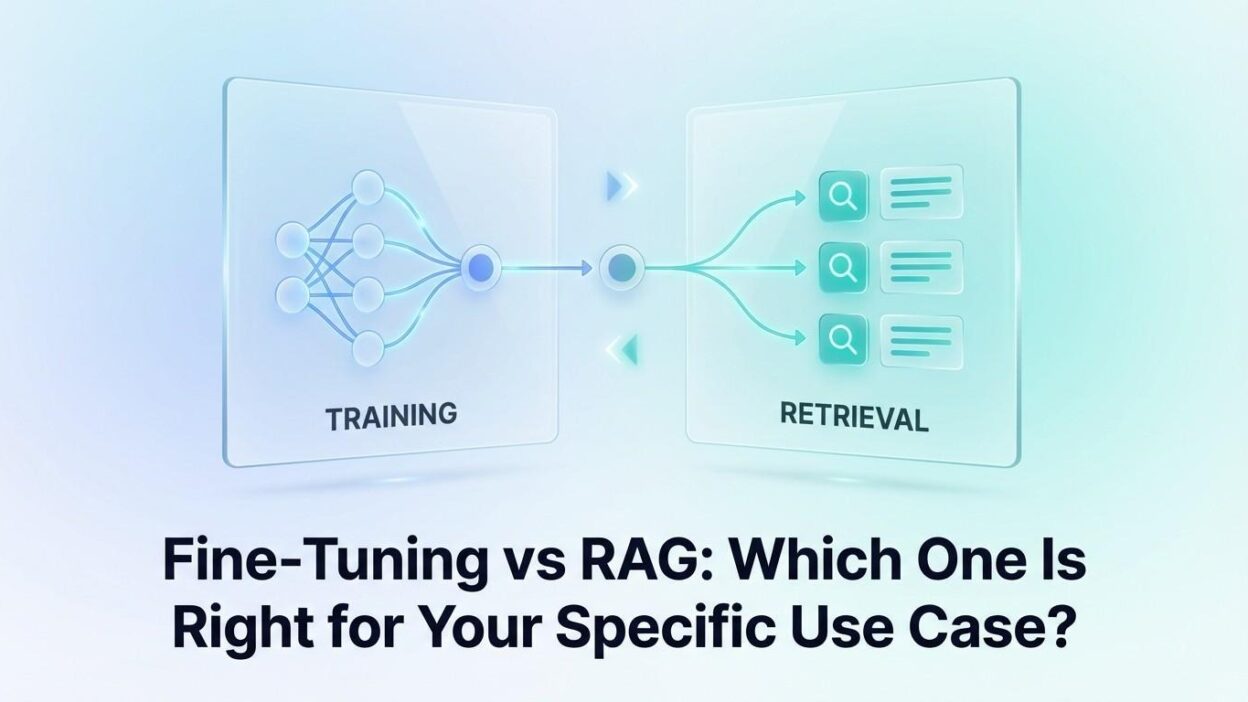
Understanding fine-tuning vs RAG starts with their fundamental design philosophy. Fine-tuning changes what the model knows inside its weights. RAG changes what the model sees at inference time. One is about permanent memory. The other is about dynamic context.
Fine-tuning requires a good dataset upfront. RAG requires a good retrieval system upfront. Fine-tuning is slower to update. RAG updates instantly. Fine-tuning is better for behavior and style changes. RAG is better for factual, document-grounded answers.
Cost is a key difference too. Fine-tuning has a high upfront compute cost. RAG has higher per-query infrastructure costs. Latency also differs. Fine-tuned models respond faster. RAG adds retrieval latency to every query. Teams must weigh these factors carefully when exploring fine-tuning vs RAG for their needs.
When to Choose Fine-Tuning
Fine-tuning shines in specific situations. Know these situations well. They will save you from expensive mistakes.
You Need Consistent Tone and Style
Brand voice matters for customer-facing AI. A general-purpose model sounds generic. A fine-tuned model sounds like your brand. You can train it on marketing copy, support scripts, or editorial guidelines. The model internalizes those patterns. Every response reflects your unique style. RAG cannot do this. Retrieval adds context. It does not change how the model writes.
You Need Specific Output Formats
Structured outputs are easier with fine-tuning. Suppose you need the model to always return JSON with specific fields. Fine-tuning enforces that pattern reliably. You train on hundreds of input-output examples. The model learns to follow the format every time. Prompt engineering alone often fails here. Fine-tuning makes output formatting predictable.
Your Data Is Stable and Curated
Fine-tuning requires high-quality labeled data. If your knowledge changes rarely, fine-tuning is a good fit. Medical coding, legal classification, and financial risk models are good examples. The rules change slowly. The training data stays relevant for months or years. RAG would add unnecessary infrastructure for these cases.
You Need Low Latency at Scale
RAG adds retrieval time to every request. At high query volumes, that latency accumulates. A fine-tuned model responds without external lookups. It is faster per query. Real-time applications like live customer chat benefit from fine-tuning. Speed matters more than up-to-date knowledge in many of these contexts.
When to Choose RAG
RAG is the right call in many enterprise AI scenarios. It excels where knowledge changes fast or accuracy is non-negotiable. In the fine-tuning vs RAG comparison, RAG wins when your data evolves frequently.
Your Knowledge Base Changes Frequently
Product documentation updates weekly. Company policies shift quarterly. News and research arrive daily. Fine-tuning cannot keep pace with this. You would retrain constantly. That is expensive. RAG lets you update your vector database instead. Push a new document. The model reflects it immediately. No retraining. No downtime. This makes RAG ideal for dynamic knowledge environments.
You Need Source Attribution
Regulated industries require citations. Legal, healthcare, and finance teams must show their sources. RAG makes this easy. The system retrieves specific document chunks. You can display those chunks alongside the AI response. Users see exactly where the answer came from. Fine-tuned models cannot do this. Their knowledge is baked in. There is no traceable source to show.
You Have a Large, Varied Document Library
Some knowledge bases have thousands of documents. Fine-tuning cannot absorb all of them reliably. The model’s context window has limits. Training on too much diverse data causes knowledge bleed. RAG handles large corpora naturally. It indexes everything in a vector database. It retrieves only what is relevant per query. Scale is not a problem.
You Want to Reduce Hallucinations
Hallucination is a serious problem in enterprise AI. Fine-tuned models still hallucinate. They might confidently state something wrong. RAG grounds the model in retrieved text. The model reads actual documents before answering. This cuts hallucination rates significantly. You anchor the model to real, verified content. That matters most in high-stakes use cases.
Combining Fine-Tuning and RAG: The Best of Both Worlds
Many mature AI systems use both together. This is often the smartest architecture. Fine-tuning handles behavior, tone, and format. RAG handles factual grounding and freshness. The fine-tuned model knows how to write. RAG tells it what to write about.
A customer support bot is a perfect example. Fine-tuning shapes the empathetic, on-brand tone. RAG pulls the latest product specs, FAQs, and policy documents. The user gets a response that sounds right and contains accurate facts. Neither approach alone delivers that experience.
The combined approach takes more engineering effort. You need a good training pipeline. You also need a robust retrieval infrastructure. But the results justify the investment for complex, production-grade AI products. Teams exploring fine-tuning vs RAG often land here after iterating.
Start simple. Build a baseline RAG system first. Evaluate its outputs. Identify where style or format falls short. Then fine-tune on those gaps. This iterative path avoids premature complexity.
Key Factors That Should Drive Your Decision
Several factors shape the right choice in the fine-tuning vs RAG decision. These factors go beyond technical capability. They include your team’s resources, your product goals, and your data situation.
Data Availability and Quality
Fine-tuning demands labeled, curated data. Collecting and cleaning this data takes real time. If your data is messy or sparse, fine-tuning will hurt more than help. RAG has lower data quality demands. Documents do not need labels. You just need them to be accurate and relevant. Teams with limited data budgets often find RAG more accessible to start.
Team Expertise and Infrastructure
Fine-tuning needs ML engineers who understand training loops, evaluation metrics, and deployment pipelines. RAG needs engineers skilled in vector databases, embedding models, and search systems. Neither is plug-and-play. Know what your team can build and maintain. Choose the approach that matches your current skillset.
Budget and Compute Costs
Fine-tuning a large model on cloud GPUs costs thousands of dollars per run. Small models with LoRA are cheaper. RAG costs scale with query volume and embedding costs. Evaluate both total cost of ownership and ongoing operational costs. Budget-constrained teams often start with RAG. Fine-tuning becomes viable as the product scales.
Risk Tolerance and Accuracy Requirements
High-stakes use cases demand accuracy. Healthcare diagnostics, legal research, and financial compliance leave no room for errors. RAG reduces risk through grounded responses. The model cites real documents. Errors are traceable. Fine-tuned models are harder to audit. Choose RAG when explainability and accuracy are non-negotiable.
Real-World Examples of Fine-Tuning vs RAG in Action
Real examples make the fine-tuning vs RAG choice concrete. Here are scenarios where each approach clearly wins.
Fine-Tuning in Practice
A healthcare startup built a clinical note generator. Doctors spoke into a microphone. The AI wrote structured clinical notes. They fine-tuned a base model on thousands of doctor-written notes. The model learned medical terminology, formatting conventions, and documentation style. The result was accurate, fast, and matched clinical standards. RAG would not have worked here. Style consistency was the goal. Document retrieval was irrelevant.
A SaaS company fine-tuned a model to classify customer support tickets. They trained it on thousands of past tickets with labels. The model learned their specific taxonomy. It routed tickets faster and more accurately than prompt engineering alone.
RAG in Practice
A law firm built an AI research assistant. It indexed thousands of case files, statutes, and internal memos. Lawyers asked questions in plain English. The RAG system retrieved relevant legal passages. The model synthesized a grounded answer with citations. Lawyers trusted the output because they could verify the sources. Fine-tuning would not have solved this. The knowledge base was too large and too dynamic.
An e-commerce company used RAG for product recommendations and FAQ responses. Their catalog changed weekly. New products, discontinued items, updated specs. RAG kept the assistant current without any retraining cycles.
FAQs: Fine-Tuning vs RAG
Is RAG better than fine-tuning for most use cases?
RAG is a better starting point for most teams. It is faster to implement. It does not require a labeled dataset. It keeps knowledge fresh without retraining. Fine-tuning becomes worth the effort when style, behavior, or structured output quality matters deeply. For most enterprise use cases, start with RAG. Add fine-tuning when you hit clear limitations.
Does fine-tuning eliminate the need for RAG?
No. Fine-tuning teaches the model a style or behavior. It does not give it access to new facts after training. If you fine-tune today, the model does not know what happens tomorrow. RAG solves this by retrieving current documents at query time. The two methods address different problems. They work best together in production systems.
How much data do I need for fine-tuning?
It depends on the task. Simple classification tasks can work with a few hundred examples. Complex generation tasks often need thousands. Quality matters more than quantity. A hundred clean, well-labeled examples often beat ten thousand noisy ones. Work with domain experts to curate your training data carefully.
Can RAG work without any fine-tuning?
Yes. Many production RAG systems use base models with zero fine-tuning. Strong prompt engineering and a well-structured knowledge base cover most needs. Fine-tuning is optional. Add it when you need specific tone, behavior, or output formats that prompting alone cannot deliver.
Which approach reduces AI hallucinations more?
RAG reduces hallucinations more reliably. It grounds the model in retrieved documents. The model reads real content before generating a response. Fine-tuned models can still hallucinate confidently. Their knowledge is internal and harder to verify. For accuracy-critical applications, RAG is the safer choice.
Read More:- Building a Multi-Modal AI Agent for Automated Video Content Analysis
Conclusion

The fine-tuning vs RAG decision is not about which method is superior. It is about which method fits your problem. Both are powerful. Both have clear strengths and limitations. Choosing well requires honest answers to a few key questions.
Does your knowledge change often? RAG is your answer. Do you need a consistent brand voice or structured output? Fine-tuning is your answer. Do you need both? Build a combined system. Start with the simpler approach. Evaluate carefully. Scale with purpose.
The AI landscape moves fast. New techniques emerge constantly. But the core principles stay stable. RAG excels at dynamic, factual, document-grounded tasks. Fine-tuning excels at behavior, style, and task-specific optimization. Master both. Know when to use each.
Teams that understand fine-tuning vs RAG deeply ship better AI products. They avoid wasted compute. They build systems users actually trust. That is the real competitive advantage in enterprise AI today. Make a deliberate choice. Build with clarity. Iterate with data.