Introduction
TL;DR Legacy systems are not going away anytime soon. Many enterprises still run critical business logic on COBOL mainframes or aging Java codebases. These systems work. They are stable. But they are expensive to maintain. Finding skilled COBOL developers is harder every year. Java code from the early 2000s lacks modern architecture. The cost of doing nothing keeps rising.
Many CTOs and engineering leaders want to migrate legacy COBOL or Java code using AI but are unsure where to start. This blog gives you a clear, practical roadmap. It covers what AI-assisted refactoring really means. It explains the tools available. It walks through the process step by step. It also highlights the risks and how to manage them.
Whether you run a bank, an insurance company, or a government agency, this guide applies directly to your situation. Let us get into it.
Table of Contents
Why Legacy Code Is a Growing Business Problem
COBOL has been around since 1959. Millions of lines of COBOL still process banking transactions every single day. Java enterprise applications from the late 1990s run insurance claim systems across the globe. These are not small codebases. They are massive. Some contain tens of millions of lines of code.
The average age of a COBOL programmer is over 55. Retirements are accelerating. New graduates do not learn COBOL. Hiring becomes a crisis over time. Java systems face a different but equally serious problem. Old Java architectures use monolithic designs. They are hard to scale. They resist modern DevOps practices. Deploying a change takes weeks, not hours.
Business agility suffers. Competitors using modern stacks ship faster. The gap widens every quarter. That is why the decision to migrate legacy COBOL or Java code using AI is gaining serious traction across industries.
The Real Cost of Inaction
Keeping legacy systems alive costs money. Licensing fees for mainframes are steep. Specialized consultants charge premium rates. Every time a developer retires, institutional knowledge walks out the door. Recovering that knowledge later is expensive and often incomplete.
Security vulnerabilities accumulate in unmaintained code. Compliance requirements evolve. Legacy systems struggle to keep up. Regulatory fines become a real risk. Adding new features becomes harder each year. The code becomes more brittle. Integration with modern APIs is painful and error-prone.
The business case for modernization is strong. The question is how to do it without disrupting operations.
What AI-Assisted Refactoring Actually Means
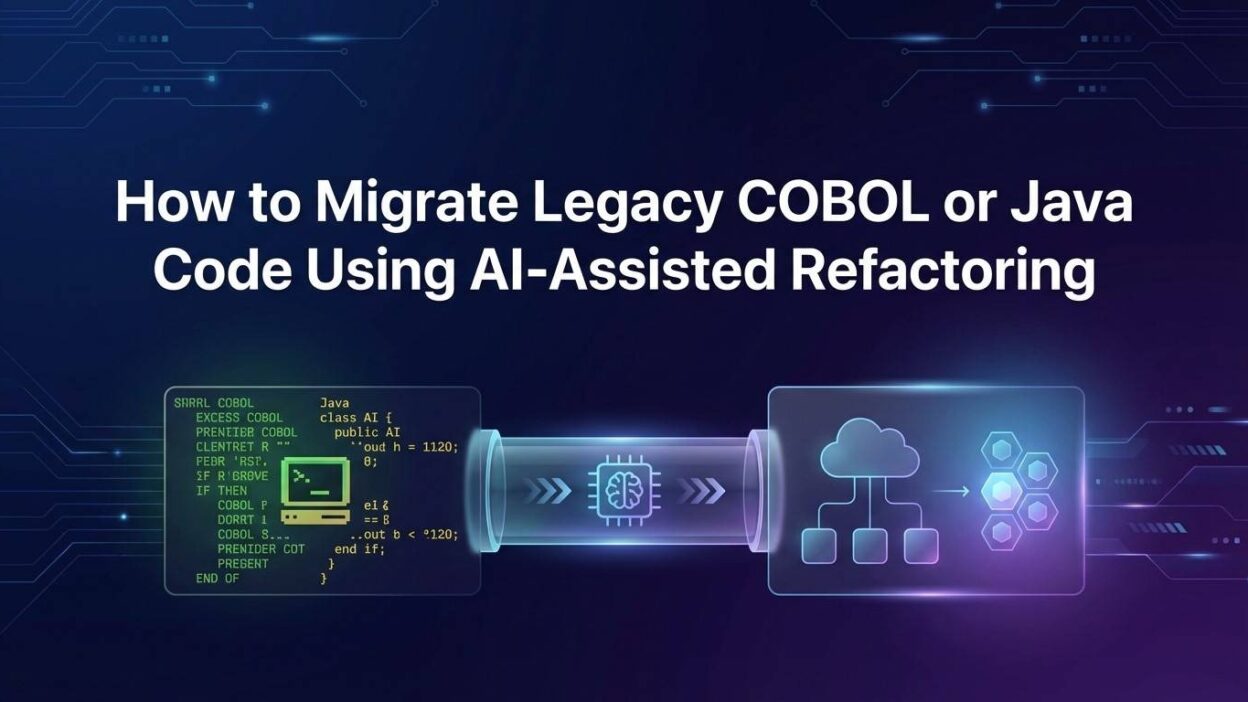
AI-assisted refactoring is not magic. It does not replace human engineers. It augments them. AI tools analyze existing source code. They understand its structure, logic, and dependencies. They generate equivalent code in a modern language or framework. They flag areas that need human review.
The goal is to preserve business logic exactly. A payroll calculation in COBOL must produce the same result in Java or Python. An interest computation algorithm must remain mathematically identical. AI tools help ensure that equivalence during the migration process.
When teams choose to migrate legacy COBOL or Java code using AI, they rely on large language models trained on millions of code samples. These models understand COBOL syntax, data division structures, and procedure divisions. They understand Java class hierarchies, design patterns, and framework conventions. They bridge the gap between old and new.
Types of AI Refactoring Approaches
There are several approaches worth knowing. Rule-based translation uses predefined mapping rules between languages. It works for simple code but struggles with complex logic. Statistical models analyze patterns in code and suggest translations. They handle more variation but need human validation. Large language model (LLM) approaches use modern AI like GPT-4 or purpose-built tools. They understand context, not just syntax. They produce more readable, maintainable output.
Hybrid approaches combine rule-based systems with LLMs. They use rules for boilerplate code and AI for complex business logic. Most enterprise-grade tools today use hybrid approaches. They produce better results than either method alone.
Tools You Can Use to Migrate Legacy Code
Many companies now offer platforms designed to help you migrate legacy COBOL or Java code using AI. Understanding your options helps you choose the right fit for your organization.
Amazon Web Services (AWS) Mainframe Modernization
AWS offers a managed mainframe modernization service. It supports automated refactoring of COBOL code to Java. It also offers replatforming to run COBOL workloads on managed infrastructure. The service integrates with AWS developer tools. It supports continuous integration pipelines. Testing environments mirror production behavior. Organizations get a path to cloud without a full rewrite from day one.
IBM watsonx Code Assistant
IBM built watsonx Code Assistant specifically for COBOL modernization. It uses a purpose-trained AI model. It converts COBOL code to Java with contextual understanding. It generates explanation documents alongside the translated code. Developers can review the logic before deploying it. IBM designed this tool with enterprise compliance in mind. It works within regulated industries like banking and healthcare.
GitHub Copilot and Custom LLM Pipelines
GitHub Copilot helps developers refactor Java code more efficiently. It suggests modern patterns as developers work. It identifies outdated APIs and recommends replacements. Some organizations build custom pipelines using OpenAI or Anthropic APIs. They feed COBOL or Java source files into LLMs. They receive translated code as output. This approach requires engineering investment but offers maximum flexibility.
Micro Focus and COBOL-to-Java Vendors
Micro Focus offers tools that modernize COBOL applications. Their Visual COBOL product lets teams run COBOL on modern platforms. Their Enterprise Server product extends COBOL to cloud environments. Several boutique vendors specialize in migration services. They combine AI tooling with human expert review. They offer fixed-price or outcome-based contracts for migration projects.
Process to Migrate Legacy COBOL or Java Code Using AI
A structured process reduces risk. It prevents surprises. Here is a practical framework that organizations use when they migrate legacy COBOL or Java code using AI.
Discovery and Codebase Assessment
Start with a full inventory of the codebase. Identify every program, copybook, JCL script, and stored procedure. Map dependencies between modules. Understand data flows. Identify dead code. Catalog business rules embedded in procedures.
AI tools can automate much of this analysis. They parse source files. They build dependency graphs. They identify code complexity scores. They flag high-risk modules that require extra attention. Discovery typically takes two to six weeks for large codebases. Do not skip this phase. It determines every decision that follows.
Define the Target Architecture
Decide where you are going before you start moving. Choose the target language and framework. Java 17 with Spring Boot is common for COBOL migrations. Python with Django or FastAPI suits data-heavy workflows. Cloud-native microservices architecture is a frequent destination for Java monolith migrations.
Define your infrastructure strategy. Will you run on AWS, Azure, or Google Cloud? Will you containerize workloads with Docker and Kubernetes? Architecture decisions made here affect everything. Make them deliberately. Involve both engineering and business stakeholders.
Set Up Test Coverage First
Testing is the safety net of any migration. You need tests before you move a single line of code. Capture the behavior of existing COBOL or Java programs. Record input and output pairs for every major business function. Use these as regression tests during migration.
AI tools can help generate test cases. Feed the old code to an AI assistant. Ask it to produce unit tests based on existing logic. Supplement with manually created edge case tests. The goal is a test suite that you trust completely. Every migrated module must pass these tests before moving forward.
Run AI-Assisted Translation
Now run the AI translation tool against your codebase. Start with simpler, lower-risk modules. Build confidence in the process before tackling complex programs. Review the AI output carefully. AI does not always get it right the first time.
Common issues include incorrect data type mappings, missed edge cases in conditional logic, and misinterpreted COBOL PERFORM loops. Human developers must review every module. Use the AI output as a strong starting draft, not a finished product. The productivity gain is real even with review overhead.
Validate and Test Rigorously
Run all regression tests against the migrated code. Compare outputs with the original system side by side. Use shadow mode deployment where both old and new systems run in parallel. Compare results in real time. Any discrepancy triggers investigation and fix.
Performance testing is equally important. Legacy COBOL often processes millions of records in batch jobs. Verify that modern equivalents match or exceed that throughput. Optimize as needed. Do not go live until performance benchmarks pass.
Incremental Cutover
Never attempt a big-bang cutover. Move one module or service at a time. Route a small percentage of traffic to the new system first. Monitor closely. Expand gradually as confidence grows. Keep the legacy system running as a fallback. Only decommission it after the new system proves stable under production load.
Feature flags and API gateway routing help manage this process. They let you control which users hit which system. They make rollback instant if a problem appears.
Common Challenges When You Migrate Legacy COBOL or Java Code Using AI
Every migration hits obstacles. Knowing them in advance helps you prepare.
Undocumented Business Logic
Legacy COBOL programs often contain business rules that no one documented. The original developer retired twenty years ago. The code is the only documentation. AI tools can extract logic from code. But they cannot always explain why a particular rule exists. Subject matter experts must validate the output. Find employees who remember the business context. Their knowledge is priceless during migration.
Data Format and Encoding Issues
COBOL uses EBCDIC encoding. Modern systems use UTF-8. Packed decimal fields in COBOL have no direct equivalent in Java or Python. Date formats differ. Numeric precision handling varies. These data-level mismatches cause subtle bugs that are hard to detect without thorough testing. AI tools are improving at handling these nuances. But human data engineers must verify every conversion.
Tightly Coupled Systems
Many legacy systems share files, databases, and batch jobs with other systems. Changing one affects others. The dependency map is rarely complete. AI discovery tools help build a more accurate picture. Use interface contracts to isolate changes. Define API boundaries early. Treat every integration point as a risk that needs a test.
Organizational Resistance
People resist change. COBOL experts feel threatened by AI-assisted migration. Java developers may resist modern architecture mandates. Leadership may underestimate the time and cost involved. Successful migrations require strong executive sponsorship. Communication must be consistent and transparent. Training programs help developers adapt to new tools and languages. Change management is as important as the technical work.
Key Concepts in Legacy Code Modernization
Organizations exploring how to migrate legacy COBOL or Java code using AI encounter several related concepts. Understanding them helps in planning and vendor evaluation.
Rehost vs Refactor vs Rearchitect
Rehosting moves the application to new infrastructure without changing code. Refactoring improves code structure while preserving behavior. Rearchitecting redesigns the system for a new target architecture. Most AI-assisted projects focus on refactoring with elements of rearchitecting. Rehosting is a temporary solution. It defers the real modernization problem.
Strangler Fig Pattern
The strangler fig pattern is a proven approach for incremental migration. New functionality goes into the modern system. Old functionality stays in the legacy system. Over time, the modern system grows. The legacy system shrinks. Eventually, the legacy system is fully replaced. This approach reduces risk. Operations never stop. The business continues running throughout the migration.
Technical Debt and Code Quality Metrics
Technical debt refers to the accumulated cost of shortcuts and poor decisions in existing code. AI tools measure technical debt using code quality metrics. Cyclomatic complexity scores reveal how hard code is to test. Coupling metrics show how tightly modules depend on each other. These metrics guide prioritization. Fix the highest-debt modules first for maximum impact.
Frequently Asked Questions
How long does it take to migrate legacy COBOL or Java code using AI?
Timeline depends on codebase size and complexity. Small systems with fewer than 500,000 lines of code may complete migration in six to twelve months. Large mainframe environments with tens of millions of lines can take three to five years. AI tools accelerate the translation phase significantly. But testing, validation, and organizational change take time regardless of tooling.
Is AI-assisted refactoring accurate enough for production systems?
AI translation accuracy has improved dramatically. Modern tools handle standard COBOL constructs with high accuracy. Complex business logic still requires human review. The right answer is not to trust AI output blindly. The right answer is to use AI to accelerate the work and rely on testing to verify correctness. With strong test coverage, you can confidently deploy migrated code.
What languages can COBOL be migrated to?
Java is the most common target language for COBOL migration. Java has strong enterprise support, mature frameworks, and a large talent pool. Python is chosen for data-intensive workloads. C# is used in Microsoft-centric environments. Some organizations migrate to modern COBOL running on Linux instead of a full language change. The choice depends on your team’s skills and your infrastructure strategy.
How much does it cost to migrate legacy COBOL or Java code using AI?
Costs vary widely. A midsize COBOL migration might run two to ten million dollars. Large enterprise mainframe modernizations can exceed fifty million dollars. AI tooling reduces labor costs compared to fully manual migration. But testing, project management, training, and infrastructure costs remain significant. Always build a full business case that includes ongoing savings from reduced mainframe costs and faster feature delivery.
Can AI handle all types of COBOL code?
AI handles standard COBOL well. Vendor-specific extensions, self-modifying code, and highly optimized batch programs pose greater challenges. CICS and IMS transaction code requires specialized handling. Some programs will need significant manual work even with AI assistance. The discovery phase identifies these difficult areas early. Plan extra time and budget for complex modules.
What skills do we need internally to support the migration?
You need COBOL experts who understand existing business logic. You need modern language developers to review and refine AI output. You need DevOps engineers to build the testing and deployment pipeline. You need a project manager who understands both business and technology. You need business analysts to validate that migrated systems produce correct outputs. This is a cross-functional effort. No single team can do it alone.
Measuring Success After Migration
Migration success is measurable. Define your metrics before the project starts. Track them throughout.
Deployment frequency is a key indicator. Modern systems deploy changes weekly or daily. Legacy systems deploy monthly or quarterly. Faster deployment means faster feature delivery. Lead time for change measures how quickly a code change reaches production. Mean time to recovery measures how fast you fix incidents. Error rates in production show whether code quality improved.
Infrastructure cost reduction is often significant. Cloud compute is cheaper than mainframe MIPS. Measure the cost per transaction before and after migration. Developer productivity improves in modern environments. Measure how many story points teams deliver per sprint after migration versus before.
Talent retention is harder to measure but equally important. Developers want to work with modern tools. Modernized systems attract stronger engineering talent. That compounds the business value of the migration over time.
The Future of AI in Legacy Modernization
AI capabilities are advancing rapidly. Today’s tools are impressive. Tomorrow’s will be more powerful. AI models are being trained on increasingly large code corpora. They get better at understanding domain-specific logic. They improve at handling edge cases in legacy code.
Agentic AI systems are emerging. They do not just translate code. They plan the migration, write tests, execute refactoring steps, validate outputs, and report progress. These systems reduce the human effort required further. They make it more feasible to migrate legacy COBOL or Java code using AI even for organizations with limited engineering resources.
The combination of AI translation, automated testing, and continuous deployment pipelines creates a powerful modernization engine. Organizations that invest in this capability now will maintain a structural competitive advantage. Those that wait will find the gap harder to close each passing year.
Read More:-Creating a DevOps Agent to Monitor Logs and Suggest Fixes
Conclusion

Legacy code modernization is one of the most important technology challenges facing established organizations today. The option to migrate legacy COBOL or Java code using AI has moved from experimental to production-ready. The tools exist. The methodologies are proven. The business case is clear.
Success requires discipline. Start with a thorough discovery phase. Define your target architecture clearly. Build test coverage before touching a line of code. Use AI to accelerate translation. Trust humans to validate the output. Cut over incrementally. Measure everything.
The organizations that move forward thoughtfully will reduce costs, improve agility, and attract better talent. They will ship features faster. They will respond to market changes more quickly. They will leave competitors running on aging mainframes further behind each year.
The time to start is now. Pick a low-risk module. Run the AI tools. See what comes out. Build confidence in the process. Then expand. Your future engineering team will thank your leadership team for making this investment today.