Introduction
TL;DR Machines now write code. They screen job applications. They approve loans. They flag medical images. AI moves faster than any human team. Speed is the promise. But speed without oversight is a gamble. That is the core tension at the heart of the ethics of AI automation.
Businesses rush to automate. They cut costs and grow faster. Many forget to ask a critical question. Who is responsible when the machine gets it wrong? This blog answers that question. It explores why human oversight matters more than ever. It lays out how to build AI workflows that stay ethical, accountable, and effective.
Table of Contents
Why the Ethics of AI Automation Demand Our Attention Now
AI adoption is not slowing down. It is accelerating. Companies in every sector deploy automation at scale. Healthcare teams use AI for diagnostics. Banks use it for fraud detection. Retailers use it for pricing and inventory. Governments use it for benefits eligibility decisions. Each deployment raises real ethical stakes.
The ethics of AI automation matter because these systems affect real people. A loan denied by an algorithm changes someone’s life. A resume filtered out by AI kills a job seeker’s chance before a human ever reads it. A medical scan misread by a model delays treatment. The consequences are serious.
Bias is one central problem. AI systems learn from historical data. Historical data reflects past human biases. The model trains on that data and inherits those biases. It then scales those biases across millions of decisions. What took human prejudice decades to cause, an AI system replicates in seconds.
Accountability is another problem. When a human makes a bad call, there is someone to question. When an algorithm makes a bad call, organizations often struggle to explain it. Black-box models offer no trail. No one can point to a reason. That opacity conflicts with basic standards of fairness.
Speed amplifies every risk. AI processes thousands of decisions per minute. A flawed model causes damage at machine speed. Human reviewers cannot catch errors they never see. This is precisely why embedding human oversight into AI workflows is not optional. It is an ethical requirement.
What Is a Human-in-the-Loop Workflow?
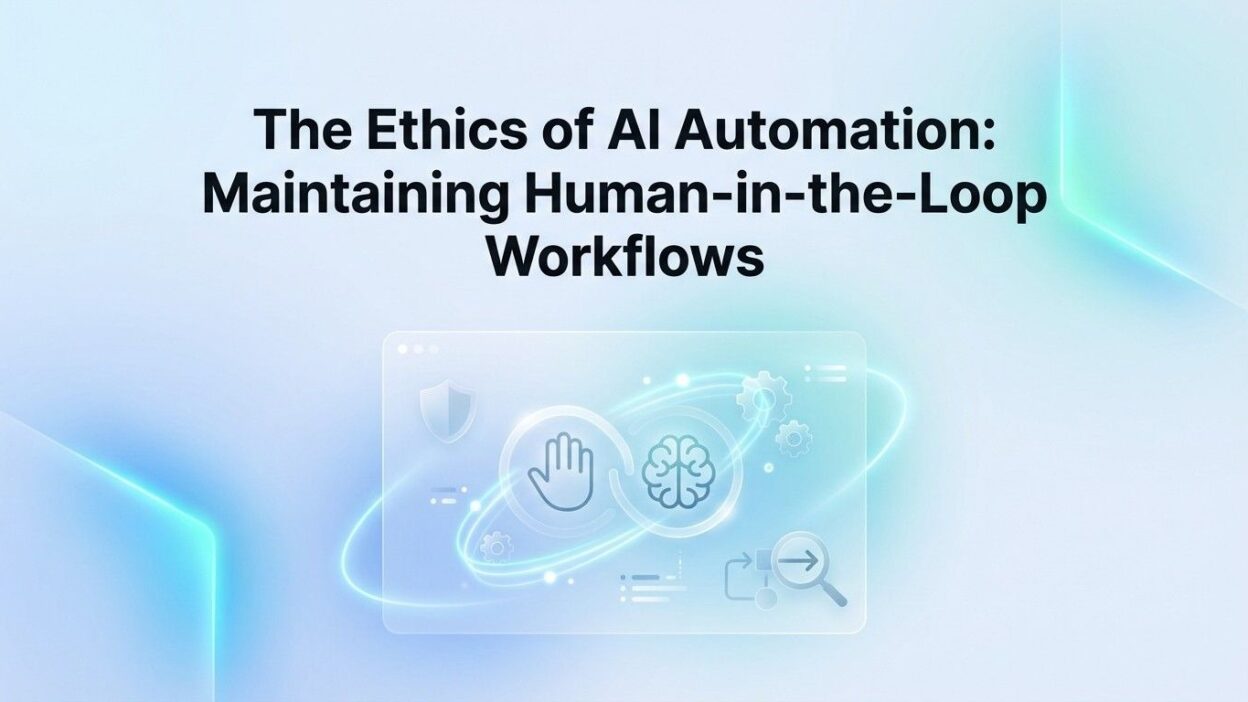
A human-in-the-loop workflow keeps a person involved in AI decision-making. The AI does not act alone. A human reviews, approves, or overrides the system at key points. The level of involvement varies. Some workflows require human sign-off on every output. Others only flag edge cases for review.
Three models define the spectrum of human involvement. The first is human-in-the-loop. A human participates at each decision step. The AI assists. The human decides. The second is human-on-the-loop. The AI acts automatically. A human monitors and can intervene. The third is human-out-of-the-loop. The AI acts fully autonomously. No human checks the output.
The ethics of AI automation demand that most high-stakes systems stay in the first or second category. Full autonomy belongs only in contexts where errors carry minimal consequences. Sorting spam emails is fine for autonomous AI. Denying someone health coverage is not.
Why Human Oversight Is Not a Bottleneck
Many engineers argue that human review slows things down. They frame oversight as friction. This framing is wrong. Human review is a quality checkpoint. It catches model errors before they compound. It builds user trust. It creates audit trails. Well-designed human-in-the-loop systems are efficient. They route only ambiguous or high-risk decisions to human reviewers. Clear, low-risk decisions move fast. Complex ones get the attention they deserve.
Designing the Right Intervention Points
Not every step needs a human. Good design identifies the moments where human judgment adds the most value. Pre-decision review works well for high-stakes outputs. Post-decision audit works well for large-volume, lower-stakes workflows. Exception-based review works well when the model flags uncertainty. Map your workflow carefully. Place humans where their judgment genuinely changes outcomes.
Core Ethical Principles That Should Guide AI Automation
Understanding the ethics of AI automation starts with clear principles. These principles are not abstract. They translate directly into system design decisions.
Fairness and Non-Discrimination
AI systems must treat people equitably. Fairness means the model does not produce systematically worse outcomes for one group versus another. This sounds simple. Achieving it is hard. Fairness requires diverse training data. It requires rigorous bias testing before deployment. It requires ongoing monitoring after launch. A model that performs well on average but fails consistently for certain demographics is not fair. Fairness checks must happen at every stage of the AI lifecycle.
Transparency and Explainability
People deserve to know when AI makes decisions about them. They deserve a meaningful explanation. Explainability is not just a technical feature. It is an ethical obligation. A model that cannot explain its reasoning cannot be held accountable. Regulatory frameworks like the EU AI Act and GDPR already mandate explainability in certain contexts. Teams must build explainability in from the start. Retrofitting it later is expensive and often incomplete.
Accountability and Responsibility
Someone must own every AI decision. This is a non-negotiable principle in the ethics of AI automation. Accountability does not disappear because a machine made the call. The organization that deploys the AI owns the outcomes it produces. This means clear governance structures. It means documented decision chains. It means humans who are empowered to override the system when something looks wrong.
Privacy and Data Minimization
AI systems consume enormous amounts of data. Much of that data is personal. Collecting more data than needed creates unnecessary risk. Good AI ethics starts with data minimization. Collect only what the model requires. Anonymize where possible. Set retention limits. Obtain consent. Privacy-by-design is not a compliance checkbox. It is a signal that your organization respects the people whose data powers your AI.
Safety and Harm Prevention
AI systems should not cause harm. This seems obvious. Achieving it requires active effort. Safety testing must cover edge cases. It must anticipate misuse. It must account for distributional shift, the problem that occurs when real-world data looks different from training data. Teams must build kill switches. They must define thresholds at which the system stops and escalates to a human. Safety is engineered. It does not emerge on its own.
Real-World Failures That Highlight the Ethics of AI Automation
Real cases make abstract ethics concrete. These examples show what goes wrong when human oversight gets cut from AI workflows.
Automated Hiring Systems and Demographic Bias
A major technology company built an AI resume screener. The model trained on resumes from successful hires over ten years. Most of those hires were men. The model learned that male-coded language predicted success. It downgraded resumes that mentioned women’s colleges. It penalized women’s sports references. The bias was systematic. The company scrapped the tool. But not before it filtered out qualified candidates. No human reviewed the screener’s logic before deployment. That absence of oversight caused real harm.
Predictive Policing and Community Impact
Several police departments adopted predictive policing algorithms. These systems flagged neighborhoods and individuals as high-risk. Officers increased patrols in flagged zones. Arrest rates rose. Those arrests fed back into the training data. The model treated rising arrest rates as validation. The cycle amplified over-policing in already over-policed communities. The algorithm did not create bias. It accelerated existing bias at machine speed. Human-in-the-loop review might have caught the feedback loop earlier.
Healthcare Triage and Racial Disparities
A widely-used hospital triage algorithm assigned health scores to patients. The score determined who received extra care. The model used healthcare cost as a proxy for health need. Black patients historically used fewer healthcare resources due to systemic access barriers. The model interpreted lower historical cost as lower medical need. Black patients received lower triage scores despite having equal or greater health needs. The ethics of AI automation demand that proxies face scrutiny before entering models used in life-affecting decisions.
How to Build Ethical Human-in-the-Loop AI Systems
Good intentions do not build ethical AI systems. Deliberate process does. Here is a practical framework grounded in the ethics of AI automation.
Start with an Ethics Impact Assessment
Before building, ask hard questions. Who does this system affect? What decisions does it make? What happens when it is wrong? Who bears the consequences of errors? Map the stakeholder impact. Identify the highest-risk decision points. Document your answers. This assessment shapes every design choice that follows. Teams that skip this step discover their oversights in production, not in planning.
Audit Training Data for Bias
Data is the foundation of every AI model. Biased data produces biased models. Audit your training data before training begins. Check for demographic representation. Identify historical patterns that reflect past discrimination. Remove or rebalance where necessary. Work with domain experts who understand the context your data comes from. A technical team alone often misses social patterns that specialists recognize immediately.
Define Human Review Triggers Precisely
Do not leave human review vague. Define exactly which outputs route to human review. Set confidence thresholds. Any prediction below a set confidence score goes to a human. Define impact thresholds. Any decision affecting health, finance, employment, or legal status gets human review. Document these triggers. Review them regularly. Triggers that made sense at launch may need adjustment as the model encounters new data distributions.
Train the Humans, Not Just the Models
Human reviewers need training too. They must understand what the AI does. They must know what its common failure modes look like. They must feel empowered to override it. Organizations that treat human review as a rubber stamp undermine the entire system. Reviewers who never override the AI provide no real check on it. Build a culture where overriding the model is normal, expected, and valued. Track override rates. An override rate of zero is a red flag, not a success metric.
Monitor Continuously After Deployment
Model performance changes over time. The world changes. User behavior shifts. Seasonal patterns emerge. Distributional shift degrades accuracy in ways that are invisible without monitoring. Set up dashboards that track model performance by demographic group. Alert when performance gaps widen. Schedule regular model reviews. The ethics of AI automation require that oversight is ongoing, not one-time.
Document Everything
Documentation creates accountability. Record training data sources. Record model architecture decisions. Record evaluation results including failure modes. Record who approved deployment. Record every significant change post-launch. When something goes wrong, documentation tells you what happened and who was responsible. It also protects your team in regulatory or legal proceedings.
Regulatory Landscape Around the Ethics of AI Automation
Regulation shapes what ethical AI requires in practice. The landscape is evolving fast. Organizations must track it closely.
The EU AI Act is the most comprehensive AI regulation to date. It classifies AI systems by risk level. High-risk systems face strict requirements. Mandatory human oversight is one. Transparency obligations are another. Bias audits are required before market entry. The Act applies to any system used in the EU regardless of where it was built.
GDPR already governs automated decision-making in Europe. Article 22 gives individuals the right to object to fully automated decisions that significantly affect them. Organizations must offer human review on request. This is not optional. Violations carry significant financial penalties.
In the United States, sectoral regulations govern AI. The Equal Credit Opportunity Act covers lending algorithms. HIPAA governs health data used in AI systems. The FTC has issued guidance on algorithmic fairness. The EEOC addresses AI in hiring. A patchwork of state laws is emerging too. Colorado and Illinois have enacted AI-specific rules for insurance and hiring respectively.
Organizations that treat the ethics of AI automation as a compliance exercise miss the point. Compliance sets a floor. Ethics sets a higher standard. Build to the higher standard. Compliance will follow naturally.
Building an Ethical AI Culture Inside Your Organization
Systems do not run themselves. People build, deploy, and maintain them. Culture determines whether ethical AI principles hold under pressure.
Leadership sets the tone. If executives treat AI ethics as a PR activity, teams will treat it the same way. Executives must demonstrate that ethical concerns slow down or stop launches when necessary. That message gives teams permission to raise issues without fear.
Diverse teams build better AI. Homogeneous teams share blind spots. A diverse team, diverse in background, discipline, gender, and lived experience, surfaces concerns that homogeneous groups miss. This is not symbolic. It is functional. Representation in the team shapes representation in the product.
Create clear escalation paths. Engineers who spot ethical problems need a place to take them. Anonymous reporting channels help. Ethics review boards help. Regular cross-functional reviews help. Make it structurally easy to raise concerns. Make it culturally safe to do so. The ethics of AI automation live or die in the daily choices of the people who build these systems.
Reward ethical behavior explicitly. Recognize teams that catch problems before deployment. Celebrate post-mortems where teams learn from failures without shame. Organizations that punish the messenger build systems that fail silently.
FAQs: Ethics of AI Automation
What does human-in-the-loop mean in AI?
Human-in-the-loop means a person stays involved in the AI decision-making process. The AI generates an output. A human reviews it before it takes effect. This review can be full approval, selective flagging, or exception-based. The key is that a human retains meaningful control over consequential decisions. This is a core practice in responsible AI deployment.
Why is AI automation ethics important for businesses?
Businesses face legal, financial, and reputational risks from unethical AI. A biased hiring algorithm exposes companies to discrimination lawsuits. A flawed credit model triggers regulatory action. A privacy violation erodes customer trust. The ethics of AI automation protect businesses from these risks. They also build long-term brand credibility. Consumers increasingly choose companies that demonstrate responsible technology use.
What are the biggest ethical risks in AI automation?
The biggest risks are bias and discrimination, lack of transparency, erosion of accountability, privacy violations, and safety failures. Bias causes disparate harm across demographic groups. Opacity prevents meaningful accountability. Diffused responsibility allows harm to go uncorrected. Privacy violations expose personal data inappropriately. Safety failures cause harm when models encounter inputs outside their training distribution.
How do I know if my AI system needs human oversight?
Ask one question. What is the worst realistic outcome if this system is wrong? If the answer involves harm to a person’s health, finances, employment, legal status, or safety, the system needs human oversight. Lower-stakes systems, like content recommendations or search ranking, tolerate more automation. Anything affecting people’s lives in meaningful ways demands human review checkpoints.
What regulations govern the ethics of AI automation?
The EU AI Act is the most comprehensive. GDPR covers automated decision-making in Europe. In the US, sectoral laws apply. These include ECOA for lending, HIPAA for health data, and EEOC guidance for hiring tools. State-level regulations are growing in Colorado, Illinois, and New York. Compliance with these frameworks is the legal minimum. Ethical AI goes further.
Read More:-SuperAGI vs BabyAGI: The Evolution of Autonomous Task Management
Conclusion

The ethics of AI automation are not a debate to settle later. Every deployment decision is an ethical decision. Speed, cost, and accuracy matter. They do not override fairness, accountability, and human dignity.
Human-in-the-loop workflows are not a concession to inefficiency. They are a commitment to responsible power. AI systems are powerful. Power without accountability causes harm. Organizations that take the ethics of AI automation seriously build systems that people can trust.
The framework is clear. Assess impact before building. Audit data before training. Define oversight triggers before launching. Train reviewers before going live. Monitor performance after deployment. Document everything always. This is not a checklist. It is a discipline.
The ethics of AI automation will define which organizations earn lasting trust. Short-term speed gains from unchecked automation fade. Reputational damage from ethical failures compounds. The organizations that build ethical human-in-the-loop systems today will lead their industries tomorrow. Start now. Build deliberately. Keep humans in the loop.