Introduction
TL;DR Enterprise deals move slower than small business deals. More people join every call. More budget sits on the line. The enterprise SaaS sales process needs its own playbook, not a copy of a simple transactional sales model.
Sales teams that skip this playbook lose deals to slower competitors who understand enterprise buyers better. Long sales cycles, multiple stakeholders, and complex procurement steps all shape the enterprise SaaS sales process. A rep who masters this process closes bigger deals and builds stronger client relationships.
This blog breaks down the full enterprise SaaS sales process from first contact to signed contract. You will learn each stage, the strategies that drive results, and the common mistakes that stall deals. You will also see practical tips your team can use starting this week.
Table of Contents
What Is the Enterprise SaaS Sales Process?
The enterprise SaaS sales process covers every step a company takes to sell software to large organizations. This process looks different from small business sales. Enterprise deals involve bigger budgets, longer timelines, and more decision makers.
Why Enterprise Sales Differ from SMB Sales
A small business often buys software after one call. An enterprise account rarely moves that fast. Legal teams review contracts. Finance teams check budgets. IT teams test security standards. The enterprise SaaS sales process must account for every one of these steps.
Core Stages of the Process
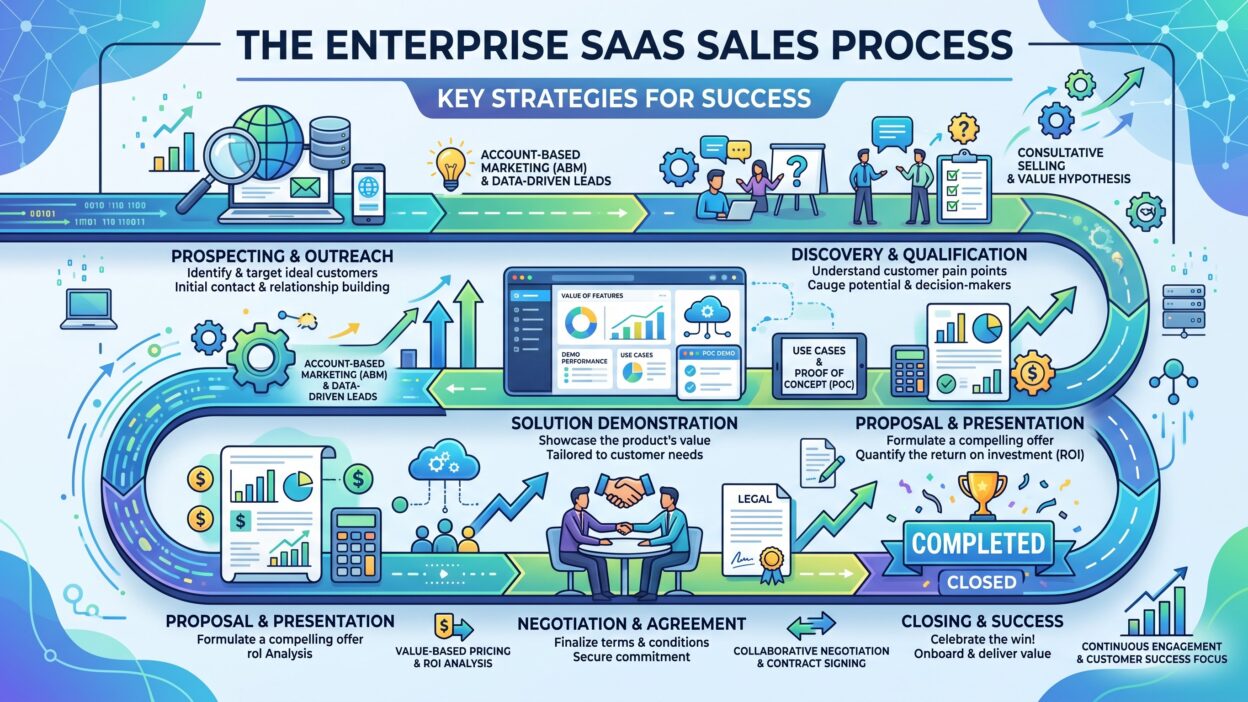
Most enterprise SaaS sales processes follow a similar shape. Prospecting starts the cycle. Discovery uncovers real business needs. Demos show the product in action. Proposals lay out pricing and terms. Negotiation settles final details. Closing signs the contract. Each stage needs its own strategy inside the enterprise SaaS sales process.
Why the Enterprise SaaS Sales Process Matters
A strong enterprise SaaS sales process protects revenue. Enterprise deals carry huge value, so one lost deal hurts far more than a lost small business deal. A clear process reduces this risk.
Sales reps without a defined enterprise SaaS sales process often skip key steps. They pitch too early. They miss key stakeholders. They lose deals to competitors who follow a tighter process.
A strong process also shortens sales cycles over time. Reps know exactly what to do at each stage. Managers can coach reps against a clear framework instead of guessing what went wrong. Revenue leaders can forecast deals with far more accuracy when every rep follows the same enterprise SaaS sales process.
Buyers benefit too. A structured process feels organized and trustworthy from the buyer’s side. Enterprise buyers already juggle many vendors and long approval chains. A rep who guides them through a clear process earns trust faster than one who improvises every call.
Key Stages of the Enterprise SaaS Sales Process
Every strong enterprise SaaS sales process breaks into distinct stages. Each stage needs its own goals and tactics.
Prospecting and Lead Qualification
Prospecting starts the enterprise SaaS sales process. Reps research target accounts using firmographic filters like company size, industry, and revenue. Strong prospecting focuses on accounts that match the ideal customer profile closely.
Qualification comes next. Reps check budget, authority, need, and timeline before investing more effort. A poorly qualified lead wastes weeks of effort later in the enterprise SaaS sales process.
Discovery Calls
Discovery calls uncover the real problems a prospect faces. Reps ask open questions about current tools, pain points, and goals. Good discovery calls build the foundation for every later stage of the enterprise SaaS sales process.
Reps who skip deep discovery often pitch features nobody asked for. Strong discovery turns a generic pitch into a tailored solution the buyer actually wants.
Product Demos and Proof of Concept
Demos show the product solving the exact problems raised during discovery. Enterprise buyers often request a proof of concept before moving forward. This step lets the buyer test the product inside their own environment.
A strong demo speaks directly to business outcomes, not just features. This stage often decides whether a deal moves forward in the enterprise SaaS sales process.
Proposal and Negotiation
Proposals lay out pricing, contract terms, and implementation plans. Enterprise buyers often push back on price or terms during this stage. Reps need strong negotiation skills to protect deal value while still meeting buyer needs.
Legal and procurement teams often join this stage. Contracts move through multiple rounds of review before both sides sign off.
Building a Repeatable Enterprise SaaS Sales Process
A repeatable process helps every rep close deals consistently. Snowflake, Salesforce, and other large SaaS companies all rely on documented playbooks for this reason.
A repeatable enterprise SaaS sales process starts with clear stage definitions. Every rep needs to know exactly what counts as a qualified lead, a completed discovery call, or a closed-won deal. Vague definitions create inconsistent pipelines and messy forecasts.
Sales enablement content supports this repeatability. Battle cards, case studies, and demo scripts give reps consistent talking points across every deal. New reps ramp faster when they follow a documented enterprise SaaS sales process instead of learning through trial and error.
CRM tools track every stage of the process too. Managers review pipeline data weekly to spot stuck deals early. A repeatable process turns sales performance into something measurable instead of guesswork.
Common Challenges in the Enterprise SaaS Sales Process
Long sales cycles create the first major challenge. Enterprise deals often take six months or longer to close. Reps must stay patient and keep momentum alive across many touchpoints.
Multiple stakeholders create another challenge. A single enterprise deal might involve a champion, an economic buyer, a technical evaluator, and a legal reviewer. Reps must manage every relationship carefully throughout the enterprise SaaS sales process.
Budget cycles also slow deals down. Enterprise companies often lock budgets months in advance. A great product pitch still stalls if the buyer has no budget left for the current quarter.
Internal competition adds friction too. Enterprise buyers often compare multiple vendors before making a final choice. Reps need strong differentiation strategies to stand out during every stage of the enterprise SaaS sales process.
Strategies for Success in Enterprise SaaS Sales
Build Multi-Threaded Relationships
Strong reps never rely on a single contact. They build relationships across departments, from technical teams to finance teams. Multi-threading protects the deal if one champion leaves the company mid-cycle.
Focus on Business Outcomes, Not Features
Enterprise buyers care about business results like cost savings, efficiency gains, or revenue growth. Reps who tie every conversation back to these outcomes build stronger cases for their product throughout the enterprise SaaS sales process.
Use Data to Guide Every Conversation
Strong reps bring data into every stage. Case studies, ROI calculators, and industry benchmarks all strengthen a pitch. Data-backed conversations feel more credible than generic sales talk.
Tools That Support the Enterprise SaaS Sales Process
CRM platforms track every deal and every stage. Sales engagement tools automate follow-up emails and call scheduling. Proposal software speeds up contract creation and e-signature collection.
Intent data tools show which accounts research relevant topics online. This data helps reps time outreach at the right moment during the enterprise SaaS sales process. Conversation intelligence tools record and analyze sales calls, helping managers coach reps more effectively.
Together, these tools remove manual work from the enterprise SaaS sales process. Reps spend more time selling and less time on administrative tasks.
Metrics That Measure Enterprise SaaS Sales Process Success
Sales cycle length shows how long deals take from first contact to close. Shorter cycles signal a stronger enterprise SaaS sales process. Win rate shows how many qualified deals actually close successfully.
Average deal size tracks revenue impact across the pipeline. Pipeline velocity combines deal size, win rate, and cycle length into one clear metric. Customer acquisition cost shows how much the company spends to win each new account.
Sales leaders review these metrics regularly to spot weak points inside the enterprise SaaS sales process. A drop in win rate might point to weak discovery calls. A longer sales cycle might point to slow legal reviews.
Best Practices for Enterprise SaaS Sales Teams
Strong onboarding sets new reps up for success. New hires need training on the product, the buyer persona, and the full enterprise SaaS sales process from day one.
Regular pipeline reviews keep deals moving. Managers should review stuck deals weekly and offer coaching where needed. Cross-team alignment between sales, marketing, and customer success keeps messaging consistent across the entire buyer journey.
Reps should also document lessons from every closed deal, won or lost. This feedback loop sharpens the enterprise SaaS sales process over time and helps the whole team avoid repeating past mistakes.
Future of the Enterprise SaaS Sales Process
AI tools will keep reshaping how reps run their enterprise SaaS sales process. Predictive lead scoring will highlight the best accounts faster. AI-generated call summaries will save reps hours of manual note-taking each week.
Buyers will keep expecting more self-service research options before ever talking to a rep. Sales teams will need to support this shift with strong content and clear product information available early in the buyer journey.
The core structure of the enterprise SaaS sales process will likely stay the same. Prospecting, discovery, demos, and negotiation will remain central. The tools supporting each stage will simply get smarter and faster.
Frequently Asked Questions
What is the enterprise SaaS sales process? The enterprise SaaS sales process describes every step a company takes to sell software to large organizations, from prospecting through contract signing.
How long does an enterprise SaaS sales process usually take? Most enterprise deals take three to twelve months. Deal size, stakeholder count, and procurement steps all affect the total timeline.
Why do enterprise SaaS sales cycles take so long? Multiple stakeholders, legal reviews, and budget approvals all slow the process down compared to smaller business deals.
What skills matter most in enterprise SaaS sales? Strong discovery skills, negotiation skills, and relationship-building skills all matter greatly throughout the enterprise SaaS sales process.
How can a company shorten its enterprise SaaS sales process? Clear stage definitions, strong sales enablement content, and proactive stakeholder management all help shorten the cycle over time.
What tools support the enterprise SaaS sales process best? CRM platforms, sales engagement tools, and intent data platforms all support reps at different stages of the process.
Read More:-Eloqua vs. HubSpot: How Do They Compare in 2026?
Conclusion

The enterprise SaaS sales process demands patience, structure, and strong relationship skills. Every stage, from prospecting through negotiation, plays a role in winning enterprise deals. Teams that document and refine their enterprise SaaS sales process close more deals with greater consistency.
Strong reps build multi-threaded relationships, tie every conversation to business outcomes, and lean on data throughout every call. Sales leaders who track the right metrics catch problems early and coach their teams toward better results.
The enterprise SaaS sales process will keep evolving alongside new tools and buyer expectations. Companies that invest in a clear, repeatable process today will close bigger deals with less friction tomorrow.