Introduction
TL;DR Choosing a CRM platform shapes how a company sells, serves, and grows. The IFS CRM vs Salesforce decision comes up often for companies weighing embedded ERP tools against a dedicated CRM giant. Both platforms handle customer data well, but they serve different types of businesses.
IFS CRM lives inside the larger IFS Cloud ERP suite. Salesforce stands alone as one of the most widely used CRM platforms in the world. The IFS CRM vs Salesforce comparison matters most for asset-heavy industries, manufacturers, and field service companies deciding between a unified ERP approach and a best-in-class CRM approach.
This blog breaks down every angle of the IFS CRM vs Salesforce debate. You will see feature comparisons, pricing considerations, AI capabilities, and real use cases for each platform. You will also find guidance on which platform fits your business best.
By the end, the IFS CRM vs Salesforce choice should feel much clearer for your specific situation.
Table of Contents
What Is IFS CRM?
IFS CRM sits inside IFS Cloud, a composable enterprise platform built for asset-intensive and service-led organizations. Companies in aerospace, defense, construction, and field service rely on IFS Cloud to run their core operations. CRM functionality comes bundled directly into this larger system.
Core Purpose of IFS CRM
IFS CRM centralizes customer records, tracks sales pipelines, and manages service cases within one connected environment. Sales teams see the same data that finance, supply chain, and field service teams see. This shared data model removes the gaps that often show up when a separate CRM sits outside the core ERP system.
Where IFS CRM Fits Best
IFS CRM works best for companies already running IFS Cloud for their broader operations. Manufacturers, asset managers, and service-heavy organizations benefit most from this tight integration. The IFS CRM vs Salesforce discussion often starts here, since IFS CRM rarely gets chosen as a standalone product apart from the wider IFS ecosystem.
What Is Salesforce?
Salesforce built its reputation as a dedicated CRM platform long before most competitors entered the space. Today, Salesforce covers sales, service, marketing, and commerce through a wide family of connected products.
Core Purpose of Salesforce
Salesforce centers on customer relationships first. Sales teams track leads, opportunities, and pipeline stages inside a highly configurable interface. Service teams manage cases and support tickets. Marketing teams run campaigns and track engagement, all from the same connected data foundation.
Where Salesforce Fits Best
Salesforce fits companies of nearly every size and industry, from small sales teams to massive global enterprises. Companies without a unified ERP system often choose Salesforce as their primary customer data hub. The IFS CRM vs Salesforce comparison tends to favor Salesforce when a company needs deep, dedicated CRM depth rather than an embedded module.
IFS CRM vs Salesforce: Feature Comparison
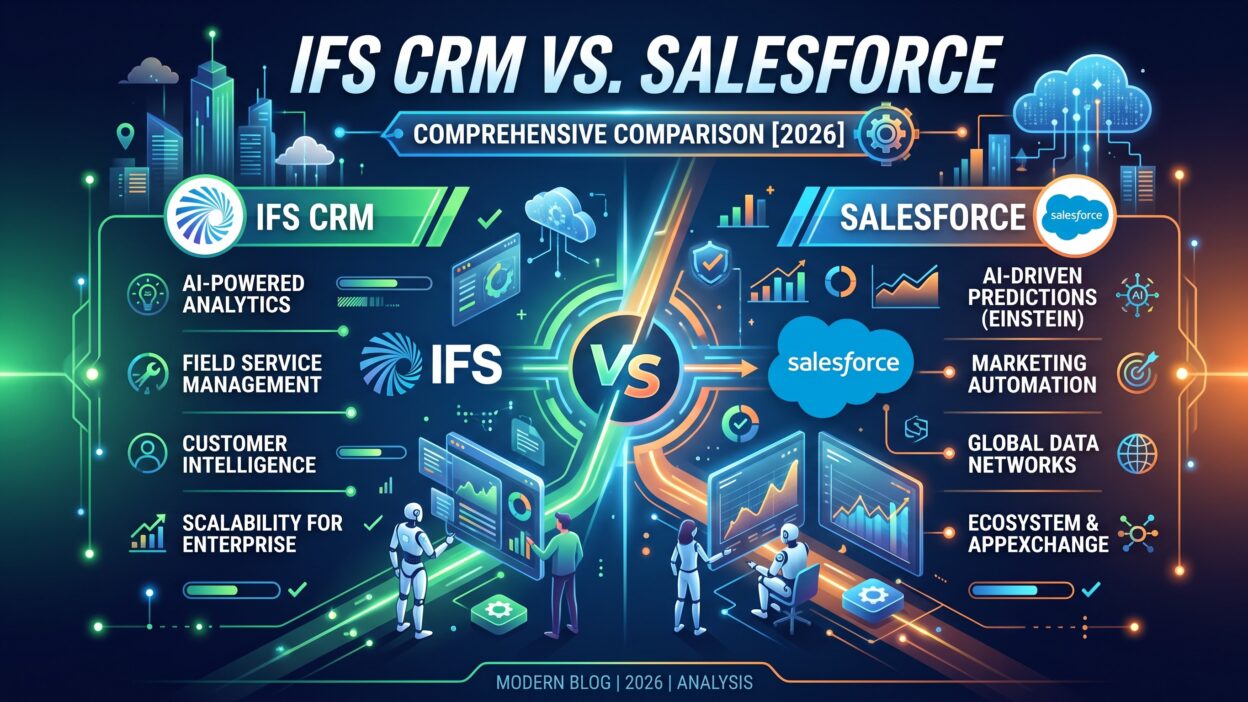
Feature depth marks one of the biggest differences in the IFS CRM vs Salesforce comparison.
Sales Pipeline Management
IFS CRM offers visual pipeline tracking with stage-based workflows and deal value tracking. This works well for straightforward sales processes tied to production or service delivery. Salesforce goes deeper here, with customizable pipeline stages, forecasting tools, and territory management built for complex, high-volume sales organizations.
Quote-to-Order and Fulfillment
IFS CRM shines in this area. Quotes flow directly into sales orders and production schedules without leaving the platform. Salesforce handles quoting well too, but companies often need extra tools or integrations to connect quotes with manufacturing and fulfillment systems outside the CRM.
AI and Automation Capabilities
Salesforce leads heavily in this category through its Agentforce platform. Autonomous AI agents now qualify leads, draft follow-up emails, and manage entire workflow steps without constant human input. IFS CRM includes IFS.ai for predictive analytics and lead scoring, but its AI scope stays narrower and more operationally focused than Salesforce’s broader agentic approach.
Customer Service Tools
Both platforms handle case management, SLA tracking, and escalation workflows. Salesforce offers deeper service automation through Agentforce Service, including AI-driven case routing. IFS CRM connects service cases directly to field service scheduling, which benefits companies running physical maintenance operations.
IFS CRM vs Salesforce: Integration and Ecosystem
Integration philosophy separates these two platforms sharply. IFS CRM lives natively inside IFS Cloud, so data flows automatically between CRM, finance, supply chain, and project management modules. Companies avoid building custom integrations between separate systems.
Salesforce takes a different approach. It connects to nearly any external tool through its massive app marketplace and API ecosystem. Companies pair Salesforce with marketing platforms, ERP systems, and data warehouses through pre-built connectors or custom development work.
The IFS CRM vs Salesforce integration story favors IFS Cloud when a company wants one unified system with no data silos. It favors Salesforce when a company wants maximum flexibility to connect dozens of specialized tools around a central CRM hub.
Salesforce’s Data Cloud adds another layer here. It merges customer data from outside sources into one unified profile that AI agents and sales teams can use. IFS Cloud achieves a similar unified view, but it does so by keeping everything inside one composable platform rather than pulling in outside data sources at scale.
IFS CRM vs Salesforce: Pricing Considerations
Pricing works differently across these platforms, which makes direct comparison tricky. IFS Cloud pricing usually gets bundled into a broader ERP contract. Companies pay for the modules they need, including CRM, rather than buying CRM as a standalone product.
Salesforce prices its products by edition and by user seat. Sales Cloud, Service Cloud, and add-ons like Agentforce each carry their own licensing costs. Companies scale spending up as they add more users or unlock deeper AI features.
The IFS CRM vs Salesforce cost comparison depends heavily on company size and existing infrastructure. A manufacturer already running IFS Cloud often finds CRM nearly free to add, since the core platform investment already covers most of the cost. A company without any ERP system in place often finds Salesforce more predictable, since pricing tiers stay clearly published and easy to budget around.
IFS CRM vs Salesforce: Industry Fit
Industry fit plays a major role in the IFS CRM vs Salesforce decision. IFS Cloud targets asset-intensive and service-led industries directly. Aerospace, defense, construction, energy, and field service companies benefit from IFS Cloud’s built-in industry logic and asset management depth.
Salesforce serves a much wider range of industries. Retail, financial services, healthcare, technology, and nearly every other sector run on Salesforce today. Its configurability lets almost any business model shape the platform around its own sales process.
Companies running complex physical operations, like fleet maintenance or manufacturing, often lean toward IFS CRM because of its native connection to asset and service data. Companies focused purely on customer relationships, without heavy asset management needs, often lean toward Salesforce instead.
IFS CRM vs Salesforce: User Experience
User experience differs noticeably between these two platforms. IFS Cloud offers a fairly intuitive interface for its CRM module, though some reviewers note a steeper learning curve around broader ERP navigation. Reps working across sales, service, and operations benefit from one consistent interface, even if that interface feels dense at first.
Salesforce built its reputation partly on interface flexibility. Admins customize dashboards, page layouts, and workflows extensively. This flexibility comes with its own learning curve too, since heavy customization sometimes makes onboarding slower for new users.
Sales reps who only need core CRM functions often find Salesforce more approachable day to day. Reps who work across sales, service, and operations inside one asset-heavy business often find IFS CRM more efficient, since they never leave one connected system to check inventory, project status, or maintenance schedules.
Real-World Use Cases
When Companies Choose IFS CRM
A construction firm running IFS Cloud for project management naturally adds IFS CRM to track client relationships alongside active projects. Sales and operations share one data source, so project updates and client communication stay perfectly aligned.
When Companies Choose Salesforce
A fast-growing software company without any ERP system chooses Salesforce to manage its entire sales motion. Marketing, sales, and service teams all work inside Salesforce, using AI agents to qualify leads and route support tickets automatically.
When Companies Run Both
Some companies run IFS Cloud for operations and Salesforce for customer-facing sales, connecting the two through APIs. This hybrid approach shows up often in the IFS CRM vs Salesforce conversation among larger enterprises with complex needs.
Strengths and Weaknesses
IFS CRM strengths center on integration depth. Companies get one connected system across sales, service, and operations. Quote-to-order flows move smoothly without manual handoffs. Industry-specific logic for asset-heavy businesses saves configuration time.
IFS CRM weaknesses show up in raw CRM depth. Compared to Salesforce, IFS CRM offers fewer advanced sales and marketing automation features. Companies needing deep campaign management or advanced AI-driven sales coaching often find IFS CRM more limited in this specific area.
Salesforce strengths center on depth and flexibility. Advanced AI agents, a massive app marketplace, and industry-agnostic configurability make Salesforce adaptable to nearly any business model. Salesforce weaknesses show up in complexity and cost. Heavy customization sometimes requires dedicated admin resources. Licensing costs climb quickly as companies add users and advanced features.
The IFS CRM vs Salesforce weakness comparison often comes down to this trade-off: unified simplicity versus dedicated depth.
Which Platform Should You Choose?
The right answer in the IFS CRM vs Salesforce debate depends entirely on your existing systems and industry. Companies already running IFS Cloud for finance, supply chain, or project management should strongly consider adding IFS CRM rather than bolting on a separate system.
Companies without an existing ERP platform, or companies in industries like retail, technology, or professional services, often find Salesforce a stronger standalone fit. Salesforce’s dedicated CRM depth and massive ecosystem support complex sales and marketing needs that go beyond core operations.
Asset-heavy industries with field service, maintenance, or manufacturing needs should weigh IFS CRM’s operational integration heavily. Companies prioritizing sales velocity, marketing automation, and AI-driven customer engagement should weigh Salesforce’s broader feature set just as heavily.
Frequently Asked Questions
What is the main difference between IFS CRM and Salesforce? IFS CRM lives inside a larger ERP platform built for asset-intensive industries. Salesforce operates as a dedicated, standalone CRM used across nearly every industry.
Is IFS CRM cheaper than Salesforce? IFS CRM often costs less as an add-on for companies already running IFS Cloud. Salesforce pricing depends on edition and user count, which can grow expensive at scale.
Which platform offers better AI features? Salesforce currently offers broader AI capabilities through Agentforce, including autonomous agents for sales and service. IFS CRM includes predictive analytics through IFS.ai, though its AI scope stays more operationally focused.
Can companies use both IFS CRM and Salesforce together? Yes. Some companies run IFS Cloud for operations and Salesforce for customer-facing sales, connecting both systems through API integrations.
Which platform fits manufacturing companies better? IFS CRM often fits manufacturing and asset-intensive companies better, thanks to its native connection to production, inventory, and service data.
Does Salesforce work well for small businesses? Yes. Salesforce offers editions built for smaller teams, though costs and complexity can grow as a business scales up its usage.
Read More:-7 Best Skylead Alternatives (2026)
Conclusion

The IFS CRM vs Salesforce comparison comes down to one core question: does your business need a unified operational platform, or a dedicated CRM powerhouse? IFS CRM wins for companies already invested in IFS Cloud, especially those running asset-heavy or service-led operations. Salesforce wins for companies that need deep, flexible CRM functionality supported by a massive ecosystem and advanced AI agents.
Neither platform works as a universal answer. The right choice depends on your existing systems, your industry, and your growth plans. Companies weighing IFS CRM vs Salesforce should map their current tech stack honestly before committing to either path.
Whichever platform you choose, strong CRM data drives better sales decisions and stronger customer relationships. The IFS CRM vs Salesforce decision matters less than how well your team uses whichever platform you pick.