Introduction
TL;DR Hiring the wrong sales rep costs your company time and money. A bad hire drains your pipeline. A great hire fills it fast. The right interview questions to hire sales reps separate the two candidates before you make an offer.
This guide gives you the exact questions top sales managers ask. You get the reasoning behind each question. You get the answers that signal a strong hire. You get the red flags that signal trouble ahead. You also get a scorecard method, common mistakes, and a full FAQ section built around real hiring situations.
Every hiring manager needs a clear plan. These interview questions to hire sales reps give you that plan today. Read through each section and build your own hiring checklist as you go.
Table of Contents
Why the Right Interview Questions Matter
A resume tells you where someone worked. It never tells you how they sell. Interview questions to hire sales reps show you real behavior under pressure. They reveal thinking patterns. They reveal grit. They reveal honesty.
Sales teams run on numbers. One weak rep can pull down a whole quarter. One strong rep can carry a struggling team through a hard quarter. The gap between these two outcomes often starts in the interview room.
Bad Hires Cost Your Sales Team
A weak sales rep misses quota for months. Your team covers the gap. Morale drops. Revenue drops too. Recruiting costs pile up fast. Training time gets wasted on someone who leaves within a year.
Onboarding a new rep takes real time and real budget. Managers spend hours on training calls. Marketing spends budget on leads that go nowhere. A rep who cannot close wastes every lead your team hands them.
Strong interview questions to hire sales reps catch these risks early. You spot weak habits before they cost you a full quarter. You save your team from carrying dead weight. You protect your budget from a slow, expensive mistake.
Good Questions Reveal Real Skills
Sales is a skill built through practice. A good candidate talks through real deals. They explain real numbers. They own real losses. A scripted answer sounds smooth but empty.
Sharp interview questions to hire sales reps push past rehearsed lines. They force candidates to think on the spot. This is where true skill shows up. A candidate who thinks clearly under a hard question often thinks clearly under a hard client call too.
Real skill also shows in small details. Listen for the numbers a candidate remembers. Listen for the names of tools they used daily. These small facts prove real experience over borrowed talking points.
How to Prepare Before You Ask Interview Questions to Hire Sales Reps
Preparation makes your interview process fair and consistent. Every candidate deserves the same fair shot. A structured approach gives you clean comparisons across candidates.
Skipping preparation leads to random results. One interviewer asks about process. Another asks only about salary history. Neither approach gives you a fair picture of true skill.
Define the Role Clearly
Write down what success looks like in ninety days. List the tools your team uses. List the deal size your reps close. A clear role definition shapes sharper interview questions to hire sales reps.
Share this definition with your hiring panel. Everyone should judge candidates against the same bar. This keeps bias out of your decision. A shared definition also speeds up your final debrief after each round of interviews.
Think about your buyer type too. A rep who thrives on high volume calls may struggle in a long enterprise sales cycle. Match your questions to the exact type of selling your team needs.
Build a Structured Scorecard
Score each answer on a simple scale. Rate communication. Rate process thinking. Rate resilience. A scorecard turns gut feeling into real data.
Use the same scorecard for every interview questions to hire sales reps session. Consistency protects you from hiring based on charm alone. Charm fades fast on a hard sales floor.
A scorecard also protects your company from bias claims. Written notes tied to a clear scale hold up far better than vague memory during a final hiring debate.
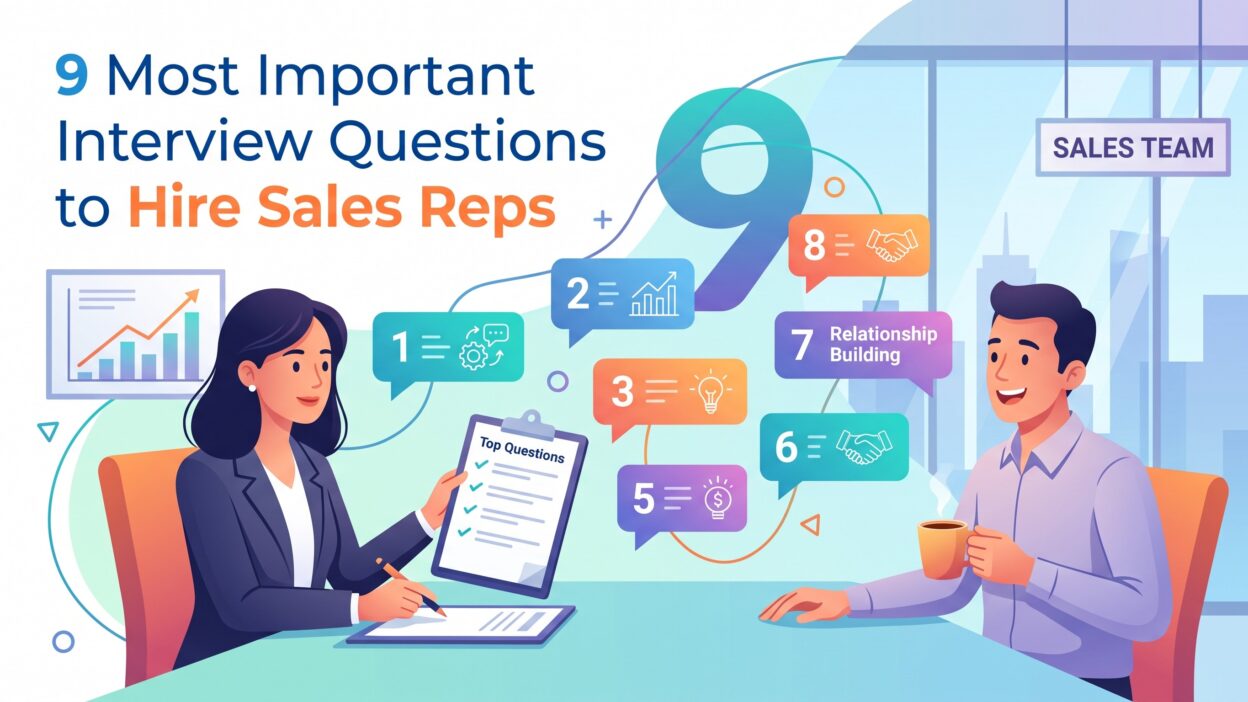
9 Most Important Interview Questions to Hire Sales Reps
These nine interview questions to hire sales reps cover the full picture of a sales candidate. Each question tests a different skill. Ask all nine for a complete read on any candidate.
Space these questions across your interview. Open with lighter questions. Save the hardest questions for the middle of your conversation, once the candidate feels settled.
1. Tell Me About a Deal You Lost. What Happened?
This is one of the most revealing interview questions to hire sales reps. Every rep loses deals. The way they talk about loss tells you everything.
Listen for ownership. A strong candidate names their own mistake. A weak candidate blames the buyer, the product, or bad timing. Strong reps also explain what they changed after the loss.
Watch their tone too. Calm reflection beats defensive excuses every time. This single question filters out reps who avoid accountability.
Ask a follow-up here. Ask what they would do differently today. A candidate with real growth gives you a clear, specific answer instead of a generic line about trying harder.
2. Walk Me Through Your Sales Process
A rep needs a repeatable process, not luck. This question checks for structure. Ask them to describe each stage from first contact to signed contract.
Good candidates name clear steps. They mention discovery calls. They mention qualifying questions. They mention follow-up cadence. Vague answers signal a rep who wings every deal.
This question also shows how they adapt to different buyer types. A rigid process without flexibility can hurt complex sales cycles. Balance matters here.
Push for specifics on their qualifying framework. A candidate who names a real method, such as a needs and budget check early in the call, shows structured thinking built through experience.
3. How Do You Handle Rejection?
Rejection hits sales reps daily. Cold calls get ignored. Emails get deleted. Deals fall through at the last step. This question checks emotional durability.
Strong answers include a personal system. Some reps track their ratio of no to yes. Some reps set a daily activity target regardless of outcome. Weak answers sound vague or dismissive of the pain rejection brings.
A rep who denies feeling frustration often hides burnout risk. Honest reps admit the sting and describe their recovery habit. That honesty builds trust with a hiring manager.
Notice how quickly they bounce back in their own story. Fast recovery in a past role often predicts fast recovery on your floor.
4. Describe a Time You Missed Your Quota
Every rep misses a number at some point. This question tests self-awareness under pressure. It also tests planning skill for recovery.
Listen for specific numbers. A candidate who remembers exact percentages shows real engagement with their own performance. Listen for the plan they built afterward. Did they change their outreach volume? Did they shift their target list?
A defensive answer here is a warning sign. Growth-minded reps treat a missed quota as data, not shame. They talk about the fix, not just the excuse.
Ask what changed in the following month. A rep who turned a bad month into a strong recovery shows real resilience under real pressure.
5. How Do You Research a Prospect Before a Call?
Preparation separates top reps from average reps. This question shows their discipline outside the spotlight of a live call.
A strong candidate names specific research steps. They check company news. They check the prospect’s role and recent posts. They tailor their opening line based on findings.
A weak candidate admits they wing most calls. That habit leads to low connect rates and short conversations. Preparation habits often predict long-term close rates better than raw charisma.
Ask how much time they spend on research per prospect. A rep with a tight, repeatable routine usually outperforms a rep with no set process at all.
6. What Makes You Stay Motivated During a Slow Month?
Sales income often swings month to month. A slow month tests grit more than a hot streak does. This question checks internal drive versus external pressure.
Great answers mention personal goals tied to bigger life plans. Some reps focus on daily habits instead of monthly results. Weak answers rely only on manager pressure or fear of missing a bonus.
Internal motivation lasts longer than fear-based motivation. A rep driven by fear alone often burns out within a year on a demanding sales floor.
Listen for a story tied to a specific slow month. Real experience sounds different from a rehearsed motivational quote.
7. Sell Me This Pen
This classic exercise still works. Hand the candidate any object nearby. Ask them to sell it back to you in under two minutes.
Watch their questions first. A strong candidate asks about your needs before pitching features. A weak candidate jumps straight into a canned pitch without any discovery.
This live exercise shows real thinking speed. It shows comfort with pressure. Scripted resumes cannot fake this moment.
Try a second object mid-interview for a fresh read. A candidate who improves their approach on the second try shows real learning ability in real time.
8. How Do You Handle a Difficult Client?
Every account eventually brings friction. Angry clients. Confused clients. Clients who threaten to cancel. This question checks patience and problem solving under stress.
Strong candidates stay calm in their story. They describe listening first before offering a fix. They describe setting clear next steps with the client.
Weak candidates escalate too fast or avoid conflict completely. Both patterns hurt long-term account health. A balanced answer shows maturity built through real experience.
Ask how the client relationship ended after the conflict. A rep who repaired trust after a hard moment shows real relationship skill beyond simple closing ability.
9. Why Do You Want to Sell for Our Company?
This final question checks genuine interest versus a generic job search. A candidate who researched your product gives specific reasons tied to your market.
Listen for details about your industry. Listen for details about your customer base. A vague answer about salary or growth alone suggests low commitment.
Candidates who show real curiosity about your product often ramp faster. They already understand your value story before day one on the job.
Ask what they would change about your current sales pitch. A sharp candidate often spots a gap and offers a fresh angle within minutes.
Behavioral Questions Versus Situational Questions
Interview questions to hire sales reps fall into two main types. Behavioral questions ask about a real past event. Situational questions ask about a hypothetical future event. Both types belong in a strong interview.
Why Behavioral Questions Work Best
A behavioral question forces a candidate to pull from real memory. “Tell me about a deal you lost” is a behavioral question. The answer draws on a real event with real details.
Real memory is hard to fake. A candidate without true experience often stumbles on small details. This gap shows up fast once you ask a follow-up question about numbers or timelines.
When to Use Situational Questions
Situational questions still hold value in a full interview. They test judgment on the spot. Ask a candidate how they would handle a fictional angry client or a fictional slow quarter.
Situational answers show raw thinking speed. Pair a situational question with a behavioral question on the same topic. This pairing gives you both a real story and a fresh judgment test in one round.
How to Score Candidate Answers Using a Simple Method
A scorecard works best with a repeatable scoring method behind it. Many sales teams use a version of the STAR method to judge answers fast and fair.
Situation and Task
Listen for a clear situation first. A strong candidate names the account, the deal size, or the client type without long delay. A vague opening often signals a weak or borrowed story.
Action and Result
Listen for the exact action the candidate took next. Then listen for a clear result tied to a number or outcome. Strong candidates connect action directly to result within a short, clear answer.
Score each part on a simple one to five scale. Add these scores across all nine interview questions to hire sales reps for a full candidate total. This total gives your hiring panel one clean number to compare across every applicant.
Interview Questions to Hire Sales Reps by Role Type
Sales roles differ widely across companies. An entry-level prospecting role needs different strengths than a senior closing role. Adjust your interview questions to hire sales reps based on the exact seat you fill.
Questions for Entry-Level Prospecting Roles
Focus on activity habits and coachability for junior roles. Ask about daily call volume in a past job. Ask about a time they learned a new tool fast. Energy and grit matter more than polish at this level.
Questions for Closing and Account Executive Roles
Focus on negotiation skill and deal complexity for senior roles. Ask about a multi-stakeholder deal they closed. Ask how they handled a tough price objection near the final stage of a contract.
Questions for Enterprise Sales Roles
Focus on long cycle management for enterprise roles. Ask how they kept a stalled deal moving across many months. Ask how they built trust with a large buying committee.
Secondary Skills to Evaluate Beyond Interview Questions
Interview questions to hire sales reps cover most of the picture. A few extra signals round out your final decision.
Communication Style
Clear speech matters on every call. Watch for rambling answers during your interview. Watch for filler words that bury the main point. Clean communication in the interview often carries over to client calls.
Pay attention to listening skill as well. A candidate who interrupts you during the interview often interrupts prospects during a real sales call.
Coachability
Ask how they took feedback from a past manager. Strong candidates describe a real change they made after criticism. Reps who resist feedback in an interview resist it on the job too.
Give a small piece of feedback mid-interview. Watch how they adjust in the next answer. Fast adjustment under light pressure often predicts fast growth on the job.
Resilience
Sales work brings daily friction. Watch how candidates react to a tough follow-up question. Calm responses under pressure predict calm responses during hard client calls.
A resilient candidate keeps their energy steady across a long interview. Energy that fades halfway through often fades halfway through a tough sales day too.
Common Mistakes to Avoid When You Hire Sales Reps
Even strong interview questions to hire sales reps fail without a smart process around them. Avoid these common traps.
Hiring for Charm Alone
Charisma feels good in a room. It does not guarantee a full pipeline. Score substance over style. A quiet candidate with a strong process often outperforms a loud candidate with no plan.
Skipping Role Play Tests
A live pitch test reveals more than any resume line. Skip this step and you miss real proof of skill. Always include one live exercise in your process.
Rushing the Decision
A fast hire under pressure often becomes a slow mistake. Give your team time to run a full set of interview questions to hire sales reps before any offer goes out. A rushed process often skips the scorecard step and loses the fair comparison you built earlier.
Ignoring Team Fit
A strong individual seller can still clash with your team culture. Ask about past team dynamics. A rep who thrives alone but avoids team collaboration may struggle in a shared pipeline environment.
Frequently Asked Questions
What are the best interview questions to hire sales reps?
The strongest questions ask about lost deals, missed quotas, and daily habits. These interview questions to hire sales reps reveal real behavior instead of rehearsed answers.
How many interview rounds should a sales hiring process include?
Most strong processes use two or three rounds. One round should include a live pitch or role play test alongside standard interview questions to hire sales reps.
Should I test sales candidates with a live pitch?
Yes. A live pitch shows real thinking speed. It proves skill that a resume cannot show on its own. Combine this test with your core interview questions to hire sales reps for a full read on any candidate.
What red flags should I watch during a sales interview?
Watch for blame in loss stories. Watch for vague answers about process. Watch for low energy around your product or market.
How long should a sales interview process take?
A focused process runs one to two weeks. Longer timelines risk losing strong candidates to a faster offer from another company.
Do these questions work for both junior and senior sales hires?
Yes. Adjust your expectations based on experience level. A junior candidate may show less polish but strong energy and coachability. A senior candidate should show sharper process detail across every answer.
A Quick Pre-Offer Checklist
Before you extend an offer, run through one final check. This step protects your team from a rushed decision after a long search.
Confirm the candidate answered every core question with a real story. Confirm your scorecard total lands above your team’s minimum bar. Confirm at least one live pitch test happened during the process. Confirm your panel agrees on team fit, not just individual skill.
This last check takes ten minutes. It saves months of cost if a mismatch slips through. A short pause here protects the full value of your interview questions to hire sales reps process.
Read More:-GTM Studio: Closing the Gap Between Ideas and Execution for RevOps
Conclusion

Hiring a great sales rep starts with the right questions. These nine interview questions to hire sales reps give you a clear view of real skill, real grit, and real process discipline. Use a scorecard. Add a live pitch test. Compare every candidate against the same bar.
A strong hire fills your pipeline and lifts your whole team. A weak hire drains both. Build your next interview around these interview questions to hire sales reps and walk into your next hiring round with real confidence.