Introduction
TL;DR Marketing teams outgrow spreadsheets fast. Once a company runs more than a handful of campaigns a month, it needs real automation software. Two names keep coming up in that search: Eloqua and HubSpot.
This Eloqua vs HubSpot comparison breaks down what each platform actually does in 2026. No vague marketing language. Just the details a buyer needs before signing a contract.
Table of Contents
What Are Eloqua and HubSpot?
HubSpot started in 2006. Brian Halligan and Dharmesh Shah built it around one idea. Buyers had changed how they shop, but most businesses still marketed the old way.
That idea grew into a full customer platform. HubSpot now covers marketing, sales, service, and content, all inside one shared database. Small businesses and large enterprises both use it today.
Eloqua took a different path. Oracle acquired the platform in 2012 and folded it into its marketing cloud lineup. Eloqua focuses on complex, multi-channel campaigns for larger organizations with dedicated marketing operations teams.
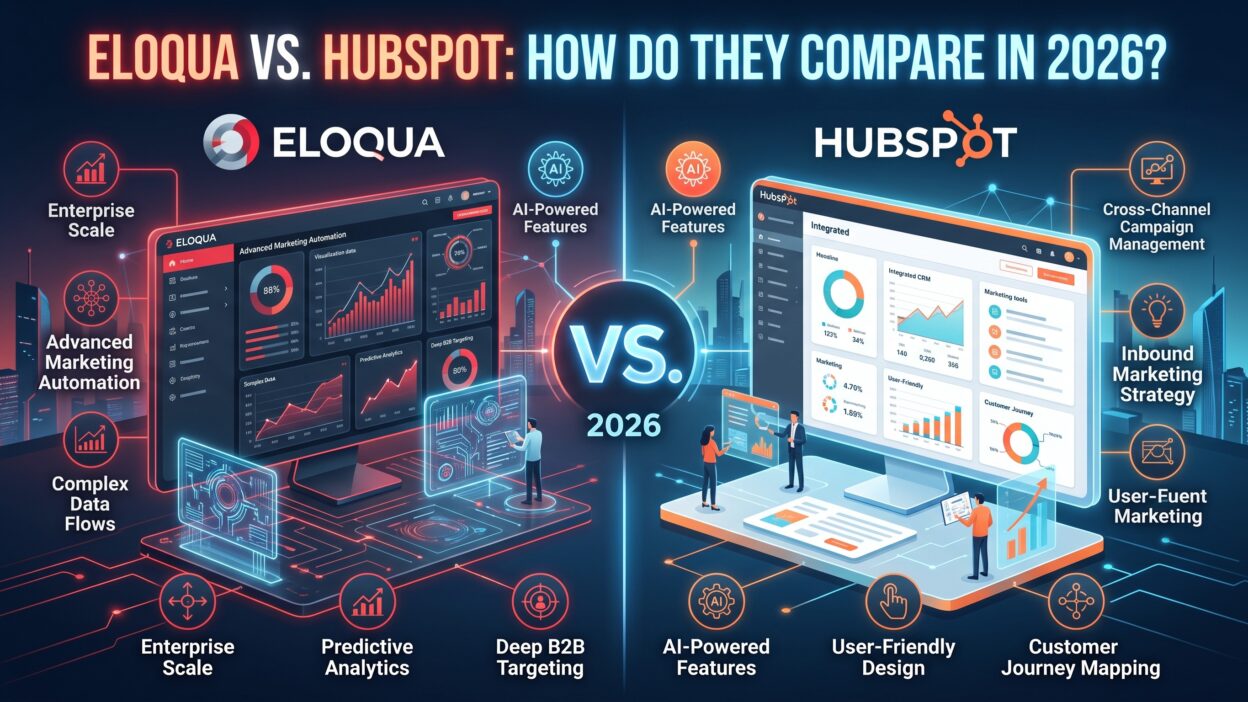
Any Eloqua vs HubSpot discussion starts with this split. HubSpot built an all-in-one platform for growing teams. Eloqua built a specialized engine for enterprise-scale campaign orchestration.
Eloqua vs HubSpot: Core Features Compared
Feature lists look similar on paper for both tools. The real differences show up once a team starts building campaigns daily.
Email Marketing and Campaign Builder
Both platforms let marketers build, send, and track email campaigns. HubSpot uses a drag-and-drop editor that most marketers learn within a day. Templates come ready-made, and A/B testing sits a few clicks away.
Eloqua uses a canvas-style campaign builder instead. Marketers map out entire customer journeys visually, with branching logic for different responses. That canvas gives more control over complex, multi-step nurture programs, but it takes longer to master.
Lead Scoring and Segmentation
Eloqua earns strong marks here. Its segmentation tools support deep, rule-based targeting across large contact databases. Enterprise teams managing hundreds of thousands of leads often prefer this level of granularity.
HubSpot handles lead scoring well too, particularly for mid-sized databases. The scoring rules stay simpler to set up. A marketing generalist can configure scoring criteria without help from an operations specialist.
CRM and Sales Alignment
This area separates the two platforms clearly. HubSpot built its own CRM from the ground up, so marketing and sales data lives in one system automatically. A sales rep sees the exact same contact record a marketer views.
Eloqua does not include a native CRM. Most Eloqua customers run Salesforce, Oracle CRM, or another system alongside it. That setup works fine, but it adds an integration layer that HubSpot users skip entirely.
Landing Pages and Forms
Both platforms support responsive landing pages and web forms. HubSpot ties these tightly into its CRM and reporting, so a form submission updates a contact record instantly. Marketers build pages without writing code.
Eloqua offers similar design tools for landing pages and forms. The editor supports advanced customization for teams with development resources. Non-technical marketers may need more training time here compared to HubSpot.
Reporting and Analytics
HubSpot delivers clean, visual dashboards that update in real time. A marketing manager can pull a campaign report in minutes without exporting data anywhere.
Eloqua offers deeper custom reporting once a team configures it properly. The learning curve runs steeper, but the ceiling for detailed, enterprise-grade reporting sits higher too.
Eloqua vs HubSpot Pricing in 2026
Pricing structure marks one of the biggest gaps in this Eloqua vs HubSpot comparison. HubSpot publishes its pricing openly. Plans start around forty-five dollars a month for basic marketing tools, then scale up based on contact volume and feature depth.
A free CRM tier exists too. Startups and small teams can test HubSpot’s core tools before spending a dollar. That entry point does not exist on the Eloqua side.
Eloqua sells through a quote-based enterprise process. Oracle prices the platform using contact-based bands rather than flat monthly tiers. Estimates place entry-level Eloqua costs well above two thousand dollars monthly, with the final number depending on contract length, contact volume, and add-on modules.
Buyers evaluating Eloqua vs HubSpot on price alone usually land on HubSpot for lower budgets. Larger enterprises with complex governance needs sometimes justify Eloqua’s higher cost through its deeper campaign controls.
Ease of Use and Learning Curve
HubSpot wins this category by a wide margin. New marketers navigate the interface within days. HubSpot Academy offers free courses covering every part of the platform, from basic email sends to advanced automation workflows.
Eloqua demands more technical comfort. Marketing operations specialists often manage the platform full time at larger companies. A new user without prior marketing automation experience needs weeks, not days, to feel confident building campaigns independently.
This gap matters for lean marketing teams. A company without a dedicated operations hire will likely struggle with Eloqua’s setup process. HubSpot removes that barrier almost entirely.
Integration Ecosystem Compared
HubSpot connects with more than three hundred third-party tools natively. Popular connections include Salesforce, Slack, Zoom, and dozens of e-commerce platforms. Setting up an integration usually takes minutes through the app marketplace.
Eloqua integrates well with Oracle’s broader product suite and major CRMs like Salesforce. Some native integrations have been decommissioned over recent years, according to user feedback, which pushes teams toward manual data uploads or custom API work.
A marketing team relying heavily on niche software tools should map out its stack before choosing either platform. HubSpot’s marketplace covers more ground for most common tools used by growing businesses today.
Customer Support and Onboarding
HubSpot support gets strong praise across review platforms. Live chat, phone support, and a massive knowledge base cover most common questions quickly. Onboarding for standard plans moves fast, often within a few weeks.
Eloqua provides capable support too, including options for round-the-clock availability on higher-tier contracts. Onboarding takes longer here because of the platform’s complexity. Enterprise clients typically work with dedicated implementation consultants during setup, which extends the timeline but improves long-term configuration quality.
Eloqua vs HubSpot: Pros and Cons
Where Eloqua Wins
Eloqua handles massive, complex nurture programs better than most competitors. Marketing operations teams managing multi-year enterprise sales cycles get more granular control here. Segmentation rules scale well across huge contact databases without performance issues.
Governance stays strong too. Large organizations juggling compliance requirements across multiple regions often need the structured process control that Eloqua provides out of the box.
Where HubSpot Wins
HubSpot wins on speed, simplicity, and total cost of ownership. Teams launch campaigns faster because the interface removes unnecessary complexity. The built-in CRM eliminates a whole category of integration headaches.
Customer satisfaction data backs this up. HubSpot holds a stronger average review rating across major software review platforms compared to Eloqua, with far more total reviews submitted by verified users.
Which Business Type Fits Each Platform
Small and mid-sized B2B companies fit HubSpot best. A marketing team of two to twenty people gets full functionality without needing a specialized operations hire. The free CRM tier lowers the barrier to entry even further for early-stage companies.
Large enterprises running complex, multi-channel campaigns across global regions fit Eloqua better. Companies already invested in Oracle’s broader ecosystem often choose Eloqua for consistency across their tech stack. A dedicated marketing operations team makes the platform far more manageable long term.
Mid-market companies sit in a gray zone. Growing fast enough to need advanced segmentation but still lean on staff, many of these teams start with HubSpot and reevaluate Eloqua only once operational complexity truly demands it.
Eloqua vs HubSpot: Which One Should You Choose in 2026?
This decision comes down to team size, technical resources, and budget. A lean marketing team without a dedicated operations specialist should choose HubSpot. The platform delivers strong results fast without requiring deep technical training.
A large enterprise with complex governance needs, massive contact databases, and an existing Oracle stack should lean toward Eloqua. The higher price tag buys deeper control over sophisticated, multi-step campaigns that HubSpot was not built to handle at that scale.
Budget plays a deciding role too. HubSpot’s transparent, tiered pricing suits companies that need predictable costs. Eloqua’s enterprise procurement model suits companies with dedicated budget for custom-quoted software.
Frequently Asked Questions
Is HubSpot better than Eloqua for small businesses? Yes, in most cases. HubSpot’s free CRM tier and lower starting price make it far more accessible for small marketing teams without enterprise budgets.
What does Eloqua cost compared to HubSpot in 2026? HubSpot publishes transparent pricing starting around forty-five dollars monthly. Eloqua uses quote-based enterprise pricing, with entry costs typically running well into the thousands per month depending on contact volume.
Does Eloqua include a built-in CRM like HubSpot? No. Eloqua does not ship with a native CRM. Most Eloqua customers pair it with Salesforce or another CRM system, while HubSpot includes its CRM natively at no extra cost.
Which platform has a shorter learning curve, Eloqua or HubSpot? HubSpot has a noticeably shorter learning curve. Most new users navigate core features within days, while Eloqua often requires weeks of training for full confidence.
Can enterprise companies use HubSpot instead of Eloqua? Yes. HubSpot serves enterprise clients today, though Eloqua still holds an edge for extremely complex, multi-region campaign governance and enterprise data control.
Which platform integrates with more third-party tools? HubSpot integrates natively with over three hundred third-party applications. Eloqua integrates well within Oracle’s ecosystem and major CRMs, but its native integration library has shrunk in recent years according to user reports.
Read More:-Intent-Based Marketing: How to Turn Buyer Signals Into Pipeline
Conclusion

This Eloqua vs HubSpot comparison points toward one clear conclusion. Both platforms handle marketing automation well, but they serve different types of teams.
HubSpot delivers speed, simplicity, and a built-in CRM at a price most growing businesses can justify quickly. Eloqua delivers deep campaign control and enterprise-grade governance for organizations that need that level of complexity.
Choose HubSpot if your team values fast onboarding and predictable costs. Choose Eloqua if your organization runs complex, large-scale campaigns and already has the operations staff to manage them. Either way, test both platforms with your actual contact data before signing a long-term contract.