Introduction
TL;DR Every GTM team now runs an AI agent somewhere in the stack. Most of those agents guess more than they reason. The model sounds confident, but the data underneath stays thin, stale, or scattered across a dozen tools. This guide explains the context layer for AI agents, why revenue teams need one, and how to build or buy the right version in 2026.
Table of Contents
What Is a Context Layer for AI Agents?
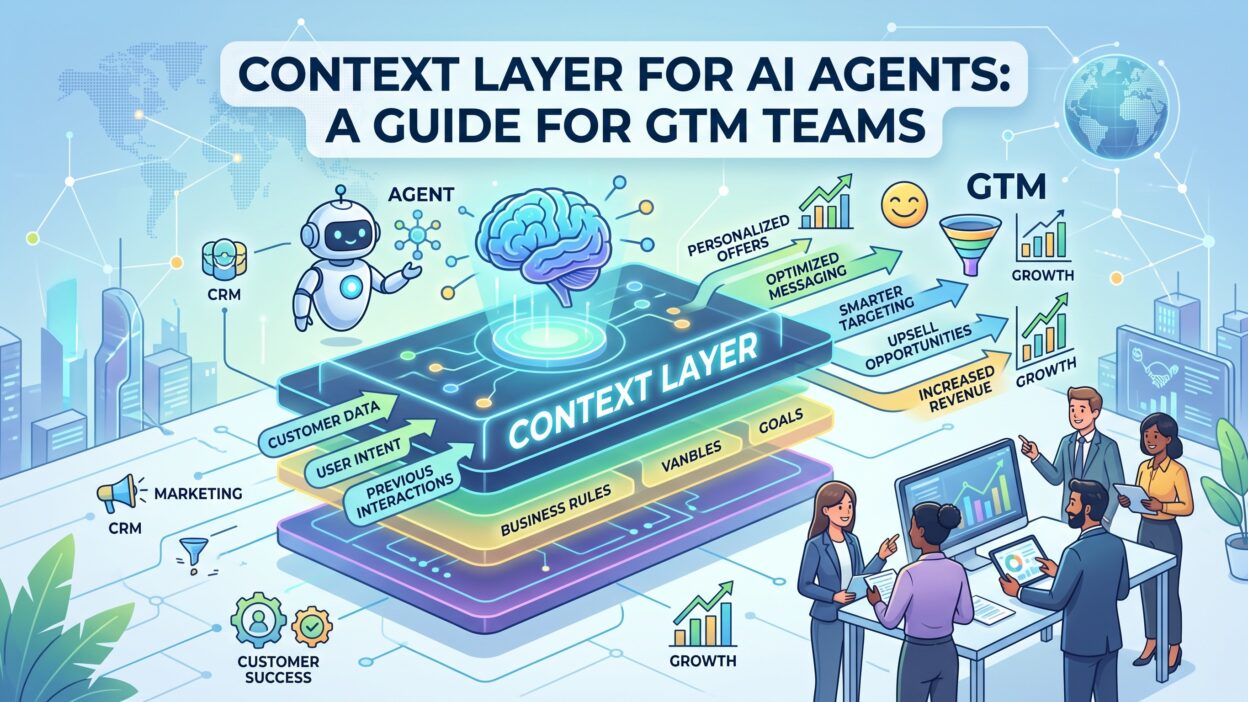
A context layer for AI agents is a governed surface that exposes verified data to any agent in your stack. It sits between raw systems, like your CRM and data warehouse, and the model doing the reasoning. Instead of an agent guessing at a contact’s role or a deal’s current stage, the context layer hands it a resolved answer.
Think of it as a single door. Behind that door sits your CRM, your intent data, your call transcripts, and your email history. An AI agent knocks once and gets a clean, ranked, permission-checked answer back. No stitching required.
A context layer for AI agents answers four things in one call. Which accounts and contacts matter for this task. How those entities connect to each other. What signals are active right now. What history explains the current situation. That combination turns a guess into a grounded action.
Why GTM Teams Need a Context Layer for AI Agents Now
Three shifts pushed this from a nice idea to a structural requirement.
The Shift from Dashboards to Autonomous Agents
Dashboards get built for humans. A rep reads a chart, applies judgment, and decides what to do next. An agent skips that judgment step entirely. It reads a context package and acts on it directly, often without a human checking the output first.
Data formatted for humans rarely transfers cleanly to agents. A field labeled “Status” means something different in five different tools. A context layer for AI agents resolves that ambiguity before the agent ever sees the data.
Agents Compound Errors at Machine Speed
A rep working from a bad record makes one mistake and corrects it on the next call. An agent working from the same bad record can run fifty downstream actions before anyone notices the problem. Speed turns a small data error into a large operational one.
This risk grows every quarter as GTM teams hand more execution to agents. A context layer for AI agents catches identity and signal problems before the agent acts, not after a customer receives the wrong message.
Messy Data No Longer Has Time to Get Cleaned
An agent generating an account brief in under twenty seconds cannot pause for someone to fix a duplicate record first. The data either resolves correctly at query time, or the output stays untrustworthy. Spreadsheets and manual cleanup used to buy teams time. Agents removed that buffer completely.
Core Components of a Context Layer for AI Agents
A working context layer is not one product. It runs as a set of capabilities working together.
Entity Resolution and Identity Matching
Large companies show up in a CRM under a dozen name variations. One context layer for AI agents job is matching every version of “Acme Corp” to a single resolved record. Without that step, an agent might treat one company as three separate accounts and act on incomplete information.
Identity resolution extends to people too. A contact who changed jobs six months ago still shows up under their old company in half your systems. A strong context layer tracks that change and updates every downstream record automatically.
Verified Signal and Intent Data
Raw activity data means little without context around it. A website visit from an unknown IP address tells an agent almost nothing useful. The same visit, resolved to a named account showing hiring growth and recent funding, tells a very different story.
A context layer for AI agents blends firmographic data, technographic data, and behavioral signals into one ranked view. That blend gives the agent enough situational awareness to prioritize the right accounts first.
Governed Permissions and Compliance
Not every agent should see every record. A context layer for AI agents enforces the same permission rules a human user would follow inside the CRM. Sensitive contract terms or compliance-flagged accounts stay restricted, even when an autonomous agent requests the data.
This governance layer also creates an audit trail. Enterprise buyers increasingly ask for proof of how an agent reached a decision, and permission logs answer that question directly.
Historical Action Memory
Agents need to know what happened before, not just what is happening now. Did a previous outreach sequence work on this account? Did a similar deal stall at the security review stage last quarter? A context layer for AI agents stores that history and feeds it back into future decisions, so the agent stops repeating mistakes.
Context Layer vs Semantic Layer vs RAG
These three terms get mixed up constantly, but they solve different problems.
A semantic layer makes sure dashboards agree on the numbers. It defines what “active customer” or “qualified lead” means across every report, so two teams pulling the same metric get the same result. A context layer for AI agents goes further. It tells the agent which numbers are current, approved, and safe to act on right now, not just which definition to use.
Retrieval-augmented generation solves a narrower problem than most teams expect. RAG finds a relevant passage in unstructured text and hands it to the model. Enterprise GTM questions rarely work that way. They span structured systems, depend on definitions nobody wrote down clearly, and require computation rather than simple retrieval. RAG alone cannot resolve entity identity or enforce governance, which is exactly where a context layer for AI agents fills the gap.
The Model Context Protocol, often called MCP, standardizes how an agent requests context from different sources. It moves context around efficiently, but it does not create that context. A well-built MCP request against a catalog with no verified data still returns nothing useful. The protocol only works as well as the governed layer sitting underneath it.
How a Context Layer for AI Agents Works in Practice
Picture a sales agent prepping for a discovery call tomorrow morning. Instead of pulling data from four separate tabs, the agent sends one request through the context layer.
The layer resolves the account identity first, matching every CRM record and email domain variation to one company. It then pulls active intent signals, recent funding news, and technographic changes tied to that account. Call history and past email threads get layered in next, showing what worked and what stalled in prior conversations.
The agent receives one ranked, resolved package back. It drafts talking points grounded in real account activity instead of generic industry assumptions. The rep opens the call already knowing which stakeholder just joined the buying committee and why.
Real-World Example: GTM Context Graphs in Action
ZoomInfo built one of the more visible implementations of this idea through its GTM Context Graph. The graph fuses verified B2B data, first-party CRM records, call history, and intent signals into one resolved entity map. AI agents access that graph through an API and through the Model Context Protocol, connecting to tools like Salesforce Agentforce, HubSpot Breeze, and Claude directly.
This matters because it shows the concept working at scale, not just in theory. When an agent inside a CRM tool asks for VP-level marketing leaders at fast-growing companies using a specific data warehouse, the context layer resolves that query against billions of signals in seconds. The agent gets a governed, ranked answer instead of a pile of unverified guesses.
Other vendors approach the problem from different angles. Some focus on metadata governance for internal data teams. Others focus purely on conversation intelligence feeding into a broader graph. The common thread across every serious implementation stays the same: raw access without verified structure does not make an agent trustworthy.
Common Mistakes Teams Make Building a Context Layer
Many GTM teams try the cheapest fix first. They bolt a chatbot onto the CRM, watch it hallucinate account details, and only then realize the problem sits in the data architecture, not the model.
Another common mistake treats MCP as a full context strategy on its own. Teams wire up the protocol, celebrate the integration, and still get bad answers because the underlying catalog has no verified definitions to serve. The protocol moves context. It does not manufacture context that never existed.
Ownership gaps also slow teams down. A context layer for AI agents touches data engineering, platform engineering, and AI engineering all at once. Projects stall when no single team owns the outcome. Naming one accountable lead early prevents months of stalled handoffs later.
How to Evaluate a Context Layer for AI Agents
Start with entity resolution quality. Ask any vendor how they handle duplicate accounts, subsidiary relationships, and job changes across contacts. Weak resolution here undermines everything built on top of it.
Check integration depth next. A context layer for AI agents should connect to your existing CRM, intent tools, and conversation intelligence platform without months of custom engineering. Native connectors save real implementation time compared to building custom pipelines from scratch.
Governance deserves equal weight. Ask how permissions travel with the data across every connected surface. An agent should never see a record a human user could not access through the same system.
Finally, test freshness. Contact and account data decays fast, with industry estimates suggesting a large share of B2B contact data goes stale within a year. A context layer that does not refresh signals continuously will feed agents outdated information within months of deployment.
Benefits of a Context Layer for GTM Teams
Sales reps stop losing time switching between a dozen tabs before every call. Marketing teams stop guessing which accounts show real buying intent versus noise. RevOps teams gain a single source of truth that every connected agent reads from, instead of each tool holding its own fragmented slice of context.
The compounding benefit matters most long term. A context layer for AI agents gets smarter every time the business defines a new metric or resolves a new entity. That improvement carries forward automatically to every agent connected to it, without rebuilding context from scratch for each new use case or model release.
Frequently Asked Questions
What is a context layer for AI agents in simple terms? A context layer for AI agents is a governed data surface that gives any AI agent verified, resolved information about accounts, contacts, and history in one request, instead of forcing the agent to guess or stitch data together manually.
How is a context layer different from a CRM? A CRM stores records for humans to read and update. A context layer for AI agents sits above multiple systems, including the CRM, and resolves identity, permissions, and signals across all of them into one machine-readable answer for an agent.
Do I need a context layer if I already use RAG? Yes, in most enterprise GTM cases. RAG retrieves relevant text passages well, but it does not resolve entity identity, enforce governance, or track structured relationships the way a context layer for AI agents does.
Does MCP replace the need for a context layer? No. MCP standardizes how an agent requests context from different sources. It moves context efficiently, but the governed data underneath still needs to exist for that request to return anything useful.
Which teams should own a context layer for AI agents? Ownership typically spans data engineering, platform engineering, and AI engineering. Successful projects name one accountable lead early, since shared ownership without a clear owner tends to stall implementation.
How do I know if my GTM data is ready for AI agents? Test entity resolution accuracy, signal freshness, and permission enforcement across your current stack. If agents already produce inconsistent or outdated answers, your team likely needs a context layer for AI agents rather than another point solution.
Read More:-How to Calculate Total Addressable Market and Perform TAM Analysis
Conclusion

GTM teams keep adding tools and keep getting the same fragmented results. Every new AI agent inherits that same fragmentation unless the data underneath changes first. A context layer for AI agents fixes the actual bottleneck instead of patching around it with another chatbot or another system prompt.
The teams pulling ahead in 2026 are not the ones running the most software. They are the ones whose agents reason from clean, resolved, governed data every single time. Building or buying a context layer for AI agents now saves months of rework later, once every workflow depends on agents acting correctly the first time.
Start small if a full enterprise rollout feels too large right now. Resolve your highest-value accounts first, connect one agent to that clean data, and expand from there. The architecture compounds, and every additional connection gets easier once the foundation holds.