Introduction
TL;DR Every real estate agent faces the same challenge. A lead comes in on a Sunday evening. You are at dinner with your family. By Monday morning, that lead has already talked to three other agents.
Speed matters enormously in real estate. Studies show that responding within five minutes of a lead inquiry increases conversion rates by up to nine times. No human agent can maintain that response speed around the clock, seven days a week.
AI for Real Estate solves this problem directly. It responds instantly, qualifies leads, schedules appointments, and keeps conversations warm until you step in to close. The best part is that it does all of this without sounding like a robot.
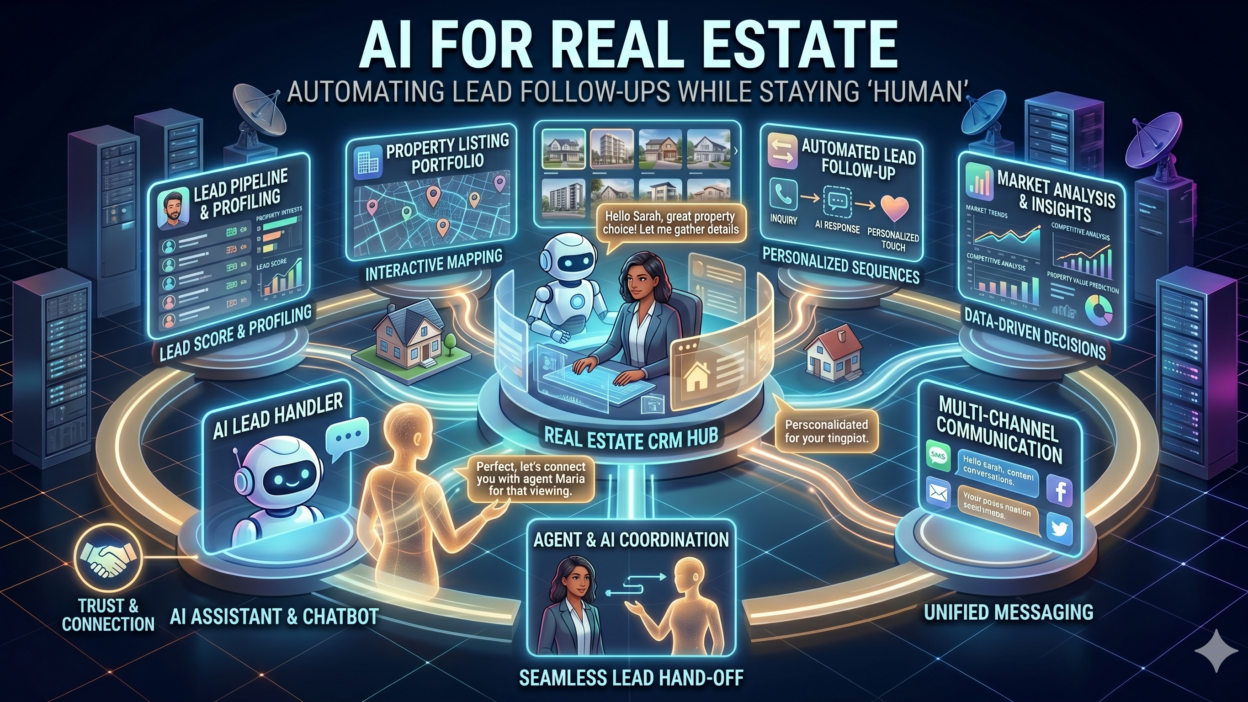
This blog breaks down exactly how AI for Real Estate automates lead follow-ups while keeping the human warmth that builds trust in a relationship-driven industry. Read every section carefully. Your competition is already paying attention to this.
Table of Contents
Why Real Estate Follow-Ups Fail Without Automation
Real estate agents are busy professionals. Between showings, open houses, negotiations, and paperwork, follow-up often falls through the cracks. A lead that does not hear from you within an hour starts losing confidence in your responsiveness.
Most agents rely on manual follow-up systems. They set reminders, write notes, and try to remember who needs a call this week. This system breaks down fast when your pipeline gets busy. Leads slip. Deals get lost.
AI for Real Estate fixes the inconsistency problem. Automation does not forget. It does not get tired. It does not skip follow-ups because a showing ran late. Every lead gets a timely, relevant message regardless of how busy your day gets.
The cost of poor follow-up is enormous. Research from the National Association of Realtors shows that most buyers contact multiple agents before choosing one. The agent who responds first and stays in touch consistently wins the relationship. AI for Real Estate makes consistent follow-up a system, not a hope.
What AI for Real Estate Actually Does in a Follow-Up System
Instant Lead Response
AI for Real Estate responds to new leads within seconds of their inquiry. A buyer fills out a form on your website at 11 PM. The AI sends a personalized welcome message immediately. It introduces you, confirms their inquiry, and asks a qualifying question to start the conversation.
That instant response sets you apart from 90 percent of agents who reply the next business day. The lead feels seen and valued before you even wake up. Your AI has already started building the relationship on your behalf.
Lead Qualification and Scoring
Not every lead deserves the same level of attention right away. AI for Real Estate qualifies leads automatically by asking smart questions. It finds out the buyer’s timeline, budget range, preferred neighborhoods, and financing status.
The AI scores each lead based on their responses. Hot leads who are ready to buy now get flagged for your immediate attention. Warm leads who are six months out get placed in a long-term nurture sequence. Cold leads stay in the system without cluttering your active pipeline.
Automated Drip Campaigns
AI for Real Estate runs multi-step drip campaigns that keep leads engaged over weeks and months. The campaign sends relevant market updates, neighborhood insights, new listing alerts, and educational content on a schedule you define.
Each message feels personal because the AI personalizes them based on what the lead told you during qualification. A buyer interested in downtown condos gets different content than a family looking for suburban homes with good school districts.
Appointment Scheduling
AI for Real Estate handles appointment scheduling without the back-and-forth email chains that waste time. The AI checks your calendar availability and offers open slots directly in the conversation. The lead picks a time. The appointment goes straight into your calendar.
Confirmation messages and reminders go out automatically. No-show rates drop significantly when leads receive a reminder the night before and two hours before the scheduled showing.
Re-Engagement of Cold Leads
Cold leads sit in most CRMs gathering dust. AI for Real Estate runs re-engagement campaigns that bring cold leads back to life. A message like “The market just shifted in your area — here are three new listings that match what you told me you were looking for” gets responses from leads who went silent months ago.
How to Keep AI Follow-Ups Feeling Human
The biggest fear agents have about AI for Real Estate is that messages will feel robotic. That fear is valid. A cold, templated message does more damage than no message at all. But the solution is straightforward when you approach it correctly.
Write Your Own Voice Into the Templates
Your AI follow-up messages should sound exactly like you. Before setting up any automation, write five to ten sample emails in your natural tone. Include phrases you use regularly. Avoid corporate language. Use contractions. Keep sentences short.
Feed those samples into your AI tool as the style guide. Good AI for Real Estate platforms let you customize every message template. The AI follows your voice, not a generic script. Leads cannot tell the difference between a message you wrote manually and one your AI sent.
Use the Lead’s First Name and Specific Details
Generic messages destroy trust instantly. Every automated message should address the lead by first name. Reference the specific property they inquired about or the neighborhood they mentioned. Use the details from the qualification conversation.
AI for Real Estate platforms pull data from your CRM to personalize each message automatically. A lead named Sarah who asked about three-bedroom homes in Austin should receive a message that mentions Sarah, three-bedroom homes, and Austin. That specificity signals human attention even when the message comes from an AI.
Know When to Hand Off to a Human
AI for Real Estate works best when it handles the early stages of lead nurturing. Once a lead signals serious buying intent, a human agent should step in. The AI recognizes these signals: responses like “I am ready to schedule a viewing” or “Can we talk this week” trigger an alert to the agent immediately.
The handoff moment is critical. Your AI should introduce you personally in its final message before you take over. Something like “James, our lead specialist, will reach out to you personally within the hour” sets the right expectation. The lead feels the transition instead of experiencing a sudden change in tone.
Avoid Over-Automating
AI for Real Estate should augment your relationship-building, not replace it. Set boundaries for your automation. After three or four automated touchpoints, a personal call or personalized video message from you carries enormous weight. The contrast between AI-assisted follow-up and genuine personal outreach makes the human moments feel even more special.
Top AI for Real Estate Tools That Agents Use in 2025
Follow Up Boss
Follow Up Boss is one of the most popular CRM and automation platforms built specifically for real estate teams. It integrates with hundreds of lead sources and automates follow-up sequences across email, SMS, and calls. The AI prioritizes your lead list every morning based on engagement signals.
The platform suits teams of all sizes. Solo agents use it to stay organized. Large brokerages use it to manage hundreds of leads across multiple agents. The learning curve is manageable for non-technical users.
Sierra Interactive
Sierra Interactive combines a real estate website, CRM, and AI follow-up system in one platform. The AI behavior engine tracks every action a lead takes on your website. It sends automated messages triggered by specific behaviors like repeated property views or saved searches.
Sierra’s AI for Real Estate approach is behavior-driven. A lead who views the same property three times receives a message asking if they want to schedule a viewing. That kind of intelligent triggering feels natural and timely rather than scripted.
Ylopo
Ylopo uses AI to run dynamic retargeting ads and automated lead nurturing simultaneously. The platform’s AI text assistant called Raiya handles SMS conversations with leads around the clock. Raiya qualifies leads, answers questions, and books appointments directly from a text conversation.
AI for Real Estate through Ylopo works particularly well for high-volume lead generation campaigns. The platform handles the nurturing load that human agents cannot sustain at scale.
Lofty (formerly Chime)
Lofty is a comprehensive real estate platform with strong AI capabilities. Its AI assistant handles lead conversations via chat, email, and SMS. The platform includes predictive analytics that identifies which leads in your database are most likely to buy or sell in the next 90 days.
Lofty’s AI for Real Estate feature set appeals to data-driven agents who want insight beyond basic automation. The predictive scoring helps agents prioritize outreach based on actual intent signals rather than guesswork.
Structurely
Structurely specializes in AI-powered conversation. Its AI assistant called Aisa Holmes conducts real, two-way conversations with leads via SMS and email. The AI handles objections, answers common questions, and schedules appointments without human intervention.
Structurely’s AI for Real Estate focus is purely on conversation quality. The platform trains its AI specifically on real estate conversations. Leads regularly mistake Aisa for a human assistant during early interactions.
How to Set Up an AI Lead Follow-Up System for Your Real Estate Business
Audit Your Current Lead Sources
Before building any automation, map every place a lead can enter your pipeline. Website forms, Zillow inquiries, open house sign-in sheets, referrals, and social media all count. Each lead source may need a different initial response sequence.
AI for Real Estate works best when every lead source connects directly to your CRM. Manual data entry is the enemy of automation. Set up direct integrations wherever possible so leads flow in automatically without human data entry.
Define Your Lead Stages
Create clear categories for your leads: new, contacted, qualified, hot, nurturing, and closed. Each stage should have a specific follow-up sequence. New leads get an instant response. Qualified leads get personalized content. Hot leads get personal attention from you directly.
AI for Real Estate automates the transitions between stages based on lead behavior. A lead who opens three emails and clicks a listing link moves automatically from nurturing to qualified. You receive a notification to reach out personally.
Write Your Message Templates
Write every automated message in your own voice before setting up the sequences. Plan out a 30-day sequence for new leads: a welcome message, a neighborhood market update, a listing alert, a check-in message, and a re-engagement message at day 30.
AI for Real Estate platforms let you customize timing, channels, and content for each touchpoint. Build in variation so leads do not receive identical messages every time. Alternate between email and SMS to meet leads on their preferred channel.
Set Up Handoff Triggers
Define the exact signals that tell your AI to hand a lead over to a human. Common triggers include a lead replying with a question, a lead mentioning a specific timeline, a lead viewing the same property more than twice, or a lead booking a call directly.
When the AI for Real Estate system detects a handoff trigger, it sends you an alert with the full conversation history. You see exactly what the lead said, what your AI replied, and what the lead’s stated interests are. You step into the conversation fully informed.
Monitor, Test, and Improve
Your first automation setup will not be perfect. Check your open rates, response rates, and appointment booking rates weekly for the first month. Adjust subject lines, message timing, and content based on what the data shows.
AI for Real Estate systems improve over time when you feed them feedback. If certain messages consistently underperform, rewrite them. If certain triggers consistently produce hot leads, create more sequences around similar behaviors.
Common Mistakes Agents Make With AI for Real Estate
Sending Too Many Messages Too Quickly
Aggressive follow-up sequences push leads away. Three messages in the first 24 hours signals desperation. Space your initial follow-up across the first week. One message within five minutes of inquiry, one the following morning, and one three days later covers the critical early window without overwhelming the lead.
Using Generic Templates Without Personalization
Template messages that start with “Dear Valued Customer” or reference no specific property details fail every time. Always personalize your AI for Real Estate messages with the lead’s name, their stated preferences, and the specific listing or area they asked about.
Automating Too Far Into the Relationship
Some agents automate every touchpoint right through to contract signing. That approach destroys trust at the most critical stages of the relationship. Use AI for Real Estate to handle early nurturing and qualification. Reserve personal communication for showings, offers, negotiations, and closing.
Never Reviewing AI Conversations
Your AI has conversations with leads on your behalf every day. Review a sample of those conversations weekly. Look for moments where the AI gave an awkward response, failed to answer a question well, or missed an obvious handoff signal. Use those learnings to improve your templates and triggers.
The Real ROI of AI for Real Estate Lead Follow-Up
Real estate agents who implement AI for Real Estate follow-up systems consistently report meaningful improvements in their numbers. Response time drops from hours to seconds. Lead contact rates increase significantly because the first message goes out before a competitor can respond.
Appointment booking rates improve when leads receive timely, relevant follow-up instead of delayed or forgotten outreach. A study by MIT found that contacting a lead within the first five minutes makes you 100 times more likely to connect than reaching out after 30 minutes.
Long-term nurture campaigns produce deals that manual follow-up would never close. Leads who are six months from buying represent enormous future revenue. AI for Real Estate keeps those leads warm without requiring your daily attention.
The cost savings are equally significant. AI for Real Estate automates work that would otherwise require a full-time inside sales agent. Many teams report replacing a $50,000 per year ISA role with an AI platform that costs a fraction of that amount monthly.
Frequently Asked Questions About AI for Real Estate
Does AI for Real Estate replace human agents?
No. AI for Real Estate handles the repetitive, time-sensitive parts of lead follow-up. Human agents close deals, build relationships, conduct showings, and negotiate contracts. The AI frees agents to focus on high-value human interactions instead of chasing cold leads manually.
How do leads feel about talking to an AI?
Most leads do not know they are talking to an AI during early conversations when the messages are well-written and personalized. The key is message quality and timing. An AI that responds instantly with a relevant, warm message creates a better first impression than a human who responds 24 hours later with a generic reply.
Which AI for Real Estate tools work best for solo agents?
Solo agents benefit most from platforms like Follow Up Boss, Lofty, or Structurely. These tools are affordable at the individual level and do not require a large team to manage. Each platform provides guided onboarding so solo agents can get started without technical support.
How long does it take to set up AI lead follow-up in real estate?
Basic setup on most AI for Real Estate platforms takes between two and five days. Writing your message templates takes the most time. Full optimization of sequences, triggers, and handoff rules takes about 30 days of live use and iteration.
Is AI for Real Estate compliant with real estate regulations?
Compliance depends on your specific market and the platform you choose. Most reputable AI for Real Estate platforms include TCPA-compliant SMS features, unsubscribe options, and data privacy protections. Always review your platform’s compliance documentation and consult your broker about local regulations before deploying automated messaging.
Can AI for Real Estate handle both buyers and sellers?
Yes. AI for Real Estate tools work for both buyer leads and seller leads. Seller campaigns focus on home valuation offers, market update reports, and listing presentation invitations. Buyer campaigns focus on new listing alerts, neighborhood data, and mortgage rate updates. Each audience gets a tailored sequence.
What happens when a lead asks a complex question the AI cannot answer?
Good AI for Real Estate platforms recognize when a question falls outside their scope. They flag the conversation for human review and let the lead know that their agent will follow up personally with a detailed answer. The AI never makes up information or gives incorrect advice about properties, pricing, or contracts.
Read More:-Staff Augmentation vs Managed Services: The Build vs Run Decision
Conclusion

The real estate industry runs on trust. Buyers and sellers make the biggest financial decisions of their lives through an agent they trust. No AI replaces that trust. AI for Real Estate builds the foundation for that trust to develop.
Speed, consistency, and personalization are what AI does best. Empathy, negotiation, and local expertise are what you do best. When you combine both, you build a business that responds faster, nurtures better, and closes more deals than any purely manual approach can sustain.
AI for Real Estate does not make you less human. It gives you more time to be human where it matters most. Instead of chasing cold leads with manual follow-ups, you spend your energy on warm conversations with buyers and sellers who are ready to move.
The agents who win in 2025 and beyond will not be the ones who resist automation. They will be the ones who use AI for Real Estate intelligently, staying warm and personal at every critical moment while letting technology handle the rest.
Start small. Pick one lead source. Build one follow-up sequence. Measure the results over 30 days. You will see the difference immediately. Then expand from there. Every sequence you add compounds your productivity and grows your pipeline.