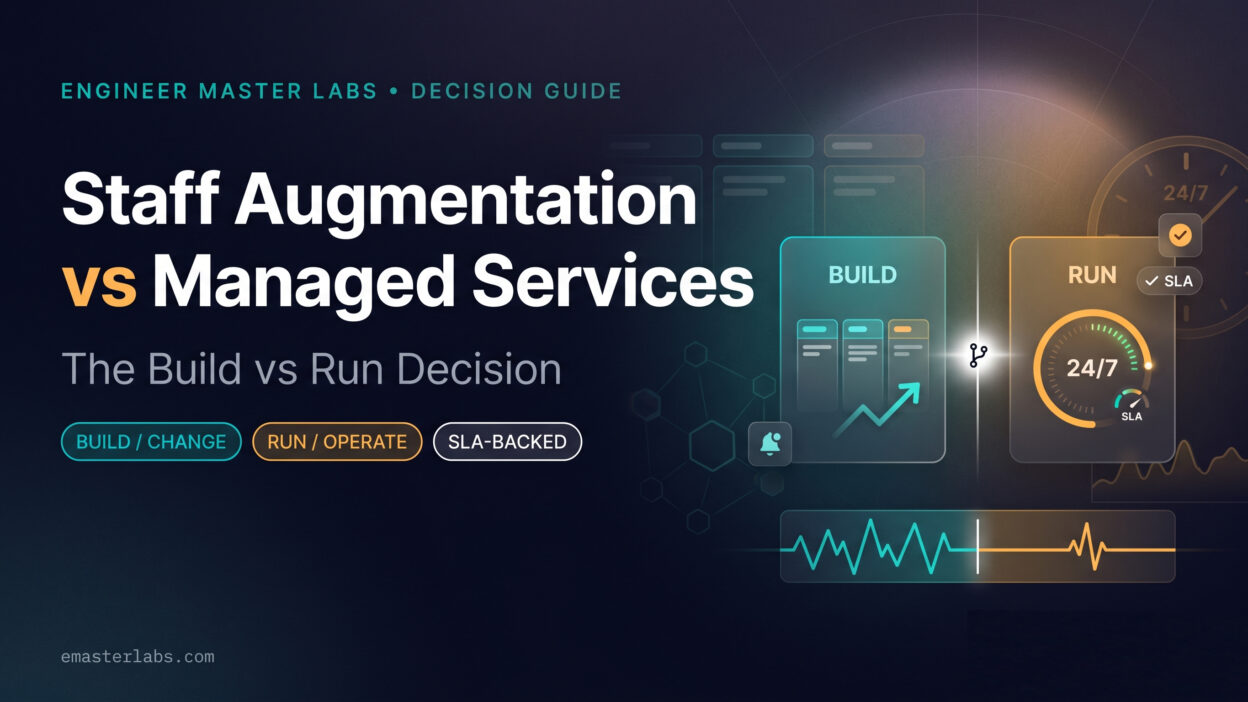
TL;DR Staff augmentation gives you engineers who work under your direction. Managed services gives you a function that runs itself under an SLA. Same vendor industry, completely different products. Get the choice wrong and you’ll either pay for management you didn’t need or lack the management you did. This post breaks down the real difference, the situations where each wins, and the hybrid pattern that most mature programs end up using.
Staff augmentation versus managed services is the most expensive choice most engineering buyers make without realizing it’s a choice. The two models look similar on a sales call. The vendor presents engineers, talks about technology, and quotes a number. What separates them shows up in month three when your operations break, or month nine when your product roadmap shifts.
This post explains what you’re actually buying with each model and why the difference matters more than the price.
Table of Contents
The Core Difference
Staff augmentation gives you engineers. You direct them. You manage them. You decide what they work on and how. The vendor handles the recruiting, payroll, and bench depth. You handle the engineering decisions.
Managed services gives you a function. The vendor runs cloud operations, security monitoring, helpdesk support, or whatever the function is. You agree on outcomes (uptime, response time, ticket resolution) and pay for the SLA. The vendor figures out staffing, scheduling, processes, and tools.
Augmentation is buying labor with management included. Managed services is buying an outcome with everything else included.
What Managed Services Actually Covers
Managed services typically wraps around stable, repeatable functions. Common categories:
Cloud operations. 24/7 infrastructure monitoring, incident response, capacity planning, cost optimization. The vendor watches your cloud, fixes problems, and provides regular reports.
DevSecOps. CI/CD pipeline maintenance, security scanning, vulnerability management, compliance reporting. Often paired with cloud ops.
Application support. L1, L2, L3 support for production applications. Bug triage, hotfix deployment, on-call rotation.
Data operations. ETL pipeline monitoring, data warehouse maintenance, BI dashboard support, data quality checks.
Helpdesk and IT support. End-user support, asset management, access provisioning. The most commoditized managed services category.
Specific platform management. Salesforce admin, ServiceNow operations, Workday support. Vendors specialize in specific platforms and provide steady-state operations.
The pattern: things that need constant attention, can be measured against an SLA, and don’t change much month to month.
Side-by-Side Comparison
| Dimension | Staff Augmentation | Managed Services |
|---|---|---|
| What you buy | Engineers | An outcome / SLA |
| Who manages the work | You | Vendor |
| Pricing model | Per-engineer monthly | Per-outcome / per-SLA |
| Best for | Build / change | Run / operate |
| Scope flexibility | High | Low (defined by SLA) |
| Required client expertise | Engineering management | Vendor management |
| Cost predictability | Medium | High |
| Speed to start | 2-4 weeks | 4-12 weeks |
| Change-friendly | Yes | No |
When Augmentation Wins
Five situations where augmentation is clearly the answer:
You’re building, not operating. New features, new products, refactors, migrations. Anything that’s a project, not a function.
The work changes frequently. Sprint priorities shift. Customer feedback drives direction. The team adjusts. Managed services is built for stability, not change.
You have engineering management. Tech leads, engineering managers, architects on staff. The augmented engineers slot into your existing structure.
Cost arbitrage matters more than predictability. You can afford some month-to-month variance in exchange for lower total cost.
You want flexibility to convert engineers to full-time later. Augmentation typically allows this. Managed services typically doesn’t.
When Managed Services Wins
Five situations where managed services is clearly the answer:
You’re operating something stable. Production cloud infrastructure that needs 24/7 attention. A SaaS app that needs L2/L3 support. A platform that needs ongoing administration. Functions, not projects.
You don’t have engineering management capacity for the function. Building a 24/7 ops team is expensive and slow. A managed services vendor has the team already.
Cost predictability is a binding constraint. CFO needs a fixed monthly number. Managed services delivers it.
You need 24/7 coverage. Building round-the-clock shifts internally costs at least $400K-700K annually for a small team. Managed services bundles this into a much smaller number.
The function is non-strategic. The work needs to happen but it’s not a competitive differentiator. No strategic reason to retain the capability internally.
The Cost Comparison
For comparable scope, managed services often looks cheaper on paper because it’s optimized for repeatable work. Augmentation often looks cheaper for project work because you’re not paying for SLA infrastructure.
Example: 24/7 cloud operations for a mid-sized SaaS company.
Augmentation approach:
- 4 senior DevOps engineers across shifts: ₹16 lakhs/month
- Tooling and infrastructure: ₹2 lakhs/month
- Internal management overhead: ~20% of engineer cost
- Annual cost: ~₹2.4 crores
Managed services approach:
- Comprehensive ops SLA with monitoring, response, capacity, cost optimization: ₹12-18 lakhs/month
- Tooling included
- Vendor handles management
- Annual cost: ~₹1.4-2.2 crores
For steady-state ops, managed services often wins on total cost. For project-driven work, augmentation wins.
The Hybrid Pattern
Most mature engineering programs end up running both models in parallel:
Augmentation for the build. Product teams, feature development, migrations, refactors. The work that changes constantly and needs engineering judgment.
Managed services for the run. Cloud operations, security monitoring, application support. The work that needs to be reliable and doesn’t change much.
The split tracks the build/run distinction in modern engineering organizations. Build teams get augmented capacity for project velocity. Run teams use managed services for steady-state coverage.
The two models can come from the same vendor or different vendors. Same-vendor is simpler operationally. Different-vendor often delivers better quality because each provider focuses on their core strength.
Common Misuses of Each Model
Three patterns that go wrong:
Using augmentation for steady-state operations. Augmented engineers don’t optimize for SLA performance. They optimize for project completion. Stick them on a 24/7 ops rotation and quality erodes within months.
Using managed services for build work. The vendor’s incentive is SLA compliance, not engineering quality. Build work outsourced as managed services produces minimal-acceptable code, not great code.
Switching between models mid-engagement. The vendor staffs differently for each model. Switching mid-engagement usually means losing the team and starting over.
SLAs That Actually Matter
If you’re going managed services, the SLAs are everything. Generic uptime numbers don’t tell you much. The SLAs that matter:
- Time to detection (TTD) for incidents at each severity
- Time to acknowledgment (TTA) once detected
- Time to resolution (TTR) at each severity
- Mean time between failures (MTBF) for managed components
- Cost optimization SLAs (% reduction in cloud spend YoY)
- Patch latency for security vulnerabilities
- RPO and RTO for backups and disaster recovery
Each SLA should have specific numbers, measurement methodology, and financial penalties for misses. Soft SLAs without consequences are marketing language, not commitments.
Decision Framework
Three questions in order:
1. Is the work building something or running something? Building goes to augmentation. Running goes to managed services. This question alone resolves 80% of cases.
2. Do I have management capacity for this work? If yes, augmentation is on the table. If no, managed services or outsourced project work.
3. Is cost predictability a hard requirement? If yes, managed services or fixed-price outsourcing. If flexibility matters more, augmentation.
Most engineering buyers default to augmentation because it feels more flexible. They’re often right for build work and often wrong for run work. The build/run distinction matters more than any other.
Working With Engineer Master Labs
Engineer Master Labs primarily offers staff augmentation because that’s where most of our clients need help: building products, scaling teams, shipping features. We also support managed services engagements for cloud operations, application support, and DevSecOps for clients who need both build and run from the same partner.
Most of our hybrid engagements start as augmentation, then layer in managed services as production systems mature. The transition feels natural because the same engineering culture covers both sides.
If you’re trying to decide between augmentation and managed services for a specific need, the fastest way to clarify is a 60-minute scoping call. We’ll walk through whether you’re building or running, your management capacity, and your cost constraints, and recommend the right model.
📧 Email: [email protected]
📞 Phone: 1-347-543-4290
🌐 Website: emasterlabs.com