Introduction
What Is HubSpot Breeze? A Full Overview
TL;DR HubSpot launched Breeze as its core AI layer. It sits inside the HubSpot CRM ecosystem. Breeze covers four main areas: Breeze Copilot, Breeze Agents, Breeze Intelligence, and Breeze Features.
Breeze Copilot acts like a smart assistant inside your HubSpot workspace. It helps you draft emails, summarize CRM records, and plan tasks. You do not need to leave your dashboard to use it.
Breeze Agents are purpose-built bots. Each agent handles a specific job. The Content Agent writes blog posts, landing pages, and social media copy. The Social Agent manages your social publishing schedule. The Prospecting Agent researches leads and writes outreach messages. The Customer Agent handles support tickets around the clock.
Breeze Intelligence adds data enrichment to your CRM. It pulls company and contact data from a large database. It also tracks buyer intent signals. You get a clearer picture of who is ready to buy.
HubSpot designed Breeze for teams that already use HubSpot CRM. If you run marketing, sales, and support from a single platform, Breeze feels natural. There is no complicated setup. The learning curve is low.
Table of Contents
What Is Salesforce Agentforce? A Full Overview
Salesforce released Agentforce in late 2024. It is a platform for building and deploying AI agents inside Salesforce. These agents use the Atlas Reasoning Engine to think through tasks step by step.
Agentforce works across multiple Salesforce clouds. It connects with Sales Cloud, Service Cloud, Marketing Cloud, and Commerce Cloud. You can build custom agents for almost any workflow.
The platform includes pre-built agent templates. These cover sales development, customer service, field service, and commerce. Each template gives you a starting point. Developers can customize them using low-code tools.
Agentforce also uses Data Cloud. It pulls from a unified customer data layer across your entire Salesforce org. The AI has access to real-time data when it makes decisions.
Salesforce designed Agentforce for enterprises. Large organizations with complex workflows find the most value here. Setup requires Salesforce expertise. Implementation takes planning, time, and technical resources.
HubSpot Breeze vs. Salesforce Agentforce: Core Feature Comparison
Ease of Use
HubSpot Breeze wins on simplicity. You activate it inside your existing HubSpot account. Most features are ready without configuration. Small and mid-sized teams get value from day one.
Salesforce Agentforce requires more groundwork. You need a Salesforce admin or developer to set up agents properly. Enterprises with dedicated IT teams handle this fine. Smaller teams find it harder to get started.
AI Agent Capabilities
Breeze Agents cover four clear use cases: content creation, social media, sales prospecting, and customer support. Each agent does its job well within the HubSpot environment. The agents follow instructions with minimal oversight.
Agentforce agents are broader and more customizable. You define the topics they handle, the actions they take, and the guardrails they follow. The Atlas Reasoning Engine lets agents handle multi-step decisions. This makes Agentforce more powerful for complex enterprise workflows.
Data and Intelligence
Breeze Intelligence enriches contact and company records. It provides intent data to help prioritize outreach. The data coverage is solid for B2B teams.
Agentforce uses Data Cloud for a deeper data foundation. It brings together data from every Salesforce product. The AI reasons across a much larger data set. Enterprises with massive customer data get more from Agentforce here.
Integration and Ecosystem
HubSpot Breeze integrates with the full HubSpot suite. It also connects with popular third-party tools through HubSpot’s app marketplace. If your stack already runs on HubSpot, Breeze plugs in seamlessly.
Agentforce connects across the Salesforce ecosystem. It also works with MuleSoft for external integrations. Large enterprises with Salesforce at the center of their stack benefit most from this connectivity.
Pricing and Accessibility
HubSpot offers Breeze Copilot free to all users. Some Breeze Agents and Intelligence features require paid plans. The pricing is transparent and accessible for growing teams.
Salesforce Agentforce pricing is more complex. Salesforce charges per conversation for some agents. Enterprise licensing adds additional layers. Budget planning requires careful calculation for large-scale deployments.
Who Should Use HubSpot Breeze?
HubSpot Breeze suits small to mid-sized businesses well. If your team uses HubSpot CRM daily, Breeze feels like a natural extension. You do not need a large IT team to get started.
Marketing teams love the Content Agent. It speeds up content production significantly. Social media managers use the Social Agent to maintain publishing schedules without manual effort.
Sales teams rely on the Prospecting Agent. It researches leads and drafts personalized outreach. Your reps spend more time on calls and less time on research.
Support teams deploy the Customer Agent for 24/7 ticket handling. It resolves common questions instantly. Human agents focus on complex or sensitive issues.
If you want AI automation without a steep learning curve, HubSpot Breeze vs. Salesforce Agentforce tips clearly in favor of Breeze for your situation. Growing companies with limited technical resources get real value here fast.
Who Should Use Salesforce Agentforce?
Salesforce Agentforce fits enterprise organizations best. Large businesses with complex sales cycles, multi-cloud Salesforce setups, and dedicated IT teams get the most out of this platform.
Service teams managing millions of customer interactions benefit from Agentforce’s scalable customer service bots. The agents handle high volumes without degrading performance.
Sales organizations with sophisticated workflows use Agentforce to automate lead qualification, opportunity updates, and follow-up sequences across large territories.
Commerce teams leverage Agentforce for personalized product recommendations and order management automation. The connection to Commerce Cloud makes this work smoothly.
If your organization already runs deeply on Salesforce products, Agentforce fits naturally. In the HubSpot Breeze vs. Salesforce Agentforce debate, Agentforce makes sense when you need enterprise-scale customization and have the technical resources to support it.
Strengths of HubSpot Breeze
Breeze delivers speed. You activate it and see results quickly. There is no complex deployment plan. Teams become productive within days of enabling the features.
Breeze provides a unified experience. Your CRM data, marketing tools, sales pipeline, and AI layer all live in one place. There is no friction between systems.
The Content Agent saves enormous amounts of time for content teams. It produces SEO-ready drafts, social posts, and landing page copy on demand. Editing is faster than starting from scratch.
Breeze Intelligence removes the manual work of researching leads. Reps get enriched contact profiles without lifting a finger. Intent signals help prioritize the highest-value prospects.
For HubSpot Breeze vs. Salesforce Agentforce comparisons focused on ROI speed, Breeze consistently scores well among SMB and mid-market teams.
Strengths of Salesforce Agentforce
Agentforce delivers depth. Enterprises can configure agents to handle extremely complex multi-step workflows. The Atlas Reasoning Engine adds genuine intelligence to agent decision-making.
The platform scales without limits. You can deploy agents across thousands of customers and millions of interactions. Performance remains consistent at enterprise scale.
Agentforce connects to Salesforce Data Cloud. This gives agents access to a full, unified view of the customer. Better data leads to smarter decisions and more relevant interactions.
The customization options are extensive. Developers can build agents that match unique business processes precisely. Pre-built templates speed up development without sacrificing flexibility.
For large organizations evaluating HubSpot Breeze vs. Salesforce Agentforce, Agentforce represents a long-term investment in enterprise AI infrastructure.
Weaknesses of HubSpot Breeze
Breeze has limitations in customization. You work within HubSpot’s defined agent framework. Deep workflow customization is not always possible without workarounds.
Breeze Intelligence data coverage may not satisfy every niche market. Some industries find gaps in the contact and company data available.
The platform depends heavily on your existing HubSpot setup. Teams that use multiple CRMs or run fragmented tech stacks get less value from Breeze.
Advanced AI reasoning is not Breeze’s strength. For simple, well-defined tasks, it performs well. For complex, multi-step enterprise decisions, it has boundaries.
Weaknesses of Salesforce Agentforce
Agentforce has a steep learning curve. Implementing it correctly requires Salesforce expertise. Organizations without strong technical teams face longer timelines and higher costs.
Pricing complexity makes budgeting difficult. The per-conversation model adds unpredictability for high-volume use cases. Total cost of ownership can grow quickly for enterprise deployments.
Smaller businesses find Agentforce overwhelming. The platform’s power becomes a burden when your team lacks the resources to configure and maintain it properly.
The dependency on the Salesforce ecosystem is both a strength and a weakness. Organizations with mixed CRM environments face significant integration challenges.
Real-World Use Cases: HubSpot Breeze vs. Salesforce Agentforce
Content Marketing
A mid-sized SaaS company uses HubSpot Breeze to produce 20 blog posts per month. The Content Agent generates first drafts. Editors refine and publish them. Content output triples without adding headcount.
A global enterprise uses Agentforce to personalize email campaigns at scale. Agents pull data from Data Cloud to tailor messaging for each segment. Engagement rates improve across all markets.
Sales Prospecting
A B2B sales team uses Breeze’s Prospecting Agent to research 100 leads per day. Each lead profile includes company data, contact information, and recommended talking points. Reps book more meetings with less research time.
An enterprise sales organization uses Agentforce to qualify inbound leads automatically. Agents ask qualification questions via chat, score the lead, and route it to the right rep. Sales velocity increases.
Customer Support
An e-commerce brand deploys Breeze’s Customer Agent to handle order tracking, return requests, and common FAQs. Customer satisfaction scores hold steady even as ticket volumes grow.
A telecommunications giant uses Agentforce to handle millions of service interactions monthly. Agents resolve billing disputes, plan changes, and technical issues. Human agents step in only for escalations.
Implementation Timeline and Complexity
Breeze implementation is fast. Most teams are up and running within days. HubSpot provides guided setup, help documentation, and in-app prompts. You do not need external consultants for standard deployments.
Agentforce implementation takes longer. Large enterprises typically spend weeks or months on configuration, testing, and rollout. Salesforce partners and certified consultants often lead the implementation. Budget for this additional investment.
For teams evaluating HubSpot Breeze vs. Salesforce Agentforce on a tight launch timeline, Breeze is the clear winner. Speed-to-value matters for teams under pressure to show AI ROI quickly.
Security, Compliance, and Data Privacy
HubSpot Breeze follows HubSpot’s established data privacy standards. It complies with GDPR, CCPA, and other major regulations. Data stays within your HubSpot account environment.
Salesforce Agentforce meets enterprise-grade security requirements. Salesforce holds numerous compliance certifications including SOC 2, ISO 27001, and FedRAMP. Large regulated industries trust the Salesforce security model.
Both platforms take data privacy seriously. For highly regulated industries like finance or healthcare, Agentforce’s compliance depth may provide an edge. For most businesses, Breeze’s security posture is sufficient.
Frequently Asked Questions
Is HubSpot Breeze free to use?
Breeze Copilot is free for all HubSpot users. Some Breeze Agents and Breeze Intelligence features require a paid HubSpot subscription. Check HubSpot’s pricing page for current plan details.
How much does Salesforce Agentforce cost?
Salesforce Agentforce pricing depends on usage and configuration. Salesforce charges per conversation in some deployment models. Enterprise contracts add additional licensing costs. Contact Salesforce for a custom quote based on your organization’s needs.
Which is better for small businesses?
HubSpot Breeze is the better choice for small businesses. It requires no dedicated IT team. Setup is fast. The free tier provides immediate value. Agentforce is built for enterprise scale and complexity.
Can I use both HubSpot Breeze and Salesforce Agentforce?
Using both simultaneously is uncommon. Most organizations pick one CRM ecosystem and build their AI strategy around it. If you run both HubSpot and Salesforce, evaluate which platform your team uses most before choosing an AI agent solution.
Does Agentforce work without Salesforce CRM?
Agentforce is designed to work within the Salesforce ecosystem. It connects deeply with Salesforce CRM, Data Cloud, and other Salesforce products. Using it outside the Salesforce environment is not the intended use case.
Which AI agent is better for content creation?
HubSpot Breeze wins for content creation. The Content Agent produces blog posts, landing pages, emails, and social copy inside your HubSpot account. Agentforce does not focus on content production as a primary use case.
How does Breeze Intelligence differ from Agentforce’s Data Cloud?
Breeze Intelligence enriches your HubSpot CRM with third-party contact and company data. It adds buyer intent signals. Agentforce’s Data Cloud is a first-party data unification platform. It merges data from across your entire Salesforce environment for deeper AI reasoning.
Read More:-Staff Augmentation vs Outsourcing: How to Pick the Right Model
Conclusion

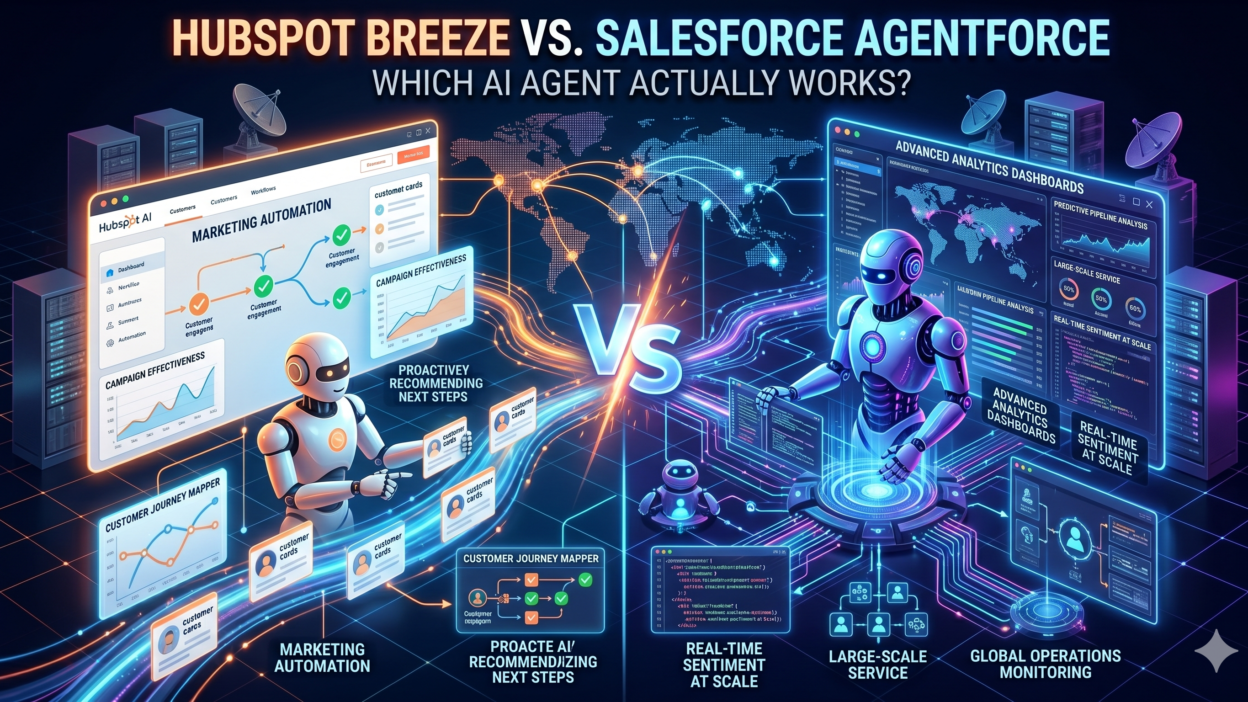
The HubSpot Breeze vs. Salesforce Agentforce decision comes down to one thing: your organization’s size, complexity, and technical resources.
HubSpot Breeze works best for small and mid-sized businesses. It is easy to activate, fast to deliver value, and built for teams that live inside HubSpot every day. Content teams, sales prospectors, and support teams all find immediate ROI without complex configuration.
Salesforce Agentforce works best for large enterprises. It offers unmatched customization, enterprise-scale performance, and deep data integration across the Salesforce ecosystem. Organizations willing to invest in implementation get a powerful, flexible AI agent platform.
Do not let the hype drive your decision. Evaluate your current stack, your team’s technical capacity, and the specific workflows you want to automate. Both platforms are strong in the right context.
In the HubSpot Breeze vs. Salesforce Agentforce race, there is no universal winner. There is only the right tool for your specific situation. Choose based on facts, not features lists.
Start with a free trial or a platform demo. Talk to your team. Map your workflows. Then make a decision grounded in real business needs. That approach always leads to better outcomes than chasing the most popular tool of the moment.