TL;DR Staff augmentation and outsourcing look similar from the outside but they fail in completely different ways. Augmentation gives you control and flexibility at the cost of management overhead. Outsourcing gives you predictability and outcome-ownership at the cost of flexibility. Pick wrong and you spend a year fighting your engagement model. This post lays out the actual difference, a decision framework, and the hybrid models that smart buyers use to get the best of both.
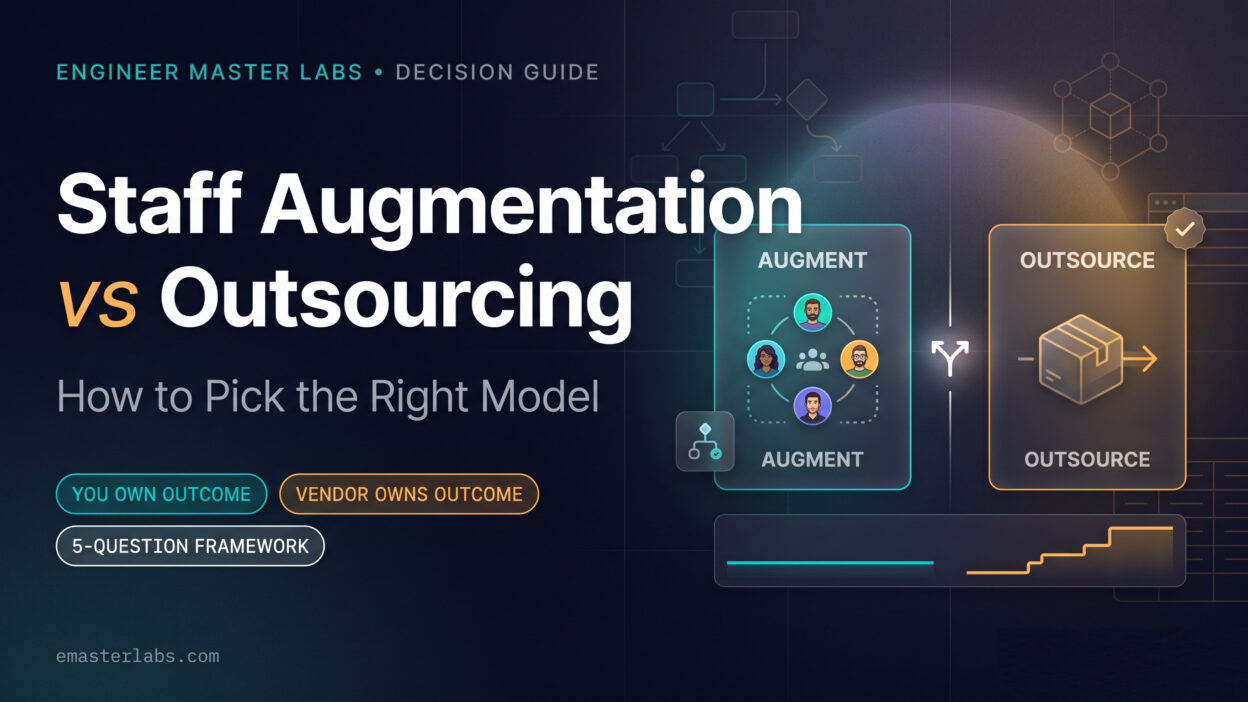
The difference between staff augmentation and outsourcing comes down to one question: who owns the outcome?
In staff augmentation, you do. The vendor provides engineers; you direct the work, integrate them into your team, and take responsibility for whether the project succeeds.
In outsourcing, the vendor does. You hand over a spec, agree on milestones, and receive a deliverable. The vendor figures out how to get there.
Both are valid. Both can save 30-50% versus full-time hiring. They suit completely different situations and they fail in completely different ways. This post helps you pick the right one and avoid the failure modes of each.
Table of Contents
The Core Difference
The clearest way to think about it:
Staff augmentation is hiring with a faster, more flexible interface. You’re still managing engineers. The vendor handles the recruiting, payroll, and bench so you don’t have to. But the day-to-day looks like managing employees. You assign work. You attend their standups. You review their code.
Outsourcing is buying an outcome. You don’t manage engineers. You manage a vendor relationship. The vendor figures out staffing, processes, and execution. You measure them on milestones and deliverables. The communication is at the project-manager level, not the engineer level.
This single distinction drives every other difference between the two models.
Side-by-Side Comparison
| Dimension | Staff Augmentation | Outsourcing |
|---|---|---|
| Outcome ownership | Client | Vendor |
| Control over how work is done | High | Low |
| Required spec clarity | Low to medium | High |
| Flexibility to change scope | High | Low (change orders) |
| Pricing model | Time and materials | Fixed price or milestone |
| Management overhead | High | Low |
| Suitable for evolving products | Yes | No |
| Suitable for stable specs | Yes (but overkill) | Yes (sweet spot) |
| Knowledge retention | Strong | Weak |
| Cost predictability | Medium | High |
When Staff Augmentation Wins
Five situations where augmentation is clearly the right answer:
Your product is evolving. Specs change weekly. Customer feedback drives priorities. The team learns and adjusts. Outsourcing this leads to constant change orders and cost overruns. Augmentation absorbs change naturally.
You have a strong tech lead but lack capacity. The architecture is sound, the practices are in place, you just need more hands. Augmented engineers integrate into the existing system without disruption.
Knowledge retention matters. Engineering knowledge accumulates with the team. With augmentation, that knowledge stays internalized in your processes and your tech lead. With outsourcing, the knowledge leaves with the vendor.
You’re integrating with internal systems heavily. Augmented engineers have ongoing access to your tools, your code, your data. Outsourcing teams have project-bounded access. The integration overhead favors augmentation when systems are tightly coupled.
You need optionality. Convert engineers to full-time. Pivot the team to a different project. Scale up or down based on revenue. Augmentation gives you all of this. Outsourcing locks you into a contract and a deliverable.
When Outsourcing Wins
Five situations where outsourcing is clearly the right answer:
You have a clear, stable spec. A defined feature with known requirements, no integration with existing systems, predictable scope. Outsourcing prices this efficiently because the vendor can plan and optimize.
You don’t have engineering management capacity. If your team is two product managers and a designer with no engineering leadership, augmentation will fail. You need a vendor that brings their own management. That’s outsourcing.
You need a one-shot deliverable. Migrate from one CMS to another. Build a marketing site. Implement a single integration. Anything self-contained with a clear endpoint. Outsourcing handles this with less overhead.
Cost predictability is a binding constraint. Fixed-price outsourcing locks the vendor into a number. They take the risk of overruns. Augmentation has no such guarantee.
The work is non-strategic. White-label products, internal tools, peripheral applications. The kind of work where you don’t need deep institutional knowledge afterward.
The Failure Modes
Each model fails in characteristic ways. Knowing them helps you avoid them.
Staff augmentation failure modes:
Engineers disengage when they feel like external resources rather than team members. Output drops, quality drops, attrition rises.
Lack of internal management capacity means augmented engineers ship in inconsistent directions. The team produces a lot of code that doesn’t fit together.
Time-zone mismatches turn into information silos. Decisions made when augmented engineers are offline create perpetual context gaps.
Cost creep without clear ROI. Augmented teams expand to fill available work. Without rigorous outcome tracking, monthly billing slowly outpaces value delivered.
Outsourcing failure modes:
Spec ambiguity becomes contract dispute. The vendor delivers exactly what was specified. The client wanted something else. Both are right by their own reading of the spec. Lawyers get involved.
Change orders explode the budget. Every adjustment requires a price negotiation. The vendor profits from changes; the client pays for them. Trust erodes.
The vendor delivers the bare minimum. Fixed-price contracts incentivize the vendor to ship the minimum acceptable work. Quality matches the contract, not your standards.
Knowledge transfer fails. The project ends, the vendor leaves, and your team can’t maintain what they built. Documentation is sparse, code is unfamiliar, and you’re trapped paying the vendor for ongoing support.
The Cost Comparison
Headline rates look similar. Real costs diverge based on how each model handles change.
For a 12-month project costing roughly $500K:
Staff augmentation, scope evolves:
- Base monthly billing × 12 = $500K
- Scope changes absorbed within billing
- Final cost: ~$500K
Outsourcing, stable spec:
- Fixed price: $450K (vendor competes on price)
- Final cost: $450K
Outsourcing, scope evolves:
- Initial fixed price: $450K
- Three change orders: $80K, $120K, $90K
- Knowledge transfer phase: $35K
- Final cost: $775K
Outsourcing wins when scope is stable. Augmentation wins when it isn’t. Most product engineering scope isn’t stable.
Hybrid Models
Smart buyers use hybrid models that capture the strengths of both:
Augmentation with outcome milestones. Time and materials billing structure with quarterly outcome reviews. The vendor commits to specific deliverables each quarter. Augmentation flexibility plus outsourcing accountability.
Outsourced module within an augmented program. The core team is augmented. A self-contained module (auth, billing, reporting) gets outsourced as a fixed-price project. The augmented team integrates the deliverable.
Discovery and execution split. Outsource the discovery phase as a small fixed-price engagement. Get a clear spec, architecture, and plan. Then augment to execute. Avoids the spec-ambiguity failure mode.
The hybrid models require more vendor management sophistication, but they resolve most of the tradeoffs cleanly.
A Decision Framework
Five questions, in order:
1. Is the scope stable? If yes, outsourcing is on the table. If no, augment.
2. Do you have engineering management capacity? If yes, augment. If no, outsource or use a managed services model.
3. Does knowledge retention matter? If yes, augment. If no, outsourcing is fine.
4. Is the work strategic? If yes, augment. If no, outsourcing reduces management overhead.
5. Is cost predictability a hard requirement? If yes, lean outsourcing. If flexibility matters more, augment.
Most product engineering work answers favor augmentation. Most one-shot, peripheral, or compliance-driven work favors outsourcing. The exceptions are common enough that the framework matters more than any default.
Common Mistakes
Three mistakes that come up repeatedly:
Choosing outsourcing because it sounds cheaper. The headline rate is lower. The total cost of ownership often isn’t. Add change orders, knowledge transfer, post-project support, and rework.
Choosing augmentation when you don’t have management capacity. Augmentation amplifies your existing engineering practices. If those practices don’t exist, augmentation amplifies the absence. The result is expensive chaos.
Picking the model based on the vendor instead of the work. Some vendors push augmentation because their margins are better. Others push outsourcing because it’s their default. Pick based on what fits your work, then find a vendor who can deliver that model well.
Working With Engineer Master Labs
Engineer Master Labs offers staff augmentation as our primary model because it suits the kind of work most of our clients need: evolving products, integrated codebases, long-term partnerships. We do limited outsourcing for self-contained projects, and we run hybrid models when that’s what the work requires.
If you’re trying to decide between augmentation and outsourcing for a specific project, the fastest way to clarify is a 60-minute scoping call. We’ll walk through the project, the scope stability, your management capacity, and the strategic context, then recommend the right model. If outsourcing fits better and we’re not the right vendor, we’ll say so.
📧 Email: [email protected]
📞 Phone: 1-347-543-4290
🌐 Website: emasterlabs.com