Introduction
Two AI image tools are making noise right now. ChatGPT Images 2.0 and Nano Banana 2 both promise stunning outputs. But which one actually delivers? This guide breaks it all down.
Table of Contents
What Are These Two Tools?
AI image generation has changed fast. New tools arrive every few months. Most of them fade quickly. A few stick around and grow stronger. Right now, two names keep coming up in every AI community. Those names are ChatGPT Images 2.0 vs Nano Banana 2.
ChatGPT Images 2.0 is OpenAI’s upgraded visual creation system. It lives inside ChatGPT. You give it a text prompt. It returns a high-quality image. The tool builds on the earlier DALL-E framework. OpenAI trained it on a much larger dataset. The results look polished and detailed.
Nano Banana 2 is a different beast. It comes from a newer company focused solely on image AI. The team built the model from scratch. They focused on speed, style variety, and affordability. Nano Banana 2 targets creators, marketers, and small businesses.
Both tools serve the same core purpose. Both use text prompts. Both return visual content. But they approach the job differently. Understanding those differences helps you pick the right tool for your work.
The question of ChatGPT Images 2.0 vs Nano Banana 2 is not just about quality. It covers speed, cost, ease of use, and output variety. This comparison covers all of it.
Core Features: A Head-to-Head Look
Image Quality and Realism
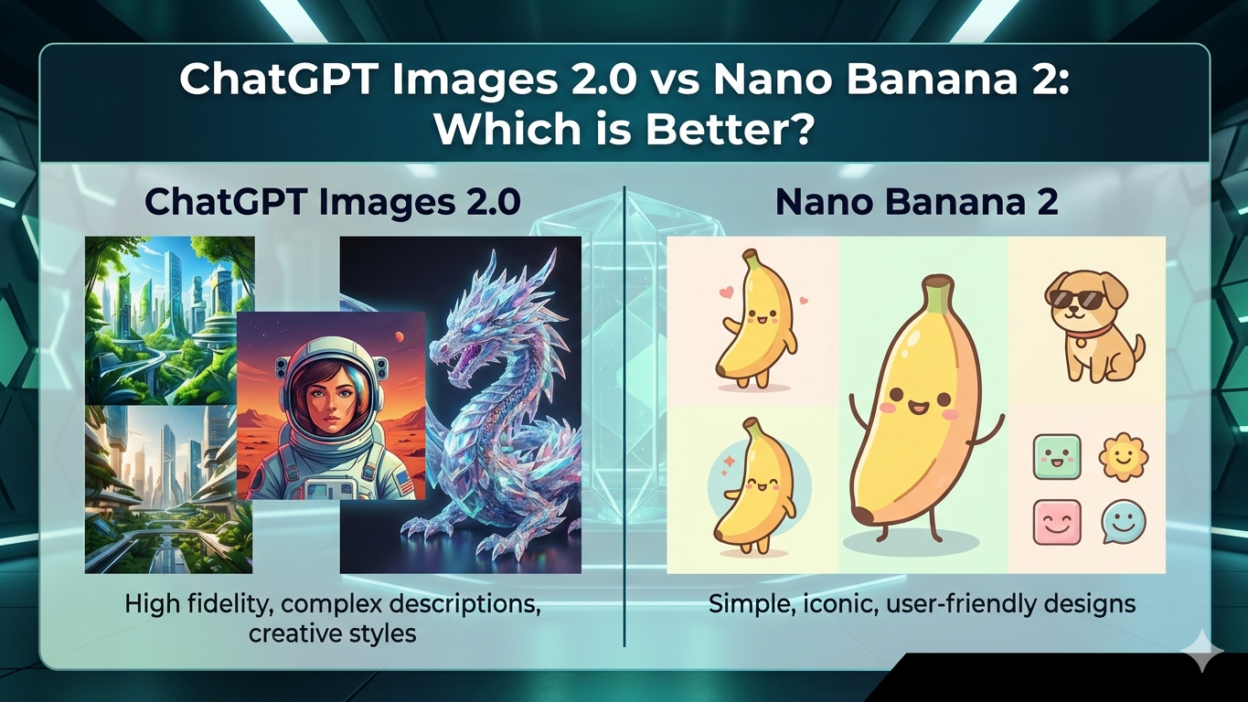
ChatGPT Images 2.0 produces sharp, photorealistic images. Skin tones look natural. Lighting feels accurate. Fine details like hair, fabric, and architecture render cleanly. The model handles complex prompts with multiple elements. It rarely drops important details from a long description.
Nano Banana 2 leans more into stylized outputs. It excels at illustration, concept art, and digital design. Realism exists in its output. But the style feels slightly more artistic than documentary. Some users prefer this. Others want strict photorealism and may find it lacking.
For product photography or stock-style images, ChatGPT Images 2.0 wins. For editorial illustrations or social media graphics, Nano Banana 2 holds its own.
Prompt Understanding
OpenAI trained ChatGPT Images 2.0 on a massive language model. That helps enormously with prompt understanding. You can write long, nuanced prompts. The tool parses them well. It catches subtle cues. It understands context like “a minimalist kitchen in the style of early 2000s Scandinavian design.”
Nano Banana 2 also handles prompts well. Its strength lies in short, punchy descriptions. Creative prompts with artistic direction produce great results. Very long prompts sometimes lose detail. Users report that a focused two-sentence prompt often outperforms a ten-sentence one.
Speed of Generation
Speed matters when you work at scale. ChatGPT Images 2.0 takes roughly 10 to 20 seconds per image. That number varies based on complexity and server load. It is not the fastest tool on the market. But the quality justifies the wait for most users.
Nano Banana 2 generates images faster. Average times fall between 4 and 8 seconds. That speed advantage is significant for bulk projects. If you generate hundreds of images per day, those seconds add up to hours.
Resolution and Output Formats
ChatGPT Images 2.0 supports multiple aspect ratios. Square, portrait, and landscape outputs all work cleanly. Default resolution sits at 1024×1024. Higher resolutions are available on paid plans. Output formats include PNG and JPEG.
Nano Banana 2 also supports multiple ratios. It adds a few more niche formats like ultra-wide cinematic ratios. Resolution options go higher on base plans. Some users report 2048×2048 outputs without upgrading. That gives more flexibility for print-ready work.
Pricing: What Does Each Tool Cost?
Pricing shapes every decision. Understanding the cost structure of ChatGPT Images 2.0 vs Nano Banana 2 helps you budget correctly.
ChatGPT Images 2.0 sits inside the ChatGPT ecosystem. Free users get limited image generations per month. ChatGPT Plus subscribers at $20 per month get significantly more. Power users on ChatGPT Pro plans get the highest limits. The pricing model ties image access to an existing subscription. That feels convenient if you already use ChatGPT for text tasks.
Nano Banana 2 uses a credit-based model. You buy credits. Each image costs a certain number of credits. A starter pack costs around $10 and covers roughly 200 images. Professional packs bring the per-image cost down significantly. Monthly subscriptions also exist starting at $15 per month.
For casual users, ChatGPT Images 2.0 offers more value if you already pay for Plus. For heavy image users, Nano Banana 2’s credit system can be more economical. Do the math based on your actual monthly usage.
Neither tool offers a truly unlimited free tier. Both require some form of payment for serious use. Budget accordingly before committing to either.
Use Cases: Who Should Use Which Tool?
ChatGPT Images 2.0 Works Best For…
Professionals who already live inside the ChatGPT interface benefit most. You can move between writing, research, and image creation without switching apps. That workflow efficiency is real and valuable.
Marketers needing photorealistic product mockups will appreciate the quality. The tool handles brand-specific prompts with care. You can describe a product, its color, its setting, and its lighting. The output looks close to a real studio photo.
Researchers and educators use ChatGPT Images 2.0 for visual explainers. The tool generates accurate diagrams, charts-as-illustrations, and concept visuals. Complex scientific prompts return usable images.
Writers using ChatGPT for long-form content can generate cover images, scene illustrations, and character concepts without leaving the platform. That integration advantage is hard to match.
Nano Banana 2 Works Best For…
Social media managers and content creators who need volume will enjoy Nano Banana 2. Speed plus affordability makes bulk generation practical. Ten images in under a minute is achievable.
Graphic designers looking for inspiration find Nano Banana 2 helpful. The stylized outputs spark ideas. They work as starting points for further refinement in Photoshop or Figma.
Small business owners needing branded visuals for websites, ads, and social posts get good value here. The tool produces usable commercial images at a low per-image cost.
Game developers and storytellers use Nano Banana 2 for concept art. Character designs, environment sketches, and prop illustrations come out strong. The artistic style suits creative industries.
When you think about ChatGPT Images 2.0 vs Nano Banana 2 from a use-case angle, the winner depends entirely on your work. There is no universal answer.
Style Variety and Customization
Style control separates good image tools from great ones. ChatGPT Images 2.0 vs Nano Banana 2 shows clear differences here.
ChatGPT Images 2.0 responds well to style keywords in prompts. You can specify “oil painting,” “watercolor,” “photorealistic,” or “cinematic.” The tool adjusts its output accordingly. Style transfer is not a dedicated feature. It works through prompt engineering. Experienced users get consistent results. Beginners may need several iterations.
Nano Banana 2 includes a dedicated style selector. You pick from preset aesthetic categories before entering your prompt. Options include Anime, Realistic, Sketch, Fantasy, and more. This lowers the learning curve. New users produce styled images on the first attempt. The system guides you rather than requiring deep prompt knowledge.
Advanced users may find Nano Banana 2’s preset system limiting. You cannot blend styles as freely as you can through prompt engineering in ChatGPT Images 2.0. Both approaches have merit depending on your skill level and creative goals.
Custom model fine-tuning exists on Nano Banana 2’s enterprise tier. You can upload your own reference images. The model learns your brand style. This feature does not currently exist in ChatGPT Images 2.0 at the same level.
Accuracy, Safety, and Content Policies
Both tools enforce content safety policies. Neither allows explicit content. Both block harmful imagery. The specific policies differ in detail.
ChatGPT Images 2.0 applies OpenAI’s existing safety framework. It is strict. Some creative prompts get refused. Political imagery involving real people often fails. Violence, even stylized, sometimes triggers refusals. Users working in mature creative genres may find this frustrating.
Nano Banana 2 takes a slightly more permissive stance on stylized and fictional content. Mature themes in a clearly artistic context pass more often. The platform verifies user age and requires terms acceptance for sensitive content access. This balance works well for professional creatives.
Factual accuracy in generated images matters for informational use cases. ChatGPT Images 2.0 handles anatomical accuracy better. Hands render correctly more often. Face proportions stay consistent. Nano Banana 2 occasionally struggles with complex anatomy in highly detailed scenes.
For safe, professional, and broadly acceptable content, both tools perform well. The differences only emerge at the edges of creative boundaries.
Integration and API Access
Developers and businesses often need API access. This is a key dimension of ChatGPT Images 2.0 vs Nano Banana 2.
OpenAI provides a mature API. ChatGPT Images 2.0 is accessible through that API. Documentation is excellent. SDKs exist for Python, JavaScript, and other languages. Rate limits apply based on your tier. Enterprise clients get dedicated access and higher limits. The API is reliable and battle-tested.
Nano Banana 2 offers an API as well. It launched more recently. The documentation is solid but less extensive than OpenAI’s. Community support is growing. The API pricing is competitive. Response times are fast. Developers building image-heavy applications find it cost-effective.
For teams already integrated into OpenAI’s ecosystem, ChatGPT Images 2.0 is the easier choice. For teams starting fresh or prioritizing cost efficiency, Nano Banana 2’s API is worth serious evaluation.
User Experience and Interface Design
Ease of use matters. Not every user is a technical expert.
ChatGPT Images 2.0 lives inside the ChatGPT chat interface. You type your prompt like a message. The image appears in the conversation thread. Editing requires typing a new prompt or modification instruction. The interface feels familiar. Anyone who has used a chat app feels at home immediately.
Nano Banana 2 has a dedicated image creation dashboard. Sliders, dropdowns, and style selectors surround the prompt field. History panels show previous generations. Favoriting, organizing, and downloading images all happen in one place. The experience feels purpose-built for image work.
Beginners may prefer Nano Banana 2’s guided interface. Experienced users who want flexibility often prefer the open-ended prompt approach of ChatGPT Images 2.0. Neither experience is bad. They suit different working styles.
Verdict: Quick Side-by-Side Summary
Best for quality & integration
ChatGPT Images 2.0
Photorealistic outputs. Deep prompt understanding. Seamless ChatGPT integration. Mature API. Best for professionals already in the OpenAI ecosystem.
Best for speed & volume
Nano Banana 2
Faster generation. Stylized art modes. Dedicated interface. Competitive pricing for bulk use. Best for creators, designers, and high-volume teams.
Frequently Asked Questions
Is ChatGPT Images 2.0 free to use?
Free ChatGPT accounts get limited image generations each month. Paid plans unlock more. The exact limit varies based on OpenAI’s current tier structure. Check the OpenAI pricing page for current details.
How does Nano Banana 2 differ from DALL-E?
Nano Banana 2 is a separate product from a different company. DALL-E is OpenAI’s image model powering ChatGPT Images 2.0. Nano Banana 2 built its own model. Key differences include generation speed, pricing model, and stylistic output characteristics.
Which tool is better for commercial use?
Both tools allow commercial use on paid plans. ChatGPT Images 2.0 grants commercial rights to generated images under OpenAI’s terms. Nano Banana 2 does the same. Always read the current terms of service before using images in paid campaigns.
Can I use either tool without coding skills?
Yes. Both tools have no-code interfaces. ChatGPT Images 2.0 uses a simple chat input. Nano Banana 2 has a visual dashboard. No technical background is needed for either.
Which produces better art-style images?
Nano Banana 2 generally produces stronger stylized art outputs. Its preset style modes are a significant advantage. ChatGPT Images 2.0 can match quality with the right prompt engineering but requires more skill to get there.
Does the ChatGPT Images 2.0 vs Nano Banana 2 comparison change for video content?
Neither tool currently generates video natively. Both focus on static images. For video generation, different tools like Sora or Runway are better options. Video support may come to both platforms in future updates.
Which tool has better customer support?
OpenAI offers email support and an extensive help center. Nano Banana 2 provides live chat on paid plans and an active community Discord. For immediate help, Nano Banana 2’s live chat gives faster responses.
Conclusion:Final Thoughts on ChatGPT Images 2.0 vs Nano Banana 2
This comparison of ChatGPT Images 2.0 vs Nano Banana 2 shows two strong tools with different strengths. Neither is universally better. Both earn their place in the AI image landscape.
Choose ChatGPT Images 2.0 when quality and integration matter most. The photorealistic output is hard to beat. The seamless connection to ChatGPT’s text capabilities adds real workflow value. Power users who invest in prompt engineering get exceptional results.
Choose Nano Banana 2 when speed, volume, and creative style variety are your priorities. The faster generation, dedicated interface, and style presets reduce friction for high-output creative work. The pricing model rewards heavy users.
The honest answer to ChatGPT Images 2.0 vs Nano Banana 2 is this: try both. Most platforms offer free trials or starter credits. Generate the same prompt on each tool. Compare the results side by side. Your own eyes and workflow will tell you which fits better than any comparison article ever could.
The AI image space will keep evolving. Both tools will release updates. Features will change. Prices will shift. Check back regularly. The tool that wins today may look different six months from now. Stay informed. Stay flexible. Pick the tool that serves your work right now.
The debate around ChatGPT Images 2.0 vs Nano Banana 2 reflects a broader truth about AI tools: the right choice depends entirely on the person using it and the work they need done.