Introduction
TL;DR The AI agent space is growing fast. New concepts appear every few weeks. Two of the most debated concepts right now are MCP and Agent Skills. Developers confuse them often. Product teams conflate them in roadmap discussions. That confusion leads to poor architectural decisions.
MCP vs Agent Skills is not just a naming debate. The two concepts represent fundamentally different approaches to extending AI agent capability. One is a protocol for connecting agents to external tools and services. The other defines what an agent can actually do on its own. Knowing the difference changes how you design, build, and deploy AI systems.
This blog gives you a complete breakdown of MCP vs Agent Skills. You will understand what each one is, how each one works, where each one fits in a real architecture, and how to decide which approach your system needs. The explanation is direct and practical. No fluff. No unnecessary abstraction. Just clear answers to a question that confuses even experienced builders.
Table of Contents
What Is MCP and Why Does It Exist
MCP stands for Model Context Protocol. Anthropic introduced it to solve a specific problem. AI models need to interact with external tools, databases, APIs, and services. Before MCP, every integration was custom. Every developer built their own connection logic. There was no standard. Every team reinvented the same wheel.
MCP creates a universal communication standard. It defines how a host application connects to external data sources and tools. It uses a client-server architecture. The AI model is the client. External tools and services act as MCP servers. The protocol handles the handshake, the capability discovery, the data exchange, and the error handling.
Think of MCP like USB for AI agents. Before USB, every peripheral needed its own proprietary connector. After USB, any device could plug into any port. MCP does the same thing for AI tool connections. An MCP-compatible agent can connect to any MCP-compatible server. The agent does not need to know the implementation details of each tool. The protocol handles translation.
MCP covers three main capability types. Resources give the model access to data and content. Tools allow the model to execute actions. Prompts provide pre-built interaction templates. All three operate through a standardized interface. This is what makes MCP genuinely powerful. It is an open standard that any developer can build for. The MCP vs Agent Skills distinction starts here — MCP is about connectivity, not capability.
What Are Agent Skills and How Do They Work
Agent Skills describe what an AI agent can do through its own trained or programmed capabilities. A skill is a discrete unit of agent behavior. It might be the ability to summarize a document. It might be the ability to write code in a specific language. It might be the ability to navigate a web interface or reason through a multi-step math problem.
Skills come from two sources. Some skills come from training. The model learned them during pre-training or fine-tuning on task-specific data. A model trained on millions of code examples develops strong coding skills. A model fine-tuned on legal documents develops strong legal reasoning skills. These are intrinsic capabilities. The agent carries them without any external connection.
Other skills come from explicit programming at the agent framework level. A developer defines a skill as a callable function. The agent framework routes certain tasks to certain skill handlers. The skill handler executes logic — sometimes calling an API, sometimes running local code, sometimes querying a database. The agent does not need to understand the implementation. It just calls the skill by name.
Skills have a clear scope. Each skill handles one type of task well. A well-designed agent skill is modular. You can add skills without rewriting other parts of the system. You can replace one skill implementation with a better one without changing the agent’s core logic. This modularity is what makes the Agent Skills concept so appealing to engineering teams building complex AI systems. The MCP vs Agent Skills question sharpens when you recognize that skills define agent behavior while MCP defines agent connectivity.
MCP vs Agent Skills: The Core Architectural Difference
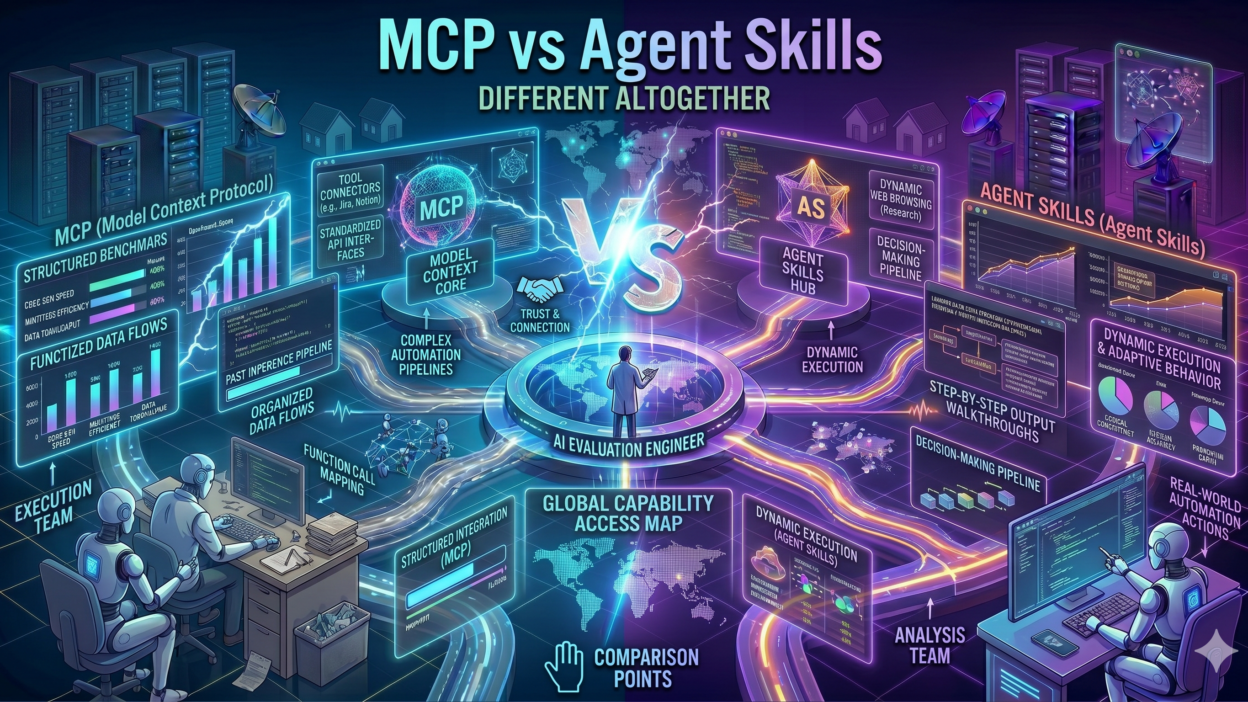
The clearest way to understand MCP vs Agent Skills is through architectural roles. MCP defines how an agent reaches outside itself. Agent Skills define what an agent can do from inside itself. These are not competing ideas. They operate at different layers of the same system. Confusing them is like confusing a network protocol with an application feature.
The Protocol Layer: What MCP Owns
MCP operates at the integration layer. When an agent needs to read a file from Google Drive, MCP handles the transport. When an agent needs to call a weather API, MCP defines the connection format. When an agent needs to query a vector database, MCP standardizes how that query leaves the agent and how the result comes back. MCP does not decide what the agent should do with the result. It only handles the pipe.
This is why MCP is powerful at scale. A team that builds one MCP server for their internal knowledge base can connect any MCP-compatible model to it instantly. They do not rebuild the integration for every new model they adopt. The protocol stays constant. The connected models can change freely. This portability is the central promise of MCP.
The Capability Layer: What Agent Skills Own
Agent Skills operate at the behavior layer. A skill determines how the agent approaches a task. A summarization skill decides the approach to condensing content. A code review skill determines which patterns to flag and which to approve. A planning skill determines how the agent breaks a complex goal into steps. None of this requires an external connection. The agent executes the skill using its own reasoning and knowledge.
Skills can use MCP connections internally. A research skill might invoke an MCP tool to fetch web content. A data analysis skill might use an MCP resource to access a structured dataset. In these cases, the skill defines what to do and MCP handles how to get the data needed to do it. The two concepts are complementary, not competing. MCP vs Agent Skills is really MCP plus Agent Skills in most mature AI systems.
Why the Confusion Exists Between MCP and Agent Skills
The confusion between MCP vs Agent Skills usually starts with tool calling. When an agent calls an external tool, it looks like it is exercising a skill. The agent decided to use the tool. The agent interpreted the result. The agent integrated that result into its response. From the outside, the whole sequence looks like one cohesive agent behavior — a skill. But the actual tool call used MCP under the hood. Understanding where the skill ends and the protocol begins is the key insight that separates thoughtful AI architects from developers who build fragile systems.
How MCP Servers Enable Richer Agent Skills
[Section 4 | Target: ~340 words | Secondary keywords: MCP server capabilities, MCP tool integration, AI agent tool use]
MCP and Agent Skills do not just coexist. They actively amplify each other. An agent with strong reasoning skills but no MCP connections is powerful but isolated. An agent with many MCP connections but weak reasoning skills makes poor use of the tools it reaches. The combination is where real capability emerges.
MCP Resources Extend Agent Knowledge Skills
An agent with a knowledge retrieval skill becomes far more capable when MCP resources provide fresh, authoritative data. The skill defines how to retrieve, evaluate, and synthesize information. MCP resources define what information is available. A legal research agent with strong synthesis skills connected to an MCP server hosting updated case law becomes an extremely powerful tool. Remove the MCP connection and the agent works only from its training data, which goes stale. Remove the skill and the agent fetches data it cannot interpret well.
MCP Tools Extend Agent Action Skills
An agent with task execution skills grows more effective when MCP tools expand the action surface. A project management skill might decide to create a task. The MCP tool handles the actual API call to Asana or Jira. The skill owns the logic. MCP owns the integration. This separation keeps the skill focused on reasoning and keeps the MCP server focused on reliable execution. Engineers can update the MCP integration without touching the skill logic. They can update the skill logic without changing the MCP server.
MCP Prompts Support Agent Skill Consistency
MCP prompt templates help agents maintain consistent behavior across skill invocations. When a customer service agent runs its response-generation skill, MCP prompts can supply up-to-date brand voice guidelines, current product information, or active policy constraints. The skill executes the generation task. The MCP prompt keeps the output aligned with real-world requirements. This is the MCP vs Agent Skills collaboration working at its most elegant.
MCP vs Agent Skills in Multi-Agent Systems
Multi-agent systems add another layer to the MCP vs Agent Skills discussion. When multiple agents collaborate on a task, both MCP and skills play distinct roles in that collaboration.
In a multi-agent system, each agent carries its own set of skills. A planning agent has strong decomposition and goal-setting skills. A research agent has strong retrieval and synthesis skills. An execution agent has strong task management and verification skills. Each agent focuses on what it does best. Skills define the specialization.
MCP handles how these agents connect to shared resources and external tools. A shared MCP server might host a document repository. Both the research agent and the planning agent can access it through the same protocol. Neither needs to implement custom data access logic. The MCP server sits in the middle and serves all agents that connect to it.
Agent-to-agent communication also benefits from protocol standardization. Some implementations use MCP as the communication layer between agents themselves. One agent exposes its capabilities as an MCP server. Another agent connects to it as an MCP client. This creates composable multi-agent architectures where agents can be plugged together and replaced like modular components. MCP vs Agent Skills in this context becomes a design question about which layer handles coordination and which layer handles computation.
Practical Decision Guide: When to Use MCP and When to Build Skills
Understanding the concepts is one thing. Making the right design choice in a real project is another. Here is a practical guide for deciding where MCP fits and where Agent Skills fit in your system.
Reach for MCP When You Need External Data or Actions
Build an MCP server when your agent needs to access a service, database, or API that lives outside the agent itself. The decision is straightforward. Does the agent need information it cannot generate from its own knowledge? Build an MCP resource. Does the agent need to perform an action in an external system? Build an MCP tool. Are there reusable prompt templates your team uses repeatedly? Put them in an MCP prompt server. MCP is your answer whenever the agent needs to reach outside its own boundaries.
Build Agent Skills When You Need Consistent Reasoning Behavior
Define an Agent Skill when you need the agent to approach a type of task in a consistent, repeatable way. If your agents need to evaluate contract language the same way every time, that is a skill. If they need to generate customer proposals in a specific format every time, that is a skill. If they need to classify user intent before routing a request, that is a skill. Skills are the right tool when you are encoding how the agent thinks, not how it connects.
The MCP vs Agent Skills framework becomes your design compass. For connectivity decisions, reach for MCP. For behavioral decisions, reach for skills. Most production AI systems need both. The clearest sign of a well-designed system is that the two layers are clearly separated and independently maintainable.
Frequently Asked Questions: MCP vs Agent Skills
Can an Agent Use Both MCP and Agent Skills at the Same Time
Yes. Most production agents use both simultaneously. An agent might apply a summarization skill to process a document it retrieved through an MCP resource connection. The two operate at different layers and do not conflict. Designing your system so skills can optionally invoke MCP connections gives you maximum flexibility. The MCP vs Agent Skills distinction matters most during architecture planning. During runtime, they work together seamlessly.
Is MCP Only for Claude Models or Does It Work with Other AI Systems
MCP is an open protocol. Anthropic released the specification publicly. Any AI model, framework, or platform can implement MCP client or server support. OpenAI tools, open-source models, and custom LLM deployments can all use MCP. The growing ecosystem of MCP servers is model-agnostic. This openness is intentional. Anthropic designed MCP to become an industry standard, not a proprietary lock-in.
Are Agent Skills Transferable Between Different Agent Frameworks
Skill transferability depends on how you implement them. Skills defined as model capabilities through fine-tuning transfer with the model itself but not to different models. Skills defined as framework-level callable functions are framework-specific and require reimplementation when switching frameworks. Designing skills as cleanly defined interfaces with documented inputs and outputs makes transfer much easier. This is a key architectural decision that teams often make too late in a project.
What Happens When You Confuse MCP with Agent Skills in System Design
Conflating MCP vs Agent Skills in design leads to tangled architectures. Teams sometimes try to encode business logic inside MCP server implementations. That logic then becomes invisible to the agent’s reasoning process. The agent cannot adapt it. The agent cannot override it. You lose the flexibility that skills are supposed to provide. Conversely, teams sometimes try to build direct API integrations into skill handlers instead of using MCP. Those integrations become brittle and non-reusable. Maintaining them becomes expensive. Getting the separation right from the start saves enormous engineering cost.
Does Using MCP Make Agent Skills Less Important
No. MCP and Agent Skills remain equally important regardless of how many MCP connections you build. More MCP connections give the agent more reach. Better skills give the agent more intelligence about how to use that reach. An agent with twenty MCP connections but weak reasoning skills will use those connections poorly. An agent with sharp skills but no MCP connections will reason well about a limited information set. The MCP vs Agent Skills balance is what determines overall agent quality.
Read More:-Top 10 Machine Learning Algorithms in 2026
Conclusion

The MCP vs Agent Skills distinction is not academic. It has real consequences for how you build, scale, and maintain AI agent systems. Getting this separation clear in your thinking changes the quality of every architectural decision that follows.
MCP is your connectivity standard. Use it whenever agents need to reach external systems, services, or data sources. It gives you portability, reusability, and a protocol that the industry is converging on. Build MCP servers for your tools and data sources. Let your agents plug in through the standard interface.
Agent Skills are your behavior library. Use them to define how your agent approaches different types of tasks. Make skills modular. Document their inputs and outputs clearly. Keep integration logic out of skill implementations. Let MCP handle the external connections that skills sometimes need.
The best AI agents in production today use MCP vs Agent Skills not as a choice between two things but as two complementary layers of the same well-designed system. MCP handles the reach. Skills handle the reasoning. Together they produce agents that are both capable and reliable. Build with that separation in mind from day one and your system will scale far more gracefully than one where the two concepts got mixed together early and never untangled.