Introduction
TL; DRThe AI model race has never been more competitive. Two names dominate the conversation in 2026. GPT 5.5 from OpenAI and Claude Opus 4.7 from Anthropic are both extraordinary products. Both push the frontier of what large language models can do. Both attract loyal, passionate user communities.
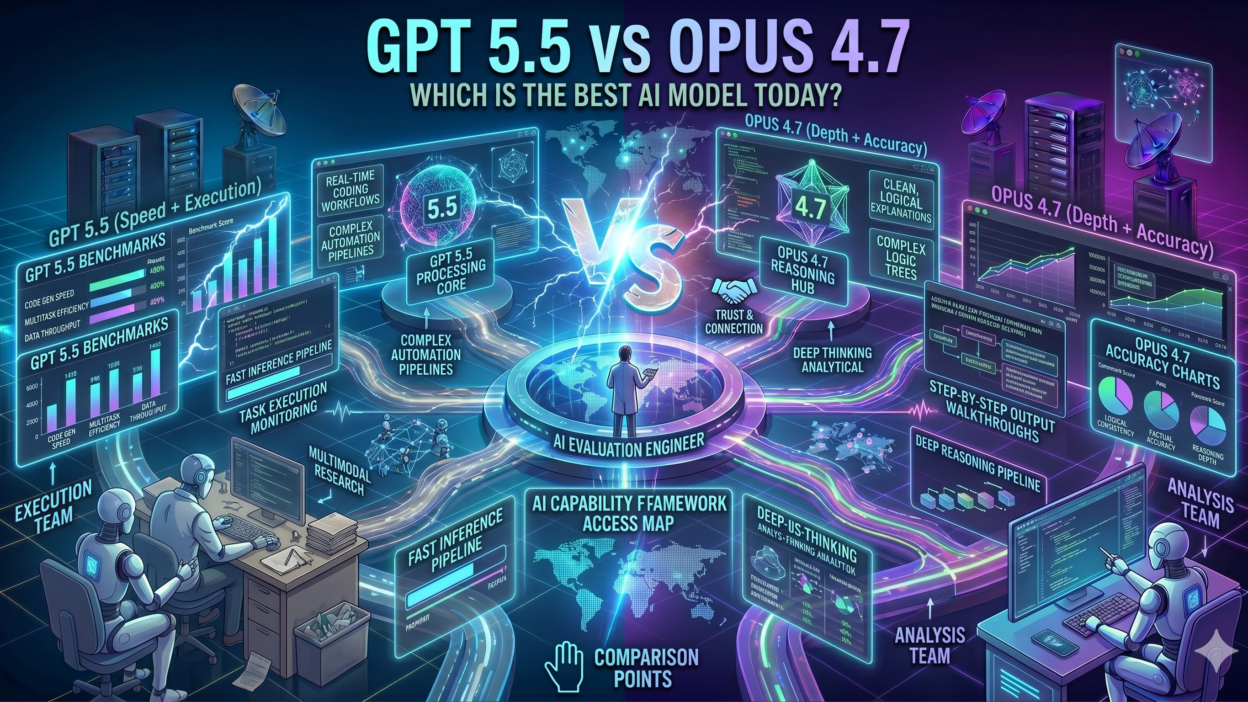
GPT 5.5 vs Opus 4.7 is not a simple question. Each model has distinct strengths. Each serves different use cases better than the other. Picking the wrong model for your workflow is a real cost. Picking the right one gives you a meaningful edge. This blog breaks down GPT 5.5 vs Opus 4.7 across every dimension that matters. You will understand their capabilities, their limits, and which one belongs in your stack.
We cover reasoning, coding, creativity, instruction following, pricing, context windows, and API access. We also answer the questions developers and teams ask most. By the end, you will have a clear framework for choosing between GPT 5.5 vs Opus 4.7 for your specific needs.
Table of Contents
Understanding GPT 5.5 and Opus 4.7: A Quick Overview
GPT 5.5 is OpenAI’s latest flagship model. It builds on the architecture of GPT-5 with significant refinements. OpenAI trained it on a broader dataset with improved instruction following. It handles multimodal inputs including text, images, audio, and structured data. GPT 5.5 delivers faster responses than its predecessor. It also shows meaningful improvements in factual accuracy and long-form task completion.
Claude Opus 4.7 is Anthropic’s current top-tier model. Anthropic built it with a strong emphasis on safety, instruction fidelity, and nuanced reasoning. Opus 4.7 is the most capable model in the Claude 4 family. It sits above Claude Sonnet 4.7 and Claude Haiku in terms of raw capability. Anthropic designed it for complex, demanding tasks where output quality matters more than raw speed.
Both models are multimodal. Both accept long context windows. Both are available via API and consumer interfaces. The surface similarities end there. Their personalities, reasoning styles, and output tendencies are genuinely different. Developers who work with both regularly describe the experience as working with two distinct collaborators rather than two versions of the same tool.
The GPT 5.5 vs Opus 4.7 debate has replaced the older GPT-4 vs Claude 3 conversation. The stakes are higher now. Both models operate at a level of capability that makes the choice genuinely meaningful for teams building production AI applications. Let us get into the details.
Reasoning and Problem-Solving: GPT 5.5 vs Opus 4.7
How GPT 5.5 Handles Complex Reasoning
GPT 5.5 shows impressive performance on multi-step reasoning tasks. It handles mathematical proofs, logical deduction chains, and scientific problem-solving with high accuracy. OpenAI integrated chain-of-thought reasoning directly into the model architecture. You do not need to prompt it to think step by step. It does this automatically on complex inputs.
GPT 5.5 performs particularly well on structured problem formats. Coding challenges, algorithmic thinking, and data analysis benefit from its systematic approach. On benchmark suites like MMLU and HumanEval, GPT 5.5 scores among the top models available. Users report that its answers feel organized and methodical. It rarely jumps to conclusions without showing its work.
Where GPT 5.5 sometimes struggles is with highly ambiguous open-ended problems. When a task lacks clear constraints, it occasionally over-engineers the solution. It reaches for complexity when simplicity would serve better. Experienced users learn to add explicit constraints to their prompts to channel this tendency productively.
How Opus 4.7 Handles Complex Reasoning
Opus 4.7 takes a different approach to reasoning. It explores problems from multiple angles before committing to an answer. Users describe its reasoning as more deliberate and nuanced. On open-ended intellectual tasks, Opus 4.7 often produces more thoughtful outputs than GPT 5.5. It weighs trade-offs explicitly. It acknowledges uncertainty clearly.
Anthropic trained Opus 4.7 with a particular focus on avoiding confident errors. It would rather express uncertainty than state something incorrect with authority. This trait makes it exceptionally valuable for research, analysis, and strategy work where being wrong confidently is more damaging than being appropriately uncertain.
On pure benchmark scores, GPT 5.5 vs Opus 4.7 is extremely close. Opus 4.7 leads on certain language understanding and reasoning benchmarks. GPT 5.5 leads on others, particularly in mathematical domains. Neither model dominates across every category. Your specific task type will determine which model gives you better results.
Coding Performance: Where GPT 5.5 vs Opus 4.7 Gets Competitive
Coding is where most developers decide their preferred model. The difference between a model that generates working code and one that generates plausible-looking broken code is enormous in production.
GPT 5.5 Coding Strengths
GPT 5.5 excels at generating boilerplate code quickly. It handles standard patterns extremely well. REST API scaffolding, database schemas, React component templates, and CLI tool structures all come out clean and accurate. It has deep familiarity with popular frameworks including Next.js, FastAPI, Django, Spring Boot, and dozens more. Developers building with common stacks report high first-pass accuracy with GPT 5.5.
GPT 5.5 also performs well on competitive programming-style problems. It solves algorithm challenges with reliable accuracy. Its code explanations are detailed and clear. Junior developers learning new concepts often prefer GPT 5.5 because its explanations follow a teachable structure that is easy to understand and replicate.
Opus 4.7 Coding Strengths
Opus 4.7 handles nuanced, complex coding tasks with particular skill. When a problem requires understanding business logic rather than just syntax, Opus 4.7 often produces more contextually appropriate code. It asks better clarifying questions when requirements are ambiguous. It also catches edge cases more consistently, which reduces debugging cycles downstream.
For security-sensitive code, Opus 4.7 is the preferred choice for many teams. Anthropic’s safety training translates into code that is less likely to introduce common vulnerability patterns. Input validation, parameterized queries, and secure defaults appear more reliably in Opus 4.7 outputs. Teams building production financial or healthcare applications consistently cite this as a key reason for choosing Opus 4.7.
On full-stack code generation tasks, GPT 5.5 vs Opus 4.7 results vary by complexity. Simple tasks favor GPT 5.5 for speed. Complex multi-layered tasks often favor Opus 4.7 for accuracy. Many developer teams use both models in their workflow — GPT 5.5 for rapid prototyping and Opus 4.7 for production-quality implementation.
Writing, Creativity, and Content Generation: A Direct Comparison
GPT 5.5 Writing Style and Output Quality
GPT 5.5 produces polished, professional writing at high speed. Its default style is clear, confident, and well-structured. Marketing copy, technical documentation, email drafts, and business reports all come out clean on the first pass. OpenAI has optimized GPT 5.5 heavily for broad content generation use cases. It is fast, consistent, and rarely produces awkward phrasing.
Where GPT 5.5 writing shows its limits is in voice and depth. When given creative latitude, it sometimes defaults to generic structures. Long-form essays and thought leadership pieces from GPT 5.5 can feel formulaic without strong prompting guidance. The writing is competent but can lack distinctive perspective without deliberate prompting to inject one.
Opus 4.7 Writing Style and Output Quality
Opus 4.7 produces writing with more natural variation and intellectual texture. Its long-form content feels more considered. Arguments build more carefully. Transitions between ideas feel more organic. Writers and editors who use both models regularly often describe Opus 4.7 outputs as needing less editing to feel genuinely human.
Opus 4.7 handles nuanced tonal requests better. When you ask for dry wit, gentle persuasion, or measured academic tone, Opus 4.7 executes those requests with more fidelity. It also handles character voice in creative fiction more convincingly than most competing models.
For high-volume content production with consistent format requirements, GPT 5.5 is the practical choice. For flagship content that represents a brand or requires genuine depth, Opus 4.7 earns its higher cost. In the GPT 5.5 vs Opus 4.7 writing battle, each model wins in a different content category.
Context Window, Speed, and Pricing: The Practical Comparison
Capability matters. So does cost and speed. Real teams make deployment decisions based on all three factors. Here is how GPT 5.5 vs Opus 4.7 stacks up on practical dimensions.
GPT 5.5 offers a 128k token context window in standard deployment. Extended context versions are available in enterprise tiers. Its response latency is lower than Opus 4.7 for most prompt types. Pricing runs at approximately fifteen dollars per million input tokens and sixty dollars per million output tokens at standard tiers. OpenAI offers volume discounts at scale.
Opus 4.7 offers a 200k token context window as its standard offering. This larger context window is a genuine advantage for long-document processing, large codebase analysis, and complex research tasks. It handles book-length inputs, extensive conversation histories, and large data sets without truncation. Pricing runs higher than GPT 5.5, reflecting its position as Anthropic’s premium flagship.
Speed is where GPT 5.5 holds a consistent edge. Its time-to-first-token and total response time are faster across most task types. For applications where latency directly impacts user experience, GPT 5.5 has a practical advantage. For batch processing and async workflows where speed matters less, Opus 4.7’s larger context window often provides more value than GPT 5.5’s faster response.
Safety, Instruction Following, and Enterprise Suitability
Enterprise adoption of AI models goes beyond raw capability. Safety, policy compliance, instruction fidelity, and governance matter enormously in production deployments.
Safety and Alignment in GPT 5.5
OpenAI has invested heavily in GPT 5.5’s safety systems. It includes reinforced refusal behaviors for harmful content categories. Its system prompt adherence is strong. Enterprises building customer-facing applications report high confidence in its ability to stay within defined behavioral boundaries. OpenAI offers an enterprise tier with additional privacy controls and data retention policies suited to regulated industries.
Safety and Alignment in Opus 4.7
Anthropic built its entire company around responsible AI development. Opus 4.7 reflects that priority deeply. Its Constitutional AI training approach produces a model that handles edge-case prompts with notable consistency. It declines harmful requests clearly and explains why. For enterprise deployments in healthcare, legal, or financial services, Opus 4.7’s documented safety approach gives compliance teams more confidence.
Instruction following is a dimension where Opus 4.7 has a meaningful edge. When given complex system prompts with multiple constraints, Opus 4.7 adheres to those constraints more consistently across long conversations. GPT 5.5 is strong on instruction following for shorter contexts but occasionally drifts from fine-grained constraints in very long exchanges. Teams building multi-turn applications with strict behavioral requirements should test both models carefully before committing.
Real-World Use Cases: Choosing GPT 5.5 vs Opus 4.7 for Your Needs
Choose GPT 5.5 When Speed and Volume Matter
GPT 5.5 is the right choice for high-volume content generation pipelines. Marketing teams running thousands of product descriptions, email campaigns, or social posts benefit from its speed and consistency. Customer support automation at scale also favors GPT 5.5. Its faster response times reduce latency in user-facing applications. Startups building consumer AI tools on tight budgets often find GPT 5.5’s pricing more manageable while still delivering excellent output quality.
Choose Opus 4.7 When Depth and Accuracy Matter Most
Opus 4.7 is the right choice for high-stakes analytical work. Legal document review, research synthesis, technical writing for regulated industries, and complex strategic analysis all benefit from its deliberate reasoning approach. When output errors have real consequences, paying for Opus 4.7’s higher accuracy is straightforward to justify. Consulting firms, law practices, and research organizations consistently report superior results with Opus 4.7 for their core workflows.
Hybrid Deployment: Using Both Models Together
Many sophisticated teams do not pick one model. They route tasks by complexity. Simple, high-volume tasks go to GPT 5.5. Complex, high-stakes tasks go to Opus 4.7. This routing approach captures cost efficiency and quality simultaneously. Building a routing layer into your AI infrastructure adds modest engineering overhead. The cost savings and quality improvements make that investment worthwhile at scale.
Frequently Asked Questions: GPT 5.5 vs Opus 4.7
Which Model Is Better for Coding: GPT 5.5 or Opus 4.7
For everyday coding tasks and rapid prototyping, GPT 5.5 edges ahead with its speed and familiarity with common frameworks. For complex architecture work, security-sensitive code, or highly nuanced implementation tasks, Opus 4.7 produces more reliable results. Most development teams benefit from having access to both. The choice depends on what you are building and how much accuracy you need on the first pass.
Is GPT 5.5 Cheaper Than Opus 4.7
GPT 5.5 is generally priced lower than Opus 4.7 at standard API tiers. Anthropic positions Opus 4.7 as a premium flagship model and prices it accordingly. For cost-sensitive applications with high request volumes, GPT 5.5 offers better economics. Always check current pricing on OpenAI and Anthropic’s documentation pages, as both companies adjust rates regularly.
Which Model Has a Better Context Window
Opus 4.7 holds the advantage here with a 200k token context window compared to GPT 5.5’s standard 128k. For use cases involving large documents, extended conversations, or full codebase analysis, Opus 4.7’s larger context is a meaningful practical advantage. GPT 5.5 enterprise tiers offer extended context options. Check availability for your region and plan.
Can I Use Both GPT 5.5 and Opus 4.7 in the Same Application
Yes. Both models are available via API. Building applications that call different models for different task types is a well-established architectural pattern in 2026. You can route tasks based on complexity, required accuracy, or cost budget. Several AI infrastructure platforms offer built-in model routing capabilities that make this approach straightforward to implement without custom engineering.
Which Model Is Better for Non-English Languages
GPT 5.5 has slightly broader multilingual training coverage in terms of language count. Both models handle major European and Asian languages well. For less common languages, GPT 5.5 generally shows stronger performance. Opus 4.7 produces higher quality outputs in major languages where depth of training matters more than breadth of language support. Test both models on your target language before committing to a production deployment.
Read More:-40 Questions on Clustering Techniques for Data Science Professionals
Conclusion

The GPT 5.5 vs Opus 4.7 debate does not have one universal answer. Both models are exceptional. Both represent the best AI capability available to developers and enterprises today. The right choice depends entirely on your use case, your budget, and your tolerance for latency versus accuracy trade-offs.
GPT 5.5 wins when you need speed, volume, and broad multimodal support. It is the workhorse model for teams moving fast and building at scale. Opus 4.7 wins when depth, accuracy, instruction fidelity, and safety matter above all else. It is the precision instrument for high-stakes intellectual and analytical work.
The smartest teams in 2026 are not debating GPT 5.5 vs Opus 4.7 as an either-or decision. They are building systems that use both. They route tasks intelligently. They capture the strengths of each model while minimizing the weaknesses. That hybrid approach is where the real competitive advantage lives.
Start with a clear inventory of your use cases. Map each task to the model that fits it best. Run A/B tests on your actual workload. Let your data decide. Both GPT 5.5 and Opus 4.7 will impress you. Your job is to find out which one impresses you in the ways that matter most for your specific goals.