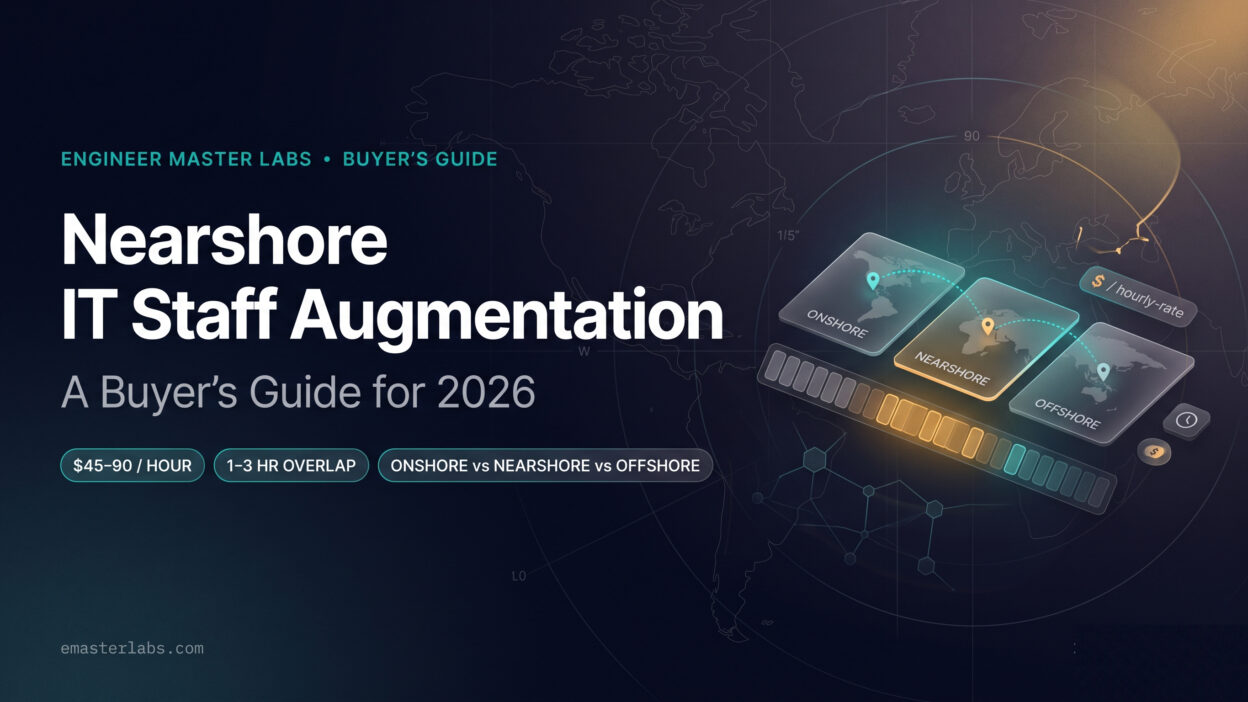
TL;DR Nearshore IT staff augmentation means hiring engineers in countries close to yours geographically and culturally. For US clients, that’s Latin America. For Western European clients, that’s Eastern Europe. The model trades some cost savings for time-zone overlap, cultural alignment, and faster collaboration. This post covers when nearshore makes sense, how it compares to offshore and onshore, and what the actual numbers look like in 2026.
Every conversation about staff augmentation eventually arrives at the geography question. Onshore is too expensive, offshore feels too far, and somewhere in the middle sits nearshore. The terminology gets confused in marketing materials, but the model itself is clean and the value proposition is straightforward.
Nearshore IT staff augmentation works best when you need real-time collaboration and mid-tier cost savings. It works less well when you have stable, well-specced work and need maximum cost arbitrage. Knowing the difference saves you a lot of money and a lot of pain.
What Nearshore Actually Means
Nearshore is defined by proximity, not by cost. The two reference points:
For a US-based client, nearshore typically means Latin America: Mexico, Argentina, Colombia, Brazil, Costa Rica, Uruguay. Time zones run within 1-3 hours of US Central. English fluency is high in tech hubs. Cultural alignment with North American business practices is strong.
For a Western European client, nearshore typically means Eastern Europe: Poland, Romania, Ukraine (with current limitations), Czech Republic, Bulgaria. Time zones run within 1-2 hours of CET. Strong technical education systems. Cultural alignment with European business practices.
Geographic proximity matters because it enables real-time collaboration. Same-day Slack responses. Pair programming. Daily standups that don’t require anyone to attend at midnight. The model exists because remote work has limits and time-zone overlap is one of them.
The Three-Way Comparison
Most discussions oversimplify the choice. There are really three options, each with distinct tradeoffs:
Onshore. Highest cost, lowest friction, fastest decision velocity. US engineers for US clients run $120-220/hour all-in. The only viable option for highly regulated work, classified projects, or specific compliance requirements.
Nearshore. Mid-cost, low friction, strong collaboration. Latin American engineers for US clients run $50-90/hour all-in. The right choice for product engineering, daily collaboration, and projects where cultural alignment matters.
Offshore. Lowest cost, highest friction, best cost arbitrage. Indian or Southeast Asian engineers for US clients run $25-55/hour all-in. The right choice for steady-state engineering, well-specced work, and maximum cost savings.
None is universally better. The best providers can mix all three based on the work.
When Nearshore Makes the Most Sense
Five situations where nearshore consistently wins:
Real-time product engineering. New features being designed and built simultaneously. Daily UX iterations. Tight feedback loops with product managers. The time-zone overlap matters here in a way it doesn’t for backend infrastructure work.
High-stakes communication work. Customer-facing features, security-sensitive code, work that requires lots of clarification. Same-day cycles compress the iteration loop dramatically.
Cultural fit-sensitive teams. Some teams just work better with engineers who share business cultural reference points. Latin American tech culture is closer to North American startup culture than Indian or Vietnamese tech culture is. This isn’t a value judgment, it’s a fit consideration.
Meetings-heavy roles. Tech leads, solution architects, customer-facing engineers. Roles that require synchronous communication for half the work day favor nearshore.
Compliance constraints that don’t require onshore. Some regulated industries are fine with nearshore (Mexico for US healthcare under specific conditions) but not with offshore.
When Offshore Wins Anyway
Three situations where offshore beats nearshore even on the collaboration dimension:
Steady-state engineering work. Maintenance, API development against stable specs, infrastructure work, data engineering. Most of this doesn’t need real-time collaboration. The 10-12 hour time difference becomes follow-the-sun productivity.
Specialized skills with thin nearshore depth. Some skills concentrated in offshore markets. India’s depth in AI/ML, embedded systems, certain enterprise platforms exceeds what most nearshore markets offer. If you need specialized depth, geography matters less than skill availability.
Maximum cost arbitrage. If you need to run a 10-engineer team for 18 months and budget is the binding constraint, offshore can save $400K-600K versus nearshore for the same scope.
2026 Cost Benchmarks
Real all-in hourly rates for senior engineers, US client perspective:
- Onshore (US): $120-220/hour
- Canada (treated as nearshore by some): $90-150/hour
- Latin America – Costa Rica, Uruguay, Argentina: $55-90/hour
- Latin America – Mexico, Colombia, Brazil: $45-75/hour
- Eastern Europe (for European clients): €40-75/hour
- Offshore – India, Vietnam, Philippines: $25-55/hour
Differences within each category come down to seniority, specialization, and provider quality. The same senior backend developer might bill $50/hour through one Mexico-based provider and $80/hour through another, with the more expensive one delivering significantly better outcomes.
The Time-Zone Overlap Math
Time-zone overlap is the most underrated variable in geographic decisions. Some math:
A US East Coast team and a Mexico City team have 8 hours of perfect overlap. Standups, meetings, real-time debugging all easy.
A US East Coast team and a Bangalore team have about 2.5 hours of forced overlap (5:30 AM to 8 AM Bangalore time, 7 PM to 9:30 PM US time). Everything outside that window is asynchronous.
This math has real consequences for engagement design. Nearshore allows the engineer to participate in the team’s normal rhythm. Offshore requires either the engineer or the team to flex hours, which over time strains both sides.
The good news: many offshore engagements work fine asynchronously, especially with strong documentation, clear ticket descriptions, and well-defined sprint goals. The bad news: they require more discipline than most teams have.
Cultural Alignment, Realistically
Cultural alignment is real but often overstated. The honest version:
Latin American tech culture is closer to North American startup culture in directness, feedback patterns, and meeting norms. Eastern European tech culture is closer to North American/Western European norms in technical rigor and process.
Indian tech culture has historically been more hierarchical and consensus-driven, though this has shifted considerably in the last decade as global product companies opened large engineering centers there. Top-tier Indian engineers working at Microsoft, Google, or Stripe communicate identically to their US counterparts.
The takeaway: cultural fit matters at the individual engineer level more than at the country level. Top engineers everywhere have adopted global tech culture. Mid-tier engineers retain more local communication patterns. Nearshore minimizes the variance. Offshore requires you to vet harder for it.
Hybrid Models
Most enterprise programs end up in hybrid models that combine geographic tiers:
Onshore lead, offshore execution. A US-based tech lead manages an offshore engineering team. The onshore presence handles client-facing communication and architectural decisions. The offshore team executes. Balances cost and collaboration well.
Nearshore product team, offshore platform team. Latin American engineers handle product features needing real-time iteration. Indian engineers handle backend infrastructure, data pipelines, ML inference. Each does what they’re best positioned for.
Distributed pods. Each pod has its own geographic mix optimized for its work. New product launch pod is mostly nearshore. Maintenance pod is mostly offshore. Security pod is onshore.
The hybrid models require more sophisticated vendor management but they capture the best of all three tiers.
What to Ask a Nearshore Provider
Specific questions that surface real information:
“What’s your engineer attrition rate over the last 12 months?” Latin American attrition has historically been higher than offshore attrition because the local market is hot. Numbers above 25% should concern you.
“How do you handle currency fluctuation?” Some providers bill in USD and absorb FX risk. Others bill in local currency and pass it on. Significant difference for multi-year engagements.
“What’s the English fluency level of your engineers?” Latin American tech English is generally strong but variable. Some providers have higher bars than others. Verify in the interview.
“What’s your security and IP framework given the geography?” Different countries have different IP enforcement realities. Verify the provider has serious legal infrastructure.
The Decision Framework
A simple framework for choosing geography:
Need real-time collaboration daily? Lean nearshore.
Need maximum cost savings on stable work? Lean offshore.
Need both? Build a hybrid model with onshore or nearshore leadership and offshore execution.
Need regulatory compliance? Verify which geographies are acceptable for your specific compliance regime.
Most clients overestimate how much real-time collaboration they actually need. A senior offshore engineer with strong English and discipline around documentation can be more productive than a mid-tier nearshore engineer in your time zone. Vet hard, choose for quality first, geography second.
How Engineer Master Labs Approaches Geography
Engineer Master Labs operates primarily out of India with an established model for working with US, European, and APAC clients. We invest heavily in time-zone-shifted shifts, strong English communication standards, and documentation discipline that compensates for the offshore time-zone gap.
For clients who need true nearshore, we partner with vetted providers in Latin America and Eastern Europe rather than overpromising what we can deliver from India. Our model is to recommend the right geographic mix for each client, even when that means handing off some work.
If you’re evaluating nearshore versus offshore versus hybrid, the fastest way to clarify your options is a 60-minute scoping call. We’ll map your collaboration requirements, your cost sensitivity, and your compliance constraints, then recommend the right model.
📧 Email: [email protected]
📞 Phone: 1-347-543-4290
🌐 Website: emasterlabs.com