TL;DR Hiring dedicated developers through an augmentation partner is the fastest, most flexible way to scale engineering capacity in 2026. Done right, you have a senior developer shipping production code in two weeks at 40% of the fully-loaded cost of a full-time hire. Done wrong, you end up paying market rates for engineers who treat your project as a side gig. This post covers what dedicated actually means, how to structure the engagement, and the questions that separate real dedication from billing language.
“Hire dedicated developers” is the most overused phrase in the staff augmentation industry. Every provider promises it. The actual definition varies wildly. Some “dedicated” developers are juggling three clients. Some are dedicated to your project but billing 80% capacity. Some are genuinely full-time on your work. Same word, very different value.
This post will help you cut through the language and figure out what you actually need.
Table of Contents
What “Dedicated” Should Mean
A dedicated developer, properly defined, has these characteristics:
- 100% of their working time on your project, with documented exceptions for vendor-side training and ops
- Reporting line into your tech lead or engineering manager
- Same Slack, same Jira, same standups, same on-call rotation
- Compensation tied to your engagement, not split across accounts
- A minimum engagement length (usually 3-6 months) to amortize ramp time
If any of those are missing, you don’t have a dedicated developer. You have a shared resource being marketed as dedicated. Some providers will be honest about this. Most won’t until you ask.
Why Companies Hire Dedicated Developers
Five common drivers, in rough order of frequency:
Speed. Your project starts in two weeks. Hiring full-time takes four months. Math wins.
Cost arbitrage. A senior dedicated developer in India costs ₹35-45 lakhs annually fully loaded. The equivalent hire in San Francisco costs $250K base. The savings, even after vendor margins, are substantial.
Specialized skills. You need a Solidity developer, a CUDA optimizer, a Kubernetes expert. Local talent doesn’t exist. Dedicated developers from a specialized provider solve this in days.
Flexibility. The project might last six months or eighteen. You don’t want a full-time hire who needs work after the project ends.
Headcount constraints. Hiring freezes, board limits, public-company optics. Dedicated developers come out of opex and often don’t count against headcount.
The Skill Categories That Work Best
Some skills suit dedicated-developer engagements better than others.
Backend developers. The most reliable category. Node.js, Python, Go, Java, .NET. Clear interfaces, testable outcomes, scalable to senior or specialized work.
Frontend developers. React, Vue, Angular, modern stacks. Works well when you have a design system. Without one, dedicated frontend developers tend to drift in style.
Mobile developers. iOS (Swift), Android (Kotlin), React Native, Flutter. Strong fit because mobile codebases are typically self-contained.
Full-stack developers. Cost-effective for early-stage products. Less effective at scale where specialization wins.
DevOps and SRE. Excellent fit when scoped to specific outcomes. Weaker as general operations support.
Data engineers. Pipeline, warehouse, ETL work. Highly augmentable.
ML engineers. Strong fit for inference, deployment, MLOps. Trickier for novel research.
Specialized roles (blockchain, embedded, AR/VR). Only viable through providers with real depth in the niche. Generalists fail here.
2026 Cost Benchmarks
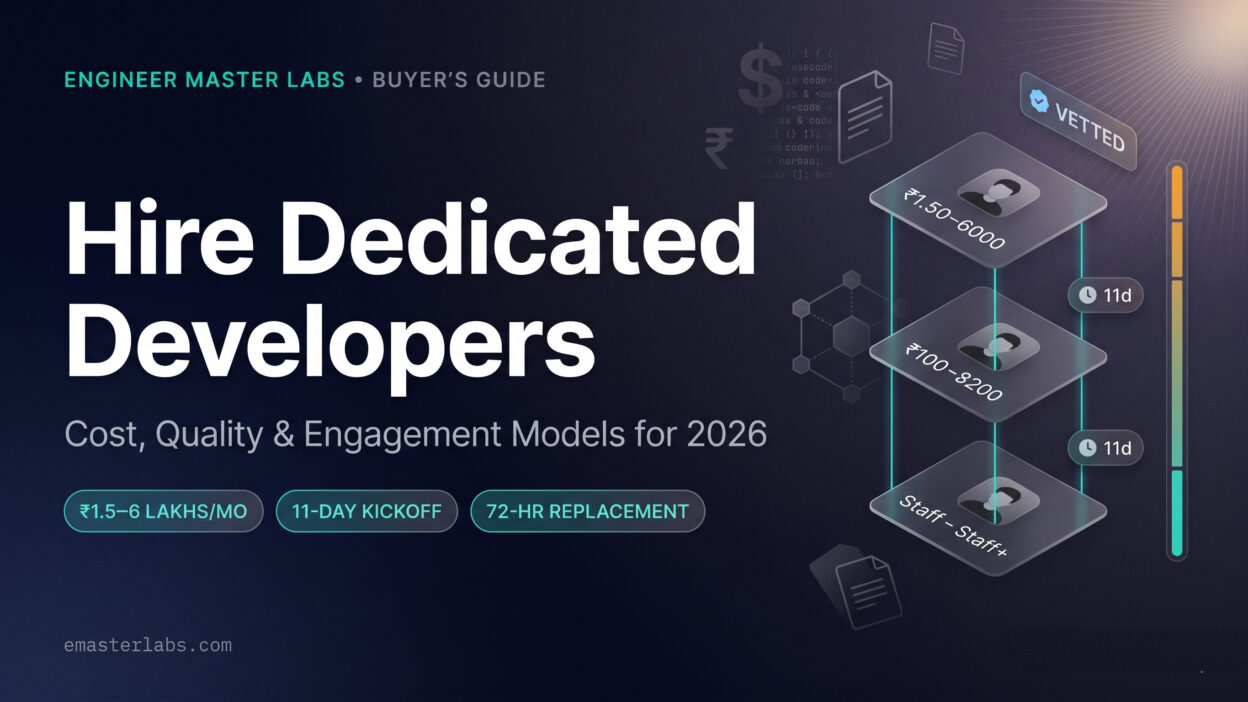
Real prices for dedicated developers in India, all-inclusive monthly billing:
- Junior backend (1-3 years): ₹1.5-2 lakhs/month
- Mid-level backend (3-6 years): ₹2-3 lakhs/month
- Senior backend (6-10 years): ₹3-4 lakhs/month
- Staff/principal level (10+ years): ₹4-6 lakhs/month
- Senior frontend: ₹2.5-3.5 lakhs/month
- Senior mobile: ₹2.8-3.8 lakhs/month
- Senior DevOps: ₹3-4.5 lakhs/month
- Senior ML engineer: ₹3.5-5 lakhs/month
- Senior blockchain developer: ₹4-6 lakhs/month
For US-based clients, the same engineers typically bill at $35-75 per hour depending on seniority. For European clients, €30-65 per hour. Rates outside these ranges are either body-shop economics (too low) or onshore-disguised-as-offshore (too high).
How to Structure the Engagement
The structure of the contract determines whether the engagement succeeds. Five clauses that matter more than the rate:
Minimum commitment. 3-6 months is typical. Less than 3 months and the engineer barely ramps. More than 12 months should require quarterly review breakpoints.
Replacement clause. 48-72 hour replacement at no additional cost if the engineer doesn’t meet expectations. Without this, you’re stuck.
IP assignment. All code, models, and documentation produced should be unambiguously yours. Generic clauses won’t cover edge cases like derivative works and pre-existing libraries. Tighten the language.
Non-solicit window. Most providers ask for 12-24 months of non-solicit, meaning you can’t hire their engineer directly. Negotiate this down to 6 months or include a buyout clause at a reasonable multiple of monthly billing.
Notice period for both sides. 30-60 days is standard. Longer locks you in, shorter leaves both sides exposed.
The Interview Process
Even with a pre-vetted bench, you should run your own interview. The bar should be the same as for full-time hires, with one twist: you’re also evaluating the provider through the engineer.
A reasonable structure:
- 30-minute intro call with engineer and a vendor delivery manager
- 60-minute live coding session, ideally on a problem from your domain
- 45-minute system design interview at appropriate level
- 30-minute behavioral conversation on past collaboration patterns
If you can’t run this in five business days, the provider isn’t serious about availability. If the engineer struggles with English communication, no amount of technical skill will compensate. If the system design feels memorized, it probably is.
Onboarding Done Right
Three things to do in the first two weeks:
Run the same orientation you’d run for a full-time hire. Architecture overview, codebase tour, customer context, product roadmap. Skip company history. Focus on what they need to ship well.
Assign a small-but-real first ticket. Something they can ship in 3-5 days that touches the codebase meaningfully. Reveals real engineering quality faster than any interview.
Set up direct communication channels. Same Slack workspace as your team. Direct access to the tech lead. Visibility into the same standups, retros, and planning sessions. The single biggest cause of dedicated-developer disengagement is communication isolation.
Performance Management
Dedicated developers should be evaluated the same way internal engineers are. Same code review standards, same sprint reviews, same expectations on participation.
Monthly performance review with the vendor delivery manager. Talk about output, code quality, communication, and any signals of disengagement. The good providers will surface concerns proactively. The bad ones will tell you everything is fine until the engineer disappears.
If something feels off, request a replacement early. The cost of replacing in month two is trivial. The cost of replacing in month eight is enormous because of context loss.
Mistakes to Avoid
Picking purely on price. The lowest bid is almost always the wrong choice. Margin pressure on the vendor leads to staffing pressure on you.
Skipping the contract review. Standard MSAs from providers favor the provider. A 30-minute review by your legal team will save you weeks of pain later.
Hiring without a clear scope. “We need a senior backend developer” is too vague. “We need someone to build out our payment service in Go, integrate with Stripe, and handle our webhook processing” is actionable. Vendors can match better when you brief better.
Treating the engineer as second-class. The Slack channels, planning meetings, and code reviews should include them by default. Excluding them creates exactly the disengagement you feared.
Not having an internal owner. Every dedicated developer needs a single internal point of contact who owns their success. Multiple stakeholders pulling in different directions guarantees waste.
When to Convert to Full-Time
Some dedicated developers are great fits and you’ll want to convert them. Three things to know:
Most providers allow conversion after 12-18 months at a fee equal to 25-40% of annual salary. This is normal industry practice and is usually worth paying.
The engineer needs to actually want to convert. Some prefer the variety of vendor work. Don’t assume.
Conversions work best when the engineer has been in the role for at least nine months. Earlier and you don’t really know them yet. Later and they’re locked into the vendor’s career path.
Hire Through Engineer Master Labs
Engineer Master Labs places dedicated developers across backend, frontend, mobile, DevOps, ML, and specialized fields like blockchain and embedded systems. We pre-vet on live coding, system design, and domain experience. We support both individual placements and pod-based engagements.
Our typical timeline: scoping call to engineer-on-keyboard in 11 business days. Replacement guarantee within 72 hours. No long-term lock-in.
If you’re looking to hire dedicated developers, the fastest way to start is a 60-minute scoping call. We’ll map your requirements, suggest the right seniority level and engagement model, and give you transparent pricing.
📧 Email: [email protected]
📞 Phone: 1-347-543-4290
🌐 Website: emasterlabs.com