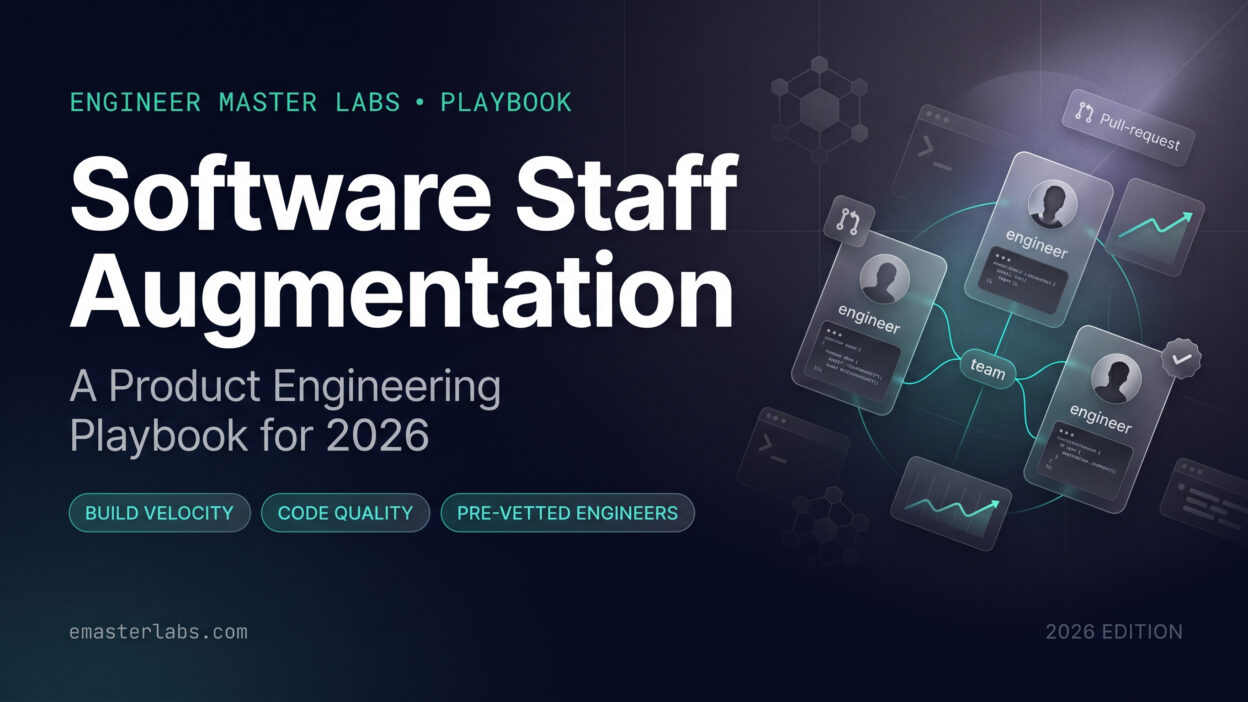
TL;DR Software staff augmentation is the specific application of the augmentation model to product engineering teams. The dynamics are different from generic IT augmentation. Velocity matters more than coverage. Culture fit matters more than certifications. Code quality compounds. This post explains how software staff augmentation actually works inside a product team, what to optimize for, and the playbook that gets you to ship faster without breaking the codebase.
Software staff augmentation gets lumped together with generic IT augmentation, and that’s a mistake. They look similar from the outside (engineers from another company joining your team) but they fail in completely different ways.
IT augmentation can survive a mediocre engineer. The work is often rule-based, well-documented, and forgiving of average performance. Software augmentation can’t. Product code lives for years. A mediocre engineer leaves a five-year tax on every team that touches their code afterwards. The bar has to be higher.
This post is for product engineering leaders who want to use augmentation without inheriting technical debt.
Table of Contents
Why Software Staff Augmentation Is Different
Three reasons the model needs different handling:
Code outlives the engagement. The augmented engineer leaves in 14 months. Their code stays for ten years. Mediocre code becomes someone else’s expensive problem.
Product context can’t be specced. Enterprise IT projects often have detailed specs. Product engineering depends on judgment calls dozens of times per day. The engineer needs to understand why the product exists, not just what to build.
Speed and quality compound differently. In IT projects, you can trade quality for speed and the consequences are bounded. In product code, the trade compounds. Today’s shortcut becomes next year’s rewrite.
Roles That Work Well in Software Augmentation
Some software roles fit the augmentation model better than others. The pattern is: roles where the work is contained, the success criteria are clear, and the institutional knowledge is shareable.
Backend engineers. The model’s sweet spot. Well-defined APIs, clear contracts, testable outcomes. Augmented backend engineers can ship production code in week two.
Frontend engineers. Works well with strong design systems and component libraries. Without those, frontend augmentation produces visual inconsistency that takes months to clean up.
Mobile engineers (iOS, Android, React Native, Flutter). Self-contained codebases, clear platform standards. Strong fit for augmentation.
QA and SDET. Often the highest-leverage augmentation hire. Test infrastructure, automation suites, and CI pipelines benefit massively from dedicated attention.
DevOps and SRE. Strong fit when scoped to specific outcomes (Kubernetes migration, observability stack, CI/CD overhaul). Weaker fit when used as general operations support.
Data engineers. Pipeline work, warehouse modeling, ETL refactoring. Highly augmentable.
ML engineers. Works well for inference infrastructure, model deployment, and pipeline work. Trickier for novel research.
Roles That Don’t Work Well
Three roles where software staff augmentation usually disappoints:
Founding engineers. The first three engineers shape the company’s technical DNA for years. That’s not a role you outsource.
Principal architects setting long-term strategy. The institutional context required is too deep. Use augmented architects for execution, not direction-setting.
Engineering managers building team culture. Culture-building requires presence, longevity, and emotional investment. Augmentation models don’t reward any of those.
The Three Engagement Models for Software Teams
Three patterns, each suited to different situations.
Embedded individual contributors. One or two engineers join your existing team. Attend your standups, write code in your repos, follow your processes. Best when you have a strong tech lead and clear capacity gaps.
Pod-based augmentation. A complete pod (tech lead + 2-3 engineers + QA) takes ownership of a workstream. Higher cost per head, faster ramp, better outcomes for self-contained features. Best when you need to spin up a new product surface without burdening the core team.
Managed extension. The provider runs an engineering team for you under your direction. Includes delivery management, performance management, and team operations. Best when you need to scale fast and don’t have the management bandwidth internally.
Most companies start with embedded ICs and graduate to pods or managed extensions as the engagement scales. The progression makes sense: prove the partner works at small scale before betting bigger.
What “Pre-Vetted” Should Actually Mean
Every staff augmentation provider claims pre-vetted engineers. Most are lying. Real vetting for software roles includes:
- A live coding interview, not a take-home test
- System design at appropriate seniority level
- Code review of past work, not just GitHub stars
- Communication assessment in English
- Reference check with previous engagements
- Cultural fit screen for the specific client environment
If a provider can’t describe their vetting process in this much detail, they don’t have one.
Then there’s the second layer. Even after vendor vetting, you should run your own technical interview. Not because you don’t trust them, but because fit varies by team. An engineer who’s perfect for a fintech client might be wrong for your AI product. The vendor can’t predict that. You can.
Onboarding Software Augmented Engineers
The onboarding playbook for software augmentation is different from full-time onboarding. The constraints are different and the goals are different.
Day 1-2: Context. Architecture overview, codebase tour, product context, customer context. Skip company history and HR rituals. Focus on technical and product context.
Day 3-5: Small ticket. A bounded, low-risk task that requires touching the codebase and submitting a PR. Reveals their real engineering quality faster than any interview did.
Week 2: Pair programming. Pair with a senior internal engineer on a more complex task. Builds trust both directions and surfaces gaps before they become problems.
Week 3-4: Independent feature. A scoped feature they own end-to-end. By the end of week four, you should know whether the engagement will work.
If after four weeks you don’t have confidence, request a replacement. Most providers honor this if you ask cleanly. The cost of swapping at week four is trivial compared to the cost of carrying a weak engineer for ten more months.
Code Quality Controls
Software staff augmentation lives or dies on code quality. Five controls that are non-negotiable:
Mandatory code review by an internal engineer for every PR from augmented engineers, especially in the first three months. After that, peer review with internal engineers can replace it.
Linters and automated quality gates in CI. Augmented engineers should fail the same way internal engineers fail. No exceptions for vendor PRs.
Test coverage requirements. If your team has standards, augmented engineers meet them. If you don’t have standards, this is the moment to introduce them.
Architecture decision records (ADRs) for any significant change. Forces the engineer to explain their reasoning, surfaces problems before they ship, and creates documentation for future engineers.
Quarterly tech debt review. Look at what augmented engineers shipped, identify what would need to change if they left tomorrow, and remediate proactively.
The AI-Augmented Engineer Question
By 2026, most serious software engineers use AI coding assistants daily. Cursor, Claude Code, GitHub Copilot, and similar tools have shifted what one engineer can ship in a sprint. This changes the augmentation calculus.
A senior engineer with strong AI-tool fluency can output what used to take two engineers in 2023. Some staff augmentation companies have integrated this into their delivery model. Others are billing 2024 rates for 2024 productivity.
Ask any provider directly: which AI coding tools do your engineers use, what’s the company policy on tool licensing, and how does this affect output expectations? If they can’t answer, they’re behind.
That said, AI tools amplify good engineers and amplify bad ones. A weak engineer with Cursor produces more bad code, faster. The vetting bar gets higher, not lower.
Common Failure Modes
Three patterns that cause software augmentation engagements to fail:
Treating augmented engineers as ticket-takers. They sit in a separate Slack channel, get tickets thrown over the wall, and never participate in product discussions. The output is technically correct and strategically wrong. Engineers disengage and quality drops.
Skipping the small-ticket trial. Throwing a complex feature at a new engineer in week one means you discover quality issues at week six, deep into expensive code. Always start small.
Letting time-zone differences become information silos. If decisions get made at standups the augmented engineers can’t attend, those engineers will always be one step behind. Either align on time zones or document decisions ruthlessly.
Cost Versus Velocity Tradeoff
The temptation in software staff augmentation is to optimize for cost. The smarter optimization is for velocity per dollar.
A senior engineer at ₹3.5 lakhs per month who ships 80% of a senior internal hire is a better deal than a mid-level engineer at ₹2 lakhs per month who ships 40%. The cost ratio looks worse on paper but the output ratio is much better.
The metric that matters is fully-loaded cost per shipped feature, including code review time, bug rate, and remediation cost. By that metric, paying for senior augmented engineers almost always wins.
Working With Engineer Master Labs
Engineer Master Labs runs software staff augmentation for product companies that care about engineering quality. Our engineers are vetted on live coding, system design, and product judgment. We staff backend, frontend, mobile, DevOps, ML, and QA roles.
Most of our clients start with one or two engineers and grow the engagement over time. We work in pods when the work is self-contained and as embedded ICs when it’s not.
If you’re building a product and need engineering capacity, the fastest way to evaluate fit is a 60-minute scoping call. We’ll walk through your tech stack, your team, and the work you need done, and tell you honestly whether we’re the right partner.
📧 Email: [email protected]
📞 Phone: 1-347-543-4290
🌐 Website: emasterlabs.com