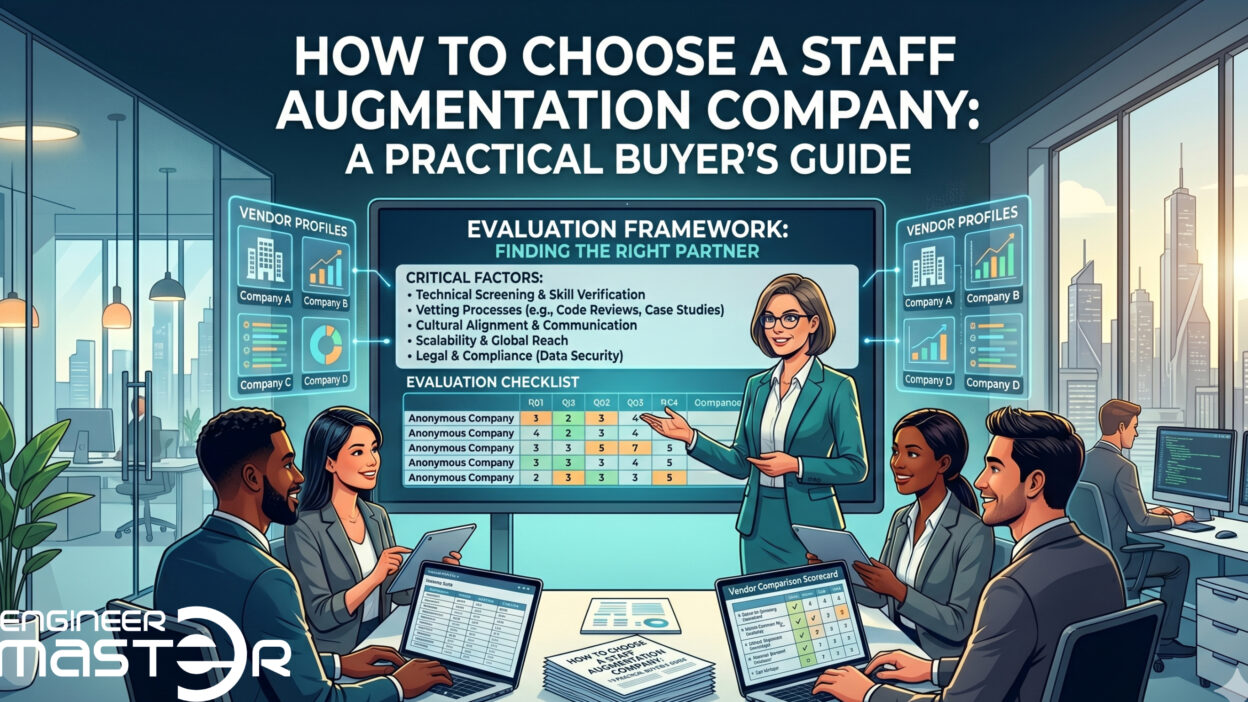
TL;DR Picking a staff augmentation company is more like picking a co-founder than picking a vendor. Get it right and you get a multi-year force multiplier. Get it wrong and you spend more time managing the vendor than shipping product. This post lays out what separates a serious staff augmentation company from a body shop, the questions that surface the difference in 30 minutes, and the red flags that should end the conversation.
The staff augmentation market is crowded. Search any tech keyword and you’ll find a hundred companies promising the same thing: pre-vetted engineers, fast onboarding, lower costs. Most of them are recycling the same LinkedIn profiles and praying you don’t notice. A few are doing real work.
The difference between the two shows up in month three. The serious staff augmentation company has engineers shipping production code, attending standups, raising the right architectural concerns. The body shop has engineers who copy Stack Overflow, miss deadlines, and need replacement. By the time you realize which one you hired, you’ve burned two months.
This guide is the filter we wish more buyers used.
Table of Contents
What a Real Staff Augmentation Company Looks Like
Strip away the marketing pages and a real staff augmentation company has six things going for it.
An engineering practice, not just a recruiting practice. The best providers have a CTO, an architecture team, and internal engineering standards. Their engineers learn from each other, get reviewed by senior peers, and follow shared best practices. A body shop is just a recruiter with a sales team.
A bench, not a pipeline. Real providers maintain bench engineers across critical skill areas. They pay them between projects so they’re available immediately. A pipeline-only provider goes hunting on Naukri the day you sign. You’ll feel the difference in week one.
Domain depth in two or three industries. A provider that claims expertise in everything has expertise in nothing. The good ones go deep in fintech, healthtech, SaaS, or some other vertical. Their engineers have shipped multiple systems in your industry and know your specific pitfalls.
Long-tenure engineers. Ask about average tenure. If it’s under 18 months, you’re looking at a churn factory. Engineers who don’t stay don’t accumulate the institutional knowledge that makes them effective on your project.
A real account management layer. Not a salesperson who disappears after the contract is signed. A delivery manager who joins your standups, monitors team health, and intervenes when something starts to slip. This is the cheapest insurance you can buy.
Operational maturity. SOC 2 or ISO 27001. NDAs and IP clauses that match enterprise requirements. Documented onboarding, security training, exit procedures. The boring stuff that determines whether your enterprise legal team will approve the engagement at all.
The Six-Question Filter
You don’t need a 47-criteria evaluation matrix. You need six questions that surface real information in a 30-minute call.
1. “What’s your average engineer tenure?” Acceptable: 30+ months. Concerning: 18-30 months. Walk away: under 18 months. This single number tells you more about engineering quality than any case study.
2. “How fast can I interview five candidates and how many of them are on the bench right now?” Acceptable: five interviews scheduled within five business days, three on bench. Concerning: longer timelines or vague answers about bench. Walk away: candidates who require “ramp-up” before joining.
3. “Who manages the engagement after we sign?” Acceptable: a named delivery manager who attends a kickoff and joins regular cadence. Concerning: account manager who only checks in monthly. Walk away: salesperson who disappears.
4. “What happens if the engineer doesn’t fit?” Acceptable: 48-72 hour replacement at no cost. Concerning: replacement in 1-2 weeks with billing for transition. Walk away: case-by-case answers or refusal to commit.
5. “Show me three recent client references in our industry.” Acceptable: three names within 24 hours, willing to take 15-minute calls. Concerning: vague references or testimonials only. Walk away: refusal or no clients in your industry.
6. “Walk me through your security posture.” Acceptable: SOC 2 or ISO 27001, documented secure SDLC, role-based access control, screen monitoring policies if applicable. Concerning: “we sign NDAs” as the entire answer. Walk away: any hesitation on enterprise data handling.
If a staff augmentation company can’t answer these six questions clearly, they’re not your partner. Move on.
Red Flags That End the Conversation
Some signals are bad enough to end the evaluation immediately. Watch for these:
The salesperson dodges your interview request. If they don’t want you talking to engineers before signing, the engineers are probably hired the day after you sign.
The pricing changes based on your urgency. Honest providers have rate cards. They flex on commitment length and team size, not on how desperate you are.
They claim expertise in everything. AI, blockchain, mobile, embedded, ERP, mainframes, CRM customization. Real expertise narrows. Marketing expertise expands.
Their case studies are vague. “Helped a Fortune 500 client achieve 10x improvement.” 10x of what? At what cost? Specific case studies have specific numbers. Vague ones are stock photos.
The MSA has aggressive auto-renewal clauses or non-compete restrictions. A confident provider doesn’t need contractual lock-in to retain you.
They oversell speed. “Engineer on your project tomorrow.” Maybe. But quality matching takes a few days. Vendors that promise instant results are skipping vetting.
The Geography Question
Most staff augmentation companies fall into one of four geographic models. Each has tradeoffs.
Pure offshore (India, Philippines, Vietnam). Lowest cost. Time-zone overlap of 4-6 hours with US clients, 2-4 hours with Europe. Best for steady-state engineering, slower for tightly coupled product work.
Nearshore (Latin America for US clients, Eastern Europe for Western Europe). 25-50% cost savings versus onshore. Strong time-zone overlap. Cultural alignment closer to client. Best for product engineering and high-collaboration work.
Hybrid. Onshore tech lead plus offshore engineering team. Captures cost savings while keeping client-facing roles in the same time zone. Most enterprise programs end up here.
Pure onshore. Highest cost. Lowest friction. Reserved for highly regulated work, classified projects, or situations where the cost premium is invisible to the client.
Pick based on the work, not the marketing. Steady backend work runs fine offshore. A new product launch with daily UX iterations runs better nearshore or hybrid.
Pricing Models You’ll Encounter
Three pricing models dominate, with a fourth growing fast.
Time and materials. Hourly or monthly billing per engineer. The default model. Predictable, transparent, easy to scale up or down. Works for almost everything.
Fixed monthly retainer. Locked monthly rate for a defined team. Slightly cheaper than T&M because you’re committing. Works when scope is stable.
Milestone-based. Payment tied to specific deliverables. Looks safer but requires extremely clear specs. Most often the wrong choice for evolving products.
Outcome-based or revenue share. Newer model where the provider earns based on business results. Aligns incentives perfectly when it works. Hard to structure and only a few providers offer it credibly.
For most engagements, monthly retainer with a quarterly review is the cleanest structure. It gives the provider stability to invest in your project and gives you the option to adjust without renegotiating every month.
What to Negotiate (and What to Leave Alone)
Buyers waste negotiation capital on the wrong things. Here’s where it actually matters.
Negotiate hard on: replacement guarantees, IP ownership, exit terms, confidentiality of your tech stack, and the right to interview engineers before they’re assigned.
Don’t bother with: a few percent off the rate. The 5% you save by squeezing the provider often costs you the engineer’s commitment. Margin pressure leads to assignment of B-team engineers.
The right move is paying market rate and demanding A-team performance. Most providers will accept this trade gladly because it’s better for both sides.
The Long-Term Relationship
Two years into a working relationship with a serious staff augmentation company, the dynamic changes. The provider knows your codebase, your customers, your product roadmap. Onboarding new engineers takes hours instead of days. The delivery manager surfaces problems before you notice them.
This compounding effect is the actual return on getting the partner choice right. Year-one savings are 30-40%. Year-three savings, if you account for the velocity advantage, are closer to 60%.
Pick someone you can imagine working with for three years. The math gets dramatically better past the first year, but only if you don’t have to switch.
Why Engineer Master Labs
Engineer Master Labs is a staff augmentation company built for the long-term relationship model. Average engineer tenure on our bench: 38 months. Average client engagement length: 22 months. We work primarily with SaaS, fintech, and AI-driven product companies.
We’re not the cheapest option in the market and we don’t try to be. We compete on engineering quality, delivery management, and the kind of operational maturity that lets enterprise clients sleep at night.
If you want to evaluate whether we’re the right fit, the fastest path is a 60-minute scoping call. We’ll walk through your requirements, explain who we’d put on the team, and give you honest pricing. If we’re not the right fit, we’ll often suggest someone who is.
📧 Email: [email protected]
📞 Phone: 1-347-543-4290
🌐 Website: emasterlabs.com