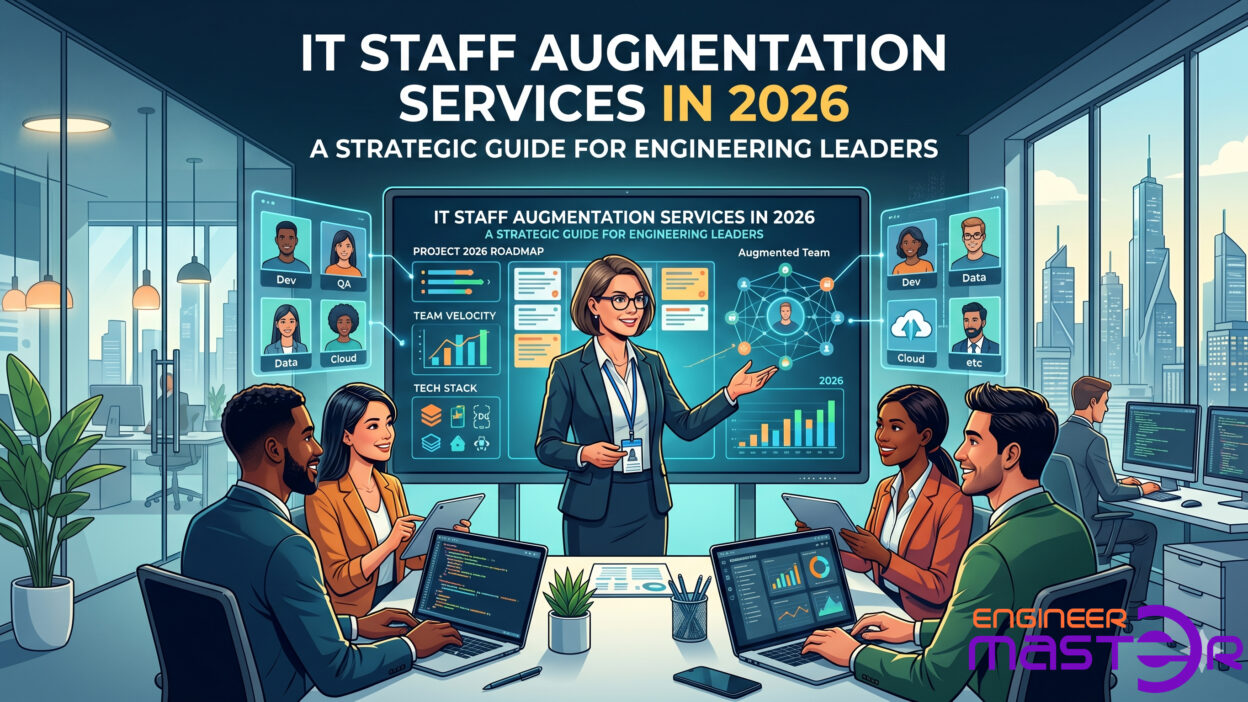
TL;DR IT staff augmentation services let you plug specialized engineers into your existing team in 2-3 weeks instead of hiring full-time over 6 months. The model has matured. In 2026, the companies winning are the ones treating it as a strategic capability lever, not a stopgap. This guide walks through what IT staff augmentation services actually include, how to pick a provider, what they cost, and the mistakes that turn a 40% cost saving into a project disaster.
The hiring market is broken. Senior cloud architects in major Indian metros now command ₹55-75 lakhs annually before equity. AI/ML engineers in the US sit at $180-260K base. Even at those numbers, most companies wait 4-7 months to fill specialized roles. By the time the new hire ramps up, the project window has closed.
This is why IT staff augmentation services have moved from a cost play to a velocity play. You get pre-vetted engineers integrated into your team in days, not quarters. You keep full control over architecture, code, and direction. You scale up and down without severance liabilities. The math works for almost everyone except very large enterprises that already have everything they need in-house.
Table of Contents
What IT Staff Augmentation Services Actually Cover
The phrase “IT staff augmentation” gets thrown around loosely. Strip away the marketing and the actual services break into four buckets:
1. Core engineering augmentation. Backend, frontend, full-stack, mobile. The bread and butter. Engineers join your sprint, attend your standups, write code in your repos. Typical engagement: 6-18 months. Typical cost in India: ₹18-45 lakhs annually fully loaded.
2. Specialized technical augmentation. AI/ML engineers, blockchain developers, cloud architects, DevOps specialists, security engineers. The rare skills you can’t reasonably hire locally. Typical engagement: 4-12 months. Typical cost: ₹25-65 lakhs annually.
3. Project leadership augmentation. Tech leads, solution architects, engineering managers. Sits between augmentation and consulting. Provides direction and code, not just labor. Typical cost: ₹40-80 lakhs annually.
4. Quality and operations augmentation. QA engineers, SDET roles, SREs, technical writers. The supporting cast that makes shipping possible. Often the highest ROI tier because it’s the easiest to underestimate and the easiest to scale. Typical cost: ₹15-35 lakhs annually.
How IT Staff Augmentation Services Differ From Other Models
People conflate three different things: staff augmentation, project outsourcing, and managed services. The distinction matters because the failure modes are different.
With staff augmentation, you direct the work. The engineers report to your tech lead, work in your tools, follow your processes. You own the outcome. The vendor provides the people and handles HR, payroll, and bench management.
With project outsourcing, the vendor owns the outcome. You hand over a spec, agree on milestones, receive deliverables. Cheaper if your spec is rock-solid. Brutal if requirements change.
With managed services, the vendor runs an entire function. Think 24/7 cloud operations or full DevSecOps coverage. You pay for an outcome and an SLA, not for people.
The right answer depends on how stable your requirements are. Stable spec? Outsource. Evolving product? Augment. Repeatable operations? Managed services.
The Real Cost Math
Most cost comparisons are dishonest. They compare a fully-loaded augmented engineer against a base salary, which is meaningless. Here’s the actual math for a senior backend engineer in 2026:
Full-time hire in India:
- Base salary: ₹35 lakhs
- Variable + ESOPs: ₹8 lakhs
- Benefits, gratuity, insurance: ₹4 lakhs
- Recruiter fee (one-time): ₹3.5 lakhs
- Onboarding and ramp time loss: ₹6 lakhs (3-month productivity gap)
- Infrastructure, laptop, software: ₹2 lakhs
- Management overhead allocation: ₹3 lakhs
- Year-one true cost: ~₹61.5 lakhs
Senior augmented engineer:
- Monthly billing rate: ₹2.8-3.5 lakhs
- Annual all-inclusive: ₹35-42 lakhs
- No recruiter fee, no ramp loss, no severance risk
- Year-one true cost: ~₹40 lakhs
The savings sit at 30-40% in year one and the gap narrows in year two and three. The bigger advantage is optionality. If the project ends, you stop billing. If you need to swap a skillset, you swap engineers. Try that with a full-time hire.
When IT Staff Augmentation Services Make Sense
Five situations where it almost always works:
You need a specialized skill for less than 18 months. AI/ML, blockchain, embedded systems, niche cloud certifications. Hiring full-time for transient needs locks you into ongoing salary obligations after the need passes.
You’re in a hiring freeze but need to ship. Augmented engineers come out of opex, often a different budget line than headcount. Many CFOs approve augmentation when they won’t approve hires.
Your project has a hard deadline. A six-month hiring cycle is incompatible with a four-month launch. Augmentation is the only realistic path.
You need to stress-test demand before committing. New product line, new market, new architecture. Augment, prove it works, then convert key people to full-time.
You need geographic or time-zone coverage. Follow-the-sun development, on-call rotations, regional compliance work. Building a full team in another country takes years. Augmentation takes weeks.
When It Doesn’t Make Sense
Three situations where augmentation will hurt you:
The role is core to your competitive moat. If your company’s defensibility comes from a specific algorithm or product capability, that work belongs in-house. The institutional knowledge needs to compound.
You don’t have an internal tech lead. Augmentation amplifies your existing engineering culture. If there’s no culture to amplify, you’ll get a team of strong individuals shipping in different directions.
You need someone to “figure out what to build.” That’s product strategy, not engineering. Pay a fractional CPO or hire a founder. An augmented engineer will optimize for tickets, not for product-market fit.
How to Evaluate IT Staff Augmentation Providers
Most evaluation guides give you 47 criteria. Useless. Here are the seven that actually matter:
Replacement guarantee. Ask: if the engineer doesn’t fit, how fast do you replace them and at what cost? A serious provider replaces within 72 hours at no charge. A weak one takes weeks and bills you for the transition.
Direct technical interviews. You should interview the engineers, not just review CVs. If the provider resists, walk away. They’re hiding something.
Bench depth in your stack. Ask for ten profiles in your specific tech stack with availability dates. If they can only show three, they don’t have real depth.
IP protection clauses. Code, models, data, and processes you produce should be unambiguously yours. Read the master services agreement carefully. The defaults often favor the vendor.
Security and compliance posture. SOC 2, ISO 27001, GDPR readiness. Required for anything touching enterprise data. Optional for early-stage products. Critical for healthcare, finance, and government work.
Reference calls with current clients. Not testimonials. Calls. Ask about communication, time-zone management, and what happened when something went wrong.
Transparent pricing. If the rate card shifts based on how badly you need someone, the relationship will degrade quickly. Honest providers publish or quickly disclose ranges.
The Onboarding Mistakes That Kill ROI
Most augmentation engagements fail in the first month, not month six. Three patterns to avoid:
Skipping context transfer. Engineers who join without architectural context, business context, and customer context produce technically correct code that misses the point. Budget two days minimum for orientation. Five if the system is complex.
Treating them as second-class. Excluding augmented engineers from product discussions, planning meetings, and Slack channels creates exactly the disengagement you feared. Treat them as you treat full-timers and they’ll perform like full-timers.
No clear ownership. Augmented engineers need a single internal point of contact. Multiple stakeholders pulling in different directions is the fastest way to waste senior talent.
Industry-Specific Considerations
Fintech and banking. Compliance is non-negotiable. Verify the provider has worked under PCI DSS, RBI guidelines, or whatever regime applies. Audit trails for code changes are required, not optional.
Healthcare. HIPAA in the US, ABDM compliance in India. Engineers handling patient data need specific training. Ask the provider what training, what frequency, what proof.
SaaS and product companies. Lower compliance burden, higher velocity expectations. Look for providers with product-engineering culture, not just project-engineering culture.
Enterprise IT. Long procurement cycles. Verify the provider can handle MSAs, vendor onboarding portals, and quarterly business reviews without breaking a sweat.
What’s Changing in 2026
Three shifts worth watching:
AI-augmented engineers. The best providers now embed engineers who use Claude Code, Cursor, and similar tools as a baseline. Effective output has roughly doubled for certain workflows. Don’t pay 2024 rates for 2024 productivity when 2026 productivity is available.
Outcome-based pricing. The hourly rate model is slowly giving way to milestone-based and even revenue-share arrangements for product engagements. Most providers won’t volunteer this. Ask.
Pod-based engagement. Instead of cherry-picking individual engineers, smart buyers are bringing in full pods (tech lead + 2-3 engineers + QA) configured for a workstream. Faster ramp, better outcomes, slightly higher cost per head.
Getting Started
If you’re considering IT staff augmentation services, the highest-leverage thing you can do this week is write a one-page document that answers four questions:
- What specific outcomes do we need in the next six months?
- What skills do we need that we don’t have?
- What’s our budget and where does it come from?
- Who internally will own the augmented team’s success?
That document will save you from hiring engineers you don’t need, paying premiums you can’t justify, and ending up with augmented capacity that nobody owns. Write it before you talk to a single provider.
Work With Engineer Master Labs
Engineer Master Labs has placed engineers across 100+ companies in IT staff augmentation engagements ranging from two-month sprints to multi-year extended teams. We pre-vet for technical depth, communication, and culture fit. Our average time from kickoff to engineer-on-keyboard is 11 days.
If you want to talk through a specific need, we offer a free 60-minute scoping call where we map your requirements, suggest the right engagement model, and give you honest pricing.
📧 Email: [email protected]
📞 Phone: 1-347-543-4290
🌐 Website: emasterlabs.com