Introduction
TL;DR Meta’s AI story hit a rough patch in 2025. Llama 4 launched in April of that year and drew widespread criticism. Multiple outlets confirmed that Meta used specially tuned sub-models to inflate benchmark scores. The general-release version performed far below what those numbers suggested. Trust in Meta’s AI announcements dropped sharply.
Then on April 8, 2026, Meta dropped something new. The company launched Muse Spark, the first model out of the newly formed Meta Superintelligence Labs. This Meta Muse Spark review examines what actually changed, what the model genuinely does well, where it still falls short, and whether it deserves the attention it is getting.
This Meta Muse Spark review draws from Meta’s official technical blog, independent benchmarks from Artificial Analysis, real-world testing reports from DataCamp, and coverage from Fortune, TechCrunch, and The Next Web. Every major claim gets a source. Nothing here rests on Meta’s word alone.
Table of Contents
The Background: How Muse Spark Came to Exist
Mark Zuckerberg was not happy with Meta’s AI trajectory after Llama 4. The company reorganized its entire AI operation in June 2025. Meta Superintelligence Labs, known internally as MSL, became the new center of gravity. Zuckerberg brought in Alexandr Wang, co-founder and former CEO of Scale AI, as Meta’s first-ever Chief AI Officer. Meta committed 14.3 billion dollars for a 49 percent stake in Scale AI as part of that deal.
Nat Friedman, former CEO of GitHub, joined to lead product and applied research. Shengjia Zhao, who co-created GPT-4 and o1 at OpenAI, became Chief Scientist. The talent list is genuinely impressive. Meanwhile, Yann LeCun, Meta’s longtime Chief AI Scientist and the loudest voice for open-source AI, left the company in November 2025 following organizational changes that reduced his role.
Meta spent the next nine months rebuilding its AI stack from the ground up. Model architecture, training optimization, and data curation all went through complete overhaul. The budget matched the ambition. Meta guided for between 115 and 135 billion dollars in capital expenditure for 2026 alone, up from 72 billion in 2025. Muse Spark is the first public output from that investment. Any honest Meta Muse Spark review has to account for this context.
A Closed-Source Departure from Meta’s Llama Legacy
The detail that drew the most reaction from the developer community was this: Muse Spark is closed source. Meta’s Llama models built an enormous open-source ecosystem. Thousands of applications, research projects, and competing products used Llama weights as a foundation. Muse Spark breaks that pattern entirely.
Meta framed the closure as temporary. Zuckerberg wrote on Threads that the company plans to release increasingly advanced models, including new open-source models, in the future. The more pragmatic reading is different. Keeping architectural innovations proprietary protects competitive advantage in a race where every capability gap matters. The pivot to closed source signals that Meta now treats itself as a genuine frontier competitor, not just an open-source research contributor.
This shift matters for anyone reading a Meta Muse Spark review from a developer perspective. No public API exists at the time of this writing, though Meta has indicated API access will come soon. Access currently routes through the Meta AI app, the Meta AI website, and increasingly through WhatsApp, Instagram, Facebook, and Messenger.
What Is Meta Muse Spark? Core Architecture and Design Goals
Muse Spark is the first model in Meta’s new Muse family. It is a frontier-class, natively multimodal large language model. Meta describes it as the first step toward personal superintelligence, which is a bold phrase that marketing teams love and technical reviewers examine carefully. This Meta Muse Spark review takes that phrase at face value only where the evidence supports it.
The model’s architecture is genuinely different from earlier Llama models. Earlier Llama models retrieved answers through pattern matching on training data. Muse Spark reasons through problems before responding. That shift in processing approach is the actual technical improvement, and DataCamp’s review calls it out explicitly as the real change.
Contemplating Mode: Multi-Agent Parallel Reasoning
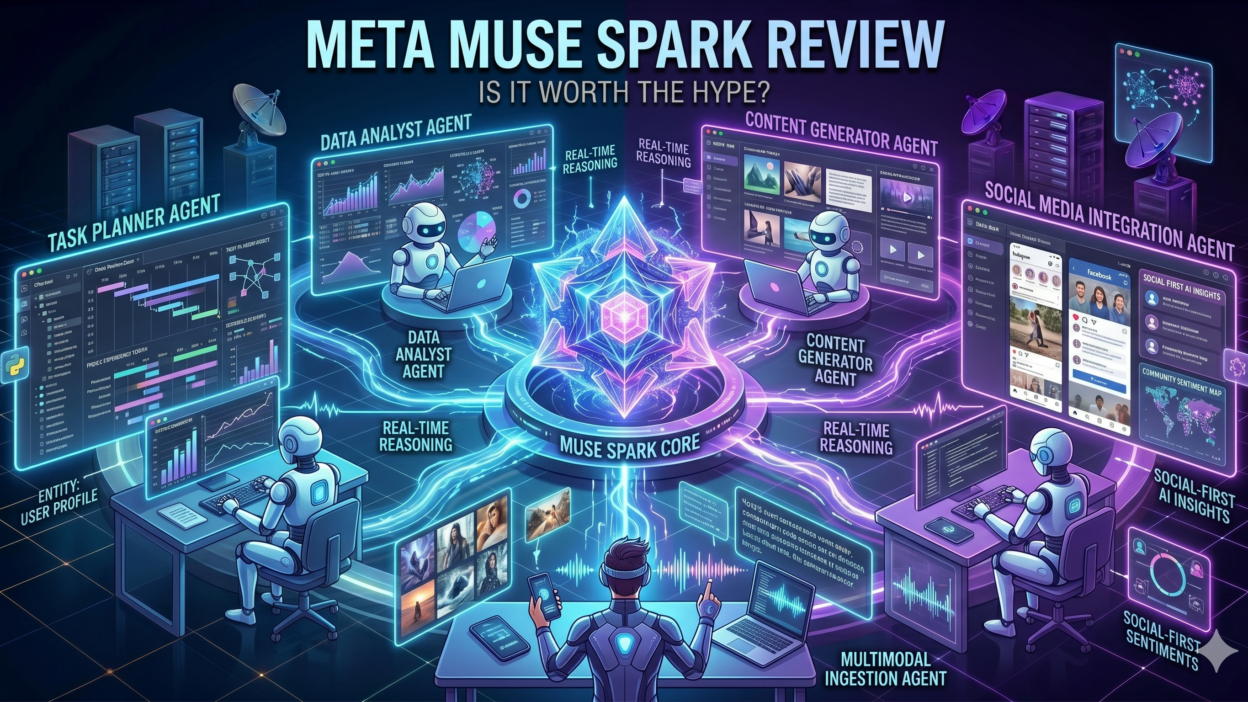
The headline feature is Contemplating mode. This mode orchestrates multiple AI agents that reason in parallel. The system breaks complex problems into components, runs several reasoning chains simultaneously, and synthesizes the results into a single coherent response. Meta positions this as direct competition with Gemini Deep Think and GPT Pro’s extended thinking modes.
Meta’s own numbers put Contemplating mode at 58 percent on Humanity’s Last Exam and 38 percent on FrontierScience Research. Independent benchmarkers at Artificial Analysis place Muse Spark fourth overall on their Intelligence Index, behind Gemini 3.1 Pro Preview, GPT-5.4, and Claude Opus 4.6. That is still top five globally, which is a genuinely strong position for a model released nine months after a near-complete team rebuild.
Multimodal Visual Understanding
Muse Spark processes visual information natively. It handles visual STEM questions, entity recognition, and image localization without requiring separate specialized models. DataCamp tested the model on a complex multi-line time-series chart. Muse Spark correctly identified all data patterns, reasoned across multiple products and timeframes, and produced insights that went beyond what the prompt explicitly requested.
The model scores 86.4 on CharXiv Reasoning, which measures figure and chart understanding. That number reflects genuine strength in visual analysis. Meta also claims strong performance on visual tasks that translate into interactive experiences, such as helping users troubleshoot home appliances through dynamic image annotations or creating mini-games from visual inputs.
Health Reasoning as a Priority Domain
Health is the third major focus area. Meta collaborated with over 1,000 physicians to curate training data specifically for health reasoning. This is not window dressing. The model scores 42.8 on HealthBench Hard and 78.4 on MedXpertQA multimodal, which are competitive numbers in the health AI benchmark space.
The practical application is direct. A user can photograph a nutritional label and get a detailed breakdown of health implications. The model can explain which muscle groups activate during specific exercises using interactive displays. These are not research capabilities waiting for productization. They are live features available through Meta AI today.
Meta Muse Spark Review: Performance Benchmarks and What They Actually Mean
Meta’s Self-Reported Numbers
Any Meta Muse Spark review written responsibly has to separate Meta’s self-reported benchmarks from independently verified ones. Meta’s history with Llama 4 makes this separation non-negotiable. Meta’s published numbers show strong performance across multimodal perception, reasoning, and health tasks. The company acknowledges performance gaps in long-horizon agentic tasks and coding workflows.
The Artificial Analysis Intelligence Index scores help here. Their evaluation is independent. Muse Spark scores 52 on their Intelligence Index. For comparison, Llama 4 Maverick scored 18 and Llama 4 Scout scored 13 at their respective releases. That single-release jump from the mid-teens to 52 represents an enormous capability leap. Muse Spark essentially closed the gap to the frontier in one product cycle.
Independent Performance Data
Artificial Analysis ran Muse Spark through GDPval-AA, their evaluation focused on real-world work tasks. Muse Spark scored 1,427. Claude Sonnet 4.6 scored 1,648. GPT-5.4 scored 1,676. Gemini 3.1 Pro Preview scored 1,320. Muse Spark sits between Gemini and the top two, which is a strong position for a first-generation product from a rebuilt lab.
On TerminalBench Hard, which measures coding and terminal task performance, Muse Spark trails Claude Sonnet 4.6, GPT-5.4, and Gemini 3.1 Pro. This aligns directly with Meta’s own acknowledged weakness in coding workflows. The gap is real. Developers who need a strong coding model should weigh this heavily in their evaluation.
Token Efficiency: A Genuine Strength
One data point from independent analysis stands out. Muse Spark used 58 million output tokens to complete the Intelligence Index evaluation. Gemini 3.1 Pro Preview used 57 million. Claude Opus 4.6 used 157 million. GPT-5.4 used 120 million. Muse Spark achieves its intelligence level with dramatically less token usage than most comparable models. That efficiency has direct cost implications for API usage when access opens up.
Real-World Usage: What Users Actually Experience
Access and Login Requirements
Users access Muse Spark through the Meta AI app or website. A Meta account from Facebook or Instagram is required to log in. TechCrunch flagged this as a privacy concern worth naming directly. Meta does not explicitly state that personal data from connected accounts feeds into Muse Spark’s responses. Given Meta’s general practice of training on public user data and its stated goal of building personal superintelligence, this connection seems probable rather than speculative.
This Meta Muse Spark review takes that concern seriously. Users who are cautious about their Meta social data being referenced or used in AI interactions should factor this into their adoption decision. Privacy-first users may prefer waiting for the API release, which would theoretically allow access with a separate account context.
Conversational Quality and Response Style
Reviews from real users describe Muse Spark’s conversational quality as noticeably improved over Meta AI’s previous experience. The model reasons before responding. Answers feel considered rather than pattern-matched. For general questions, creative tasks, and health information requests, the quality competes directly with top-tier models.
The Contemplating mode adds a visible reasoning layer. Users see the model working through a problem before the final response appears. This transparency builds trust in the output. Whether the extended thinking genuinely improves accuracy or primarily signals effort is a question that longer-term user testing will answer more definitively than any launch-week review can.
Visual Task Performance in Practice
The multimodal capabilities test well in practical use. Uploading an image and asking Muse Spark to analyze it, annotate it, or generate interactive content from it produces strong results. The model handles complex charts, product images, and health-related photographs accurately. The 86.4 CharXiv Reasoning score translates into genuine real-world usefulness, not just benchmark performance.
Strengths and Weaknesses: An Honest Assessment
Where Meta Muse Spark Genuinely Excels
Health reasoning is the clearest strength. The collaboration with over 1,000 physicians produced measurable results. HealthBench Hard and MedXpertQA scores confirm this is not marketing positioning alone. For health-adjacent use cases, Muse Spark deserves serious consideration.
Visual understanding is the second genuine strength. The model processes images natively and accurately. Chart analysis, STEM image interpretation, and real-world object annotation all perform well. This is a meaningful differentiator from text-focused models that bolt image processing on as an afterthought.
Token efficiency is the third underappreciated strength. Using 58 million tokens to match the intelligence of models that require 120 to 157 million tokens is a significant architectural achievement. When API access opens, this efficiency will translate directly into lower costs for developers.
Where Meta Muse Spark Falls Short
Coding is the clearest weakness. Meta acknowledges this directly. Independent benchmarks confirm it. Developers who need a model for code generation, debugging, or terminal tasks should look at Claude Sonnet 4.6, GPT-5.4, or Gemini 3.1 Pro before committing to Muse Spark for that use case.
Abstract reasoning is another gap. ARC-AGI-2 performance trails top competitors. Long-horizon agentic systems, where the model needs to plan and execute multi-step tasks over extended sequences, also need improvement. Meta names this gap honestly in its technical blog.
Accessibility is the third limitation. The closed-source model with no public API and a required Meta social account login creates barriers that previous Llama releases never had. Developers and researchers who built on Llama’s open weights will feel this change acutely. The planned API release will help, but the timeline remains unconfirmed.
Meta Muse Spark vs the Competition
Muse Spark vs GPT-5.4 and Claude Sonnet 4.6
GPT-5.4 and Claude Sonnet 4.6 both outperform Muse Spark on real-world work task evaluations and coding benchmarks. That gap is real and relevant for professional users. Muse Spark closes the gap significantly on health reasoning and multimodal visual tasks. This Meta Muse Spark review does not declare a universal winner because no universal winner exists. Each model has a domain where it leads.
Muse Spark vs Gemini 3.1 Pro Preview
Gemini 3.1 Pro Preview scored lower than Muse Spark on the Artificial Analysis Intelligence Index, at 1,320 on GDPval-AA versus Muse Spark’s 1,427. Muse Spark leads Gemini on health and multimodal benchmarks. Gemini leads on long-horizon agentic and coding tasks. For teams already inside the Google ecosystem, Gemini integration advantages may outweigh raw benchmark differences.
Frequently Asked Questions About Meta Muse Spark Review
Is Meta Muse Spark available for free?
Yes. Muse Spark is currently available through the Meta AI app and website at no cost. A Meta account linked to Facebook or Instagram is required. Contemplating mode, the advanced parallel reasoning feature, is rolling out gradually and may not be available to all users immediately. No paid tier has been announced yet, though that could change as adoption grows.
Is Meta Muse Spark better than ChatGPT?
This Meta Muse Spark review avoids a simple yes or no answer because the comparison depends on use case. Muse Spark leads on health reasoning and visual analysis. ChatGPT with GPT-5.4 leads on coding, real-world work tasks, and general-purpose versatility. Users who focus on health, wellness, or image-heavy tasks will find Muse Spark competitive. Developers and coders will likely prefer GPT-5.4 or Claude for now.
Why did Meta make Muse Spark closed source?
Meta broke from its open-source Llama tradition with Muse Spark to protect competitive advantages in architectural innovation. The company positions this as temporary, with plans to release future open-source models. The practical reality is that in a frontier AI race, sharing architectural breakthroughs immediately hands competitors a shortcut. Muse Spark represents a strategic pivot, not just a product decision.
How does Contemplating mode work in Muse Spark?
Contemplating mode orchestrates multiple AI agents that reason in parallel. The system decomposes a complex problem into sub-problems, runs independent reasoning chains on each, and synthesizes the outputs into a final response. This approach competes with Gemini Deep Think and GPT Pro extended thinking modes. Meta’s benchmarks show 58 percent on Humanity’s Last Exam and 38 percent on FrontierScience Research when using Contemplating mode.
Does Muse Spark raise privacy concerns?
Yes, this deserves honest acknowledgment. Muse Spark requires login with a Meta social account. Meta’s general practice involves training on user data from its platforms. The company has not explicitly stated what personal data from connected accounts feeds into Muse Spark’s personalization or training pipelines. Privacy-conscious users should review Meta’s AI data policies carefully before using health or personally sensitive information with the model.
What secondary keywords relate to the Meta Muse Spark review?
Related search terms include Meta AI model 2026, Meta Superintelligence Labs model, Muse Spark vs ChatGPT, Meta Muse Spark benchmark, Muse Spark Contemplating mode, Meta AI health features, Muse Spark multimodal review, Meta closed-source AI, Muse Spark performance review, and Meta AI app update 2026. These terms frequently appear alongside Meta Muse Spark review in search results.
Read More:-HubSpot Breeze vs. Salesforce Agentforce: Which AI Agent Actually Works?
Conclusion

This Meta Muse Spark review lands on a nuanced verdict. The model is genuinely impressive in specific areas. Health reasoning and visual understanding are real strengths, not benchmark theater. The intelligence leap from Llama 4 to Muse Spark is dramatic and independently verified. Token efficiency is an underrated advantage. The Contemplating mode represents a meaningful step toward deeper AI reasoning.
The weaknesses are also real. Coding lags behind Claude and GPT-5.4. Long-horizon agentic tasks need more work. The closed-source model with a required social account login creates friction for developers and privacy-conscious users. Anyone who followed the Llama 4 benchmark controversy will apply healthy skepticism to Meta’s self-reported numbers, even as independent evaluations confirm much of the story.
The hype is partially earned. Meta rebuilt its AI operation in nine months and produced a top-five frontier model. That is a genuine achievement. It does not lead every benchmark. It does compete seriously across several important domains. For consumer users inside Meta’s ecosystem, Muse Spark delivers a meaningfully better AI experience than anything Meta has offered before.
This Meta Muse Spark review recommends it for health-related queries, visual analysis tasks, and general-purpose conversational AI within the Meta ecosystem. Developers should wait for the API and evaluate coding performance carefully before committing. Privacy-sensitive users should read Meta’s data policies before sharing personal health information with the model.
Meta is back in the frontier AI race. Muse Spark is the proof. Whether the company can close the remaining gaps in coding and agentic reasoning with the next models in the Muse family is the question worth watching over the next six to twelve months.