Introduction
TL;DR Healthcare has always struggled with one major challenge. Getting patients into the system quickly and correctly is harder than it looks. Long wait times, mountains of paperwork, and data entry errors frustrate both patients and staff. AI patient onboarding is changing all of that right now.
Hospitals and clinics are under real pressure. They need to serve more patients with fewer resources. They also need to keep data accurate and secure. AI patient onboarding steps in to fix this exact problem. It automates repetitive tasks, reduces human errors, and speeds up the entire intake process.
This blog explores how AI patient onboarding reshapes healthcare workflows. You will learn what it does, why it matters, and where it is headed. Whether you run a clinic or work in health tech, this guide gives you a clear picture of what is happening in the industry today.
What Is AI Patient Onboarding?
AI patient onboarding refers to using artificial intelligence to manage how new patients enter the healthcare system. It covers everything from collecting patient information to verifying insurance and scheduling appointments. Traditional onboarding relies heavily on manual work. Staff fill out forms, enter data, and verify documents by hand. This process takes time and invites mistakes.
AI patient onboarding replaces much of this manual work with smart automation. The system collects data directly from patients through digital forms or chatbots. It validates the information in real time. It cross-checks insurance details with payer databases. It even flags missing or inconsistent data before a patient reaches the front desk.
Core Components of AI Patient Onboarding
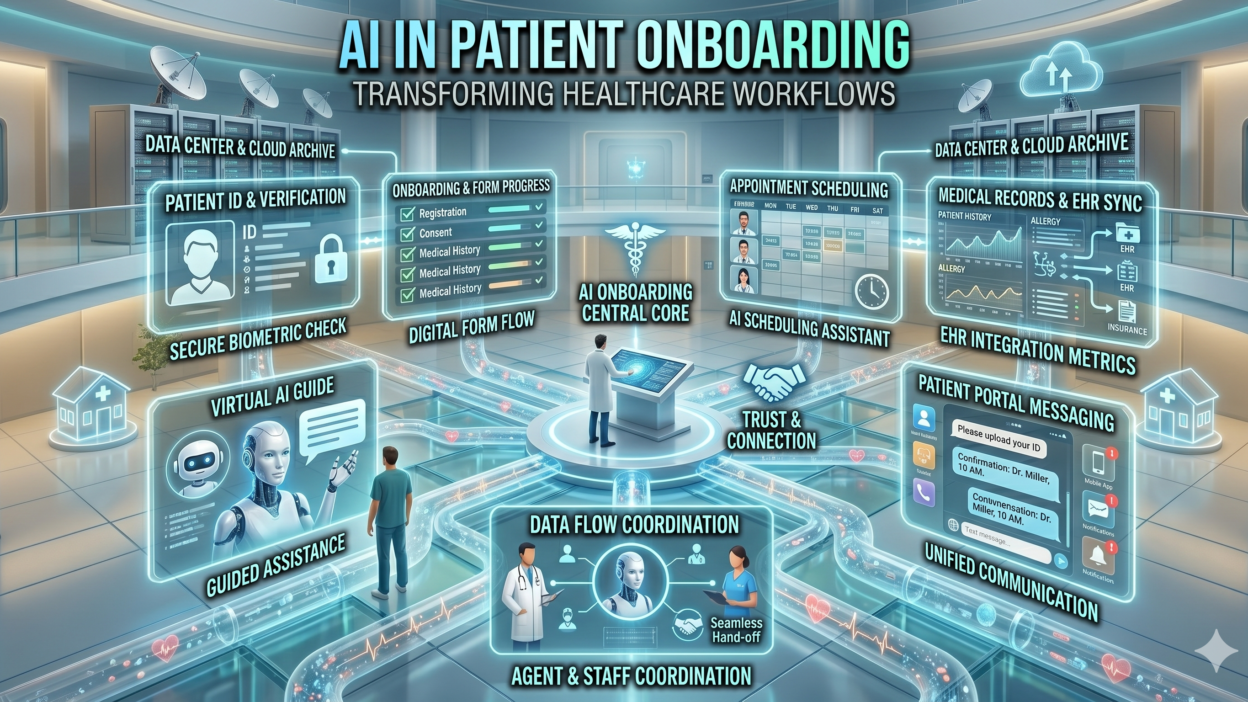
Every AI patient onboarding system has a few key parts. First, there is a digital intake module. Patients fill out forms on their phones or computers before their visit. The AI reads the data and organizes it automatically. Second, there is an identity verification layer. The system checks patient identity using documents or biometrics. Third, there is an insurance eligibility checker. The AI queries payer systems instantly and confirms coverage. Fourth, there is a data integration engine. This connects patient data to the electronic health record or EHR system without manual transfer.
Each of these parts works together. The result is a smooth, fast, and accurate onboarding experience. Patients spend less time in waiting rooms. Staff spend less time on data entry. The whole clinic runs more efficiently.
Why Traditional Patient Onboarding Falls Short
Old onboarding methods create real problems. A patient arrives at the clinic and fills out paper forms. Staff then re-enter that same data into a computer. This double-entry process is slow and error-prone. A single typo in a patient’s date of birth or insurance ID can create billing issues that take weeks to resolve.
Patients also get frustrated fast. Nobody likes sitting in a waiting room filling out the same forms they filled out last year. Research shows that poor onboarding experiences hurt patient satisfaction scores. Low scores lead to fewer return visits. That directly affects clinic revenue.
The Hidden Cost of Manual Onboarding
Manual onboarding costs more than most healthcare administrators realize. Staff time spent on data entry is expensive. Claim denials due to incorrect insurance information cost even more. One study found that hospitals lose billions of dollars each year to preventable billing errors. Many of those errors start at intake.
AI patient onboarding directly attacks this problem. It eliminates duplicate data entry. It catches errors before they become claim denials. It speeds up the intake process so staff can focus on patient care instead of paperwork. The financial case for AI patient onboarding is very strong.
How AI Transforms the Patient Onboarding Process Step by Step
Digital Pre-Registration
AI patient onboarding starts before the patient walks in the door. Patients receive a link to a secure digital form days before their appointment. The form is intelligent. It asks follow-up questions based on previous answers. If a patient says they have diabetes, the form asks about current medications and recent lab results. This gives the care team relevant information ahead of time.
The AI also reads information from uploaded documents. A patient can photograph their insurance card. The AI extracts the member ID, group number, and payer name automatically. No manual typing is needed.
Real-Time Insurance Verification
Insurance verification is one of the biggest pain points in healthcare intake. Staff call payer hotlines or use manual portals to check eligibility. This takes time. Errors happen. AI patient onboarding automates this completely.
The system queries payer databases the moment a patient submits their information. It confirms active coverage, co-pay amounts, and deductible status in seconds. Staff see a clear eligibility summary on their dashboard. They know exactly what the patient owes before the appointment even begins.
Smart Data Validation
AI patient onboarding systems validate data in real time. They check for missing fields, formatting errors, and inconsistencies. If a patient enters a date of birth that does not match the name on their insurance card, the system flags it immediately. The patient gets a prompt to correct the information before submitting.
This catches errors at the source. Problems get fixed before they enter the EHR. The clinical team receives clean, accurate data every time.
Seamless EHR Integration
Once validated, the AI pushes patient data directly into the EHR. No manual re-entry happens. The record is created or updated automatically. Lab orders, referral notes, and consent forms attach to the patient’s chart instantly.
This integration also triggers other workflows. Appointment reminders go out. Pre-visit instructions send automatically. The care team gets notified when a high-risk patient is coming in. Everything moves without human hands guiding each step.
Key Benefits of AI Patient Onboarding in Healthcare
Faster Patient Intake
Speed is the most obvious benefit. AI patient onboarding cuts intake time dramatically. What used to take 20 or 30 minutes at the front desk now takes five minutes at home. Waiting rooms empty faster. Appointment schedules run on time. Patient flow improves across the entire facility.
Fewer Administrative Errors
Human error drops significantly with AI patient onboarding. The system does not get tired. It does not misread handwriting. It does not accidentally skip a field. Every piece of data gets checked against validation rules before entering the system. Error rates fall. Claim denial rates fall with them.
Better Patient Experience
Patients notice when intake feels modern and easy. A smooth digital check-in process signals that the clinic values their time. AI patient onboarding creates a positive first impression. Satisfied patients are more likely to return. They are also more likely to recommend the clinic to others.
Reduced Staff Workload
Front desk staff bear enormous pressure. They handle phones, walk-in patients, and data entry all at once. AI patient onboarding lifts the data entry burden off their shoulders. Staff can focus on greeting patients and solving real problems. Job satisfaction improves. Turnover rates drop.
Enhanced Data Security and Compliance
Healthcare data is highly sensitive. AI patient onboarding systems build security into every step. Data transfers use encryption. Access controls limit who can see patient information. Audit trails record every action. These features help healthcare organizations stay compliant with HIPAA and other data protection regulations.
AI Patient Onboarding and Healthcare Workflow Integration
AI patient onboarding does not work in isolation. It connects to the broader healthcare workflow. When onboarding runs smoothly, every downstream process benefits.
Clinical workflows start with accurate patient data. When AI patient onboarding delivers clean records, doctors spend less time correcting information. They spend more time on diagnosis and treatment. Nurses see accurate medication lists. Pharmacists receive correct allergy information. Everyone works with better data.
Integration with Scheduling Systems
AI patient onboarding connects directly with scheduling platforms. When a patient completes pre-registration, the system confirms their slot. It sends reminders at set intervals. If a patient cancels, the system opens the slot for other patients automatically. No staff member needs to manage this manually.
Integration with Billing Systems
Billing departments benefit enormously from AI patient onboarding. Insurance data arrives verified and accurate. Patient demographic information is complete. Co-pay expectations are set before the visit. Claims go out cleaner. Payment cycles shorten. Revenue cycle management improves across the board.
Integration with Telehealth Platforms
Telehealth adoption grew rapidly in recent years. AI patient onboarding fits perfectly into virtual care workflows. Patients register online. The AI verifies their identity and insurance before the video call begins. Consent forms sign digitally. The virtual visit starts on time with no administrative delays.
Real-World Examples of AI Patient Onboarding in Action
Large Hospital Systems
Large hospitals handle thousands of patients every day. Manual onboarding at that scale is nearly impossible to do accurately. Many major health systems now use AI patient onboarding platforms to manage intake across multiple locations. These systems centralize patient data and ensure consistency regardless of which facility a patient visits.
Specialty Clinics
Specialty clinics often require detailed pre-visit information. An orthopedic clinic needs to know a patient’s injury history. A cardiology practice needs recent ECG results. AI patient onboarding collects this information intelligently before the appointment. Specialists walk in prepared. Consultation time increases. Administrative time decreases.
Community Health Centers
Community health centers serve vulnerable populations. Many patients have limited English proficiency or low digital literacy. Advanced AI patient onboarding platforms offer multilingual support and guided form completion. They walk patients through each question clearly. This makes quality healthcare more accessible to underserved communities.
Challenges in Implementing AI Patient Onboarding
Technology Infrastructure Requirements
Not every healthcare facility has modern IT infrastructure. AI patient onboarding requires reliable internet connectivity and compatible EHR systems. Smaller clinics may need to upgrade their technology before implementing these tools. Initial setup costs can be a barrier for resource-limited organizations.
Staff Training and Change Management
New technology always meets some resistance. Staff familiar with paper-based workflows may feel uncertain about AI tools. Successful AI patient onboarding implementation requires strong change management. Training programs must be clear and practical. Leadership must communicate the benefits clearly and consistently.
Patient Digital Access
AI patient onboarding assumes patients have smartphones or computers. Not all patients do. Elderly populations and low-income communities may lack digital access. Healthcare organizations need backup options. Kiosks in waiting areas can help. Staff assistance during digital intake should always be available.
Data Privacy Concerns
Patients want to know their data is safe. AI patient onboarding systems must be transparent about how they collect and store information. Clear privacy notices build patient trust. Vendors must demonstrate strong security credentials. Organizations must vet AI vendors carefully before implementation.
The Future of AI Patient Onboarding
Predictive Analytics in Onboarding
Future AI patient onboarding systems will do more than collect data. They will analyze it to predict patient needs. The system might flag a patient as high-risk for no-show based on past behavior and send an extra reminder. It might identify patients who need social support services before they arrive. Predictive capabilities will make onboarding proactive, not just reactive.
Voice-Based Onboarding
Voice AI is improving rapidly. Soon, patients will complete their intake entirely through voice conversation. A virtual assistant will ask questions and record answers in natural language. This removes the barrier of typing for older or less tech-savvy patients. Voice-based AI patient onboarding could dramatically expand access to digital intake tools.
Personalized Patient Journeys
AI will make onboarding more personalized. The system will recognize returning patients and pre-fill their information. It will tailor intake questions based on visit type and patient history. It will recommend health resources based on conditions noted during intake. Every patient experience will feel custom-built.
Blockchain for Data Security
Blockchain technology may enter AI patient onboarding in the near future. Blockchain creates immutable records that nobody can alter without a trace. Patient consent records stored on blockchain are tamper-proof. This adds another layer of security and trust to the onboarding process.
Frequently Asked Questions (FAQs)
What is AI patient onboarding and how does it work?
AI patient onboarding uses artificial intelligence to automate how patients enter the healthcare system. It collects patient data digitally, verifies insurance in real time, validates information for accuracy, and sends clean data directly to the EHR. The entire process happens faster and more accurately than manual onboarding.
Is AI patient onboarding secure and HIPAA-compliant?
Yes. Reputable AI patient onboarding platforms build HIPAA compliance into their design. They use data encryption, role-based access controls, and audit trails to protect patient information. Organizations should always verify a vendor’s compliance certifications before implementation.
How long does it take to implement AI patient onboarding?
Implementation timelines vary by organization size and EHR system. Small clinics may go live in a few weeks. Large hospital systems may take several months. The integration with existing EHR and billing platforms is often the most time-consuming part of the process.
Can AI patient onboarding work for patients without smartphones?
Yes. Most platforms offer multiple access points. Patients can use computers, tablets, or in-clinic kiosks. Staff can assist patients who need help completing the digital intake. The system adapts to different levels of digital access.
Does AI patient onboarding replace front desk staff?
No. AI patient onboarding does not replace staff. It removes repetitive tasks from their workload. Staff can focus on patient interaction, problem-solving, and clinical support. Human judgment remains essential in healthcare. AI handles the administrative burden so people can focus on people.
What are secondary keywords related to AI patient onboarding?
Related terms include automated patient intake, digital health registration, healthcare workflow automation, patient experience technology, EHR integration, insurance verification automation, and healthcare AI solutions. These terms often appear together with AI patient onboarding in healthcare content.
Read More:-Top 7 AI CRM Alternatives for Non-Tech Founders
Conclusion

AI patient onboarding is not a trend. It is a permanent shift in how healthcare operates. The old way of manual intake, paper forms, and telephone verification served its purpose. That time has passed.
Today’s patients expect digital experiences. They book flights, manage bank accounts, and order groceries on their phones. They want the same convenience from their healthcare providers. AI patient onboarding delivers exactly that. It meets patients where they are and makes entry into the healthcare system fast, easy, and accurate.
Healthcare organizations that invest in AI patient onboarding gain more than efficiency. They gain patient trust. They reduce costly errors. They free their staff to do what they do best — care for people. The financial returns are real. The operational improvements are measurable. The patient satisfaction gains are immediate.
The future of AI patient onboarding is even more promising. Predictive tools, voice interfaces, and deeper EHR integration will continue to raise the bar. Organizations that adopt these technologies now will be well-positioned for whatever comes next.
The message is clear. Healthcare workflows improve when AI patient onboarding is part of the equation. Start exploring what this technology can do for your organization today. The patients you serve will thank you for it.