Introduction
TL;DR Contact centers run on data, and Verint turns that data into action. This Verint Features breakdown covers every major tool the platform offers in 2026, so you know exactly what you get before you commit to a purchase.
Table of Contents
What Is Verint
Verint builds customer engagement software for large contact centers and enterprise teams. The platform covers workforce management, analytics, and automation under one roof. Companies use it to manage agents, track performance, and understand customer behavior at scale.
The platform started with call recording and quality monitoring. It grew into a full customer experience suite, with AI-driven analytics and automation layered on top. This growth sets Verint apart from smaller, single-purpose tools.
Large enterprises like this setup because it removes fragmentation. A contact center doesn’t juggle five separate vendors for scheduling, recording, and analytics. Everything stays under one platform, with data flowing between modules automatically.
This Verint Features guide breaks down every core tool, from workforce management to speech analytics and bot automation. Each section answers a real question a buyer asks before choosing a platform for their contact center.
Mid-size teams test individual modules before expanding. Large enterprises run their entire customer engagement operation through the platform. Either way, the core toolkit stays consistent across most deployment types.
Core Verint Features Overview
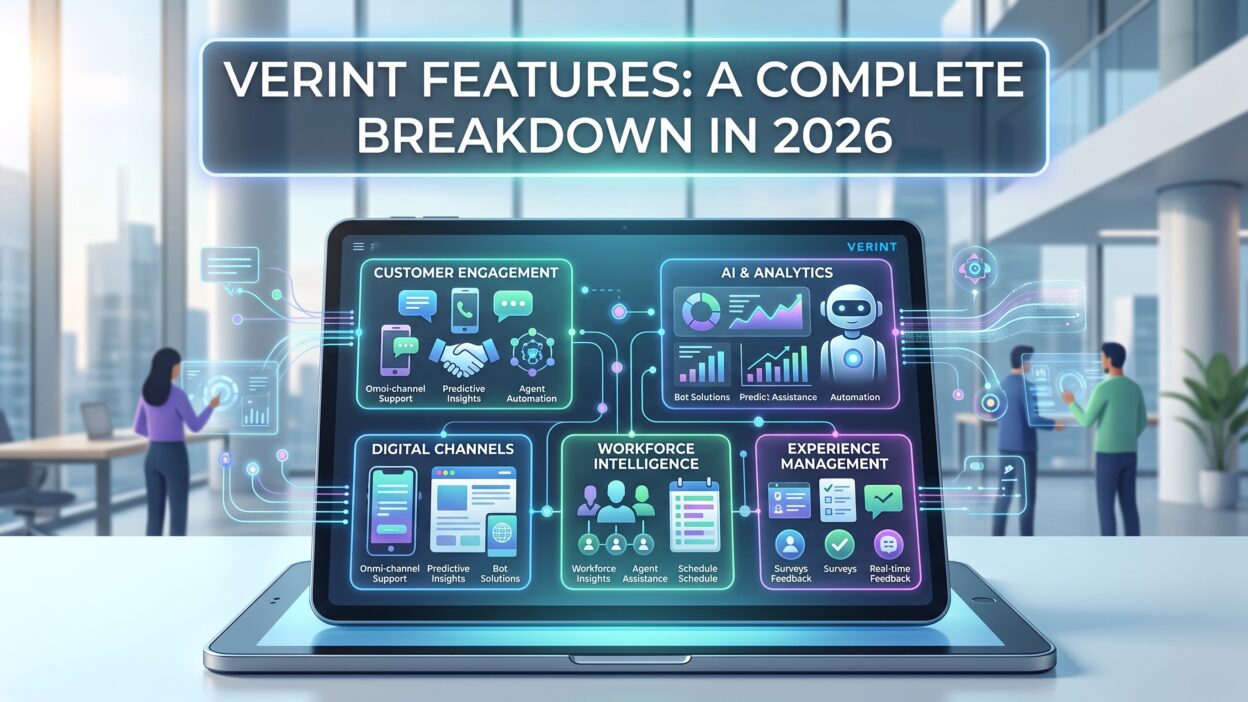
The platform organizes tools around the full customer engagement lifecycle. Workforce management handles scheduling and forecasting. Analytics tools process calls, chats, and emails to surface patterns humans would miss manually. Automation tools handle repetitive tasks so agents can focus on complex issues.
Data flows between modules without manual export and import work. A scheduling change updates forecasts automatically. A flagged call feeds directly into coaching workflows. This connected structure saves contact center managers significant administrative time each week.
Cloud deployment dominates most new implementations, though on-premise options still exist for enterprises with strict data residency requirements. Most buyers researching Verint Features in 2026 lean toward the cloud version for faster updates and lower maintenance overhead.
Unified Dashboard and Reporting
Managers see agent performance, call volume, and quality scores from one central dashboard. This single view replaces the scattered spreadsheets many teams relied on before adopting a unified platform.
Custom reports let managers slice data by team, time period, or specific metric. This flexibility matters for enterprises running multiple departments with different performance goals.
Role-Based Access Controls
Different users see different data based on their role. A frontline supervisor sees their team’s metrics. A director sees performance across the entire organization. This structure keeps sensitive data restricted to the people who actually need it.
Workforce Management Tools
Scheduling sits at the center of workforce management inside the platform. Managers build schedules based on forecasted call volume, agent skills, and time-off requests. The system suggests optimal shift patterns automatically, reducing the manual guesswork managers used to rely on.
Forecasting tools predict call volume based on historical patterns and seasonal trends. Accurate forecasts prevent understaffing during peak periods and overstaffing during slow periods, both of which cost money in different ways.
Real-time adherence tracking shows whether agents follow their assigned schedule. A manager sees instantly when an agent runs late from a break or misses a scheduled shift, allowing quick correction before service levels drop.
Self-service scheduling lets agents request time off, swap shifts, or bid on open shifts directly inside the platform. This feature reduces the back-and-forth email chains that used to consume managers’ time every week.
Intraday Management
Call volume rarely matches forecasts exactly. Intraday management tools help supervisors adjust staffing in real time when volume spikes or drops unexpectedly. This flexibility keeps service levels steady even during unpredictable days.
Alerts notify supervisors when staffing falls below a set threshold. This early warning system prevents small staffing gaps from turning into major service failures during busy periods.
Skills-Based Routing
Agents get matched to calls based on their specific skills and certifications. A complex technical issue routes to a specialized agent, while a simple billing question routes to a general support agent. This matching improves first-call resolution rates across the board.
Speech and Text Analytics
Speech analytics processes recorded calls to surface patterns across thousands of conversations. The system flags mentions of competitors, compliance risks, and customer frustration without a human listening to every single call manually.
Sentiment analysis scores each interaction based on tone and word choice. Managers spot declining sentiment trends early, before they show up in survey scores or churn numbers weeks later.
Text analytics applies the same pattern recognition to chat and email interactions. This extends visibility beyond phone calls into every channel a customer might use to reach support.
Keyword and phrase tracking flags specific terms managers care about, like a competitor name or a product complaint. This targeted tracking helps teams catch emerging issues before they spread across a wider customer base.
Root Cause Analysis
The platform groups similar customer issues together, revealing patterns a single agent would never notice on their own. A spike in calls about a specific feature often points to a product bug or a confusing update that needs attention.
This root cause visibility ranks among the most valued Verint Features for enterprise teams managing large support volumes, since it shifts focus from reacting to individual complaints toward fixing systemic problems.
Compliance Monitoring
Automated compliance checks flag calls that miss required disclosures or violate regulatory scripts. This reduces legal risk significantly compared to relying on random manual call reviews alone.
AI and Automation Tools
Verint Features include a growing suite of AI-driven automation tools built to reduce manual agent workload. Bots handle simple, repetitive inquiries, freeing human agents to focus on complex issues that actually need a person.
Intelligent virtual assistants answer common questions across chat and voice channels. These bots learn from real interactions over time, improving accuracy without requiring constant manual retraining from an engineering team.
Agent assist tools work alongside human agents in real time. The system suggests responses, pulls up relevant knowledge base articles, and flags compliance risks while a call happens, not after it ends.
Automated quality scoring replaces manual call review for a large percentage of interactions. This lets quality teams focus their limited time on the calls that genuinely need human judgment.
Knowledge Management Integration
Agents access a centralized knowledge base directly inside their workspace. The AI suggests relevant articles based on the conversation happening in real time, cutting down search time during live customer interactions.
This integration reduces average handle time noticeably, since agents spend less time hunting for answers and more time actually helping the customer resolve their issue.
Customer Feedback and Experience Management
Survey tools collect customer feedback right after an interaction ends. Response rates stay higher than standalone survey tools, since the request appears immediately while the interaction stays fresh in the customer’s mind.
Feedback data connects directly to the interaction record, so managers see exactly which call or chat led to a specific rating. This connection makes coaching conversations far more specific and useful than generic survey scores alone.
Journey mapping tools track a customer’s path across multiple touchpoints, from a website chat to a phone call to a follow-up email. This full picture helps teams spot friction points that a single-channel view would miss entirely.
Voice of the Customer Programs
Enterprise teams build ongoing voice of the customer programs using data pulled from surveys, social media, and support interactions combined. This unified view helps leadership teams prioritize product and service improvements based on real customer signals rather than guesswork.
Trend reports show how sentiment shifts over months or quarters. A consistent decline in one product area often signals a deeper issue worth investigating before it grows into a larger churn problem.
Verint Features vs Competitors
NICE and Genesys stand as the closest competitors in the enterprise contact center space. Each platform covers workforce management, analytics, and some form of automation, though the depth and pricing structure differ across providers.
NICE offers a similarly broad feature set, with strong workforce management tools and a large partner ecosystem. Pricing runs close to Verint in many enterprise deals, though contract terms differ based on negotiated volume.
Genesys leans heavily into cloud-native architecture and strong omnichannel routing. Teams prioritizing flexible, modern infrastructure sometimes lean toward Genesys over a more traditional enterprise vendor.
Verint Features stand out most clearly around speech analytics depth and compliance monitoring. Few competitors match the granularity of root cause analysis this platform offers at comparable enterprise pricing tiers.
Why Choose Verint Over Alternatives
Large enterprises with strict compliance requirements benefit from the platform’s mature monitoring tools. Financial services and healthcare organizations often lean toward Verint because of this regulatory strength specifically.
The unified data model across workforce management and analytics reduces integration headaches compared to stitching together separate best-of-breed tools from different vendors.
Teams already running large-scale operations find the platform’s scalability reassuring. Verint handles thousands of concurrent agents without the performance issues smaller platforms sometimes struggle with under heavy load.
Pricing Overview
Verint pricing runs on a custom quote model rather than published flat rates. Enterprise software at this scale rarely fits a one-size-fits-all price, since deployment size and module selection vary widely between customers.
Pricing depends on the number of agents, the specific modules selected, and the deployment type chosen. A company using only workforce management pays differently than one adding full speech analytics and automation on top.
Cloud deployment often lowers upfront costs compared to on-premise installations, since it shifts infrastructure spending into a predictable subscription model rather than a large capital expense.
Implementation and Training Costs
Implementation costs sit separate from the licensing fee itself. Large enterprise rollouts require dedicated project management, integration work, and staff training, all of which add to the total cost of ownership beyond the base subscription.
Pros and Cons of Verint
Verint Features bring workforce management, analytics, and automation together under one enterprise platform. Speech and text analytics surface patterns human reviewers would miss across large call volumes. Compliance monitoring reduces regulatory risk for industries facing strict oversight. Scalability handles large agent counts without major performance issues. Integration between modules removes the friction of managing separate point solutions.
Pricing requires a custom quote, which makes budget planning harder during early vendor comparison. The platform carries a real learning curve for teams new to enterprise-grade contact center software. Smaller businesses often find the full feature set beyond what their current scale actually requires.
None of these drawbacks feel unusual for enterprise software at this level. Every full-featured platform trades simplicity for depth, and Verint Features lean clearly toward depth over a lightweight, plug-and-play experience.
Who Should Use Verint
Large enterprise contact centers benefit heavily from the unified workforce management and analytics toolkit. This removes the need for multiple disconnected vendors managing different parts of the operation.
Regulated industries like finance and healthcare benefit from the strong compliance monitoring built into the platform. This reduces the manual review burden that regulatory requirements often create for smaller compliance teams.
Companies running high call volumes benefit from AI-driven analytics that would take a human team weeks to process manually. This speed advantage becomes more valuable as call volume grows.
Organizations focused on customer experience improvement benefit from the journey mapping and voice of the customer tools, which connect feedback directly to operational data across every channel.
Smaller teams just starting to formalize their contact center operations might find a lighter platform a better starting point before scaling into the full Verint toolkit later.
Implementation and Onboarding Guide
Implementation starts with a discovery phase, where the vendor team maps current workflows against the platform’s available modules. This phase sets realistic expectations for timeline and required internal resources.
Data migration comes next, moving historical call records, agent data, and existing schedules into the new system. Large enterprises often run this phase over several weeks to avoid disrupting daily operations.
Integration work connects the platform to existing CRM and telephony systems. This step determines how smoothly data flows between Verint and the other tools a company already relies on daily.
Agent and supervisor training happens before full rollout. Teams that invest real time in training see faster adoption and fewer support tickets during the first month after launch.
A phased rollout, starting with one team or location before expanding company-wide, reduces risk compared to a single company-wide launch happening all at once.
Frequently Asked Questions
What are the main Verint features?
The main Verint Features include workforce management, speech and text analytics, AI-driven automation, compliance monitoring, and customer feedback tools, all connected under one enterprise platform.
Is Verint cloud-based?
Yes. Most new deployments run on the cloud version, though on-premise options remain available for enterprises with strict data residency or regulatory requirements.
How much does Verint cost?
Verint uses a custom quote model based on agent count, selected modules, and deployment type. There is no published flat rate, since enterprise pricing varies widely by company size and needs.
Does Verint support speech analytics?
Yes. Speech analytics processes recorded calls to flag sentiment, compliance risks, and recurring customer issues without requiring a human to review every single interaction manually.
Is Verint suitable for small businesses?
Verint targets large enterprises and regulated industries most directly. Smaller businesses often find the full feature set beyond their current needs and may prefer a lighter platform initially.
Does Verint integrate with existing CRM systems?
Yes. Integration work connects Verint to existing CRM and telephony platforms during implementation, allowing data to flow between systems without manual export and import processes.
Is Verint better than NICE or Genesys?
Each platform serves slightly different priorities. Verint Features stand out for compliance monitoring and analytics depth, while NICE and Genesys offer their own strengths in workforce management and cloud-native routing.
Read More:-OnceHub LeadConnector Integration: Complete Guide [2026]
Conclusion

This Verint Features breakdown covered workforce management, analytics, automation, and compliance tools in full detail. The platform brings large-scale contact center operations together under one connected system, which removes the fragmentation that comes from managing several separate vendors.
Speech and text analytics stand out as some of the strongest Verint Features available in 2026. Few competitors match the depth of root cause analysis and compliance monitoring this platform offers at enterprise scale.
Large enterprises and regulated industries gain the most value from the full toolkit. Smaller teams just building out their contact center operations might find a lighter platform a better fit for now.
Based on this full breakdown, Verint Features suit organizations that need depth, scale, and compliance strength over a simple, lightweight tool. Request a custom quote, map your current workflow against the platform’s modules, then decide if the investment matches your long-term operational goals.